
Excision of Urethral Diverticulum – Male

Why is it done?

  • Usually, an infected peri-urethral gland blocks and becomes infected, UTI symptoms
  • Causes a bulge which interferes with urination
  • Can mimic prostate enlargement LUTS
  • Dribbling after urination
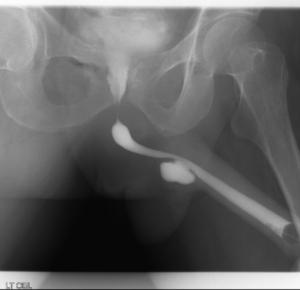
  • Usually, a retrograde urethragram the urethra delineates this beautifully.
How is it done?

  • This procedure is done under a general anesthetic, as decided by the anesthetist.
  • The legs will be elevated into the lithotomy position.
  • This procedure is done both cystoscopically and with an incision over the urethra (Bulbous Spongiosum or Perineum)
  • The urethra is evaluated endoscopically and a catheter placed
  • If it is a small urethral diverticulum, it can be opened into the urethra endoscopically
  • If it has a narrow neck, then an external approach:
  • The penis or perineum will then be incised over the urethrocele.
  • A Fogarty catheter will be placed inside the diverticulum and the balloon inflated to delineate the borders of the diverticulum.
  • The diverticulum will be dissected out with injuring adjacent structures.
  • The neck will be tied off at the level of the adjoining urethra.
  • Dissolvable closure sutures will be placed for hemostasis
  • A cystoscopy confirms no injury to the urethra.
  • A catheter will be placed until you are awake for some compression.
  • Prophylactic antibiotics will be given to prevent infection.

Complications

Side–effects

  • Any anesthetic has its risks, and the anesthetist will explain all such risks.
  • Complications: hemorrhaging, and urine retention
  • Catheter will be left in for 10 days
  • Trial without catheter in day surgery
  • If you cannot urinate after 2-3 attempts, a catheter may be inserted to empty your bladder.
  • You may suffer temporary incontinence
  • You may suffer permanent incontinence as advised by Jo, depending on the location of the diverticulum. Make sure you have discussed this with Jo before the surgery.
  • NB! Each person is unique and for this reason, symptoms may vary!


   Download Information Sheet

Wes Urethral Diverticulum Excision Male

Copyright 2019 Dr Jo Schoeman

Extra-Corporeal Shock Wave Lithotripsy – ESWL

ESWL

Non-invasive technique of shattering renal or ureteric calculi using sound waves. This service is provided by Queensland Lithotripsy Service who brings their lithotripter to the hospital chosen for your procedure.

Why is it done?

  • Renal stones of any size, usually larger than 1cm obstructing/ non-obstructing the renal pelvis or ureter.
  • Conservative form of treatment with external treatment administered through the skin with electromagnetic/ piezo-electric shock waves.
  • Shock waves compress and distract the stone and the stone crystal fragments at its weakest links.
  • Non-invasive.
  • 70% of patients are stone free after this procedure, depending on the size of the stone and consistency of the stone.
  • You may present with colicky pain on the affected side when stone fragments make their way down the ureter.

What to be aware of:

  • Colicky pain that persists.
  • Infection and fever.

Contact the rooms or your nearest Emergency Department ASAP

How is it done?

  • Patients will receive a general anaesthesia.
  • Prophylactic antibiotics is given.
  • The correct kidney is identified and marked while you are awake.
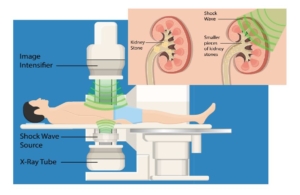
  • You are placed on a specifically designed table where a compartment in the bed underlying the affected kidney is removed to enable a large fluid containing probe to press up against your back.
  • With radiological imaging the shock waves are aimed onto the stone in 2 90 degree angles.
  • The stone is then bombarded with the shock waves. A total of approx. 4000 shots are administered until the stone fragments and disappears.

What next?

  • As soon as you are awake and have kept some food down and emptied your bladder, you may leave for home.
  • You may experience blood in your urine.
  • You may experience colicky/crampy pains as you pass the fragments.
  • Allow for a few days for stabilization of symptoms.
  • A follow-up appointment will be scheduled for 3 months.
  • If any stones are caught and sent for evaluation, stone analysis results will be discussed at this consultation in order to formulate a plan to prevent recurrences.
  • DON’T SUFFER IN SILENCE, OR YOU WILL SUFFER ALONE!


Download Information Sheet

Wes Extra Corporeal Shock Wave Lithotripsy ESWL