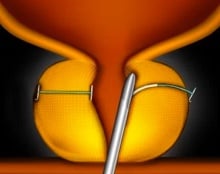
Trans Urethral De-Roofing of Prostate Abscess
Non invasive opening of an abscess found in the prostate, Very similar to a TURP with the exception that the bladder neck is preserved
Why is it done?
- This procedure is performed when you have been diagnosed with a prostatic abscess, usually after an MRI investigation.
- You would have had a history of swinging low to high grade fevers, a history of catheterization or instrumentation.
- Not improving on antibiotics.
- You may possibly be very sick with High Dependancy Unit (HDU) admission on intravenous antibiotics.
- This procedure is done where the abscess or fluid collection in the parenchyma of the prostate is in the transitional zone of the prostate and easily accessible via endoscopic technique.
- It is done under a general anaesthetic with prophylactic antibiotics in place, or appropriate Antibiotics as per your serum cultures.
How is it done? 

- Patients will receive a general Anaesthesia unless otherwise indicated.
- A cystoscopy is performed by placing a camera in the urethra with the help of lignocaine gel.
- The inside of the prostatic urethra and bladder is viewed for pathology and especially signs of the abcess. If any suspicious lesions are seen, a biopsy will be taken.
- The area of the prostatic urethra above the abcess is resected until the abcess is opened and drained.
- The bladder neck and urethral sphincter is preserved.
- Laser can also be utilized and is probably preferred due to lack of bleeding.
- Prophylactic antibiotics will be given to prevent any infections.
What can go wrong?
- Any anaesthesia has its risks and the anaethiatist will explain this to you.
- You will wake up with a catheter in your urethra and bladder. This will remain in the bladder for 1-3 days depending on the technique used and incidence of post-operatve bleeding. And until signs of sepsis have cleared.
- You may have a continuous bladder irrigate running in and out of your bladder to prevent clot formation until the urine clears.
- Lower abdominal discomfort for a few days.
- NB! Each person is unique and for this reason symptoms vary!
What next?
- You will be hospitalized until all signs of sepsis have cleared.
- You will a trial without catheter as soon as your urine is clear.
- You will be discharged as soon as you can completely empty your bladder.
- You may initially suffer from urge incontinence and will improve within the next 6 weeks.
- Allow for 6 weeks for stabilization of symptoms.
- You may have a change in ejaculate volume and could even suffer retrograde ejaculation.
- There may be some blood in your urine. You can remedy this by drinking plenty of fluids until it clears.
- A follow-up appointment will be scheduled for 6 weeks. Should your pathology be worrisome, you will be contacted for an earlier appointment.
- DON’T SUFFER IN SILENCE, OR YOU WILL SUFFER ALONE!
Download Information Sheet