
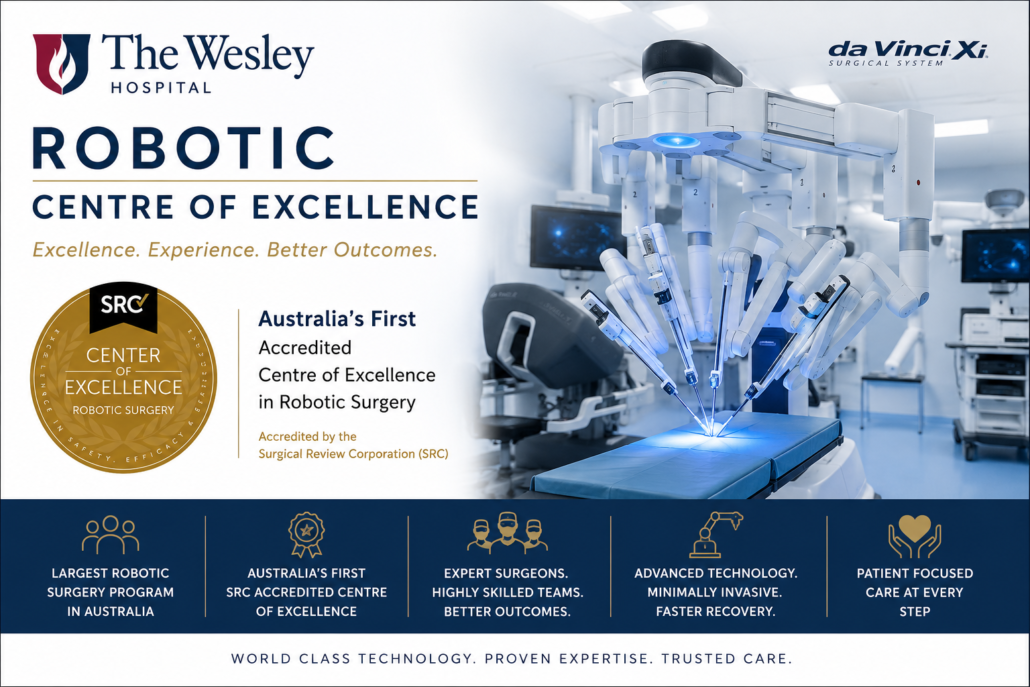
The Wesley Hospital: Australia’s First Centre of Excellence in Robotic Surgery
Excellence, experience and innovation in urological care
When considering complex urological surgery, the technology available is important. Just as important, however, are the surgeon’s experience, the expertise of the theatre team, the hospital infrastructure and the systems supporting the patient before, during and after surgery.
For patients undergoing robotic urological surgery in Brisbane, The Wesley Hospital has established itself as one of Australia’s leading centres for robotic and minimally invasive surgery.
The Wesley was recognised as Australia’s first Centre of Excellence in Robotic Surgery (COERS) by the international Surgical Review Corporation (SRC). This accreditation followed an independent assessment of surgical experience, hospital infrastructure, processes, patient pathways and commitment to quality improvement.
Today, The Wesley describes its robotic program as the largest in Australia, with robotic surgery extending across multiple surgical specialties.
What does “Centre of Excellence in Robotic Surgery” actually mean?
A robot in an operating theatre is an impressive piece of technology, but owning a robot does not by itself create a robotic centre of excellence.
Centre of Excellence accreditation by the Surgical Review Corporation involves assessment of areas including:
- surgical volumes and experience
- surgeon training and expertise
- hospital infrastructure
- treatment pathways
- equipment and technology
- patient education
- multidisciplinary and consultative services
- peri-operative processes
- quality and safety systems
- commitment to ongoing improvement.
The Wesley became Australia’s first SRC-accredited Centre of Excellence in Robotic Surgery following a rigorous assessment process. SRC records confirm The Wesley’s robotic Centre of Excellence accreditation dating from 2017.
For patients, the significance is straightforward: robotic surgery at The Wesley is supported by an established program rather than simply access to a surgical robot.
A long history of robotic surgery at The Wesley
The Wesley’s robotic program began with the da Vinci S Surgical System, with robotic surgery commencing in January 2010 with robotic radical prostatectomy.
The program subsequently expanded considerably.
By 2024, The Wesley reported approaching its 10,000th da Vinci-assisted surgical procedure, with robotic surgery being performed across nine specialties by more than 40 surgeons.
The hospital has also achieved several milestones in Australian robotic surgery.
In 2014, The Wesley became the first Australian hospital to have two da Vinci robotic systems. More recently, it became the first hospital in Queensland to house three da Vinci Xi surgical robots.
This surgical volume matters because robotic surgery is not simply about sophisticated equipment. It requires a coordinated and experienced team of surgeons, anaesthetists, theatre nurses, assistants and peri-operative staff who work with the technology regularly.
Urology at the heart of The Wesley robotic program
Urology has played a major role in the development of robotic surgery at The Wesley.
Indeed, the hospital’s robotic program began with robotic radical prostatectomy for prostate cancer, and urological surgery has remained a major component of the program.
Over time, robotic urology has expanded well beyond prostate cancer surgery.
The Wesley has reported performing the full spectrum of robotic urological procedures, including:
Robotic radical prostatectomy
Robotic-assisted radical prostatectomy is used for selected men with localised or locally advanced prostate cancer.
The da Vinci system provides the surgeon with magnified three-dimensional vision and highly articulated instruments, allowing precise dissection within the confined space of the male pelvis.
Depending upon the cancer and individual anatomy, surgery may include:
- nerve-sparing prostatectomy
- non-nerve-sparing prostatectomy
- pelvic lymph node dissection
- reconstruction of the bladder neck and urethra.
Robotic surgery for very large benign prostates
Men with very large benign prostates causing significant urinary obstruction may be suitable for robotic-assisted simple prostatectomy or robotic enucleation of the prostate.
This can be particularly useful when the prostate is too large for some conventional transurethral procedures.
The obstructing inner portion, or adenoma, of the prostate is removed while leaving the outer prostate capsule behind.
The Wesley has specifically reported robotic enucleation for benign prostatic hyperplasia as part of its urological robotic program.
Robotic partial nephrectomy
Not every kidney tumour requires removal of the entire kidney.
For appropriately selected renal tumours, robotic partial nephrectomy allows the tumour to be removed while preserving as much normal functioning kidney tissue as possible.
Robotic technology can be particularly valuable for the precise steps involved in:
- identifying the tumour,
- controlling the renal blood supply when required,
- excising the tumour,
- controlling bleeding, and
- reconstructing the remaining kidney.
The aim is cancer control combined with preservation of renal function wherever safely possible.
Robotic radical nephrectomy
Larger or more complex kidney cancers may require removal of the entire kidney.
Selected patients may undergo robotic-assisted radical nephrectomy, allowing complex kidney surgery to be performed using a minimally invasive approach where clinically appropriate.
Robotic pyeloplasty
A pelvi-ureteric junction obstruction (PUJO) occurs when drainage of urine from the kidney into the ureter is restricted.
Robotic pyeloplasty allows the narrowed segment to be removed and the ureter reconstructed onto the renal pelvis.
The precision and articulation of robotic instruments are particularly useful when performing this delicate reconstruction and suturing.
Robotic ureteric reconstruction
Complex narrowing, scarring or injury involving the ureter may require reconstructive surgery.
Depending upon the location and length of the abnormal segment, robotic reconstruction may include:
- ureteric reimplantation
- uretero-ureterostomy
- psoas hitch
- Boari flap reconstruction
- other complex upper urinary tract reconstruction.
The objective is simple, even when the surgery is not: restore reliable drainage from the kidney while preserving renal function.
Robotic radical cystectomy
For selected patients with aggressive or muscle-invasive bladder cancer, removal of the bladder may be required.
Robotic radical cystectomy is one of the more complex procedures performed in urological robotic surgery.
The Wesley has been associated with significant Australian milestones in this area, including robotic cystectomy and intracorporeal urinary reconstruction.
Following removal of the bladder, urinary reconstruction may involve an ileal conduit or, in selected patients, construction of a neobladder.
More than robotic surgery
One of the strengths of a major urological centre is that not every problem needs a robot.
Modern urology requires access to multiple technologies and treatment approaches, allowing treatment to be tailored to the individual patient rather than forcing every patient down the same pathway.
Depending upon the condition, urological treatment at a major tertiary hospital such as The Wesley may involve:
Prostate cancer
Management may include:
- active surveillance
- prostate MRI and targeted biopsy
- robotic radical prostatectomy
- radiation oncology
- medical oncology
- focal therapies in appropriately selected patients
- hormonal therapy
- multidisciplinary cancer management.
Benign prostate enlargement
Treatment may range from medication and minimally invasive procedures through to endoscopic laser surgery, TURP and robotic surgery for very large glands.
Kidney disease
Expertise may encompass:
- investigation of renal masses
- active surveillance of small renal masses
- minimally invasive ablation in selected patients
- partial nephrectomy
- radical nephrectomy
- reconstructive renal surgery.
Bladder cancer
Treatment can range from cystoscopic surveillance and transurethral resection of bladder tumour (TURBT) through to intravesical therapies such as BCG or mitomycin, and major surgery including radical cystectomy.
Urinary stone disease
Modern management may include:
- ureteroscopy
- flexible ureterorenoscopy
- laser lithotripsy
- percutaneous stone surgery
- ureteric stenting
- metabolic evaluation and prevention of recurrent stones.
Functional and reconstructive urology
Patients with urinary dysfunction may require specialised investigation and treatment for:
- urinary incontinence
- overactive bladder
- bladder outlet obstruction
- urethral stricture disease
- neurogenic bladder
- voiding dysfunction
- post-prostatectomy incontinence.
Treatment may involve urodynamic assessment, pelvic floor rehabilitation, medication, Botox, sacral neuromodulation, reconstructive surgery, male slings or artificial urinary sphincters where appropriate.
The importance of multidisciplinary care
Complex urological disease rarely exists neatly inside one specialty.
A patient with prostate cancer, for example, may require input from urology, radiology, pathology, radiation oncology, medical oncology, physiotherapy and specialised nursing services.
Kidney and bladder cancer patients may similarly require coordinated input from multiple disciplines.
The Wesley has highlighted this multidisciplinary approach as an important component of its urological and robotic program, particularly collaboration between urology, radiology, radiation oncology and medical oncology.
This allows treatment decisions to focus on the whole patient rather than simply the operation.
Why does robotic experience matter?
Robotic technology provides the surgeon with several technical advantages, including:
- high-definition three-dimensional vision
- magnification of the operative field
- highly articulated instruments
- tremor filtration
- precise movement within confined anatomical spaces
- improved ability to perform delicate dissection and reconstruction.
The surgeon, however, remains in complete control of the operation. The robot does not independently perform surgery.
The potential benefits of minimally invasive robotic surgery can include smaller incisions, reduced blood loss, less postoperative discomfort, shorter hospitalisation and faster recovery, although the benefits and risks vary according to the operation and individual patient.
And this is where experience becomes important.
The robot is a sophisticated instrument. The outcome still depends upon the people using it and the team surrounding the patient.
A recognised Australian leader in robotic surgery
The Wesley Hospital’s robotic program has grown from its first robotic prostatectomy in 2010 into one of Australia’s largest and most established robotic surgical programs.
Its recognition as Australia’s first Centre of Excellence in Robotic Surgery, combined with high surgical volumes, multiple da Vinci systems and a broad multidisciplinary surgical program, reflects a substantial institutional commitment to robotic and minimally invasive surgery.
For urological patients, this means access not simply to robotic technology, but to a hospital environment with extensive experience managing prostate, kidney, bladder, ureteric, reconstructive and functional urological conditions.
Choosing the right operation, not simply the newest operation
Robotic surgery has transformed many areas of urology, but it is not automatically the best treatment for every patient.
Sometimes the best treatment is robotic surgery.
Sometimes it is laser surgery, endoscopic surgery, medication, radiation therapy, focal treatment or active surveillance.
And sometimes the most sophisticated treatment is knowing that no operation is required at all.
The goal of contemporary urological care should therefore be to combine experience, technology and evidence to select the treatment that best suits the individual patient.
At a high-volume centre such as The Wesley Hospital, access to advanced robotic technology sits within a much broader framework of specialised urological, oncological, imaging, nursing and allied-health expertise.
That combination is what turns an impressive machine into a comprehensive surgical program.
Considering urological or robotic surgery?
If you have been diagnosed with a prostate, kidney, bladder or other urological condition, an individual assessment can help determine whether robotic surgery, another minimally invasive procedure or non-surgical management is most appropriate.
Treatment recommendations should take into account your diagnosis, imaging, general health, personal priorities and the relative advantages and disadvantages of each available option.
Technology provides possibilities. Experience helps determine when to use them.
This information is intended for general patient education and should not replace individual medical advice. The suitability, benefits and risks of any procedure should be discussed with your treating urologist.
Further information
More information about the robotic surgery program and Centre of Excellence accreditation is available from The Wesley Hospital robotic surgery service and the Surgical Review Corporation accreditation record.


Leave a Reply
Want to join the discussion?Feel free to contribute!