
Single-Port Robotic Surgery: The Next Evolution of da Vinci Surgery in Urology
Robotic surgery has transformed modern urology. Now, the technology is evolving again.
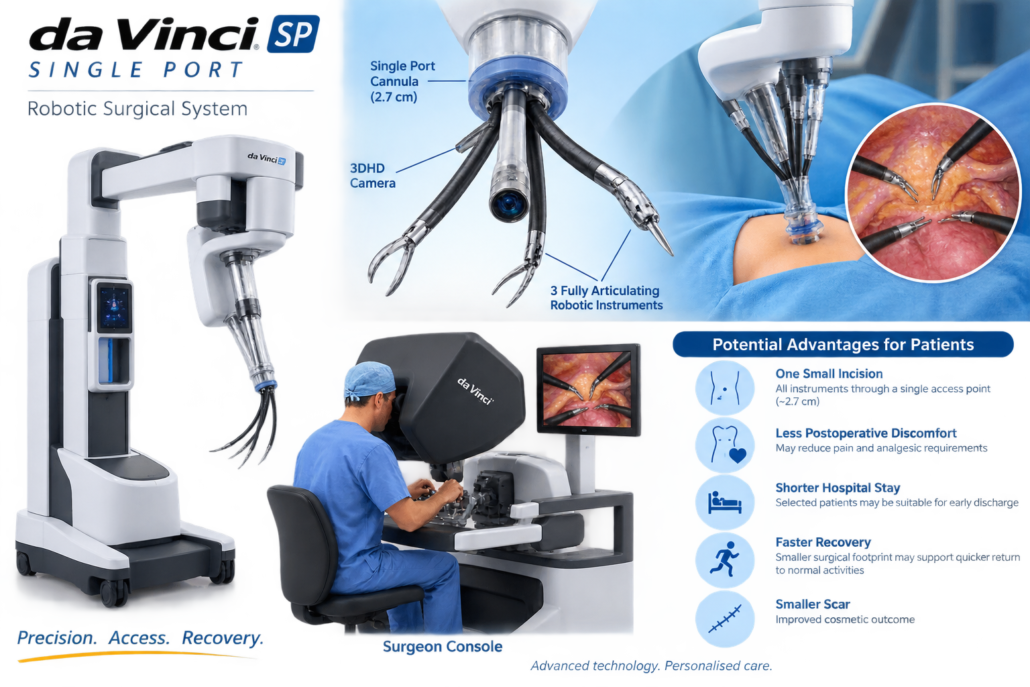
The da Vinci SP® (Single Port) Surgical System represents a new generation of robotic-assisted surgery designed to allow complex operations to be performed through one small surgical access point, rather than the multiple abdominal ports traditionally required for robotic surgery.
For suitable patients, this offers an exciting possibility: maintaining the precision and control associated with robotic surgery while potentially reducing the physical footprint of the operation.
What is the da Vinci SP system?
Traditional multi-port robotic surgery generally requires several small abdominal incisions. Each incision accommodates a camera, robotic instrument or assistant port.
The da Vinci SP system takes a different approach.
Through a single approximately 2.7 cm cannula, the system can deploy:
- Three fully wristed robotic instruments
- A flexible, articulating 3D high-definition camera
- Instruments capable of triangulating once inside the body
The surgeon remains completely in control of the operation from the robotic console. The robot does not perform the surgery independently. Rather, it translates the surgeon’s hand movements into precise movements of the instruments inside the patient.
The system provides 360-degree anatomical access and was specifically designed to facilitate surgery within confined anatomical spaces.
Why is Single-Port surgery particularly interesting in urology?
Much of urological surgery occurs deep within relatively confined areas of the body, particularly surgery involving the prostate, bladder and kidney.
This makes urology particularly well suited to the development of single-port techniques.
The da Vinci SP platform is being used internationally for procedures including:
- Robotic radical prostatectomy for prostate cancer
- Robotic simple prostatectomy or prostate enucleation for very large benign prostates
- Partial nephrectomy for selected kidney tumours
- Radical nephrectomy
- Pyeloplasty for pelvi-ureteric junction obstruction
- Selected reconstructive urological procedures
Importantly, the technology also allows surgeons to explore different routes to the target organ. For prostate surgery, for example, selected procedures may potentially be performed through extraperitoneal or transvesical approaches rather than traversing a larger area of the abdominal cavity.
What are the potential advantages for patients?
The obvious attraction is fewer incisions, but the potential benefits extend beyond the cosmetic appearance of the scar.
One main access point
Instead of several robotic ports spread across the abdomen, the SP system introduces the camera and three robotic instruments through a single access site.
For the patient, this can mean a smaller overall surgical footprint.
Potentially less postoperative discomfort
Early clinical evidence comparing single-port with conventional multi-port robotic approaches has reported less postoperative pain in some procedures.
This may translate into reduced analgesic requirements and greater comfort during the first few days after surgery.
Shorter hospital stay
One of the most interesting findings emerging from early SP experience is the possibility of shorter hospitalisation for selected procedures and patients.
Some international centres have developed pathways where appropriately selected patients undergoing certain SP procedures can leave hospital considerably earlier than would traditionally have been expected.
Potentially faster recovery
Reducing the number of abdominal access points and, in selected operations, avoiding unnecessary entry into parts of the abdominal cavity may help reduce the physiological impact of surgery.
The aim is simple: perform the operation that needs to be done while disturbing as little normal anatomy as possible.
Smaller scars
For many patients, particularly younger men undergoing prostate cancer surgery, the cosmetic result also matters.
Single-port surgery concentrates access into one main incision rather than several separate robotic scars.
A smaller scar does not determine whether cancer surgery has been successful, of course. Cancer control, continence, erectile function and surgical safety remain far more important than cosmetics.
Nevertheless, if equivalent surgery can ultimately be achieved through a smaller access footprint, it represents another meaningful refinement of minimally invasive surgery.
Single-Port radical prostatectomy for prostate cancer
Robotic-assisted radical prostatectomy is already one of the established surgical treatments for localised prostate cancer.
During surgery, the prostate and seminal vesicles are removed and the bladder is reconstructed onto the urethra. Where oncologically appropriate, preservation of the nerves responsible for erectile function may also be attempted.
The da Vinci SP system provides the surgeon with magnified 3DHD vision and highly articulated instruments while allowing the operation to be approached through a single primary access point.
Early studies of SP prostatectomy have reported encouraging results, including shorter hospital stays, shorter catheterisation in some series, less postoperative pain and lower complication rates in selected comparisons, without apparent compromise of functional outcomes. However, SP remains a developing technology and longer-term comparative evidence continues to accumulate.
That distinction is important.
Single Port does not automatically mean “better” for every patient.
The best surgical approach depends upon the cancer, prostate size, previous abdominal surgery, anatomy, other medical conditions and, importantly, the experience of the surgeon and surgical team.
Single-Port surgery for very large benign prostates
Another particularly interesting application is surgery for men with very large prostates causing severe urinary obstruction.
Traditionally these men may have required open simple prostatectomy or, more recently, endoscopic laser enucleation or multi-port robotic simple prostatectomy.
The SP platform allows surgeons to perform robotic simple prostatectomy through a highly focused approach, including a transvesical approach directly through the bladder in appropriately selected patients.
Early experience suggests this may allow the durable urinary outcomes associated with simple prostatectomy while reducing some of the immediate recovery burden associated with conventional transabdominal surgery.
Is Single-Port surgery safer?
It is tempting to assume that fewer incisions automatically means safer surgery.
Medicine is rarely that cooperative.
Every operation still carries risks including bleeding, infection, injury to surrounding structures, anaesthetic complications and procedure-specific complications.
After prostate cancer surgery, additional considerations include:
- Temporary or persistent urinary incontinence
- Erectile dysfunction
- Bladder-neck contracture or urethral narrowing
- Lymphocele where lymph-node dissection is performed
- Urinary leakage
- Need for further treatment if prostate cancer recurs
The SP platform changes how the surgeon accesses the operation. It does not remove the fundamental risks of the operation itself.
Patient selection and surgical experience therefore remain critical.
The Gambaro Community and Prostate Cancer Care
Technological advances do not arrive in hospitals by magic. Behind the gleaming robotic arms is something much more human: patients, families, clinicians, donors and communities willing to invest in better healthcare.
The Gambaro family’s support for prostate cancer care at The Wesley Hospital is an outstanding example.
For more than a decade, the Gambaro community has supported prostate cancer care through its annual fundraising luncheon.
At the 2024 Gambaro Prostate Cancer Care Luncheon, the community raised more than $545,000, with funds directed towards enhancing future prostate cancer care services and treatment at The Wesley Hospital. This luncheon takes place next week 4 September 2026, ensure you are there to assist the Wesley to secure funding for the single port DaVinci.
This relationship has a long history. Earlier Gambaro fundraising events at The Wesley also promoted advances in prostate cancer diagnosis and minimally invasive robotic surgery, bringing together clinicians, patients and the wider Brisbane community.
Why fundraising for prostate cancer technology matters
Modern prostate cancer care extends far beyond simply purchasing a piece of equipment.
High-quality care requires an ecosystem that may include:
Advanced imaging → accurate diagnosis → multidisciplinary assessment → precision surgery → specialist nursing → rehabilitation → survivorship care
Community fundraising can help hospitals invest across this pathway, supporting technology, equipment, clinical services, education and improvements in patient care.
The Gambaro community’s longstanding commitment to prostate cancer care demonstrates what can happen when philanthropy and medicine pull in the same direction.
The future: smaller access, bigger possibilities
The evolution of robotic surgery has been remarkable.
We have moved from large open incisions to laparoscopic surgery, then to multi-port robotic surgery and now towards sophisticated single-port robotic procedures capable of operating through increasingly focused anatomical pathways.
The da Vinci SP system is another step along that journey.
Its promise is not simply that surgeons can operate through one incision. The more interesting possibility is that surgeons may increasingly tailor the surgical access route itself to the individual patient.
For patients undergoing prostate, kidney or reconstructive urological surgery, that may eventually mean less tissue disruption, less postoperative discomfort, shorter hospitalisation and a quicker return to normal life, while maintaining the fundamental goals of safe and effective surgery.
And behind advances such as these are not only surgeons and engineers.
They are also communities.
Through initiatives such as the Gambaro Prostate Cancer Care fundraising program, community support continues to help The Wesley Hospital pursue advances in prostate cancer diagnosis, treatment and patient care.
Sometimes progress in surgery comes through several small incisions.
Increasingly, it may come through just one.
Important information
The da Vinci SP system is a surgical platform rather than a treatment in itself. Not every patient or urological procedure is suitable for a single-port approach. The potential advantages and risks depend upon the particular procedure, patient anatomy, underlying condition and experience of the treating surgical team.
Patients considering robotic surgery should discuss conventional multi-port robotic surgery, single-port surgery and other appropriate alternatives with their urologist before deciding on treatment.


Leave a Reply
Want to join the discussion?Feel free to contribute!