
Anorgasmia: When Orgasm Becomes Difficult or Impossible
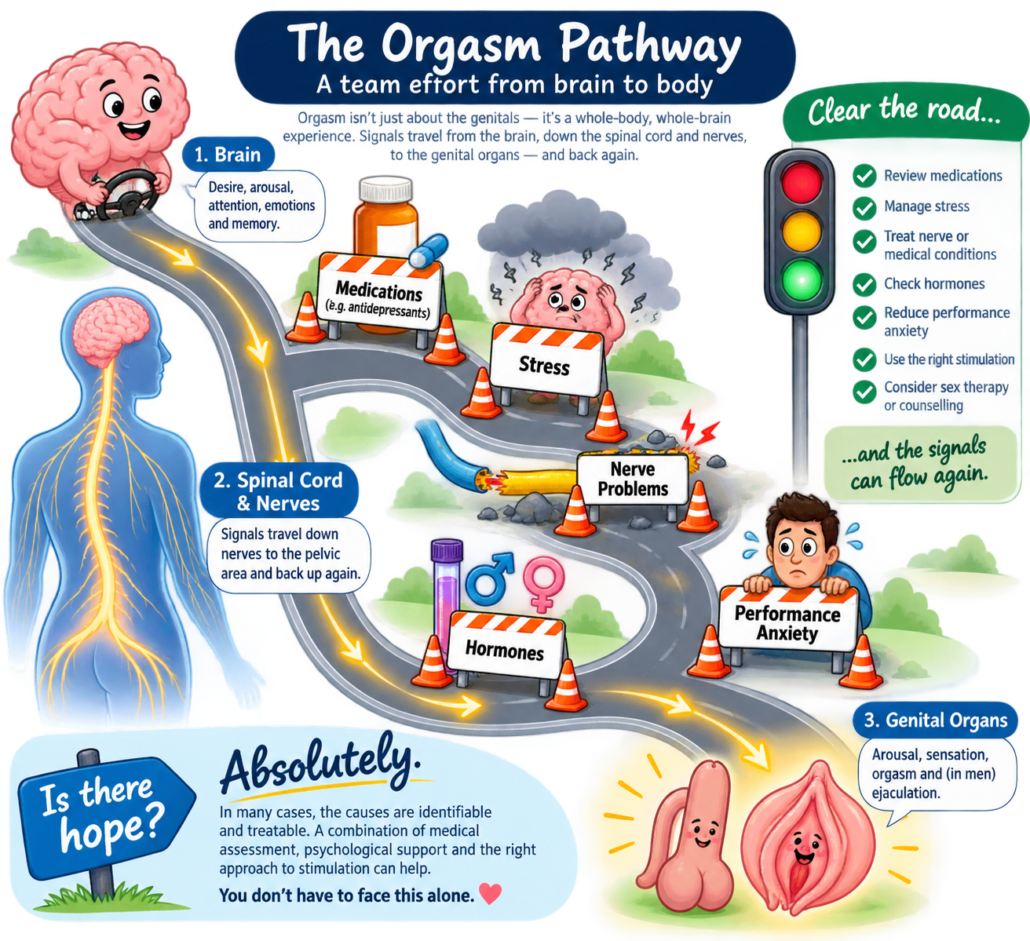
Is there hope? Absolutely.
Anorgasmia is the inability, or persistent difficulty, to reach orgasm despite sexual stimulation and arousal that would normally be expected to produce one.
For some people, orgasm has never occurred. For others, it was previously normal but has gradually or suddenly become difficult or impossible.
Although anorgasmia can be frustrating, confusing and sometimes distressing for both the individual and their partner, it is important to understand one thing from the outset:
Anorgasmia does not necessarily mean that something is permanently damaged, and in many cases there are identifiable and potentially treatable contributing factors.
Orgasm is not simply a genital reflex. It involves the brain, spinal cord, peripheral nerves, hormones, emotions, attention, sexual stimulation and relationship context. If one part of this rather complicated orchestra is playing from the wrong sheet of music, the finale may not arrive.
What is an orgasm?
Orgasm is a complex neurological and physiological event involving the brain, spinal cord, pelvic nerves and genital organs.
In men, orgasm usually occurs at approximately the same time as ejaculation, but orgasm and ejaculation are actually separate processes. A man may therefore:
- ejaculate with little or no pleasurable orgasm;
- experience orgasm without normal ejaculation;
- have markedly delayed orgasm; or
- be unable to achieve orgasm at all.
Similarly, women may experience normal desire and arousal but have considerable difficulty reaching orgasm.
Anorgasmia can therefore affect both men and women.
Different Types of Anorgasmia
Understanding the pattern can provide important clues about its cause.
Lifelong or primary anorgasmia
The person has never experienced an orgasm.
Acquired or secondary anorgasmia
Orgasm was previously possible but has subsequently become difficult or impossible.
This is particularly important because a new change may be associated with medication, surgery, neurological disease, hormonal changes, psychological factors or changes within a relationship.
Generalised anorgasmia
Orgasm cannot be achieved under virtually any circumstances, including masturbation and partnered sexual activity.
Situational anorgasmia
Orgasm occurs in some circumstances but not others.
For example, someone may be able to reach orgasm during masturbation but not during intercourse, or with one form of stimulation but not another.
This distinction is often extremely helpful.
What Causes Anorgasmia?
There is rarely a single universal cause.
Anorgasmia is best approached as a biological, neurological, hormonal, medication-related and psychological condition rather than assuming that the problem is entirely physical or entirely “in the mind.”
1. Medications
Medication is one of the most important potentially reversible causes.
Antidepressants, particularly selective serotonin reuptake inhibitors (SSRIs), are well recognised for causing delayed orgasm or anorgasmia.
Other medications may also interfere with sexual function, including some:
- antidepressants;
- antipsychotic medications;
- medications used for anxiety;
- blood pressure medications;
- medications affecting hormonal pathways; and
- other drugs acting on the central nervous system.
If the problem appeared after starting a new medication or increasing its dose, this is worth discussing with your doctor.
Do not stop prescribed medication suddenly simply because sexual side effects have developed. There may be alternatives, dose adjustments or other strategies available.
2. Previous Pelvic or Prostate Surgery
For men, anorgasmia or significant changes in orgasm can occasionally occur following pelvic surgery.
This may include:
- radical prostatectomy;
- prostate surgery;
- bladder surgery;
- colorectal or pelvic surgery; and
- surgery affecting pelvic nerves.
After radical prostatectomy, for example, ejaculation is no longer possible because the prostate and seminal vesicles have been removed and the reproductive tract has been disconnected.
However, this does not automatically mean that orgasm is impossible.
Many men remain capable of experiencing a “dry orgasm” following prostatectomy, although the sensation may feel different from what they experienced before surgery.
3. Neurological Causes
Orgasm depends heavily on intact nerve pathways between the genitalia, spinal cord and brain.
Conditions that may interfere with these pathways include:
- diabetes;
- multiple sclerosis;
- spinal cord injury;
- peripheral neuropathy;
- pelvic nerve injury; and
- some neurological diseases.
Reduced genital sensation can make orgasm considerably more difficult even when erections and sexual desire remain relatively intact.
4. Hormonal Factors
Hormonal abnormalities can sometimes contribute to orgasmic dysfunction.
Depending upon the individual circumstances, assessment may include consideration of:
- testosterone;
- prolactin;
- thyroid function; and
- other hormonal abnormalities.
Low testosterone is particularly relevant when anorgasmia occurs together with reduced libido, fatigue or erectile difficulties.
Hormone testing is not necessarily required for everyone and should be guided by the history and clinical findings.
5. Erectile Dysfunction and Reduced Arousal
Sometimes the apparent inability to orgasm is actually downstream from another sexual difficulty.
For example, a man may have an erection sufficient for penetration but insufficiently firm or sustained to generate the stimulation necessary to reach orgasm.
Treating associated erectile dysfunction may therefore improve orgasmic function. Current AUA guidance recommends addressing coexisting erectile dysfunction appropriately in men with delayed ejaculation.
6. Alcohol and Recreational Drugs
Alcohol may reduce anxiety in small quantities, but excessive alcohol can blunt genital sensation and interfere with the neurological processes required for orgasm.
Recreational drugs may similarly affect sexual desire, erections, sensation and orgasm.
7. Changes in Sexual Stimulation
Sometimes there is nothing structurally wrong at all.
A person’s nervous system may simply have become accustomed to a particular pattern, pressure, speed or intensity of stimulation during masturbation that is difficult to reproduce during partnered sex.
This can produce the rather puzzling situation of:
“Everything works perfectly on my own, but not with my partner.”
That distinction is useful rather than embarrassing because it suggests that the orgasm pathway itself is functioning.
Treatment may involve changing masturbation technique, varying stimulation and gradually allowing the nervous system to respond to a broader range of sexual sensations.
The Psychological Component
Psychology is not an afterthought in the management of anorgasmia.
The brain is arguably our most important sexual organ.
Orgasm requires a peculiar combination of stimulation, attention and letting go. Trying intensely to make an orgasm happen can sometimes make it less likely to occur.
Performance anxiety can create a frustrating cycle:
Difficulty reaching orgasm → worrying about orgasm → trying harder → monitoring performance → increasing anxiety → even greater difficulty reaching orgasm.
Eventually sex can begin to feel less like intimacy and more like an examination with an inconveniently unpredictable pass mark.
Psychological contributors may include:
- performance anxiety;
- stress;
- depression;
- general anxiety;
- relationship difficulties;
- fear of disappointing a partner;
- previous negative sexual experiences;
- guilt or shame surrounding sexuality;
- cultural or religious beliefs;
- previous sexual trauma; and
- excessive focus on whether orgasm is going to occur.
Importantly, identifying a psychological contribution does not mean that the symptoms are imaginary.
Psychological factors cause genuine changes in arousal, attention, autonomic nervous system activity and sexual response.
How Can Anorgasmia Affect a Relationship?
The effects can extend well beyond the bedroom.
The person experiencing anorgasmia may feel:
- frustrated;
- embarrassed;
- inadequate;
- anxious;
- less interested in initiating sex; or
- concerned that something is physically wrong.
Their partner may interpret the problem quite differently:
“Am I no longer attractive?”
“Am I doing something wrong?”
“Why can’t I satisfy my partner?”
Neither interpretation may be correct.
When couples stop talking about the problem, however, assumptions quickly fill the silence. ISSM notes that orgasmic disorders can cause distress for both individuals and their partners.
Open communication can therefore be an important part of treatment.
How Is Anorgasmia Investigated?
There is no single “anorgasmia test.”
Assessment usually begins with a careful and confidential discussion.
Your doctor may ask:
- Have you ever experienced orgasm?
- Did the problem start suddenly or gradually?
- Can you orgasm during masturbation?
- Can you orgasm with a partner?
- Are erections normal?
- Has genital sensation changed?
- Is sexual desire normal?
- Have you started any new medications?
- Have you had pelvic or prostate surgery?
- Are there neurological symptoms?
- Is ejaculation occurring normally?
- Are there significant stresses or relationship difficulties?
Depending upon the circumstances, further assessment may include a physical examination, neurological assessment, medication review and selected blood tests.
Testing is guided by the history rather than performing an enormous battery of investigations for everyone.
Treatment
Treatment should be directed toward the underlying cause wherever possible.
Review medications
If symptoms began after starting an antidepressant or another medication, discuss this with the prescribing doctor.
Options may sometimes include:
- dose adjustment;
- changing medication;
- changing timing; or
- considering an alternative treatment.
This must be done under medical supervision.
Treat associated erectile dysfunction
If erections are unreliable, optimising erectile function may improve stimulation and the likelihood of orgasm.
Address hormonal abnormalities
Documented testosterone deficiency or other hormonal abnormalities should be treated appropriately rather than assuming that testosterone will improve orgasm in everyone.
Modify stimulation
Changing the type and intensity of sexual stimulation can be remarkably useful for some people.
This might involve:
- longer periods of stimulation;
- changing masturbation technique;
- varying pressure and speed;
- incorporating different forms of stimulation;
- reducing dependence on one very specific masturbation technique; and
- communicating more clearly with a partner about what actually feels pleasurable.
For women, directed self-stimulation, education about sexual anatomy and appropriate clitoral stimulation are established components of management.
Sex Therapy and Psychological Treatment
A psychologist or appropriately trained psychosexual therapist can be extremely valuable.
Therapy is not simply sitting on a couch discussing childhood while everyone carefully avoids mentioning sex.
Modern psychosexual therapy can be practical and goal-directed.
Treatment may include:
- reducing performance anxiety;
- cognitive behavioural therapy;
- mindfulness techniques;
- sensate-focus exercises;
- addressing negative beliefs surrounding sex;
- working through previous traumatic experiences;
- improving communication;
- changing established patterns of sexual stimulation; and
- couples therapy.
Mindfulness can be particularly helpful in shifting attention away from:
“Am I going to orgasm?”
and back towards:
“What am I actually feeling?”
Psychotherapy, cognitive behavioural approaches, mindfulness-based therapy and sex therapy all have roles in selected patients with orgasmic disorders.
Sometimes removing orgasm as the immediate “goal” of sexual activity paradoxically makes orgasm easier to achieve.
Are There Medications for Anorgasmia?
This is an evolving area.
Various medications have been investigated for male delayed orgasm or anorgasmia, but evidence remains limited and there is currently no universally effective medication specifically approved to restore orgasm.
For women with orgasmic disorder, there is likewise no established medication that reliably restores orgasm.
Treatment therefore needs to be individualised.
Beware of internet advertisements promising tablets or supplements that “guarantee” orgasm. Sexual neurophysiology is considerably more complicated than the advertising department would have you believe.
What About Orgasm Without Pleasure?
Occasionally a person experiences the physical event of orgasm or ejaculation but feels little or no pleasure.
This is sometimes described as orgasmic anhedonia or pleasure-dissociative orgasmic dysfunction.
Potential contributors include medications, psychological factors, hormonal abnormalities and neurological problems. Assessment should again concentrate on identifying and treating the underlying cause.
Is There Hope?
Yes.
Anorgasmia can be persistent, but it should not automatically be regarded as permanent.
The first objective is to establish why orgasm has become difficult.
Sometimes the answer is relatively straightforward: a medication, erectile dysfunction, inadequate stimulation or a hormonal problem.
Sometimes several factors are interacting.
And sometimes the physical problem creates anxiety, which then perpetuates the physical problem.
Successful treatment may therefore require more than one approach:
medical assessment + medication review + optimisation of sexual function + appropriate stimulation + psychological or psychosexual therapy.
The AUA specifically recognises education and psychological-health expertise as important components in caring for men with delayed ejaculation and related orgasmic difficulties.
When Should I See a Urologist?
Consider seeking medical advice when:
- you previously experienced normal orgasms and suddenly cannot;
- the problem persists and bothers you;
- you have reduced genital sensation;
- you also have erectile dysfunction;
- symptoms developed following pelvic or prostate surgery;
- symptoms began after starting medication;
- ejaculation has disappeared or significantly changed;
- you have neurological symptoms; or
- the problem is causing anxiety or relationship difficulties.
There is no reason to be embarrassed about discussing orgasm with your urologist.
Sexual function is part of normal human health, and orgasmic problems are legitimate medical concerns.
The Bottom Line
Anorgasmia is rarely as simple as something being “broken.”
Orgasm sits at the intersection of the brain, nerves, hormones, genital sensation, medications, sexual stimulation, emotions and relationships.
That complexity can make anorgasmia challenging to investigate, but it also creates multiple opportunities for treatment.
The most useful approach is often multidisciplinary, combining medical evaluation with attention to psychological and relationship factors.
Most importantly, don’t quietly give up on your sex life.
Anorgasmia deserves proper assessment, an open conversation and an individualised treatment plan. There may not always be a magic switch, but there are often several switches worth checking.


Leave a Reply
Want to join the discussion?Feel free to contribute!