
Movember and the digital rectal examination: does it still matter?
The digital rectal examination (DRE) has been part of prostate assessment for generations. It is also one of the tests men are most likely to dread, joke about, or avoid. As Movember prompts conversations about prostate health, it is worth asking what a DRE can actually tell us today and when it is useful.
The short answer: a DRE still has a place in clinical assessment, but it is not recommended as a routine add-on to PSA testing for every asymptomatic man. PSA blood testing is the main early-detection test. A DRE can add physical information in selected situations, and it remains one part of monitoring some men with known prostate cancer.
What is a DRE?
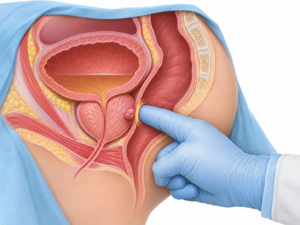
A DRE is a brief examination in which a clinician gently inserts a gloved, lubricated finger into the rectum to feel the back surface of the prostate. The clinician assesses features such as the prostate’s size, shape, firmness, symmetry and any distinct lump or irregular area. It may also give information about tenderness or other rectal findings.
The prostate sits in front of the rectum, so the examination can only feel part of the gland. It cannot reliably assess the whole prostate, and some cancers, particularly those in areas that cannot be reached by touch, may not be felt. A normal DRE therefore does not rule out prostate cancer.
What extra information can it provide?
PSA is a blood marker produced by prostate tissue. It helps estimate risk, but PSA alone does not show where a possible cancer is or how the prostate feels. A DRE gives the clinician a physical finding to interpret alongside the PSA result, symptoms, family history and, when indicated, MRI and biopsy.
A firm nodule, marked asymmetry, or an unusually hard or fixed-feeling area can increase concern and prompt further assessment, even if the PSA is not markedly raised. An abnormal DRE may also help estimate the clinical extent of a cancer and its likelihood of being more significant. But it is not a cancer diagnosis: benign enlargement, inflammation and examiner variation can affect what is felt. A suspicious finding usually needs further assessment, often including MRI and possibly biopsy.
DRE is not a substitute for PSA, MRI or biopsy. Nor does a normal examination provide a guarantee that cancer is absent.
Can it find cancers that produce little PSA?
Occasionally, prostate cancer is found after a suspicious DRE even when PSA is low. Some uncommon or poorly differentiated cancers can produce less PSA than expected. In the 2026 European Association of Urology guideline, a suspicious DRE with PSA at or below 4 ng/mL was associated with a positive predictive value ranging widely from 5% to 30% in the cited evidence. This shows why a distinctly abnormal examination should not automatically be dismissed because of a reassuring PSA.
That does not mean DRE is a dependable way to screen for low-PSA cancers. Many cancers cannot be felt, and DRE’s performance as a stand-alone screening test is limited. If symptoms, imaging or other clinical features raise concern, the clinician should consider the full picture rather than rely on either a normal PSA or a normal DRE alone.
Should every man having a PSA test also have a DRE?
No. The NHMRC-approved 2026 Guidelines for the Early Detection of Prostate Cancer in Australia suggest that DRE not be offered in primary care as a routine addition to PSA testing and risk assessment for asymptomatic men. The RACGP Red Book also advises against routine DRE as an addition to PSA testing in asymptomatic men seeking early detection.
This reflects evidence that routine DRE adds little to population early-detection pathways compared with PSA-based assessment, while it can create discomfort and deter some men from discussing testing. PSA testing itself is a choice to make after discussing potential benefits and harms with a GP; it is not an automatic test for everyone.
A DRE may still be appropriate when a person has symptoms, a concerning PSA result, an abnormality on imaging, or another clinical reason for a physical examination. A clinician should explain why it may help in that specific situation and discuss alternatives where appropriate.
What about men already on active surveillance?
Active surveillance is a monitoring approach for selected men with lower-risk prostate cancer, intended to identify evidence of meaningful change while avoiding or delaying treatment side effects when it is safe to do so.
The 2026 Australian guideline proposes periodic DRE alongside PSA measurements, MRI where appropriate and repeat biopsy when clinically indicated. A change in the examination may be one reason to bring forward MRI or biopsy. It is not, by itself, usually enough to decide that treatment should start. The European Association of Urology also includes DRE in surveillance protocols, while recognising that its frequency may be reduced in selected men with stable MRI and other reassuring findings. Monitoring plans vary with the cancer’s features, prior tests and the person’s circumstances.
Why is the DRE so famous, and why are some men apprehensive?
For many years, before PSA testing and prostate MRI were available, clinicians had fewer ways to assess the prostate. The DRE was a quick bedside examination that could identify a large or locally advanced abnormality. It became closely associated with “getting your prostate checked,” and popular culture has kept it in the spotlight.
When I discuss it with patients, I sometimes call DRE the “dreaded rectal examination” a little wordplay that can break the ice. It acknowledges the test’s reputation, but it is not a request to grin and bear it: I explain what I’m doing, ask permission, and stop if you ask.
The examination can feel intimate or embarrassing. Some men worry it will hurt, feel exposed, or be judged. Others have heard jokes that link the test to masculinity or sexuality. These concerns are understandable, but a DRE is a clinical examination; it says nothing about a person’s identity or sexuality. Many people find it awkward or uncomfortable rather than painful, although experiences differ.
You can ask the clinician to explain each step before starting, request a chaperone, discuss positioning, and ask them to stop at any time. Consent matters. You do not need to agree to an examination simply because you have come to talk about PSA testing.
What should I do this Movember?
If you are thinking about prostate testing, speak with your GP about your age, family history, health and preferences. Ask whether PSA testing is suitable for you and whether an examination would add useful information in your circumstances. If you have urinary symptoms, blood in your urine or semen, persistent unexplained pain, or another concern, arrange an assessment rather than waiting for a routine screening test.
Movember is a chance to make the conversation easier. The aim is not to insist that every man must have a DRE. It is to help each person understand the available tests, feel able to ask questions, and make an informed decision with their clinician.
This article provides general information and is not a substitute for personal medical advice.
References and further information
- Prostate Cancer Foundation of Australia. 2026 Guidelines for the Early Detection of Prostate Cancer in Australia. NHMRC-approved recommendations, 18 May 2026. See Recommendations 4.1 and 8.2.1.
- The Royal Australian College of General Practitioners. Guidelines for preventive activities in general practice, 10th edition — prostate cancer. Recommendations updated 28 June 2024.
- European Association of Urology. EAU Guidelines on Prostate Cancer: Diagnostic Evaluation, 2026 edition.
- European Association of Urology. EAU Guidelines on Prostate Cancer: Treatment and active-surveillance follow-up, 2026 edition.
- Sajjad W, et al. Comparing the Performance of Digital Rectal Examination and Prostate-specific Antigen as a Screening Test for Prostate Cancer: A Systematic Review and Meta-analysis. European Urology Oncology. 2024. PubMed.