
Regulated Bladder Distension: Can Stretching the Bladder Help a Small or Painful Bladder?
For patients living with interstitial cystitis/bladder pain syndrome (IC/BPS) or a persistently small functional bladder capacity, the bladder can become an unforgiving little alarm clock: filling produces pain or pressure, urinary frequency increases, and sleep may be repeatedly interrupted by trips to the bathroom.
One procedure sometimes considered in carefully selected patients is regulated bladder distension, more commonly called cystoscopic hydrodistension.
Hydrodistension has been used for decades, both to assess the bladder and as a therapeutic procedure. It can improve symptoms in some patients, but it is important to understand that it is not a cure for interstitial cystitis, and the scientific evidence for lasting benefit remains mixed. Current guidelines therefore regard it as a selective treatment rather than something that should routinely be performed in every patient with bladder pain.
What is regulated bladder distension?
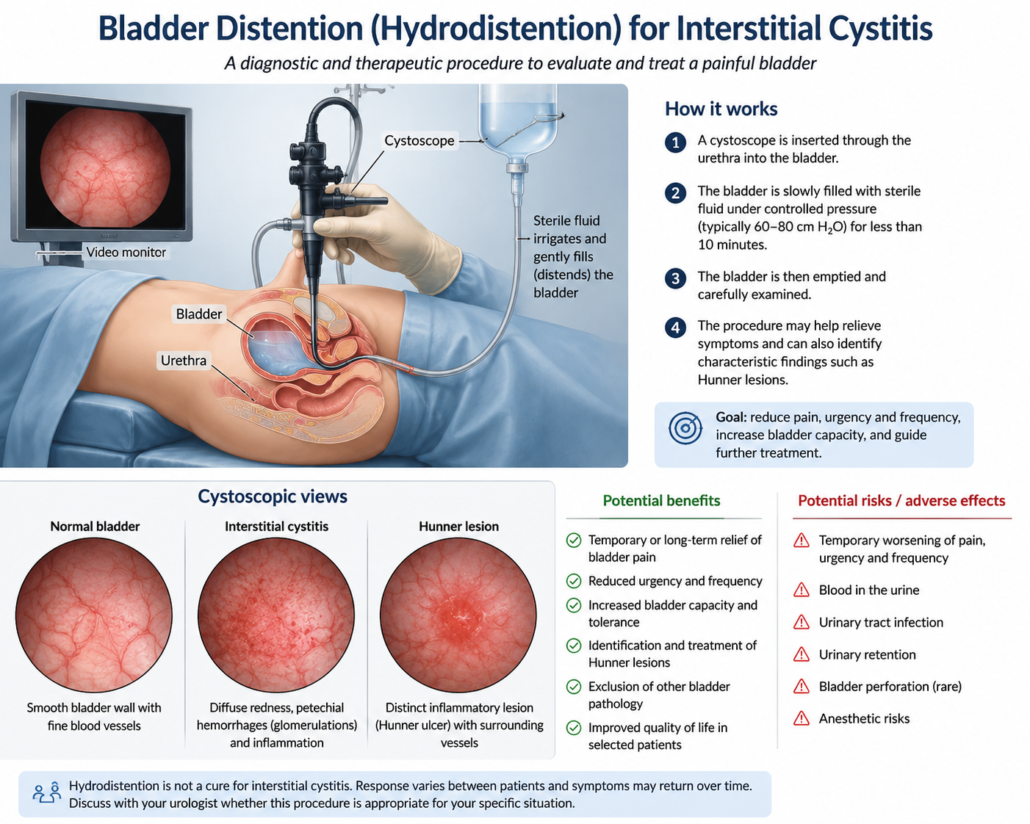
Regulated bladder distension involves gradually filling the bladder with sterile irrigation fluid during cystoscopy, usually while the patient is under anaesthesia.
The important word is regulated.
Modern hydrodistension should not simply involve filling the bladder as much as possible. Pressure, volume and duration need to be carefully controlled to minimise injury to the bladder.
A commonly described technique is low-pressure, short-duration hydrodistension, traditionally using an irrigation pressure of approximately 60–80 cm H₂O for less than 10 minutes.
The procedure allows the urologist to:
- examine the bladder carefully;
- exclude other abnormalities such as bladder stones or tumours;
- identify Hunner lesions associated with a particular phenotype of IC/BPS;
- assess the bladder mucosa following distension;
- determine the bladder’s anatomical capacity under anaesthesia;
- identify a severely reduced or fibrotic bladder capacity; and
- potentially provide temporary improvement in pain, urgency and urinary frequency.
Importantly, the bladder capacity measured under anaesthesia can be very different from the volume a patient can comfortably hold while awake.
Why might bladder distension improve symptoms?
The exact mechanism remains uncertain.
Several explanations have been proposed.
Temporary increase in functional bladder capacity
Some patients with bladder pain develop progressively smaller functional voided volumes because bladder filling produces discomfort or urgency.
Hydrodistension may temporarily allow the bladder to accommodate a larger volume and may interrupt the cycle of:
bladder filling → pain → early voiding → progressively smaller functional capacity.
However, this does not necessarily mean that hydrodistension permanently enlarges a genuinely scarred or fibrotic bladder.
Alteration of bladder sensory signalling
Stretching of the bladder wall may temporarily alter afferent sensory signalling between the bladder and nervous system.
This may reduce the sensation of:
- urgency;
- bladder pressure;
- suprapubic discomfort; and
- pain associated with bladder filling.
This proposed neuromodulatory effect may explain why some patients experience considerable symptomatic improvement despite relatively little change in anatomical bladder capacity.
Diagnostic and therapeutic treatment of Hunner lesions
Cystoscopy performed during hydrodistension can make Hunner lesions more apparent. Once identified, these lesions can be treated separately with fulguration, laser treatment or steroid injection where appropriate.
It is important to distinguish improvement from treating a Hunner lesion from improvement attributable to the hydrodistension itself.
Hydrodistension for interstitial cystitis/bladder pain syndrome
This is the condition in which hydrodistension has been studied most extensively.
IC/BPS is characterised by bladder-related pain, pressure or discomfort accompanied by urinary symptoms such as frequency and urgency, after other identifiable causes have been excluded.
Hydrodistension is not required to diagnose every patient with IC/BPS, but cystoscopy and distension can be particularly useful when the diagnosis is uncertain, Hunner lesions are suspected, or invasive treatment is being considered.
The European Association of Urology notes that hydrodistension is commonly performed but that the scientific justification remains limited, describing its therapeutic role in primary bladder pain syndrome as limited.
This does not mean that it never works. Rather, we cannot reliably predict who will respond or how long the response will last.
How effective is bladder hydrodistension?
This is where expectations need to be realistic.
Older observational studies of low-pressure, short-duration hydrodistension reported clinically significant improvement in approximately:
| Time after treatment | Reported symptomatic response |
|---|---|
| 1 month | approximately 30–54% |
| 2–3 months | approximately 18–56% |
| 5–6 months | approximately 0–37% |
These studies were generally small and heterogeneous, and many lacked placebo or sham controls.
AUA educational material similarly notes that observational studies have demonstrated meaningful improvement in approximately half of selected patients, sometimes lasting as long as 12 months. The absence of good sham-controlled trials, however, makes the treatment effect difficult to quantify precisely.
The EAU guidelines highlight how quickly benefit can disappear in some patients. In one comparison involving hydrodistension, approximately 70% of patients treated with hydrodistension alone had returned to their previous symptoms after one month.
What does the newer research show?
A recent systematic review provides an important update.
Lim and colleagues reviewed 14 studies involving 1,404 patients undergoing hydrodistension for interstitial cystitis. Nine studies evaluated distension lasting 15 minutes or less, while five older studies investigated considerably longer distension periods.
Some studies demonstrated significant improvements in pain and symptom scores, while others showed no statistically significant improvement.
The authors concluded that hydrodistension can provide symptomatic relief in some patients but that the available evidence remains limited by:
- heterogeneous techniques;
- small patient populations;
- observational study designs;
- differences in duration and pressure;
- inconsistent outcome measures; and
- substantial risk of bias.
Interestingly, prolonged distension appeared in some studies to produce longer-lasting responses, but this potentially comes at the cost of greater risk of serious complications, particularly bladder perforation.
This creates something of a therapeutic tightrope: more aggressive distension might theoretically produce a greater effect, but pushing harder is not necessarily safer or better.
What about a genuinely small bladder?
A distinction needs to be made between a functionally small bladder and an anatomically contracted bladder.
Functional small bladder
A patient with bladder pain may void frequently at volumes of only 100–200 mL because further filling becomes uncomfortable.
Under anaesthesia, however, the bladder may accommodate a considerably larger volume.
In this situation, hydrodistension may have both diagnostic and therapeutic value.
Anatomically small or fibrotic bladder
Some patients have genuine fibrosis and loss of bladder compliance.
Causes can include:
- severe longstanding IC/BPS;
- previous pelvic radiotherapy;
- chronic inflammatory bladder disease;
- tuberculosis or other uncommon chronic infections;
- previous bladder surgery;
- chemical cystitis; and
- other causes of bladder fibrosis.
Hydrodistension is much less likely to produce durable enlargement of a severely fibrotic, non-compliant bladder.
Indeed, determining anatomical bladder capacity during hydrodistension can help identify the subgroup of patients whose reduced capacity results from fibrosis rather than simply pain-related early voiding.
Patients with severely contracted bladders therefore require individual assessment rather than repeated attempts to mechanically stretch the bladder.
What are the potential benefits?
For appropriately selected patients, benefits may include:
- reduced bladder pain;
- reduced urgency;
- reduced urinary frequency;
- improved bladder filling tolerance;
- increased functional voided volumes;
- reduced nocturia;
- improved quality of life;
- identification of Hunner lesions;
- determination of true anatomical bladder capacity; and
- exclusion of other bladder pathology.
Some patients experience substantial improvement and occasionally request repeat hydrodistension when symptoms eventually return.
Others experience little or no improvement.
Unfortunately, there is currently no perfect test that tells us beforehand which patient will fall into which group.
What happens immediately after the procedure?
Temporary worsening of symptoms is relatively common.
For several days patients may experience:
- burning when passing urine;
- increased urinary frequency;
- urgency;
- bladder discomfort or spasms;
- pelvic pain; and
- blood in the urine.
A short-term flare of IC/BPS symptoms can also occur after hydrodistension. This is generally managed with analgesia and supportive treatment.
The bladder has, after all, just undergone considerably more filling than it normally tolerates, so it may complain rather loudly for a short period afterwards.
What are the potential complications?
Most complications are minor and temporary, but patients should understand that more significant complications are possible.
These include:
Haematuria
Blood in the urine is relatively common immediately following the procedure and generally settles spontaneously.
Bladder pain and symptom flare
Paradoxically, the procedure intended to improve bladder pain may initially make it worse.
Symptoms usually settle, but occasionally the flare can be prolonged.
Urinary tract infection
Instrumentation of the urinary tract carries a risk of infection.
Patients developing fever, chills, worsening pain or difficulty passing urine following the procedure should seek medical attention.
Urinary retention
Temporary difficulty emptying the bladder can occasionally occur, particularly following anaesthesia or when additional bladder treatments have been performed.
Temporary catheterisation may be required.
Bladder perforation or rupture
This is uncommon with carefully controlled modern techniques but represents the most important procedural complication.
The risk becomes more concerning when high pressures or prolonged distension are employed.
Anaesthetic complications
Because hydrodistension is generally performed under anaesthesia or sedation, the usual anaesthetic risks also apply.
Why pressure and duration matter
Historical hydrodistension techniques could be considerably more aggressive than contemporary practice.
The American Urological Association has specifically advised against high-pressure, long-duration hydrodistension because it has been associated with serious complications including:
- bladder rupture;
- significant bleeding; and
- sepsis.
High-pressure techniques above approximately 80–100 cm H₂O, particularly when combined with prolonged distension, have not demonstrated sufficiently consistent additional benefit to justify these increased risks.
This is why contemporary treatment should be controlled rather than heroic. The objective is therapeutic distension, not a competition to discover the maximum volume a bladder can tolerate.
Can bladder distension be repeated?
Yes, in selected patients.
If a patient obtains substantial improvement lasting several months, repeat hydrodistension may be considered when symptoms recur.
However, repeated procedures should not simply become an automatic treatment cycle.
The potential benefit needs to be balanced against:
- repeated anaesthesia;
- postoperative symptom flares;
- infection;
- bleeding;
- bladder injury;
- cost and inconvenience; and
- availability of alternative therapies.
A patient who experienced no meaningful improvement after a properly performed initial hydrodistension is unlikely to benefit from endlessly repeating the same procedure without reconsidering the diagnosis and treatment strategy.
How does hydrodistension fit into modern IC/BPS treatment?
IC/BPS is increasingly regarded as a heterogeneous condition rather than a single disease.
Treatment may therefore include combinations of:
- dietary and behavioural modification;
- bladder retraining;
- pelvic floor physiotherapy;
- pain management;
- oral medication;
- intravesical bladder instillations;
- treatment of Hunner lesions;
- hydrodistension;
- intradetrusor botulinum toxin;
- neuromodulation; and
- rarely, major reconstructive surgery for severe refractory disease.
The 2025 Canadian Urological Association guideline, for example, conditionally recommends intradetrusor botulinum toxin, with or without hydrodistension, for selected patients with IC/BPS refractory to other treatments, although the certainty of evidence remains very low.
Hydrodistension combined with Botox
There is increasing interest in combining hydrodistension with intradetrusor botulinum toxin A.
Botulinum toxin may reduce sensory signalling from the bladder as well as detrusor activity.
The EAU guideline cites studies in which patients receiving hydrodistension plus botulinum toxin had more sustained improvement in pain and bladder capacity than patients undergoing hydrodistension alone.
This does not mean Botox is appropriate for every patient. Potential complications include increased residual urine and urinary retention, occasionally requiring intermittent self-catheterisation.
So, does regulated bladder distension actually work?
Yes, for some patients, but not reliably and usually not permanently.
That is probably the fairest interpretation of the current evidence.
Hydrodistension can produce worthwhile improvement in pain, frequency and functional bladder capacity in a subset of patients with IC/BPS. Some patients experience surprisingly prolonged relief.
However:
the response is unpredictable, symptoms commonly recur, and high-quality evidence demonstrating durable long-term benefit remains limited.
The most recent systematic review reached essentially the same conclusion: hydrodistension remains a viable but controversial treatment because studies suggest benefit while the overall quality and consistency of evidence remain insufficient.
The European Association of Urology consequently considers hydrodistension to have a limited therapeutic role, despite its continued use in clinical practice.
The bottom line
Regulated bladder hydrodistension is best viewed as a selective diagnostic and therapeutic procedure rather than a cure for a small or painful bladder.
It may be particularly useful when:
- IC/BPS symptoms remain troublesome despite conservative treatment;
- bladder capacity appears markedly reduced;
- Hunner lesions are suspected;
- anatomical bladder capacity needs to be established; or
- cystoscopy is required to exclude another cause for the symptoms.
When performed, a carefully controlled, low-pressure and relatively short-duration technique has traditionally been favoured because aggressive high-pressure distension increases the risk of bladder injury without convincing evidence of superior benefit.
For patients with a genuinely scarred, contracted and poorly compliant bladder, however, hydrodistension should not be expected to magically restore normal bladder capacity. These patients may require a different and more individualised management strategy.
Ultimately, the question is not simply:
“Can the bladder be stretched?”
It is:
“Why is this bladder small or painful, and is controlled distension likely to change the underlying problem?”
That distinction is central to selecting the patients most likely to benefit.
Research and guideline references
- Lim S, Alhamdani Z, Qin KR, et al. Optimal Duration of Hydrodistension for Symptomatic Treatment of Interstitial Cystitis: A Systematic Review. Neurourology and Urodynamics. First published 2025. The review included 14 studies and 1,404 patients and highlighted both potential symptomatic benefit and substantial heterogeneity in the evidence.
- European Association of Urology. EAU Guidelines on Chronic Pelvic Pain: Primary Bladder Pain Syndrome. Current guidance describes the scientific basis for hydrodistension as limited and its therapeutic role as relatively limited.
- American Urological Association. Diagnosis and Treatment of Interstitial Cystitis/Bladder Pain Syndrome. Low-pressure, short-duration hydrodistension is described as an option, while high-pressure, prolonged hydrodistension is discouraged because of the increased risk of serious adverse events.
- Canadian Urological Association. CUA guideline: Diagnosis and treatment of interstitial cystitis/bladder pain syndrome. Observational studies reported variable and generally declining response rates following hydrodistension.
- Canadian Urological Association. 2025 CUA Guideline: Selected treatment recommendations for interstitial cystitis/bladder pain syndrome. Discusses contemporary treatment options including intradetrusor botulinum toxin with or without hydrodistension in refractory IC/BPS.
- Malde S, Palmisani S, Al-Kaisy A, Sahai A. Guideline of guidelines: bladder pain syndrome. BJU International. 2018. The review highlights substantial variation between international recommendations and the limited evidence supporting hydrodistension as a long-term therapeutic strategy.
This information is intended for general patient education and does not replace individual assessment by a urologist. The appropriateness and technique of bladder hydrodistension should be determined according to the underlying diagnosis, bladder characteristics, previous treatments and individual patient circumstances.


Leave a Reply
Want to join the discussion?Feel free to contribute!