The Centre for Men and Families Australia: Helping Men Through Crisis, Change and Transformation
When a man says “I’m fine”, sometimes he isn’t
Men are often remarkably good at carrying things.
We carry responsibility. We carry families. We carry financial pressures, expectations, disappointments, grief and fear. And occasionally, we carry all of them at once while still answering the question “How are you going?” with the traditional Australian male response:
“Yeah, good mate.”
Sometimes we are good.
Sometimes we are anything but.
For more than 25 years, the Centre for Men and Families Australia (CFMF) has been creating places where men can put down some of what they carry, speak honestly about their lives, listen to other men and discover that they do not have to negotiate life’s difficult passages alone.
The Centre describes itself as a national harm-prevention charity supporting men’s emotional, mental, relational and spiritual wellbeing. Its work includes men’s circles, counselling, retreats, Men’s Rites of Passage, programs for younger men and community events.
Its central idea is remarkably simple:
Men need other men. Not to fix them, but to walk alongside them.
Why is this on a urologist’s website?
Because urology is about considerably more than kidneys, bladders and prostates.
Over many years of looking after men, one becomes very aware that a diagnosis rarely remains confined to an organ.
Prostate cancer can become a confrontation with mortality.
Erectile dysfunction can challenge a man’s confidence, sexuality and intimate relationship.
Urinary incontinence can affect dignity and willingness to socialise.
Infertility can challenge deeply held ideas about fatherhood.
Testicular cancer may confront a young man with questions about masculinity before he has even had much opportunity to define what masculinity means to him.
A catheter, a cancer diagnosis, sexual dysfunction or major surgery can unexpectedly open a door into much bigger questions:
Who am I now?
What if my body no longer works as it once did?
Am I still desirable?
What am I frightened of?
Who can I talk to about this?
And perhaps the most difficult question:
Do I have to carry this alone?
The answer should be no.
The origins of the Centre
The work that eventually became the Centre for Men and Families began in 1998, when Rob Jones established Men Transforming Men in Kenmore, Queensland.
Rob Jones is the founder of the Centre and a qualified counsellor and spiritual director. The early work grew from a recognition that men needed to be equipped to support other men.
What began with mentoring, community camps, breakfasts, counselling and gatherings gradually developed into a much broader men’s movement.
In 2004, Rob and his wife Sharon Jones committed themselves more fully to the work. The organisation subsequently developed relationships with other men’s organisations and with the work of Franciscan teacher Richard Rohr and the Centre for Action and Contemplation in the United States.
That relationship helped establish the Men’s Rites of Passage tradition in Australia and introduced generations of Australian men to a different understanding of masculinity: one based not simply upon achievement, independence and strength, but also upon vulnerability, contemplation, responsibility, service and emotional maturity.
The Centre continues this work today.
Rob Jones and a different vision of men’s work
Rob Jones’ contribution deserves particular recognition.
The important insight behind this work was not that men were somehow defective and needed repairing.
It was that many men had never been given a safe environment in which to explore their inner lives.
Many of us were taught how to do.
Far fewer were taught how to be.
We learned how to work, compete, provide, solve problems and endure adversity.
But what do we do with grief?
What do we do with failure?
What happens when a marriage ends?
When a child is struggling?
When someone we love dies?
When our career disappears?
When cancer arrives?
When our body begins to age?
When sexuality changes?
When the identity we constructed over decades suddenly stops making sense?
These questions cannot always be solved with a bigger toolbox.
Sometimes a man needs a circle rather than a solution.
From crisis to connection
Men can arrive at a crisis through many different doors.
It may be:
- relationship breakdown
- divorce or separation
- bereavement
- loneliness
- unemployment or retirement
- financial pressure
- fatherhood
- ageing
- loss of purpose
- sexual difficulties
- chronic illness
- cancer
- anxiety or emotional distress
- or simply the uncomfortable feeling that life is no longer working in the way it once did.
The Centre provides several pathways through which men can connect with others, including professional counselling, regular men’s Circle Groups, retreats, online programs and Rites of Passage experiences.
The emphasis is not simply upon talking.
It is upon being heard without judgement.
That distinction matters.
Men are often surrounded by people and yet profoundly lonely.
You can work in an office of 100 people, play golf with the same mates for 20 years and attend every family barbecue while never telling another human being what is actually happening inside you.
Connection is not the number of people around us.
It is the number of people with whom we can safely be real.
Men’s circles: putting down the armour
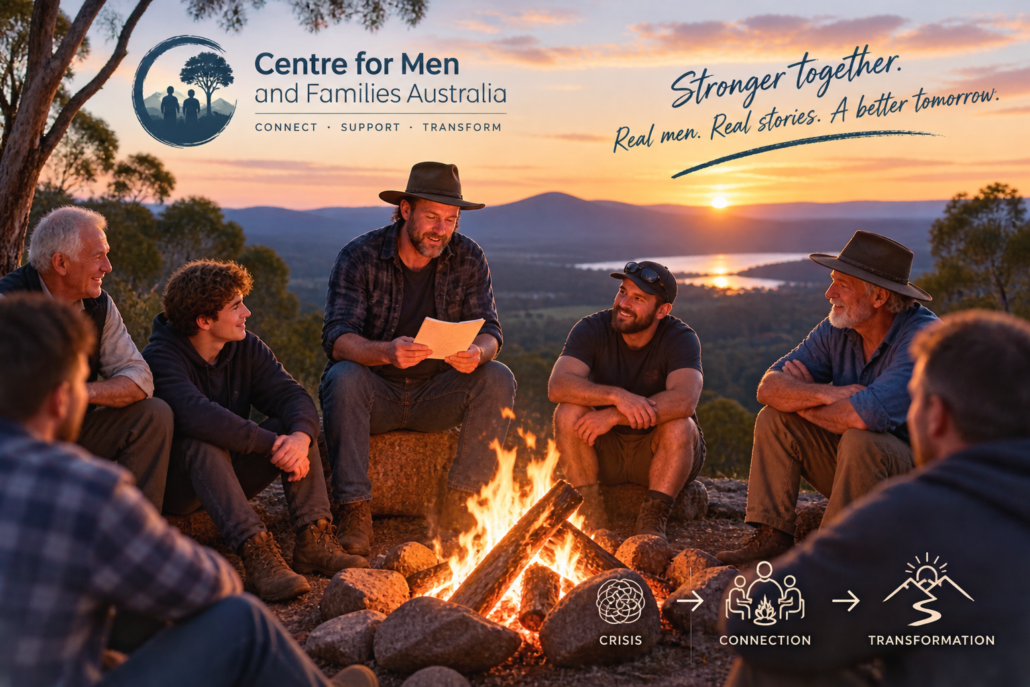
One of the simplest expressions of the Centre’s work is the men’s circle.
There is no requirement to arrive with a dramatic story.
A man does not need to be in crisis.
Men sit together, listen and speak honestly.
For some, this initially feels extremely unfamiliar.
We are generally comfortable discussing football, politics, work, interest rates and whether the barbecue is hot enough.
Talking about fear, loneliness, shame, ageing, sexuality or grief can require considerably more courage.
But something interesting happens when one man speaks honestly.
Another man recognises himself in the story.
Then another speaks.
The room changes.
The problem that seemed uniquely shameful becomes recognisably human.
“I thought I was the only one.”
Those can be extraordinarily liberating words.
Watching men change
One of the most powerful aspects of organisations such as the Centre is not necessarily what happens during a single weekend, retreat or meeting.
It is what happens over years.
Men return.
They continue meeting.
They become mentors.
Some eventually become elders for younger men.
A man who once arrived carrying anger may gradually discover the hurt beneath it.
A man obsessed with achievement may discover that his value is not determined by his job title.
A father may begin listening differently to his children.
A husband may become more emotionally available to his partner.
A man who spent decades avoiding grief may finally allow himself to grieve.
And the man who once needed the circle may eventually become the man holding the circle for somebody else.
That is transformation.
Not becoming a completely different person.
Perhaps becoming more fully the person who was underneath the armour all along.
The Centre’s philosophy extends this transformation beyond the individual man. When a man becomes healthier emotionally and relationally, the effects can flow outward into his marriage, children, friendships, workplace and community.
Transformation becomes generational.
Men’s Rites of Passage
The Centre’s Men’s Rites of Passage work has been strongly influenced by the tradition associated with Richard Rohr.
Rather than regarding adulthood as something that automatically arrives with a driver’s licence, mortgage or first grey hair, rites-of-passage traditions ask deeper questions about maturity.
What must a man relinquish?
What pain must he acknowledge?
What can he no longer control?
What does he have to offer others?
What kind of man does he wish to become?
CFMF currently offers a five-day Men’s Rites of Passage experience for men over 30 and Forged, a wilderness-based rites-of-passage experience for younger men aged 18–30.
These experiences use community, nature, reflection, ritual and the wisdom of older men to explore identity and mature masculinity.
From silence to poetry: when men find words
Perhaps one of the most interesting recent expressions of the Centre’s philosophy has been through poetry.
At first glance, poetry and Australian masculinity may appear slightly uneasy companions.
Give a group of Australian men a chainsaw, a fishing rod or a football and everybody knows roughly what to do.
Give them a blank sheet of paper and ask them to describe their inner life…
Things become interesting.
Yet poetry can reach places ordinary conversation sometimes cannot.
The Centre recently invited men to contribute to its “Men Like Me” Poetry Competition, encouraging original poetry exploring the experience of being a man, including vulnerability, emotional truth, spiritual growth and the complexity and struggles of modern masculinity.
This represents something important.
For generations, many men expressed emotion principally through silence.
Today’s men are gradually discovering a larger vocabulary.
Poetry provides permission to speak indirectly about things that may be difficult to say directly:
A father.
A son.
A body growing older.
Love.
Sex.
Regret.
Cancer.
Failure.
Anger.
Forgiveness.
Death.
Hope.
Sometimes a man cannot begin with:
“I am frightened.”
But perhaps he can write a poem about standing alone beside the ocean at night.
And perhaps that is where the conversation begins.
Masculinity does not require emotional silence
Supporting men’s emotional lives is sometimes mistakenly interpreted as asking men to become less masculine.
The opposite may be true.
Healthy masculinity can include strength and tenderness.
Courage and vulnerability.
Independence and belonging.
Leadership and humility.
Sexual confidence and the ability to acknowledge sexual difficulty.
Providing for others and knowing when to ask others for help.
The mature man does not necessarily carry less.
He learns what is his to carry, what he must put down and when he needs another man’s shoulder beside his own.
When illness becomes a doorway
Nobody would choose prostate cancer, incontinence, erectile dysfunction or another serious health problem as a route toward personal growth.
Illness is illness.
It deserves appropriate investigation and good medical treatment.
But illness can also interrupt the story we have been telling ourselves.
Suddenly the body demands attention.
Priorities shift.
Relationships matter differently.
Questions that were conveniently postponed become difficult to ignore.
This can be frightening.
It can also become an invitation.
An invitation to speak.
To reconnect.
To repair relationships.
To reconsider priorities.
To ask for help.
And perhaps to discover that strength does not always mean standing alone.
Supporting the whole man
Good men’s healthcare should recognise that a prostate is attached to a person.
Treating prostate cancer successfully while ignoring the man’s fear, sexual identity, relationship or emotional wellbeing is incomplete care.
Likewise, restoring continence after prostate surgery is important, but so is helping the man regain confidence in returning to work, intimacy, exercise and ordinary social life.
Sometimes that requires a urologist.
Sometimes a physiotherapist.
Sometimes a psychologist or counsellor.
Sometimes a partner.
And sometimes what a man needs most is simply another man who can sit beside him and say:
“I’ve walked some of this road too.”
That is where communities such as the Centre for Men and Families can become enormously valuable.
Where can men find support?
The Centre for Men and Families Australia welcomes men from different backgrounds and beliefs. You do not need to be experiencing a major crisis to become involved.
Men can explore:
Men’s Circle Groups
Regular gatherings where men can speak honestly, listen and develop meaningful connections with other men.
Counselling and Support
Professional counselling, including online support, for men experiencing emotional, relational or life difficulties.
Men’s Rites of Passage
A five-day experience for men aged 30 and over exploring identity, transition and mature masculinity.
Forged
A rites-of-passage experience designed for younger men aged 18–30.
Retreats, Gatherings and Workshops
Opportunities for men to reconnect, reflect and continue their personal development.
Visit the Centre for Men and Families Australia to learn more about its programs, counselling services and men’s groups.
If you or someone you know is experiencing an immediate mental health crisis or is at risk of self-harm, seek urgent professional assistance. The Centre itself directs men needing urgent support to MensLine Australia on 1300 78 99 78.
A final thought
Medicine is very good at measuring things.
We can measure PSA.
Urine flow.
Bladder pressure.
Testosterone.
Kidney function.
Tumour size.
Even erections can, rather unromantically, be measured.
But some of the things that determine whether a man is truly well are considerably harder to put on a graph.
Does he have purpose?
Can he love?
Can he receive love?
Can he admit when he is frightened?
Can he forgive?
Can he grieve?
Does he have men around him who know his real story?
And when life eventually knocks him off the path, as life has a habit of doing, does he know where to turn?
For more than two decades, Rob Jones and the men and women associated with the Centre for Men and Families Australia have been creating places where Australian men can explore precisely these questions.
The result is not simply men who talk more.
At its best, it is men becoming more emotionally present partners, fathers, friends, mentors and elders.
Men finding language for what hurts.
Men learning that vulnerability and strength are not enemies.
Men discovering that crisis does not necessarily have to be the end of a story.
Sometimes it is the place where a different story begins.


Leave a Reply
Want to join the discussion?Feel free to contribute!