
The Female Orgasm: A Guide for Men Who Would Like to Understand It Better
Different equipment. Different wiring. Different timetable.
One of the more useful things a man can learn about female sexuality is surprisingly simple:
A woman’s orgasm is not just the female version of a man’s orgasm.
There are important similarities, but the anatomy, nerve pathways, sexual response and psychological influences can be quite different.
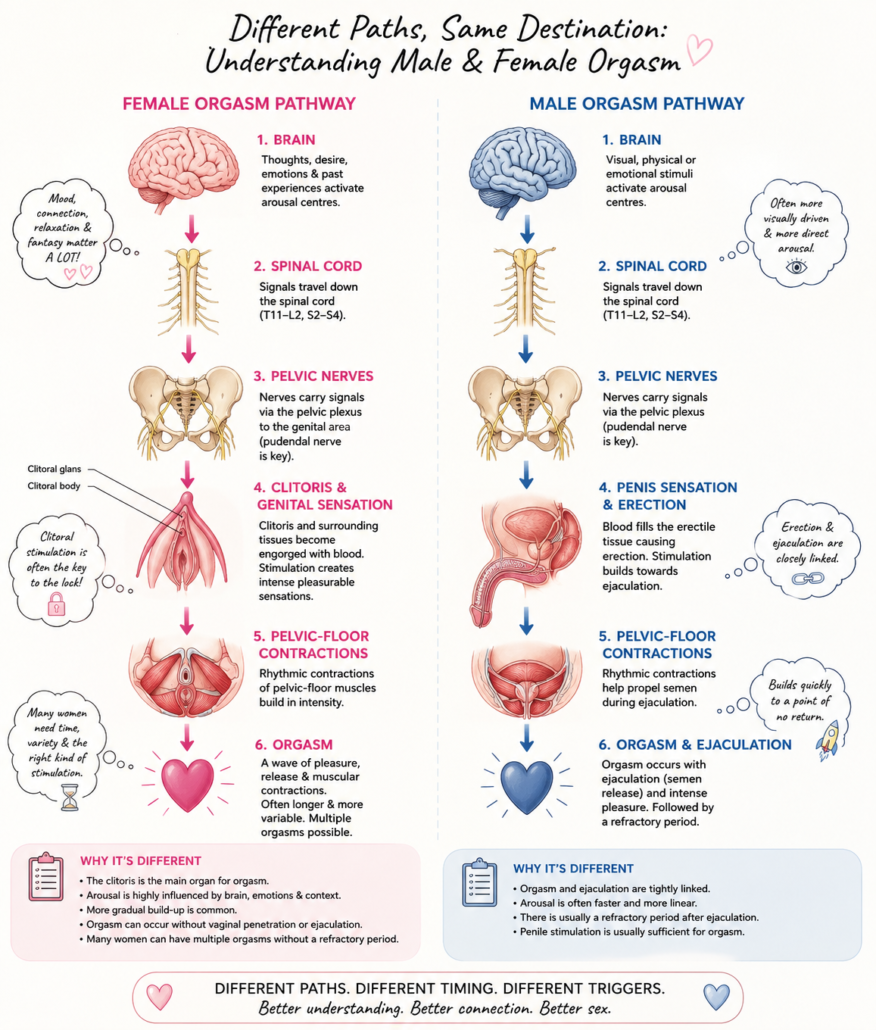
For many men, sexual arousal follows a relatively predictable path: stimulation → erection → increasing excitement → ejaculation and orgasm → recovery.
Female sexual response is often less linear. Arousal may build gradually, disappear, return, plateau for a while, suddenly accelerate or occasionally decide that tonight it has other plans.
Understanding this difference can remove a great deal of unnecessary pressure from both partners. So, guys take notes.
What exactly is a female orgasm?
An orgasm is an intense neurological and muscular response occurring at the peak of sexual arousal.
It involves coordinated activity between:
- the brain
- sensory nerves
- the spinal cord
- the clitoris and surrounding genital tissues
- the pelvic floor muscles
- the autonomic nervous system
- hormones and neurotransmitters
- emotional and psychological responses
During orgasm, there are usually rhythmic contractions of the pelvic floor muscles together with an intense sensation of pleasure and release.
Some women describe a very obvious peak. Others describe a spreading wave of pleasure, warmth, pulsation or relaxation.
There is considerable normal variation.
Gentlemen, Meet the Clitoris
If there is one piece of anatomy worth understanding, this is it.
The clitoris is the principal organ responsible for female orgasm.
And it is considerably larger than the small structure visible externally.
The visible portion, called the glans clitoris, is only the tip of a much larger erectile organ. Internally, the clitoris extends around the vaginal opening through paired structures known as the crura and vestibular bulbs.
During sexual arousal these tissues become engorged with blood.
In other words, female genital anatomy contains erectile tissue too.
The penis and clitoris actually develop from related embryological tissues.
They are relatives, although they have subsequently pursued rather different careers.
Isn’t orgasm caused by vaginal penetration?
Sometimes.
But this is one of the most persistent misunderstandings about female sexuality.
Many women do not reliably orgasm from vaginal penetration alone.
For many women, direct or indirect clitoral stimulation is the most reliable route to orgasm.
During intercourse, movement may indirectly stimulate the clitoris and its surrounding internal structures. For some women this produces orgasm easily. For others, additional clitoral stimulation is required.
Neither response is abnormal.
A woman who requires clitoral stimulation to orgasm does not have a sexual dysfunction simply because penetration alone is insufficient.
That is anatomy, not failure.
What About the “G-Spot”?
The so-called G-spot remains an area of scientific discussion.
Some women report intense sensitivity along the anterior wall of the vagina. This region lies close to the urethra, periurethral glands and internal components of the clitoral complex.
Rather than necessarily being a completely separate “orgasm button”, some researchers consider this area part of a broader interconnected clitoral-urethral-vaginal anatomical complex.
More importantly, women vary enormously in what feels pleasurable.
There is no secret anatomical combination that somebody has forgotten to tell men about.
The Brain May Be the Most Important Sexual Organ
Genital stimulation sends sensory signals through peripheral nerves to the spinal cord and brain.
But the brain does considerably more than simply receive those signals.
Sexual arousal can be influenced by:
desire + sensation + attention + emotional connection + relaxation + stimulation + context
At the same time, competing signals can interfere:
stress + anxiety + pain + distraction + relationship difficulties + fear + self-consciousness + medications
This helps explain something men sometimes find confusing.
A woman can be physically stimulated but not sufficiently aroused to orgasm.
Conversely, strong psychological arousal can greatly amplify relatively modest physical stimulation.
The nervous system is not simply an electrical cable running from the genitals to the brain. The brain is actively interpreting what is happening.
Female Arousal Often Needs Time
Male sexual response can sometimes move from “nothing much happening” to “fully operational” with impressive efficiency.
Female arousal frequently develops more gradually.
As arousal increases:
- blood flow to the genital tissues increases
- the clitoris becomes engorged
- vaginal lubrication usually increases
- genital sensitivity changes
- the pelvic floor becomes increasingly active
- heart rate and breathing increase
- mental focus on sexual stimulation may intensify
The amount of stimulation required varies enormously between women and even within the same woman on different occasions.
Age, fatigue, hormonal status, medications, stress and relationship circumstances can all influence the response.
So there is no medically correct number of minutes before a woman “should” orgasm.
Is There Such a Thing as a Normal Female Orgasm?
Yes.
Actually, there are lots of normal female orgasms.
Some are intense.
Some are subtle.
Some involve obvious pelvic contractions.
Some feel more like a prolonged wave of pleasure.
Some women orgasm quickly.
Others require prolonged stimulation.
Some can experience several orgasms relatively close together.
Others experience one and then lose interest in further stimulation.
And some women do not orgasm every time they have sex.
All of these can fall within normal sexual experience.
Frequency is not a scorecard.
Multiple Orgasms: Fact or Fiction?
They are real, but they are certainly not compulsory.
Men commonly experience a refractory period after ejaculation during which another erection or orgasm may be difficult or impossible for a period of time.
Women do not necessarily have the same physiological refractory period.
Some therefore remain highly aroused after orgasm and can experience another orgasm with continued stimulation.
Others become extremely sensitive after orgasm and want stimulation to stop immediately.
Again, both are normal.
Orgasm and Ejaculation Are Not the Same Thing
For men, ejaculation and orgasm usually occur together, which makes it tempting to think they are essentially the same event.
They are not.
Even in men they are separate physiological processes that usually happen almost simultaneously.
In women, orgasm does not require ejaculation.
Some women experience the release of fluid during intense sexual stimulation or orgasm. This may arise from periurethral glands, the bladder or a combination of sources.
It is not necessary for orgasm and its absence means absolutely nothing about the quality of the sexual experience.
Why Might a Woman Have Difficulty Reaching Orgasm?
Difficulty reaching orgasm is common.
When persistent and distressing, it may be referred to as female orgasmic disorder or anorgasmia.
Possible contributors include:
Psychological factors
Stress, anxiety, depression, previous negative sexual experiences, body-image concerns, performance anxiety and difficulty relaxing can interfere with orgasm.
Relationship factors
Poor communication, unresolved conflict, lack of emotional intimacy or simply not communicating what type of stimulation feels pleasurable can contribute.
Medications
Certain medications can substantially delay or prevent orgasm.
Antidepressants, particularly SSRIs and SNRIs, are well-known examples.
Some other psychiatric medications and medications affecting the nervous system may also contribute.
Menopause and hormonal changes
Reduced oestrogen levels can contribute to vaginal dryness, discomfort and changes in genital sensitivity.
The hormonal transition around menopause can also influence desire and arousal.
Pain
Sex should not routinely hurt.
Vaginal dryness, vulval conditions, pelvic floor muscle problems, endometriosis, infections and other pelvic disorders can make sexual activity painful.
Pain is a remarkably effective way of telling the brain:
“Perhaps orgasm is not today’s priority.”
Neurological conditions
Damage or disease affecting the brain, spinal cord or peripheral nerves may alter genital sensation and orgasm.
This can occur with conditions such as multiple sclerosis, spinal cord disease, pelvic nerve injury and some forms of neuropathy.
Pelvic surgery
Operations involving the pelvis may occasionally alter sensation, anatomy or sexual response.
An Important Lesson for Men: More Effort Isn’t Always the Answer
When something is not working, the instinctive male response can be:
Try harder.
Unfortunately, sexual physiology doesn’t always reward enthusiasm with increased horsepower.
Too much pressure, speed or intensity can actually become uncomfortable and reduce arousal.
Female orgasm often depends more on appropriate stimulation than simply more stimulation.
Communication is therefore considerably more useful than guesswork.
Don’t Turn Orgasm Into an Examination
One of the quickest ways to make orgasm more difficult is to make it compulsory.
Questions such as:
“Are you close?”
“Why aren’t you coming?”
“Did you?”
may be well intentioned, but they can suddenly transform an intimate experience into something resembling a practical driving test.
Performance anxiety activates precisely the mental processes that can interfere with sexual arousal.
Orgasm is much easier when it is allowed to happen rather than being monitored.
The Orgasm Gap
Research has repeatedly identified differences in orgasm frequency between heterosexual men and women.
This does not mean that female orgasm is inherently difficult.
Part of the difference probably reflects misunderstandings about female anatomy and the tendency to make vaginal penetration the central measure of sexual activity despite the importance of the clitoris.
Learning the anatomy, communicating and allowing sufficient arousal can make a considerable difference.
What Can Partners Do?
Perhaps the most useful principle is:
Be curious rather than assuming.
Every woman’s sexual response is different.
Partners can help by:
- allowing sufficient time for arousal
- recognising the importance of clitoral stimulation
- asking rather than guessing what feels pleasurable
- varying pressure, rhythm and stimulation according to feedback
- avoiding making orgasm the compulsory endpoint
- addressing vaginal dryness or pain
- maintaining emotional intimacy and communication
- recognising that stress and fatigue matter
- remembering that what worked perfectly last time may not necessarily be today’s preferred formula
Sexual communication may initially feel awkward.
It usually becomes considerably easier once both partners realise they are on the same team.
Does a Woman Need to Orgasm for Sex to Be Successful?
No.
Orgasm can be an important and pleasurable part of sexual intimacy, but it does not need to occur during every sexual encounter.
Pleasure, intimacy, affection and connection can all exist without orgasm.
The difficulty arises when a woman wants to orgasm but persistently cannot, particularly if this is causing distress to her or affecting the relationship.
That deserves assessment rather than embarrassment.
When Should Medical Advice Be Considered?
A woman should consider discussing the issue with her GP, gynaecologist, sexual-health clinician or appropriately trained specialist if there is:
- a persistent inability to orgasm that causes distress
- a significant change from her previous sexual function
- reduced genital sensation
- pain during sexual activity
- vaginal dryness or menopausal symptoms
- neurological symptoms
- difficulty following pelvic surgery
- concern that medication is affecting sexual function
Treatment depends on the cause.
It may involve education, medication review, treatment of vaginal dryness or hormonal problems, pelvic floor physiotherapy, psychological or psychosexual therapy, treatment of underlying medical conditions and, importantly, helping a woman and her partner understand her individual sexual response.
A Final Message for Men
The female orgasm isn’t a complicated version of the male orgasm.
It is its own physiological process.
The clitoris matters enormously. The brain matters enormously. Time, comfort, communication and psychological context matter too.
Perhaps the most important lesson is that there is no universal technique and no required timetable.
Female sexuality varies between women and within the same woman throughout her life.
Understanding that difference can take considerable pressure off both partners.
And if you are wondering whether listening, communication and understanding anatomy really matter more than trying to perform some secret advanced manoeuvre…
Yes. They do.
Sometimes good sex begins not with knowing exactly what to do, but with being comfortable enough to ask.


Leave a Reply
Want to join the discussion?Feel free to contribute!