
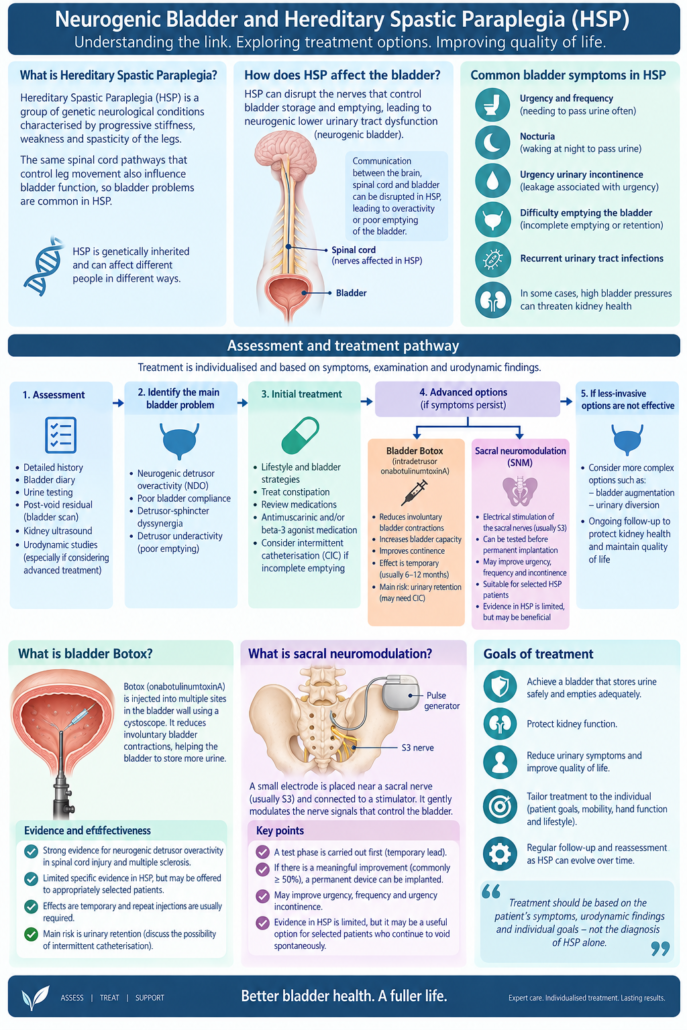
Neurogenic Bladder in Hereditary Spastic Paraplegia: Treatment, Botox and Sacral Neuromodulation
Hereditary Spastic Paraplegia (HSP) is best known for causing progressive stiffness, weakness and spasticity of the legs. However, the neurological pathways controlling the bladder travel through the same spinal cord neighbourhood, and bladder dysfunction can therefore become an important and sometimes underestimated part of HSP.
Studies of patients with HSP have reported lower urinary tract symptoms in a substantial proportion of patients, particularly urgency, urinary frequency, nocturia and urgency urinary incontinence. Difficulty emptying the bladder can also occur. Urodynamic studies frequently demonstrate neurogenic detrusor overactivity, sometimes accompanied by detrusor-sphincter dyssynergia.
The modern term for this problem is neurogenic lower urinary tract dysfunction (NLUTD) rather than simply “neurogenic bladder”, because the neurological condition may affect the bladder, bladder outlet and urinary sphincter in different ways.
For patients with HSP, treatment therefore needs to be individualised. The aim is not merely to reduce trips to the toilet. We want to achieve a bladder that stores urine safely, empties adequately, protects the kidneys and interferes as little as possible with everyday life.
How does HSP affect the bladder?
Normal bladder control requires remarkably complicated communication between the brain, spinal cord, bladder and urinary sphincter.
During filling, the bladder should remain relaxed while the urinary sphincter remains closed. When it is appropriate to urinate, the brain permits the bladder to contract while the sphincter relaxes.
HSP can disrupt these pathways.
The commonest urodynamic abnormality reported in HSP is detrusor overactivity, where involuntary bladder contractions occur during filling.
Patients may consequently experience:
- urinary urgency and frequency;
- waking repeatedly at night to urinate;
- urgency urinary incontinence;
- difficulty postponing urination;
- hesitancy or a poor urinary stream;
- incomplete bladder emptying;
- recurrent urinary tract infections; and
- occasionally significant urinary retention.
Importantly, symptoms do not always tell us exactly what the bladder is doing. Two patients saying, “I can’t hold on,” may have quite different underlying bladder physiology.
That is where urodynamic assessment can become particularly useful.
Investigating bladder dysfunction in HSP
Assessment should be tailored to the severity of symptoms and the patient’s neurological and urological risk.
It may include a detailed history, bladder diary, urinalysis, measurement of post-void residual urine, renal function assessment and ultrasound of the kidneys and bladder.
Urodynamic studies are particularly valuable when symptoms are significant, treatment has failed, bladder emptying is abnormal or invasive treatment such as Botox is being considered.
Urodynamics can identify:
Neurogenic detrusor overactivity (NDO)
The bladder contracts involuntarily while filling.
Poor bladder compliance
Bladder pressure increases excessively as the bladder fills. This is particularly important because sustained high storage pressures can potentially threaten the upper urinary tract.
Detrusor-sphincter dyssynergia (DSD)
Instead of relaxing during urination, the urinary sphincter contracts against the bladder.
Detrusor underactivity
The bladder contracts inadequately and therefore does not empty properly.
The EAU and AUA/SUFU guidelines emphasise risk-based evaluation and ongoing surveillance of patients with neurogenic lower urinary tract dysfunction rather than treating symptoms in isolation.
First-line treatment
Treatment depends upon whether the main problem is storage, emptying or a combination of both.
Lifestyle and bladder strategies
Some patients benefit from relatively simple measures such as:
- adjusting fluid intake;
- reducing excessive caffeine;
- timed voiding;
- managing constipation;
- bladder retraining where appropriate;
- pelvic-floor physiotherapy in selected patients; and
- reviewing medications that may worsen bladder function.
Mobility is an important consideration in HSP. A bladder that gives somebody 20 seconds’ warning may be considerably more disabling when that person also has difficulty walking quickly to a toilet.
Treatment goals therefore need to reflect the patient’s mobility, hand function, independence and quality of life, something specifically emphasised by neuro-urology guidelines.
Medication
For predominantly overactive bladder symptoms, treatment commonly begins with an antimuscarinic medication and/or a beta-3 adrenergic agonist.
Antimuscarinic drugs can reduce involuntary bladder contractions but may cause dry mouth, constipation, blurred vision and cognitive adverse effects in susceptible patients.
Beta-3 agonists may provide an alternative or can sometimes be combined with an antimuscarinic.
Post-void residual urine should be considered, particularly when there is already evidence of impaired bladder emptying.
Intermittent catheterisation
When significant urinary retention or incomplete bladder emptying occurs, clean intermittent catheterisation (CIC) may be required.
This can sound intimidating when first discussed, but many patients become remarkably comfortable with the technique.
HSP creates an additional consideration: progressive lower-limb disability, hand function and mobility need to be considered when deciding whether intermittent catheterisation will remain practical.
Where possible, intermittent catheterisation is generally preferable to long-term indwelling catheterisation for bladder emptying in neuro-urological patients.
Botox injections into the bladder
For patients with persistent neurogenic detrusor overactivity despite medication, Botulinum toxin A (Botox) injected into the detrusor muscle can be extremely useful.
Botox temporarily reduces excessive acetylcholine-mediated contraction of the bladder muscle.
The result is essentially a bladder that becomes a little less excitable.
How is bladder Botox performed?
Using a cystoscope, multiple small injections of Botulinum toxin A are placed into the bladder wall.
It is usually performed as a short day procedure under local anaesthetic, sedation or general anaesthesia depending upon the patient and clinical circumstances.
The treatment is temporary and therefore generally needs to be repeated when its effect wears off.
How effective is Botox?
There is strong evidence for intradetrusor onabotulinumtoxinA in neurogenic detrusor overactivity associated with spinal cord injury and multiple sclerosis.
Randomised studies in these populations show:
- fewer episodes of urinary incontinence;
- increased bladder capacity;
- reduced detrusor pressures;
- improved urodynamic storage parameters; and
- improved quality of life.
The AUA/SUFU guideline gives this treatment a Grade A evidence recommendation in MS and spinal cord injury when oral treatment has failed.
The EAU likewise recommends detrusor Botulinum toxin A injections for neurogenic detrusor overactivity when antimuscarinic therapy is ineffective.
But what about HSP specifically?
This distinction is important.
HSP-specific clinical trials of intradetrusor Botox are very limited.
HSP therefore cannot simply inherit the strength of evidence available for MS and spinal cord injury. The AUA/SUFU guideline places Botox treatment for neurogenic disorders other than MS or spinal cord injury in a lower evidence category, although it states that treatment may be offered to appropriately selected patients whose symptoms have not responded adequately to oral medication.
In clinical practice, this makes the urodynamic diagnosis particularly important.
If an HSP patient has convincing neurogenic detrusor overactivity producing significant urgency, incontinence or unsafe bladder storage pressures despite conservative and medical treatment, intradetrusor Botox is a logical treatment option.
The evidence is therefore strongest for treating the urodynamic abnormality, rather than Botox having been proven specifically for the genetic diagnosis of HSP.
What are the disadvantages of Botox?
The most important adverse effect is incomplete bladder emptying or urinary retention.
A patient who previously urinated normally may need intermittent catheterisation after treatment.
The AUA/SUFU guideline therefore specifically recommends discussing the possibility of urinary retention and intermittent catheterisation before Botox is administered to a spontaneously voiding patient.
Other possible complications include urinary tract infection, haematuria, discomfort during urination and the need for repeated treatment.
This discussion is particularly important in HSP patients whose mobility or hand function might make self-catheterisation difficult.
Sacral neuromodulation
Another intriguing option is sacral neuromodulation (SNM).
Rather than temporarily weakening the bladder muscle, SNM attempts to modulate the neurological circuitry controlling bladder storage and emptying.
A small electrode is positioned close to a sacral nerve, usually the S3 nerve root, and connected to an electrical stimulator.
Think of it less as “shocking the bladder” and more as adjusting the electrical conversation between the bladder, spinal cord and brain.
A major advantage: it can be tested first
SNM generally begins with a trial or test phase.
A temporary or tined lead is placed near the sacral nerve and connected to an external stimulator.
Symptoms are then assessed.
A clinically meaningful improvement, commonly around 50% or greater, is generally required before proceeding to implantation of the permanent pulse generator.
That provides an important advantage: the patient effectively auditions the treatment before committing to the permanent implant.
Does sacral neuromodulation work in neurogenic bladder?
The evidence is promising but considerably less robust than the Botox evidence for MS and spinal cord injury.
The AUA/SUFU guideline states that SNM may be offered to selected patients with neurogenic lower urinary tract dysfunction who have urinary urgency, frequency and/or urgency incontinence, but rates the evidence as Grade C.
Studies involving mixed neurological populations have demonstrated improvements in:
- urgency;
- urinary frequency;
- urgency incontinence;
- voided volume;
- bladder capacity; and
- quality of life.
However, these studies include heterogeneous neurological diseases, making it difficult to predict outcomes for one particular condition.
The AUA/SUFU guideline specifically advises against SNM in neurogenic bladder caused by spinal cord injury or spina bifida, but HSP is not listed as an absolute contraindication.
What about sacral neuromodulation specifically for HSP?
Here we need to be particularly careful about claims of efficacy.
There is currently very limited direct evidence specifically studying SNM in patients with Hereditary Spastic Paraplegia.
Most of the evidence supporting SNM in neurological disease comes from mixed cohorts containing conditions such as multiple sclerosis, Parkinson’s disease, stroke, incomplete spinal cord disorders and other neurological conditions.
Consequently, it would be inappropriate to tell an HSP patient that sacral neuromodulation has a proven success rate specifically for HSP.
Instead, I would regard SNM as a potential treatment for carefully selected HSP patients, particularly those who:
- continue to void spontaneously;
- have troublesome urgency, frequency or urgency incontinence;
- have failed conservative and pharmacological treatment;
- do not have dangerous high-pressure bladder physiology requiring a different strategy; and
- demonstrate a convincing response during the SNM test phase.
The test phase becomes particularly valuable when the evidence base for the underlying neurological disorder is limited.
Botox or sacral neuromodulation: which is better in HSP?
There is currently no good HSP-specific head-to-head trial demonstrating that one is superior to the other.
The choice should therefore be driven by the patient’s bladder physiology.
Botox may be particularly attractive when:
there is proven neurogenic detrusor overactivity, bladder pressures need to be reduced, medication has failed and the patient accepts the possibility of intermittent catheterisation and repeated injections.
Sacral neuromodulation may be attractive when:
urgency, frequency and urgency incontinence predominate, the patient continues to empty reasonably well, conservative and pharmacological therapy have failed, and there is no contraindication to implantation.
SNM also offers the considerable advantage of a test phase before permanent implantation.
The two therapies should therefore not necessarily be regarded as competitors. They act differently and may suit different neuro-urological phenotypes.
Why urodynamics matter before choosing treatment
For HSP, I believe one of the most useful questions is not simply:
“Does the patient have a neurogenic bladder?”
It is:
“What type of neurogenic bladder dysfunction does this particular patient have?”
An HSP patient with severe detrusor overactivity and high storage pressures is fundamentally different from an HSP patient with urgency but satisfactory storage pressures, and different again from somebody with detrusor underactivity and a large residual urine volume.
The treatment should follow the physiology.
This is particularly relevant because HSP studies confirm that detrusor overactivity is common, but voiding dysfunction and other urodynamic abnormalities also occur.
What happens when less-invasive treatments fail?
A small proportion of patients develop severe neurogenic lower urinary tract dysfunction that cannot be adequately controlled with medication, catheterisation, Botox or neuromodulation.
More invasive options can include bladder augmentation or urinary diversion, depending upon bladder pressures, continence, renal risk, mobility and the patient’s ability to catheterise.
Fortunately, these procedures are required far less commonly than the conservative, pharmacological and minimally invasive treatments discussed above.
Follow-up is important
HSP is a neurological condition that can evolve over time. Bladder function can evolve with it.
A treatment that worked well several years ago may therefore need reassessment if symptoms change.
Patients should seek review if they develop:
- worsening urinary incontinence;
- increasing difficulty emptying;
- recurrent urinary infections;
- new urinary retention;
- haematuria;
- flank pain; or
- a significant change in their usual bladder pattern.
Depending upon risk, follow-up may include post-void residual measurement, renal function, renal tract imaging and repeat urodynamics.
Current EAU guidance emphasises ongoing surveillance and reassessment in neuro-urological patients, with the intensity of follow-up determined by individual risk. The 2026 EAU Neuro-Urology Guidelines have also updated recommendations regarding diagnosis, treatment, Botulinum toxin A and follow-up.
The bottom line
Bladder dysfunction is a genuine and sometimes overlooked component of Hereditary Spastic Paraplegia.
The commonest problem is neurogenic detrusor overactivity, producing urgency, frequency, nocturia and urgency incontinence, although impaired emptying and detrusor-sphincter dysfunction can also occur.
Treatment usually progresses from conservative measures and medication to intermittent catheterisation where necessary, followed by more advanced therapies in appropriately selected patients.
Intradetrusor Botox is an effective established treatment for neurogenic detrusor overactivity, although the highest-quality evidence comes from MS and spinal cord injury rather than HSP itself. Its principal trade-off is the possibility of urinary retention and the need for intermittent catheterisation.
Sacral neuromodulation is another potential option for selected HSP patients, especially those with refractory urgency, frequency and urgency incontinence who continue to void spontaneously. However, the evidence specifically for HSP remains limited, so the temporary test phase is particularly useful in determining whether an individual patient is likely to benefit.
Most importantly, treatment should be based on the patient’s symptoms, urodynamic findings, bladder-emptying ability, mobility and individual goals rather than the diagnosis of HSP alone.
References and further reading
- Fourtassi M, Jacquin-Courtois S, Scheiber-Nogueira MC, et al. Bladder dysfunction in hereditary spastic paraplegia: a clinical and urodynamic evaluation. Spinal Cord. 2012;50:558–562.
- Braschinsky M, Zopp I, Kals M, Haldre S, Gross-Paju K. Bladder dysfunction in hereditary spastic paraplegia: what to expect? J Neurol Neurosurg Psychiatry. 2010;81:263–266.
- Ginsberg DA, Boone TB, Cameron AP, et al. The AUA/SUFU Guideline on Adult Neurogenic Lower Urinary Tract Dysfunction: Treatment and Follow-up. J Urol. 2021;206:1106–1113.
- Ginsberg DA, Boone TB, Cameron AP, et al. The AUA/SUFU Guideline on Adult Neurogenic Lower Urinary Tract Dysfunction: Diagnosis and Evaluation. J Urol. 2021.
- European Association of Urology. EAU Guidelines on Neuro-Urology, 2026.
- European Association of Urology. Neuro-Urology: Botulinum toxin A injections. The guideline recommends detrusor Botulinum toxin A for neurogenic detrusor overactivity when antimuscarinic therapy is ineffective.
Important note
This information is intended for general patient education and does not replace individual medical assessment. Hereditary Spastic Paraplegia encompasses multiple genetic and clinical phenotypes, and bladder treatment should be individualised following appropriate neurological and urological assessment.


Leave a Reply
Want to join the discussion?Feel free to contribute!