
Does Size Matter?
The long and the short of it
Penile size is one of those subjects that generates enormous interest, considerable anxiety and, unfortunately, a remarkable amount of questionable information on the internet.
Men may quietly compare themselves with partners, friends’ exaggerated stories, pornography, locker-room mythology or, apparently, the occasional cucumber.
So, does penile size actually matter?
The short answer is: sometimes, but usually much less than men think.
From a urological perspective, most men who are concerned about penile size have a penis that falls within the normal range. Sexual satisfaction is influenced by many factors, including erection quality, communication, attraction, confidence, technique and intimacy. A measuring tape tells us surprisingly little about most of these.
What Is a “Normal” Penis Size?
There is a wide range of normal penile sizes.
Large systematic studies in which measurements were performed by healthcare professionals suggest that the average adult penis is approximately:
- Flaccid length: about 9 cm
- Erect length: about 13–14 cm
- Erect circumference: about 11–12 cm
There is considerable natural variation around these averages.
Importantly, flaccid size is a poor predictor of erect size.
This has given rise to the decidedly non-medical but useful distinction between the “grower” and the “shower.” Some penises change dramatically between the flaccid and erect states, while others start larger but change proportionately less.
Both are normal.
Length Versus Girth: Which Matters More?
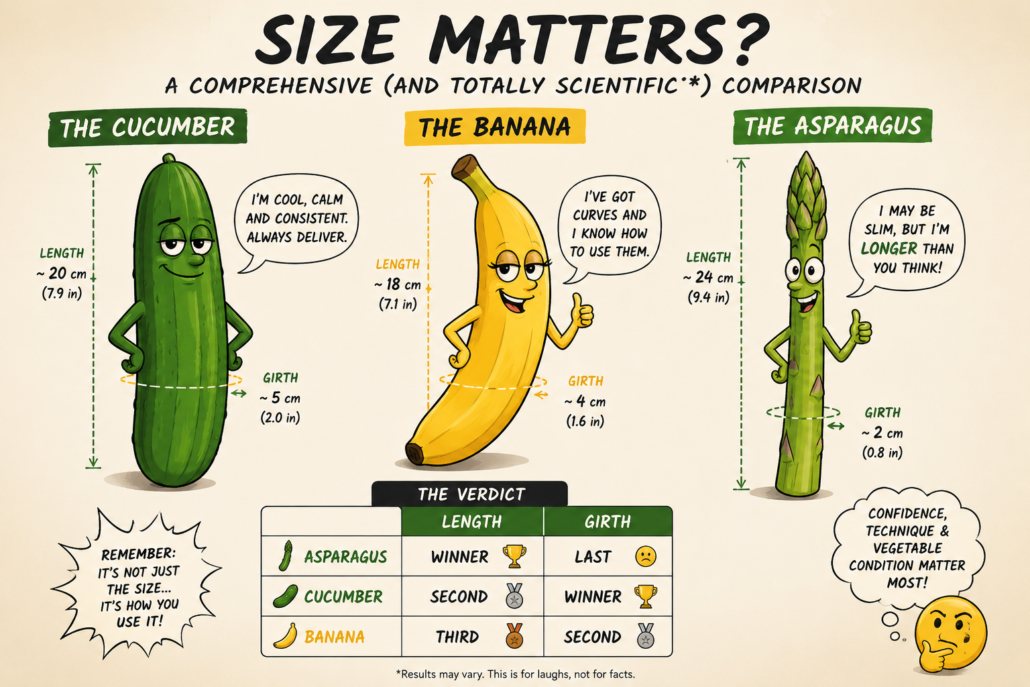
This is where the cucumber, banana and asparagus comparison becomes surprisingly educational.
A cucumber may win the girth competition.
An asparagus spear may have impressive length.
The banana brings curvature and enthusiasm to the proceedings.
But none of them is an appropriate benchmark for human anatomy.
When researchers ask about sexual satisfaction, penile dimensions are generally far less important than men often assume. For many partners, girth may have somewhat more influence on sensation than additional length, but there is no universally “ideal” penis.
The vagina is also a highly adaptable organ, and sexual pleasure depends on considerably more than penetration.
Bigger is therefore not automatically better.
At some point, additional size can actually become uncomfortable.
Why Do So Many Men Think They Are Too Small?
Perception plays an enormous role.
A man looking down at his own penis views it from an angle that tends to make it appear shorter. Looking at someone else from the front produces a completely different perspective.
Then there is pornography.
Pornography is not a random anatomical survey of the male population. Performers may be selected partly because of unusual anatomy, and camera angles, grooming and perspective can further exaggerate apparent dimensions.
Using pornography to determine whether your penis is normal is rather like watching the Olympics to decide whether you’re reasonably fit.
How Should Penile Length Be Measured?
If measurement is medically relevant, it needs to be performed consistently.
The most useful clinical measurement is usually stretched penile length.
The penis is gently stretched and measured along its upper surface from the pubic bone to the tip of the glans. The ruler is pressed through the fat overlying the pubic bone.
This last point matters.
The disappearing penis
Weight gain, particularly around the lower abdomen and pubic region, can make a normal penis appear significantly shorter because part of the shaft becomes hidden within the surrounding tissue.
The penis has not necessarily become smaller. More of it has simply gone undercover.
Weight reduction can therefore increase the visible penile length without changing the anatomical length of the penis itself.
Can a Penis Actually Become Shorter?
Yes.
Changes in apparent or actual penile length can occur with:
- increasing body weight
- ageing
- erectile dysfunction
- Peyronie’s disease
- penile fibrosis or scarring
- pelvic or penile surgery
- radical prostatectomy
- hormonal abnormalities in selected circumstances
- a buried penis
Peyronie’s disease deserves particular mention. Scar tissue within the penis can produce curvature, narrowing, indentation and loss of length, sometimes accompanied by painful erections.
A noticeable change in penile shape or length should therefore be assessed rather than simply attributed to ageing.
What Is a Micropenis?
A true micropenis is uncommon.
It is a medical diagnosis based on stretched penile length being significantly below the expected range for age and population, generally more than 2.5 standard deviations below the mean.
This is very different from simply having a penis that is below average.
Remember, approximately half of all men must mathematically be below the average. Statistics can be cruel that way.
If there is genuine concern about unusually small penile size, assessment by a urologist can establish whether the anatomy is within the normal range and whether further investigation is appropriate.
Does Size Affect Sexual Satisfaction?
Usually far less than expected.
Good sexual function depends on a complicated mixture of:
Erection quality + sensation + arousal + communication + technique + confidence + relationship factors.
Penile length is only one variable in a much larger equation.
For penetrative intercourse, an erection that is sufficiently firm and sustainable is generally considerably more important than gaining another centimetre of length.
This is why a man concerned about “size” sometimes actually has an erection-quality problem. A partially rigid penis may appear shorter and narrower than during a full erection.
Treating erectile dysfunction can consequently improve both function and perceived size.
When Should You See a Urologist?
Consider seeking medical advice if you have:
- a significant or progressive reduction in penile length
- new penile curvature
- painful erections
- penile narrowing or an hourglass deformity
- difficulty obtaining or maintaining erections
- a buried or concealed penis
- concerns about a genuinely very small penis
- problems following prostate or pelvic surgery
- persistent anxiety about penile size
- an interest in penile enlargement procedures
A clinical assessment can distinguish normal anatomical variation from a condition that may benefit from treatment.
The Cucumber, Banana and Asparagus Test 🥒🍌🌱
Vegetables make excellent salads.
They make terrible anatomical reference standards.
Penises vary naturally in length, circumference, curvature, proportion and appearance. There is no single ideal shape.
The largest cucumber does not automatically make the best salad, and the largest penis does not automatically produce the best sexual experience.
Sexual satisfaction is much more complicated, and fortunately much more interesting, than a ruler measurement.
The Bottom Line
For the overwhelming majority of men, penile size matters considerably less than they fear.
A healthy penis that provides comfortable erections, sensation and satisfactory sexual function is far more important than whether it wins a theoretical locker-room measuring competition.
If you’re worried about penile size, erection quality, curvature or a change in penile appearance, a urological assessment can provide an objective measurement and determine whether there is actually a medical problem.
And perhaps the most important measuring advice of all:
Measure against medical standards, not pornography, internet advertising or the vegetable aisle.


Leave a Reply
Want to join the discussion?Feel free to contribute!