
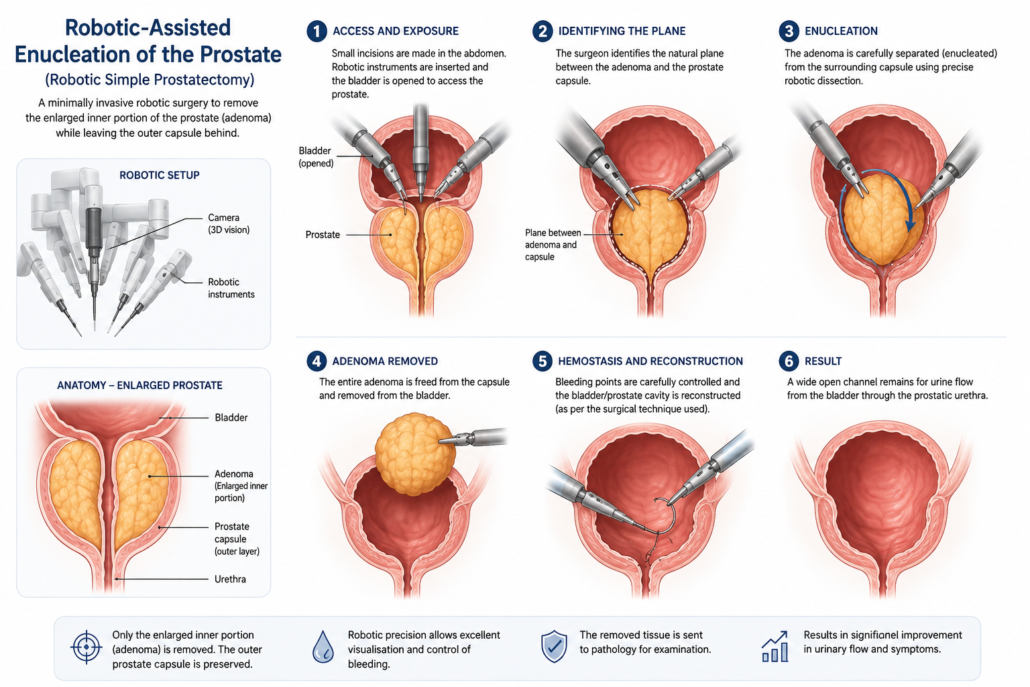
Robotic-Assisted Enucleation of the Large Benign Prostate
A modern surgical option for very large benign prostate enlargement
Benign prostatic hyperplasia (BPH), or benign prostate enlargement, becomes increasingly common as men age. For many men, symptoms can initially be controlled with medication or minimally invasive treatments. However, when the prostate becomes very large, simply creating a small channel through the prostate may not provide the durable result required.
Robotic-assisted simple prostatectomy (RASP), sometimes described as robotic-assisted adenoma enucleation, is designed to remove the bulk of the obstructing benign prostate tissue while leaving the outer prostate capsule behind.
Importantly, this is not the same operation as a robotic radical prostatectomy for prostate cancer. In a radical prostatectomy, the entire prostate and seminal vesicles are removed. In robotic simple prostatectomy, only the enlarged central adenoma responsible for urinary obstruction is removed.
Current guidelines recognise robotic-assisted simple prostatectomy as an established surgical option for men with large to very large prostates.
Why does a large prostate cause problems?
The prostate surrounds the urethra immediately below the bladder.
As benign prostate tissue enlarges, it can compress and distort the urethra. The bladder then has to work increasingly hard to push urine through this narrowed channel.
Symptoms may include:
- Weak urinary stream
- Hesitancy or difficulty starting urination
- Straining
- Intermittent urinary flow
- A feeling that the bladder has not emptied properly
- Frequent urination
- Urgency
- Getting up repeatedly at night to urinate
- Acute or chronic urinary retention
- Recurrent urinary infections
- Bladder stones
- Blood in the urine
- Progressive deterioration of bladder function
- In severe cases, obstruction affecting the kidneys
Surgery is particularly appropriate when significant symptoms persist despite conservative or medical therapy, or when BPH produces complications such as recurrent urinary retention, infection, bladder stones, recurrent bleeding or renal impairment.
When is robotic prostate enucleation considered?
Robotic-assisted enucleation is particularly attractive when the prostate is large or very large.
There is no magical prostate volume at which the robot suddenly becomes necessary. Treatment needs to be individualised according to prostate anatomy, symptoms, bladder function, other medical conditions and the surgeon’s expertise.
In practice, robotic simple prostatectomy is most commonly considered for prostates approximately 80–100 mL or larger, and can be particularly useful for extremely large glands well beyond 150–200 mL.
The EAU describes simple prostatectomy as a treatment primarily for substantially enlarged prostates, traditionally above approximately 80–100 mL.
Typical indications include:
- Severe lower urinary tract symptoms caused by a very large prostate
- Recurrent urinary retention
- Dependence on an indwelling or intermittent urinary catheter
- Failure or intolerance of BPH medications
- Recurrent bladder infections associated with obstruction
- Recurrent bleeding from a large vascular prostate
- Bladder stones associated with prostate obstruction
- Very high residual urine volumes
- Progressive bladder dysfunction caused by obstruction
- Upper urinary tract or renal consequences from longstanding obstruction
- A very large median lobe protruding into the bladder
- A very large prostate where conventional TURP would be impractical or require extensive resection
Robotic surgery can also be useful when another bladder procedure, such as removal of large bladder stones or repair of a bladder diverticulum, needs to be performed at the same operation.
How is the operation performed?
The procedure is usually performed under a general anaesthetic using a robotic surgical platform.
Several small incisions are made in the abdomen. Robotic instruments and a high-definition three-dimensional camera are introduced through these ports.
The surgeon remains completely in control of the operation. The robot does not perform the surgery independently. Rather, it translates the surgeon’s hand movements into extremely precise movements of miniature instruments inside the body.
There are several variations of robotic simple prostatectomy, including transvesical, transcapsular, extraperitoneal and newer single-port approaches.
Finding the natural plane
The principle of the operation is beautifully simple.
The enlarged prostate consists of an inner adenoma surrounded by the compressed outer prostate or surgical capsule.
The surgeon identifies the natural anatomical plane between these layers and carefully separates the adenoma from the capsule.
Think of removing the flesh of an orange while deliberately leaving the peel behind. 🍊
The obstructing prostate adenoma is progressively freed from its surrounding capsule and removed.
Bleeding points can be precisely controlled using robotic suturing and cautery. The remaining prostate cavity and bladder are then reconstructed according to the surgical technique being used.
The removed prostate tissue is sent to pathology for examination.
What happens to the prostate afterwards?
The prostate is not completely removed.
The peripheral prostate and capsule remain in the body.
This is important because:
- PSA does not normally fall to zero after the operation.
- The remaining prostate tissue can still develop prostate cancer in the future.
- Appropriate PSA surveillance and prostate cancer screening should therefore continue.
Occasionally, previously unsuspected prostate cancer may also be identified when the removed adenoma is examined by the pathologist.
What happens to urinary flow?
Removing the obstructing adenoma creates a very large channel between the bladder and the remaining prostatic urethra.
Most appropriately selected patients experience substantial improvements in:
- Urinary flow
- Bladder emptying
- Residual urine
- Urinary symptoms
- Quality of life
Studies of laparoscopic and robotic simple prostatectomy demonstrate substantial improvements in urinary symptom scores and maximum urinary flow rates.
For a man who has spent years waiting for his bladder to negotiate with a very large prostate, the improvement in flow can be rather dramatic.
The urinary catheter
A urinary catheter is placed during the operation.
This allows urine to drain freely while the bladder and prostate cavity heal. Depending upon the operation and surgeon’s technique, continuous bladder irrigation may initially be used to prevent blood clots accumulating within the bladder.
How long does the catheter stay in?
Catheter duration varies considerably between surgical techniques and centres.
Following conventional robotic simple prostatectomy, a catheter commonly remains for approximately 5–10 days, although some contemporary techniques permit earlier removal.
Recent comparative studies report catheter durations around 5–11 days following RASP, although protocols vary substantially between surgeons and institutions.
Laser enucleation procedures such as HoLEP generally permit earlier catheter removal. A 2026 meta-analysis comparing robotic simple prostatectomy with laser enucleation found that catheterisation was approximately 3.5 days shorter after laser enucleation.
In some patients a cystogram may be performed before catheter removal, particularly when extensive bladder reconstruction has been performed.
What can I expect after catheter removal?
The first few days can be a little lively.
Patients may experience:
- Urinary frequency
- Urgency
- Mild burning
- Blood in the urine
- Passing occasional small clots
- Temporary leakage
- A sudden improvement in urinary flow
Urinary frequency and urgency can take longer to settle if the bladder has been struggling against obstruction for many years.
Removing the obstruction fixes the prostate problem, but an ageing or overactive bladder does not necessarily receive the memo immediately.
Advantages of robotic-assisted enucleation
For appropriately selected men with very large prostates, potential advantages include:
Removal of a very large amount of obstructing tissue
Rather than simply widening the channel, the procedure anatomically removes most of the transition-zone adenoma.
Suitable for extremely large prostates
The technique is relatively independent of prostate size and can be particularly useful when the prostate is enormous.
Excellent visualisation
The robotic system provides magnified three-dimensional vision and excellent access to the bladder and prostate.
Precise control of bleeding
Robotic suturing allows individual bleeding vessels to be identified and controlled.
Lower morbidity than traditional open simple prostatectomy
Compared with open surgery, robotic simple prostatectomy generally produces less blood loss, lower transfusion rates and shorter hospitalisation, although robotic operations can take longer.
Simultaneous bladder surgery
Large bladder stones, selected bladder diverticula and other pathology can potentially be managed during the same operation.
Durable removal of obstruction
Because most of the obstructing adenoma is removed, substantial recurrent obstruction from regrowth is uncommon.
Possible complications
As with any major surgical procedure, complications can occur.
Bleeding
Some bleeding is expected because the prostate has a rich blood supply.
Blood transfusion is uncommon with modern robotic techniques but remains possible, particularly with exceptionally large glands, anticoagulant therapy or significant postoperative bleeding.
Rarely, significant bleeding may require return to theatre.
Urinary infection
A urinary infection can occur following surgery or while the catheter is present.
Symptoms can include fever, burning, cloudy urine or feeling systemically unwell.
Blood clots and catheter blockage
Bleeding can produce clots within the bladder.
Continuous bladder irrigation may therefore be used during the early postoperative period. Occasionally a catheter may require irrigation or replacement, and rarely clot evacuation under anaesthesia is necessary.
Temporary urinary incontinence
Some men experience temporary urinary leakage following catheter removal.
This generally improves as the external urinary sphincter adapts to the newly unobstructed urinary channel.
Pelvic floor exercises may assist recovery.
Persistent severe stress urinary incontinence is uncommon but remains a recognised complication.
Urinary urgency
Urgency, frequency and urge incontinence may temporarily become more noticeable after surgery.
Men who had longstanding bladder obstruction may have developed detrusor overactivity or impaired bladder function. Consequently, bladder symptoms may take weeks or months to settle and occasionally require additional treatment.
Bladder neck contracture
Scar tissue can occasionally develop around the bladder outlet.
If significant, this may require an endoscopic procedure to reopen the channel.
Urethral stricture
Scar tissue can develop within the urethra following instrumentation or catheterisation.
This is uncommon but may require dilatation, urethrotomy or, rarely, reconstructive surgery.
Injury to surrounding structures
Rare complications include injury to the:
- Bladder
- Ureteric openings
- Ureter
- Rectum
- Bowel
- Blood vessels
Major complications requiring additional surgery are uncommon but possible.
General surgical complications
These include:
- Deep vein thrombosis
- Pulmonary embolism
- Chest infection
- Cardiovascular complications
- Anaesthetic complications
- Port-site hernia
- Wound infection
Appropriate preventative measures are used according to individual patient risk.
What happens to ejaculation?
This deserves particular emphasis.
Retrograde or absent ejaculation is very common.
During normal ejaculation, the bladder neck closes and semen travels forward through the urethra.
After removal of a large prostate adenoma, this mechanism is altered. Semen may pass backwards into the bladder or there may be very little visible ejaculate.
The sensation of orgasm usually remains, but ejaculation is frequently dry or markedly reduced.
This can significantly affect fertility and should be discussed before surgery in men who may wish to father children.
What about erections?
Robotic simple prostatectomy is different from radical prostatectomy for prostate cancer.
The prostate capsule and surrounding neurovascular structures are generally preserved.
Consequently, erectile dysfunction is not an inevitable consequence of robotic simple prostatectomy.
Temporary deterioration can occur following any major pelvic operation, particularly in older men with pre-existing vascular or erectile problems, but many men maintain their preoperative erectile function.
Will the prostate grow back?
One of the major advantages of anatomical enucleation is its durability.
The majority of the obstructing adenoma is physically removed rather than simply compressed or partially vaporised.
Some benign prostate tissue remains and can slowly enlarge over many years, so recurrent obstruction is possible, but clinically significant regrowth requiring repeat surgery appears uncommon.
Long-term RASP-specific retreatment data are less mature than data for older procedures because robotic simple prostatectomy is a newer technique. Studies nevertheless show durable functional improvement, and contemporary comparisons demonstrate similar symptom and flow improvements between RASP and anatomical endoscopic enucleation.
For perspective, long-term data for traditional open simple prostatectomy, which uses the same fundamental principle of adenoma enucleation, show endourological reintervention rates of approximately 3% at one year, 6% at five years and 8.8% at eight years. These figures should not be presented as RASP-specific recurrence rates, but they demonstrate the durability of complete adenoma enucleation.
Robotic enucleation versus HoLEP
Both procedures are excellent options for large prostates.
HoLEP removes the adenoma through the urethra using a holmium laser and subsequently morcellates the tissue within the bladder.
Robotic simple prostatectomy approaches the prostate through the abdomen and bladder or prostate capsule.
Recent evidence suggests that both produce substantial and broadly comparable improvements in urinary symptoms, urinary flow and bladder emptying.
HoLEP generally has the advantages of:
- No abdominal incisions
- Shorter catheterisation
- Shorter hospitalisation in many series
- Very low blood loss
- Excellent durability
Robotic surgery may be particularly attractive when:
- The prostate is exceptionally large
- There are very large bladder stones
- Concomitant bladder reconstruction is required
- Prostate anatomy makes a robotic approach advantageous
- The surgeon has extensive robotic experience
- Endoscopic enucleation expertise is not available
The best procedure is therefore not determined by prostate volume alone.
Robotic enucleation versus TURP
TURP remains an excellent operation for appropriately sized prostates, but attempting to resect an enormous prostate piece by piece can become a lengthy undertaking.
Robotic enucleation removes the adenoma anatomically and is therefore particularly suited to large-volume disease.
For very large prostates, current guidelines support simple prostatectomy and anatomical endoscopic enucleation rather than assuming conventional TURP is the optimal treatment.
Recovery after robotic prostate enucleation
Hospital stay varies according to the technique, prostate size and individual recovery.
After discharge, patients are generally encouraged to walk regularly but avoid strenuous exercise and heavy lifting during the early healing period.
Blood in the urine may come and go for several weeks, particularly after physical activity.
Patients should seek medical attention for:
- Inability to pass urine
- A catheter that stops draining
- Heavy persistent bleeding
- Large blood clots
- Fever or chills
- Increasing abdominal pain
- Chest pain or shortness of breath
- Significant calf swelling or pain
Is robotic-assisted enucleation right for every large prostate?
No.
The decision should take into consideration:
- Prostate volume and anatomy
- Severity of urinary symptoms
- Urinary flow and residual urine
- Bladder function
- Previous urinary retention
- Presence of bladder stones or diverticula
- PSA and prostate cancer risk
- Previous prostate surgery
- Anticoagulant or antiplatelet medication
- General health
- Anaesthetic risk
- Patient priorities regarding ejaculation and sexual function
- Availability and experience of the treating surgeon
Alternatives may include HoLEP, other forms of endoscopic enucleation, bipolar TURP, GreenLight laser surgery, Aquablation, prostate artery embolisation, medical therapy or continued observation, depending upon prostate size, anatomy and the individual patient’s circumstances.
The bottom line
For men with a very large benign prostate causing significant urinary obstruction, robotic-assisted prostate enucleation offers a powerful and durable surgical solution.
Rather than trimming away small amounts of tissue, the surgeon follows the natural anatomical plane around the prostate adenoma and removes the obstructing tissue almost in its entirety.
The trade-off is that this remains a significant operation, usually requiring several days of catheterisation and a period of recovery. Retrograde or absent ejaculation should be expected, and complications including bleeding, infection, temporary incontinence, bladder neck contracture and urethral stricture can occur.
For the appropriately selected patient, however, the combination of substantial adenoma removal, excellent urinary flow improvement, low retreatment requirements and the precision of robotic surgery makes robotic-assisted simple prostatectomy an important contemporary option for the very large benign prostate.
This information is intended for general patient education and does not replace individual assessment and advice from a urologist.


Leave a Reply
Want to join the discussion?Feel free to contribute!