TURP for Benign Prostatic Hyperplasia (BPH)
The Traditional Benchmark for Prostate Surgery
For decades, Transurethral Resection of the Prostate (TURP) has been one of the most established surgical treatments for urinary obstruction caused by benign prostatic hyperplasia (BPH).
Although newer technologies such as GreenLight laser vaporisation, HoLEP, Aquablation, Rezūm and robotic-assisted simple prostatectomy/enucleation have expanded the treatment menu, TURP remains an important benchmark against which many newer procedures are compared.
The basic principle is refreshingly straightforward: remove the obstructing prostate tissue from the inside and create a wider channel for urine to pass through.
What is BPH?
Benign prostatic hyperplasia is the non-cancerous enlargement of the prostate that commonly occurs as men age.
As the prostate enlarges around the urethra, it may progressively restrict urinary flow. Symptoms can include:
- A weak urinary stream
- Difficulty starting urination
- Straining to urinate
- Intermittent or stop-start flow
- Feeling that the bladder has not emptied completely
- Urinary frequency
- Urgency
- Getting up several times at night to urinate
- Acute or chronic urinary retention
Importantly, prostate size and symptoms do not always travel together. A relatively modest prostate can produce significant obstruction, while some very large prostates cause surprisingly little trouble.
What is a TURP?
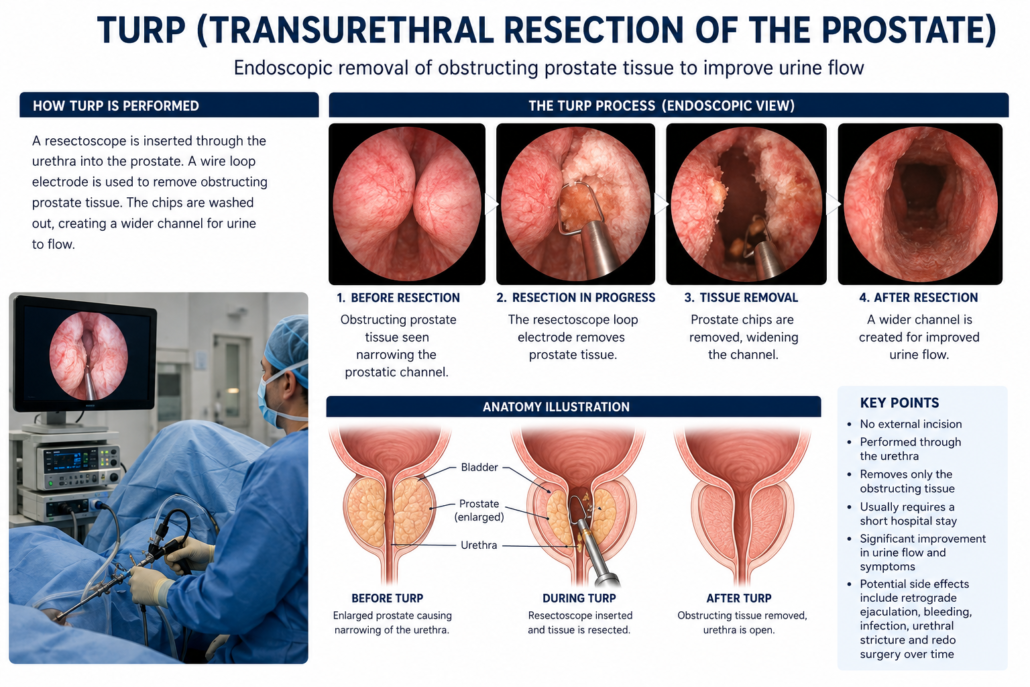
TURP stands for Transurethral Resection of the Prostate.
There is no external incision.
A specialised telescope called a resectoscope is passed through the urethra and into the prostate. A small electrical loop is then used to progressively remove pieces of obstructing prostate tissue.
Think less “removing the prostate” and more opening up the tunnel through it.
The outer portion of the prostate remains behind. TURP is therefore very different from a radical prostatectomy, where the entire prostate is removed to treat prostate cancer.
The removed prostate tissue is usually sent to pathology for examination.
Monopolar versus Bipolar TURP
There are two principal forms of TURP.
Monopolar TURP
Traditional monopolar TURP uses electrical current passing between the resection loop and a grounding pad on the patient.
It requires non-conductive irrigation fluid during surgery.
One uncommon but potentially serious complication is TUR syndrome, where excessive absorption of irrigation fluid can cause dilution of the blood sodium concentration.
Bipolar TURP
Modern bipolar TURP allows the electrical circuit to remain localised around the resection electrode and permits the use of normal saline irrigation.
This substantially reduces the risk of TUR syndrome and has made TURP safer, particularly when longer operating times are required.
For this reason, bipolar TURP has become widely used in contemporary practice.
Who Should Consider TURP?
TURP is generally considered when urinary symptoms from benign prostate enlargement are sufficiently troublesome or when BPH begins causing complications.
Common indications include:
Moderate to severe lower urinary tract symptoms
Men whose symptoms remain troublesome despite medication, or who prefer definitive surgical treatment, may benefit from TURP.
Recurrent urinary retention
Repeated episodes requiring catheterisation suggest significant bladder outlet obstruction.
Catheter-dependent urinary retention
Some men become unable to urinate without a catheter. TURP may restore spontaneous voiding, although success also depends on how well the bladder muscle continues to function.
Recurrent urinary tract infections
Incomplete bladder emptying can contribute to recurrent infections.
Bladder stones
Persistent obstruction and residual urine may encourage bladder stone formation.
Recurrent bleeding from an enlarged prostate
Significant or recurrent haematuria attributable to BPH can occasionally be an indication for surgery.
Progressive bladder dysfunction
Longstanding obstruction may cause bladder wall thickening, diverticula, increasing residual urine and eventually impaired bladder contractility.
Kidney impairment or hydronephrosis due to bladder outlet obstruction
This represents an important indication for relieving the obstruction.
What Size Prostate is Suitable for TURP?
TURP has traditionally been particularly suitable for prostates in approximately the 30–80 mL range.
The 2026 European Association of Urology guideline continues to regard TURP as a standard surgical treatment for appropriately selected men with moderate-to-severe lower urinary tract symptoms and prostates in this general size range.
Larger prostates can certainly be treated by TURP, particularly in experienced hands, but increasing gland size means:
- Longer operating time
- Greater bleeding risk
- More tissue requiring resection
- Potentially incomplete adenoma removal
- Greater likelihood of requiring staged surgery
For substantially larger glands, anatomical enucleation procedures such as HoLEP or, in selected patients, robotic-assisted simple prostatectomy/enucleation may offer advantages because they remove a greater proportion of the obstructing adenoma.
When Might TURP Not Be Appropriate?
There are relatively few absolute contraindications to TURP, but there are circumstances where surgery should be delayed or another approach considered.
Active urinary infection
A symptomatic urinary tract infection should generally be treated before elective surgery because instrumentation can increase the risk of sepsis.
Uncorrected bleeding disorder
Significant coagulopathy requires appropriate assessment and management before surgery.
Anticoagulant and antiplatelet medications require individualised management. They should never simply be stopped without medical advice, as the risk of bleeding must be balanced against the patient’s cardiovascular or thromboembolic risk.
Severe urethral stricture disease
If a resectoscope cannot safely pass through the urethra, the urethral problem may require treatment first or an alternative surgical strategy may be required.
Very large prostate
This is not an absolute contraindication, but procedures such as HoLEP or robotic/open simple prostatectomy may be more appropriate for some very large glands.
Poor bladder contractility
Not every weak stream is caused purely by the prostate.
A bladder that has become significantly underactive may still empty poorly even after an excellent TURP.
This distinction can be particularly important in men with chronic urinary retention, neurological disease, diabetes or very large residual urine volumes. Urodynamic pressure-flow studies can occasionally help determine whether obstruction, impaired bladder contraction, or a mixture of both is responsible.
What Happens During TURP?
TURP is usually performed under either general or spinal anaesthesia.
The resectoscope is passed through the urethra to the prostate.
The surgeon progressively removes obstructing prostate tissue until a wide channel has been created between the bladder and the urethra.
Bleeding points are cauterised during the procedure.
At completion, a urinary catheter is usually inserted. Continuous bladder irrigation may be used initially to prevent blood clots accumulating inside the bladder.
Most patients remain in hospital until the urine has cleared sufficiently and the catheter can safely be removed.
What Should I Expect Afterwards?
It is common to experience:
- Blood in the urine
- Burning or stinging during urination
- Increased urinary frequency
- Urgency
- Temporary difficulty controlling urgency
- Intermittent blood or small clots for several weeks
The urinary stream often improves relatively quickly, while frequency and urgency can take longer to settle.
This is particularly true when the bladder has been fighting obstruction for many years. Removing the obstruction does not necessarily make an irritable bladder forget its old habits overnight.
Risks and Complications of TURP
TURP is well established and generally safe, but it remains an operation and complications can occur.
Bleeding
Some bleeding is expected.
Occasionally bleeding may be sufficient to require:
- Prolonged bladder irrigation
- Blood transfusion
- Return to theatre for evacuation of blood clots and control of bleeding
Significant transfusion is much less common with contemporary techniques than historically.
Infection
Urinary tract infection can occur following TURP.
Patients with long-term catheters, recurrent infections or significant residual urine may have a higher risk.
Rarely, infection can progress to urosepsis.
Temporary Urinary Retention
Some patients cannot urinate immediately after catheter removal.
The catheter may need to be reinserted temporarily.
This is more likely when the bladder muscle has become weak following longstanding obstruction.
Retrograde Ejaculation
One of the most important long-term consequences of TURP is retrograde ejaculation.
Normally, the bladder neck closes during ejaculation so semen travels forwards through the penis.
After TURP, the bladder neck may remain open during ejaculation. Semen therefore travels backwards into the bladder and is subsequently passed harmlessly with the urine.
The orgasmic sensation is usually preserved, but little or no semen may emerge from the penis.
Retrograde ejaculation is common after conventional TURP and should be discussed before surgery, particularly in younger men concerned about fertility or preservation of ejaculation.
Erectile Dysfunction
Most men do not develop erectile dysfunction simply because they have undergone TURP.
Some men report changes in erectile function after surgery, while others notice improvement associated with better sleep, fewer urinary symptoms and improved general wellbeing.
Age, cardiovascular disease, diabetes, medications and pre-existing erectile dysfunction frequently have a greater influence on erections than the TURP itself.
Urinary Incontinence
Temporary urgency and urge leakage can occur during recovery.
Persistent significant urinary incontinence following uncomplicated TURP is considerably less common.
A contemporary systematic review and meta-analysis of randomised TURP studies reported an overall incontinence rate of approximately 8%, although this includes differing definitions and follow-up intervals and therefore should not be interpreted as an 8% rate of permanent severe incontinence.
Urethral Stricture After TURP
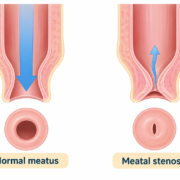
One of the important delayed complications is a urethral stricture.
A stricture is scar tissue that progressively narrows the urethra.
Symptoms may include:
- A gradually weakening urinary stream
- Spraying or splitting of the stream
- Straining
- Incomplete bladder emptying
- Recurrent urinary infections
- Urinary retention
The reported rate varies considerably between studies.
The EAU urethral stricture guideline reports urethral stricture rates following monopolar or bipolar TURP of approximately 1.7–11.7%, reflecting differences in surgical technique, instrumentation, follow-up and definitions.
A more recent systematic review of randomised TURP studies found an overall urethral stricture rate of approximately 3%.
For patient counselling, therefore, a reasonable practical message is:
Urethral stricture occurs in roughly 2–5% of contemporary TURP patients in many series, although reported rates vary more widely.
Potential contributing factors include the diameter of the resectoscope, duration of surgery, urethral trauma, postoperative catheterisation and other technical factors.
A stricture may be treated with urethral dilatation, endoscopic urethrotomy or, for more complex or recurrent strictures, urethroplasty.
Bladder Neck Contracture
Scar tissue can also develop at the bladder neck following TURP.
This is called bladder neck stenosis or bladder neck contracture.
The EAU guideline reports rates following TURP ranging approximately 2.4–9.7%, although contemporary rates vary considerably according to technique and patient population.
It can produce symptoms very similar to recurrent BPH and may require an endoscopic bladder neck incision or resection.
Can the Prostate Grow Back After TURP?
Yes, but perhaps “grow back” is slightly misleading.
TURP removes the obstructing inner portion of the prostate but does not remove the entire prostate gland.
Remaining benign prostate tissue can therefore enlarge over subsequent years.
Some men eventually develop recurrent obstruction and require another operation.
Importantly, not every patient who develops recurrent urinary symptoms has recurrent BPH. Other causes include:
- Urethral stricture
- Bladder neck contracture
- Overactive bladder
- Underactive bladder
- Recurrent adenoma
- Prostate cancer
Assessment is therefore preferable to simply assuming that “the prostate has grown back.”
What is the Redo Rate After TURP?
TURP provides durable symptom improvement for most men, but reoperation becomes more common with increasing follow-up.
A large systematic review involving 119 studies and more than 130,000 patients estimated TURP reoperation rates of approximately:
| Time after TURP | Reoperation rate |
|---|---|
| 1 year | 4.0% |
| 2 years | 5.0% |
| 3 years | 6.0% |
| 5 years | 7.7% |
Longer-term population data also demonstrate the durability of TURP. An Austrian nationwide analysis cited by the EAU found actual repeat TURP rates of approximately 2.4% at one year, 6.1% at five years and 8.3% at eight years. When procedures for urethral stricture and bladder neck stenosis were also included, the overall retreatment rate reached approximately 12.7% at eight years.
These figures highlight an important distinction:
“Redo TURP” and “reoperation after TURP” are not necessarily the same thing.
A subsequent procedure might be required because of recurrent prostate obstruction, but it may instead be required to treat a urethral stricture or bladder neck contracture.
TUR Syndrome
Traditional monopolar TURP carries a small risk of TUR syndrome, caused by absorption of large volumes of non-saline irrigation fluid. This is a serious complication occasionally requiring an ICU admission as it can cause brain swelling.
This can result in:
- Low blood sodium
- Nausea and vomiting
- Confusion
- Blood pressure changes
- Neurological disturbances
- Cardiovascular complications
Modern bipolar TURP using saline irrigation has dramatically reduced this particular complication.
Does TURP Cause Prostate Cancer?
No.
BPH and prostate cancer are different diseases.
However, because TURP only removes part of the prostate, prostate cancer can still develop in the remaining gland.
Appropriate PSA surveillance and prostate assessment may therefore still be required after TURP.
Occasionally, unsuspected prostate cancer is discovered when TURP tissue is examined by the pathologist.
Advantages of TURP
TURP remains popular because it offers several important advantages:
- Long-established procedure
- Excellent improvement in urinary flow
- Significant improvement in urinary symptoms
- No external incision
- Widely available
- Tissue is obtained for pathological examination
- Durable results
- Particularly effective for appropriately selected medium-sized prostates
- Extensive long-term outcome data
Despite the arrival of numerous newer technologies, TURP remains an important reference standard for surgical treatment of BPH. Long-term studies demonstrate sustained improvement in urinary symptoms and flow.
Disadvantages of TURP
Potential disadvantages include:
- Anaesthetic and surgical risks
- Bleeding
- Catheterisation and hospital admission
- Retrograde ejaculation
- Temporary urinary urgency
- Infection
- Urethral stricture
- Bladder neck contracture
- Small risk of persistent incontinence
- Possibility of future retreatment
- Less suitable than anatomical enucleation for some very large prostates
TURP versus Modern BPH Surgery
TURP remains highly effective, but it is no longer the only surgical option.
Depending on prostate size, anatomy, medications, general health and the importance of preserving ejaculation, alternatives may include:
- GreenLight laser vaporisation
- HoLEP
- Aquablation
- Rezūm water-vapour therapy
- Prostatic urethral lift
- Other minimally invasive surgical therapies
- Robotic-assisted simple prostatectomy or adenoma enucleation
Long-term comparisons increasingly suggest that anatomical endoscopic enucleation procedures can achieve lower retreatment rates than TURP in appropriately selected patients, particularly with larger glands.
There is therefore no single “best prostate operation” for every patient.
The aim is to match the procedure to the prostate, bladder and priorities of the man attached to them.
The Bottom Line
TURP remains one of the most proven and effective operations for benign prostate obstruction.
It can provide substantial and durable improvement in urinary flow and lower urinary tract symptoms, particularly in men with appropriately sized prostates and confirmed bladder outlet obstruction.
Patients should nevertheless understand the potential longer-term complications. Urethral stricture is generally reported in the low single-digit percentages in contemporary studies, although published rates range more widely. Repeat intervention becomes progressively more likely with longer follow-up, with pooled data suggesting a reoperation rate of approximately 7–8% by five years.
TURP may be the old workhorse of BPH surgery, but it has not wandered off to the retirement paddock just yet. For the right prostate and the right patient, it remains a highly effective treatment.
Important Information
This information is intended for general patient education and does not replace individual medical advice. The most appropriate treatment for BPH depends on prostate size and anatomy, severity of obstruction, bladder function, medications, general health, sexual priorities and personal preferences. A consultation with a urologist can help determine whether TURP or an alternative treatment is most appropriate.




Leave a Reply
Want to join the discussion?Feel free to contribute!