
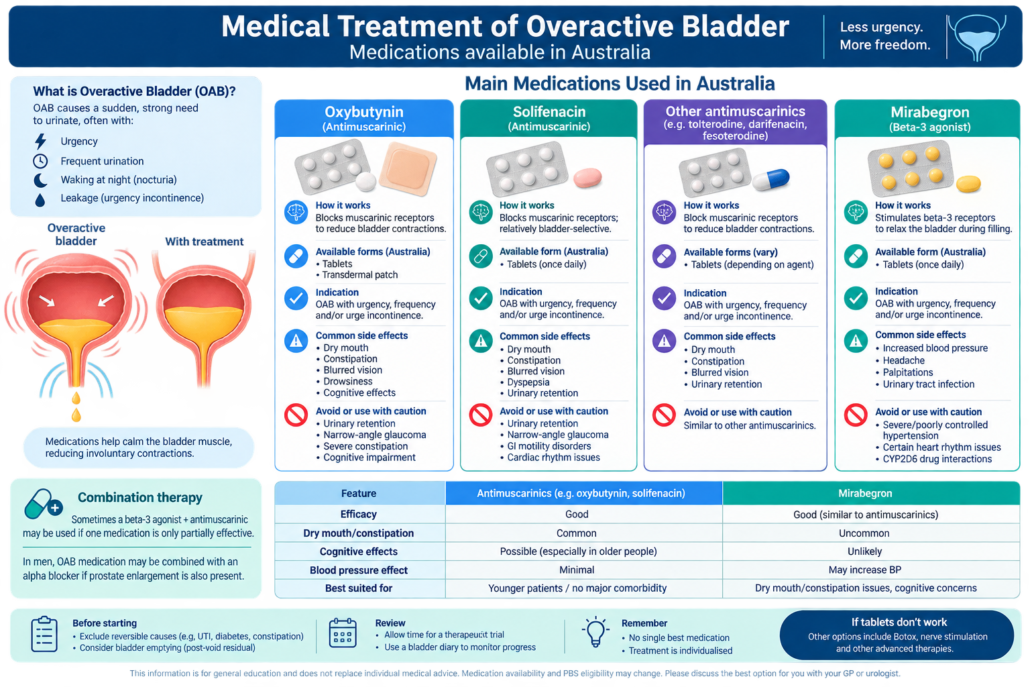
Medications for Overactive Bladder in Australia: What Are the Options?
Overactive bladder (OAB) can make life feel as though the bladder has taken control of the daily timetable. A trip to the shops becomes a mental map of toilets, a long car journey requires strategic planning, and the sound of running water can suddenly become surprisingly persuasive.
Fortunately, several medications are available in Australia that can reduce urinary urgency, frequency and urgency urinary incontinence.
What is an overactive bladder?
Overactive bladder is a symptom syndrome characterised by urinary urgency, usually accompanied by increased urinary frequency and nocturia, with or without urgency urinary incontinence.
Typical symptoms include:
- A sudden compelling need to urinate that is difficult to postpone
- Passing urine frequently during the day
- Waking repeatedly at night to urinate
- Leakage of urine before reaching the toilet
- Having to plan activities around access to toilets
Importantly, OAB is a clinical diagnosis rather than simply a finding on urodynamic testing. Some patients with OAB demonstrate detrusor overactivity during urodynamic studies, while others do not.
Before starting medication, potentially reversible causes should be considered, including urinary tract infection, excessive fluid or caffeine intake, poorly controlled diabetes, constipation, bladder stones and bladder outlet obstruction.
In men, particularly those with prostate enlargement, it is important to determine whether urgency is occurring together with significant bladder outlet obstruction and incomplete bladder emptying.
When should medication be considered?
Initial management will often include conservative measures such as:
- Bladder training
- Timed voiding
- Reduction of excessive caffeine
- Modification of excessive fluid intake
- Weight reduction where appropriate
- Treatment of constipation
- Pelvic floor physiotherapy
- Management of contributing vaginal or genitourinary changes associated with menopause
Medication may be offered when symptoms remain bothersome despite conservative measures, or when the severity of symptoms warrants combining behavioural and pharmacological treatment.
The two major medication groups used for OAB are:
- Antimuscarinic or anticholinergic medications
- Beta-3 adrenergic agonists, principally mirabegron
Australian guidance notes broadly similar efficacy between beta-3 agonist and anticholinergic therapy, although their adverse-effect profiles are quite different.
1. Oxybutynin
Oxybutynin is one of the longest-established medications for overactive bladder and detrusor overactivity.
In Australia it is available in oral formulations, and transdermal oxybutynin patches are also available. Current PBS listings include oxybutynin 5 mg tablets and a 3.9 mg/24-hour transdermal patch.
How does it work?
Oxybutynin blocks muscarinic receptors involved in detrusor contraction. This reduces involuntary bladder contractions and can improve urgency, frequency and urgency incontinence.
Advantages
Oxybutynin is well established, effective in appropriately selected patients and relatively inexpensive.
The transdermal patch may produce fewer systemic anticholinergic effects, particularly dry mouth, than conventional oral treatment.
Common side effects
These include:
- Dry mouth
- Constipation
- Dry eyes
- Blurred vision
- Drowsiness
- Dizziness
- Difficulty emptying the bladder
- Cognitive disturbance, particularly in older patients
Oxybutynin can cross the blood-brain barrier, making cognitive adverse effects an important consideration, especially in elderly or vulnerable patients.
When should oxybutynin be avoided or used cautiously?
Particular caution is required in patients with:
- Significant urinary retention
- Gastric retention or severe gastrointestinal motility disorders
- Uncontrolled narrow-angle glaucoma
- Myasthenia gravis
- Significant constipation
- Cognitive impairment
- A high existing anticholinergic medication burden
2. Solifenacin
Solifenacin is another antimuscarinic medication widely used for OAB.
The TGA indication includes treatment of overactive bladder associated with urgency urinary incontinence, urgency or increased urinary frequency.
It is commonly prescribed once daily.
Advantages
Solifenacin is relatively bladder-selective and once-daily dosing is convenient. Many patients tolerate it better than immediate-release oxybutynin.
Common side effects
These include:
- Dry mouth
- Constipation
- Blurred vision
- Dry eyes
- Dyspepsia
- Difficulty passing urine
- Urinary retention
Higher doses may improve symptoms in some patients but generally increase anticholinergic adverse effects.
Contraindications and precautions
Solifenacin should be avoided or used cautiously in patients with significant urinary retention, severe gastrointestinal retention, uncontrolled narrow-angle glaucoma and certain significant cardiac rhythm abnormalities.
Renal and hepatic impairment and potential drug interactions should also be considered when selecting the dose.
3. Other antimuscarinic medications
Other antimuscarinic agents that may be encountered in the management of OAB include drugs such as darifenacin, tolterodine and fesoterodine, depending on current Australian availability, registration, individual circumstances and prescribing arrangements.
Although the individual pharmacology varies, their overall therapeutic principle is similar: reducing muscarinic stimulation of the bladder.
The familiar anticholinergic family of adverse effects therefore remains:
dry mouth + constipation + blurred vision + possible urinary retention.
There is no perfect “bladder-only” anticholinergic medication. Muscarinic receptors are distributed throughout the body, which explains why medications intended to calm the bladder may simultaneously make the mouth dry and the bowel somewhat less enthusiastic.
Anticholinergic medications and memory
This deserves particular attention.
Increasing evidence has raised concern about the cumulative anticholinergic burden, especially in older people.
Anticholinergic medications can contribute to:
- Confusion
- Sedation
- Cognitive impairment
- Falls
- Functional decline
Long-term exposure to medications with strong anticholinergic activity has also been associated in observational research with cognitive decline and dementia, although an association does not by itself prove that an individual OAB medication causes dementia.
Australian Prescriber specifically highlights that cumulative exposure to drugs with anticholinergic effects may contribute to cognitive decline and loss of functional capacity in older people.
For this reason, medication selection should consider the patient’s total anticholinergic burden, including medications prescribed for depression, allergies, sleep disorders and other conditions.
In an older patient, particularly one with existing cognitive concerns, a beta-3 agonist may therefore be preferable when clinically appropriate. Recent Australian Therapeutic Guidelines discussion similarly recommends particular caution with conventional anticholinergic therapy in patients over 65 years.
4. Mirabegron
Mirabegron is a beta-3 adrenergic receptor agonist and provides an important alternative to anticholinergic therapy.
Rather than blocking acetylcholine, mirabegron stimulates beta-3 receptors in the bladder detrusor, promoting relaxation during bladder filling and thereby increasing functional bladder storage.
It is TGA-approved for overactive bladder.
Who may benefit from mirabegron?
It can be particularly useful in patients who:
- Cannot tolerate anticholinergic medications
- Develop troublesome dry mouth or constipation
- Have concerns regarding cognitive adverse effects
- Have an already high anticholinergic medication burden
- Have had an inadequate response to an antimuscarinic
Advantages
Mirabegron causes substantially fewer classic anticholinergic adverse effects such as dry mouth and constipation.
Its efficacy is broadly comparable with anticholinergic therapy, making tolerability an important part of choosing between the two classes.
Side effects
Potential adverse effects include:
- Increased blood pressure
- Headache
- Palpitations
- Tachycardia
- Urinary tract infection
- Occasionally urinary retention
Atrial fibrillation has also been reported.
Hypertension is important
Blood pressure should be assessed when considering mirabegron.
It should be avoided in patients with severe or poorly controlled hypertension, and blood pressure monitoring is advisable during treatment. Australian guidance highlights particular concern around blood pressure of approximately 180/110 mmHg or greater.
Drug interactions
Mirabegron inhibits the CYP2D6 enzyme, meaning it can increase exposure to certain medications metabolised through this pathway.
Extra care may therefore be necessary with drugs such as some beta blockers, antidepressants and anti-arrhythmic medications. Particular caution is appropriate with narrow-therapeutic-index CYP2D6 substrates such as flecainide and propafenone.
Can medications be combined?
Yes.
For patients who experience a partial response to a single medication, combination therapy using a beta-3 agonist plus an antimuscarinic may sometimes provide additional symptom improvement.
However, combination treatment may also increase adverse effects and requires careful patient selection.
In men with coexisting benign prostate enlargement and bladder outlet symptoms, an OAB medication may sometimes be combined with an alpha blocker, particularly when storage symptoms such as urgency and frequency remain troublesome after treatment of the obstructive component.
A post-void residual urine measurement can be particularly useful before escalating treatment in patients at risk of incomplete bladder emptying.
What about vaginal oestrogen?
Postmenopausal women with OAB may also have symptoms of genitourinary syndrome of menopause, including vaginal dryness, irritation, recurrent urinary infections and urinary urgency.
Where vaginal atrophy is present, local vaginal oestrogen may form part of management rather than simply escalating conventional OAB medication. This approach is also recognised in contemporary Australian guidance.
Which OAB medication is best?
There is no single winner.
Treatment should be individualised according to:
| Clinical situation | Medication consideration |
|---|---|
| Younger patient without major comorbidity | Antimuscarinic or mirabegron |
| Significant dry mouth | Consider mirabegron |
| Severe constipation | Avoid or minimise anticholinergic therapy |
| Older patient/cognitive concerns | Minimise anticholinergic burden |
| Significant uncontrolled hypertension | Avoid mirabegron |
| Poor bladder emptying/high residual urine | Use OAB medication cautiously |
| Narrow-angle glaucoma | Antimuscarinics may be inappropriate |
| Partial response to one drug | Consider dose adjustment, alternative agent or combination therapy |
| OAB with vaginal atrophy | Consider local vaginal oestrogen as part of treatment |
| OAB with male bladder outlet obstruction | Assess obstruction and residual urine before escalating therapy |
How long should medication be tried?
OAB medications do not work instantly.
Patients will generally require a therapeutic trial followed by reassessment of:
- Urinary frequency
- Number of urgency episodes
- Urgency urinary incontinence
- Nocturia
- Pad usage
- Side effects
- Quality of life
A bladder diary can be particularly useful because it turns a vague impression of improvement into something measurable.
If medication is ineffective, increasing the dose indefinitely is not necessarily the answer. The diagnosis should be reconsidered and other treatment options discussed.
What if tablets do not work?
Medication is only one rung on the OAB treatment ladder.
For patients with persistent, troublesome symptoms despite behavioural therapy and appropriate medication, further investigation may include:
- Bladder ultrasound and post-void residual measurement
- Cystoscopy in selected patients
- Urodynamic studies where the diagnosis or underlying bladder dysfunction requires clarification
More advanced treatment options can include:
Intravesical Botulinum Toxin (Botox)
Botulinum toxin can be injected into the bladder wall to reduce involuntary detrusor activity. It can be highly effective, although urinary tract infection and temporary difficulty emptying the bladder are recognised risks.
Sacral neuromodulation
Sacral neuromodulation uses electrical stimulation of the sacral nerves involved in bladder control and can be considered in appropriately selected patients with refractory OAB.
Other neuromodulation techniques
Posterior tibial nerve stimulation and related neuromodulation approaches may also have a role in selected patients.
The bottom line
Overactive bladder is common, treatable and often requires a stepwise approach rather than simply prescribing a tablet.
Antimuscarinic medications such as oxybutynin and solifenacin remain useful treatments, but their potential for dry mouth, constipation, urinary retention and cognitive adverse effects needs to be considered.
Mirabegron provides an important alternative, particularly when anticholinergic adverse effects are problematic, but blood pressure and potential drug interactions require attention.
The best treatment depends on the individual patient’s symptoms, age, bladder emptying, medical conditions and other medications.
And if tablets fail, that does not mean treatment has reached the end of the road. Botox, neuromodulation and other therapies provide additional options for the bladder that remains stubbornly determined to run its own timetable.
References
- Australian Prescriber. Management of urinary incontinence in adults.
- Australian Prescriber. Anticholinergic drugs for overactive bladder.
- Australian Prescriber. Mirabegron for overactive bladder.
- Hilmer SN, Gnjidic D. The anticholinergic burden: from research to practice. Australian Prescriber. 2022;45:118–120.
- Therapeutic Goods Administration. Australian Public Assessment Report: Mirabegron.
- Therapeutic Goods Administration. Solifenacin registration and approved indication for overactive bladder.
- Pharmaceutical Benefits Scheme. Current oxybutynin tablet and transdermal patch listings.
- Australian Prescriber. Therapeutic Guidelines Kidney and Urinary, discussion of contemporary OAB pharmacotherapy.
This information is intended for general patient education and does not replace individual medical assessment. Medication availability, PBS eligibility and prescribing restrictions can change. Patients should discuss the most appropriate treatment with their GP, urologist or other treating clinician.


Leave a Reply
Want to join the discussion?Feel free to contribute!