
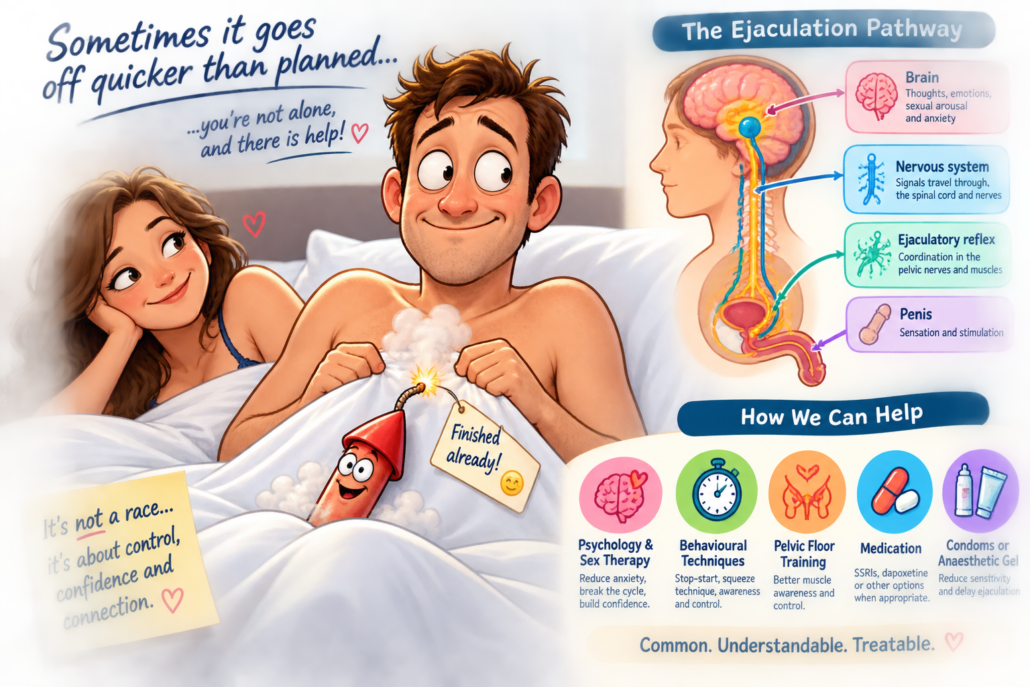
Premature Ejaculation: When Things Happen Earlier Than You’d Like
Premature ejaculation (PE) is one of the most common sexual concerns affecting men. Yet it is also one of the least discussed.
Many men worry that they are the only person experiencing it, or that it means there is something fundamentally wrong with their sexual function or relationship. Neither is necessarily true.
Premature ejaculation is common, often treatable, and usually manageable. Treatment may involve behavioural techniques, psychological or sex therapy, medication, treatment of an underlying medical problem, or a combination of these approaches.
What Is Premature Ejaculation?
There is no stopwatch that defines a satisfying sex life.
Premature ejaculation is better understood as ejaculation that repeatedly occurs sooner than a man or couple would like, with difficulty delaying ejaculation and resulting frustration, distress, avoidance of sexual activity or relationship difficulties.
In lifelong PE, ejaculation often occurs within approximately one minute of vaginal penetration, although the definition is not simply about time. In acquired PE, there is usually a noticeable and troublesome reduction in the time to ejaculation compared with the man’s previous experience.
Importantly, occasional rapid ejaculation is normal and does not necessarily mean that you have PE.
The key questions are:
- Does it happen repeatedly?
- Do you feel unable to control or delay ejaculation?
- Is it causing distress for you or your partner?
- Has something changed from how things used to be?
If the answer to several of these questions is yes, it may be worth discussing with your GP or urologist.
The Two Main Types of Premature Ejaculation
Lifelong Premature Ejaculation
Lifelong, or primary, PE usually begins with a man’s earliest sexual experiences and continues throughout adult life.
Ejaculation typically occurs very quickly during most sexual encounters and there may be very little sense of control over when ejaculation occurs.
There appears to be an important biological component to lifelong PE. Differences in serotonin signalling and individual sensitivity of the ejaculatory reflex have been proposed.
In other words, lifelong PE is not simply a matter of poor self-control.
Acquired Premature Ejaculation
Acquired, or secondary, PE develops in a man who previously had satisfactory control over ejaculation.
This distinction is important because acquired PE may have an identifiable contributing factor.
Possible associations include:
- erectile dysfunction
- performance anxiety
- relationship difficulties
- stress or depression
- prostatitis or pelvic discomfort in some men
- thyroid disorders, particularly hyperthyroidism
- changes in medications or recreational drug use
- changes in sexual circumstances
- prolonged periods without sexual activity
When PE develops relatively suddenly, identifying and treating the underlying problem may substantially improve ejaculation.
What Causes Premature Ejaculation?
There is rarely one simple explanation.
Ejaculation is controlled through a complex interaction between the brain, spinal cord, peripheral nerves, hormones, neurotransmitters, sexual stimulation and psychological factors.
Biological Factors
Serotonin is particularly important in controlling ejaculation. Certain serotonin pathways appear to delay ejaculation, which helps explain why medications that increase serotonin activity can be effective treatments for PE.
Genetic and neurobiological differences may therefore explain why some men naturally have a much shorter ejaculatory latency than others.
Erectile Dysfunction
This is an important and sometimes overlooked relationship.
A man who is worried about losing his erection may unconsciously hurry sexual activity and ejaculation. This can gradually create a pattern of rapid ejaculation.
Treating the erectile dysfunction can sometimes significantly improve the PE as well.
Is Premature Ejaculation “All in the Mind”?
No.
But psychology can certainly play a role.
This distinction is important.
Premature ejaculation can have genuine biological components, particularly in lifelong PE. Telling a man simply to “relax” is therefore unlikely to solve the problem.
At the same time, anxiety can amplify the problem.
A common cycle develops:
Rapid ejaculation → worry about the next sexual encounter → increased monitoring and performance anxiety → increased arousal → even faster ejaculation.
Sex can gradually begin to feel more like an examination than something enjoyable.
Breaking this cycle can be an important part of treatment.
The Role of Psychology and Sex Therapy
Psychological therapy can be particularly helpful when PE is associated with:
- performance anxiety
- relationship tension
- fear of sexual failure
- depression or general anxiety
- unrealistic expectations about sexual performance
- avoidance of intimacy
- reduced sexual confidence
Psychosexual counselling can also help couples communicate more openly about sexual expectations.
For some men, combining psychological or behavioural therapy with medication is more effective than relying on either approach alone.
The aim is not to suggest that PE is imaginary. Rather, treatment addresses both the physical ejaculatory reflex and the psychological environment surrounding it.
Behavioural Techniques
Several techniques can help some men develop greater awareness and control of their level of sexual arousal.
Stop-Start Technique
Sexual stimulation is stopped when ejaculation feels close. Once the sensation subsides, stimulation begins again.
With practice, this may help a man recognise the point at which ejaculation becomes difficult to stop.
Squeeze Technique
A variation involves briefly stopping stimulation and applying gentle pressure to the penis when ejaculation feels imminent.
This technique is used less commonly today but can still be useful for some couples.
Pelvic Floor Training
The pelvic floor muscles are involved in ejaculation as well as urinary control.
Some men may benefit from learning better awareness and control of these muscles, particularly under the guidance of a pelvic floor physiotherapist with experience in male sexual dysfunction.
More exercise is not necessarily better. Excessive pelvic floor tension may actually be counterproductive in some men.
Condoms and Reduced Sensitivity
Condoms reduce penile sensation and may delay ejaculation in some men.
Thicker condoms or condoms specifically designed to reduce sensitivity may provide additional benefit.
This is a simple and low-risk option worth trying before progressing to medication.
Local Anaesthetic Creams and Sprays
Topical anaesthetic preparations containing agents such as lidocaine and/or prilocaine can reduce penile sensitivity and delay ejaculation.
They are generally applied before sexual activity.
Potential problems include:
- excessive penile numbness
- reduced sexual pleasure
- irritation
- transfer of the anaesthetic to a partner, causing genital numbness
Using the correct amount and following product instructions is important. A condom may sometimes help prevent transfer to a partner.
Medication for Premature Ejaculation
Several medications can delay ejaculation.
SSRIs
Selective serotonin reuptake inhibitors, or SSRIs, were originally developed as antidepressants. One of their recognised effects is delayed ejaculation.
Medications such as paroxetine, sertraline, fluoxetine and escitalopram may therefore sometimes be prescribed for PE.
Depending on the medication and clinical circumstances, treatment may be taken daily rather than immediately before sexual activity.
Possible side effects include:
- nausea
- tiredness
- sweating
- reduced libido
- erectile difficulties
- changes in mood
- difficulty reaching orgasm
These medications should be prescribed and monitored by an appropriate medical practitioner and should not be started, stopped or altered without medical advice.
Dapoxetine
Dapoxetine is a short-acting SSRI specifically developed for premature ejaculation and is taken before anticipated sexual activity rather than continuously.
Its availability and regulatory status vary between countries, including Australia, so treatment needs to be discussed with your doctor rather than purchased from unregulated online sources.
PDE5 Inhibitors
Medications such as sildenafil or tadalafil primarily treat erectile dysfunction rather than PE.
They may nevertheless be helpful when premature ejaculation occurs together with erectile dysfunction.
For some men, improving confidence in the reliability of their erection also reduces the urge to rush sexual activity.
What About Tramadol?
Tramadol can delay ejaculation, but it is an opioid medication and carries risks including sedation, dependence, interactions with other medications and other potentially serious adverse effects.
For these reasons, it is not usually considered a preferred first-line treatment for PE.
Is Testosterone Treatment Helpful?
Usually not.
Testosterone replacement is not a routine treatment for premature ejaculation.
If symptoms or examination suggest testosterone deficiency or another hormonal problem, appropriate blood tests may be performed. Hormone treatment should only be considered when a genuine hormonal abnormality has been demonstrated.
Is Surgery the Answer?
Generally, no.
Premature ejaculation is not normally treated surgically.
Procedures designed to permanently reduce penile sensation or alter penile nerves are controversial and can potentially cause permanent numbness, altered sensation, pain or sexual dysfunction.
Treatment should usually begin with reversible, evidence-based approaches.
When Should You See a Urologist?
Consider seeking medical advice when PE:
- occurs during most sexual encounters
- is causing significant distress
- is affecting your relationship
- has developed suddenly
- occurs together with erectile dysfunction
- is associated with urinary symptoms, pelvic pain or penile discomfort
- has not responded to simple measures
A consultation does not necessarily mean extensive testing.
For many men, the most useful part of the assessment is simply a careful conversation about when the problem began, erectile function, sexual circumstances, medications, general health and any associated urinary or hormonal symptoms.
Blood tests or other investigations may occasionally be appropriate depending on the circumstances.
Is There Hope?
Absolutely.
Premature ejaculation is not a measure of masculinity, fertility or the quality of a relationship.
It is a common sexual dysfunction with several potential treatment strategies. Some men respond well to relatively simple measures. Others benefit from medication, treatment of associated erectile dysfunction, psychosexual therapy, or a combination of approaches.
Perhaps most importantly, treatment should not focus exclusively on adding minutes to a stopwatch.
The real goals are better control, less anxiety, greater sexual confidence and a more satisfying sexual experience for both partners.
There is no universally “correct” duration for sex.
If ejaculation is consistently occurring earlier than you would like and it is bothering you, that is reason enough to discuss it.
A Final Word
Premature ejaculation can be difficult to bring up in conversation, but for a urologist it is an everyday medical issue.
You will almost certainly not be the first person to mention it that day.
And occasionally, the most effective first treatment is simply getting the subject out of the bedroom shadows and into a conversation where something can actually be done about it.
This information is intended for general patient education and does not replace individual medical assessment. Treatment should be tailored to your medical history, medications, symptoms and circumstances.


Leave a Reply
Want to join the discussion?Feel free to contribute!