
Robotic-Assisted Radical Prostatectomy: When Is a Non-Nerve-Sparing Procedure Necessary?
Removing the prostate while putting cancer control first
Robotic-assisted radical prostatectomy is a well-established surgical treatment for localised and selected locally advanced prostate cancer. During the operation, the prostate gland and seminal vesicles are removed, and the bladder is reconnected to the urethra. In selected patients, pelvic lymph nodes may also be removed.
One of the important decisions made before and during prostate cancer surgery is whether the nerves responsible for erections can safely be preserved.
This is known as nerve-sparing prostatectomy.
Unfortunately, nerve preservation is not always appropriate. When prostate cancer is close to, involves, or is suspected of extending beyond the outer edge of the prostate near these nerves, attempting to preserve them may compromise the completeness of cancer removal.
In this situation, a partial or complete non-nerve-sparing robotic prostatectomy may be recommended.
The guiding principle is simple:
Preserve the nerves when it is oncologically safe to do so, but do not preserve them at the expense of adequately treating the prostate cancer.
What are the nerves that are being “spared”?
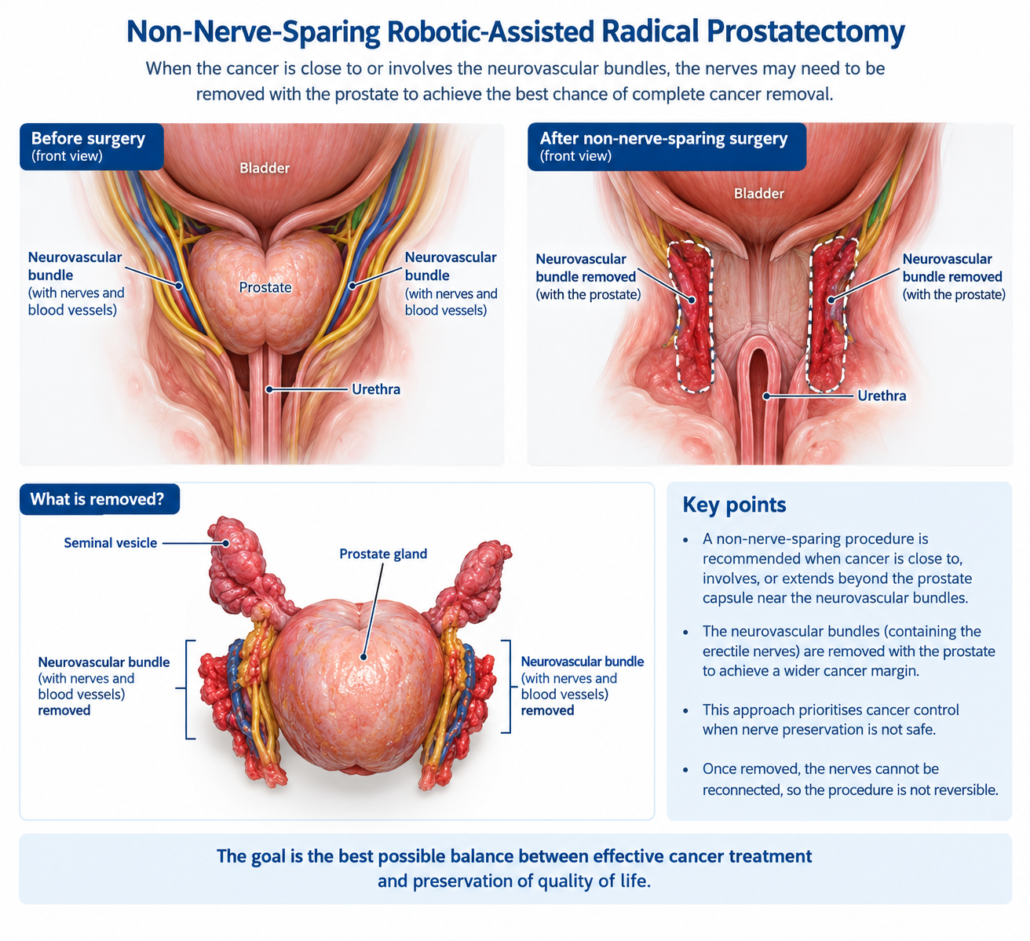
Running immediately alongside the prostate are delicate bundles of nerves and blood vessels known collectively as the neurovascular bundles.
These structures contain nerves that play an important role in producing erections.
They sit extremely close to the outer surface, or capsule, of the prostate. This anatomical relationship creates a challenge during prostate cancer surgery.
If the cancer is safely contained within the prostate and sufficiently distant from the neurovascular bundle, the surgeon may be able to carefully dissect the prostate away while preserving the nerves.
This is a nerve-sparing radical prostatectomy.
If cancer is suspected to extend towards or through the prostate capsule in this area, the surgeon may need to remove some or all of the neurovascular tissue together with the prostate.
This is a non-nerve-sparing prostatectomy.
Why would a surgeon deliberately remove the erectile nerves?
It may initially seem counterintuitive to remove structures that are so important for sexual function.
The reason is cancer control.
The primary purpose of radical prostatectomy is to completely remove the prostate cancer.
If a tumour is growing very close to the edge of the prostate, particularly next to a neurovascular bundle, dissecting too close to the prostate in an attempt to preserve the nerves could potentially leave cancer cells behind.
This is called a positive surgical margin.
In appropriately selected patients, taking a wider margin around the prostate may therefore provide a safer cancer operation.
The decision represents a balance between:
Cancer control
and
preservation of erectile function.
When these two goals conflict, cancer control generally takes priority.
When may a non-nerve-sparing prostatectomy be recommended?
Non-nerve-sparing surgery may be considered when there is a significant risk that prostate cancer has extended towards or into the tissues surrounding the prostate.
Examples include:
Locally advanced prostate cancer
A tumour suspected of extending through the prostate capsule, particularly clinical T3 disease, may require a wider surgical excision.
Cancer close to the neurovascular bundle on MRI
Modern multiparametric prostate MRI can provide valuable information about the location of the tumour and its relationship to the prostate capsule and neurovascular bundles.
Features suggesting extraprostatic extension may influence the decision not to preserve the nerve bundle on that side.
High-grade prostate cancer
Higher-grade cancers, including cancers with an unfavourable Gleason score or ISUP Grade Group, may have a greater likelihood of extending outside the prostate.
The biopsy result alone does not automatically determine whether the nerves can be preserved, but it forms part of the overall assessment.
Extensive cancer on prostate biopsy
Large-volume disease, particularly when concentrated along the outer portion of the prostate near a neurovascular bundle, may make nerve preservation less appropriate.
Very high PSA or other high-risk features
PSA level, PSA density, biopsy findings, MRI appearance and clinical examination are considered together when estimating the likelihood of disease extending beyond the prostate.
Cancer involving one particular side of the prostate
Importantly, nerve sparing does not necessarily have to be “all or nothing.”
If the cancer is predominantly on one side, it may sometimes be possible to preserve the neurovascular bundle on the opposite side.
This is known as unilateral nerve sparing.
Nerve sparing is not simply YES or NO
Modern robotic prostate surgery is more nuanced than dividing operations into completely nerve-sparing and completely non-nerve-sparing procedures.
Depending on the location and extent of the cancer, surgery may involve:
- Bilateral nerve sparing
- Unilateral nerve sparing
- Partial nerve sparing
- Wider excision on one side and nerve preservation on the other
- Complete bilateral non-nerve-sparing surgery
The surgical plan can therefore be tailored to the individual patient and, importantly, to the cancer on each side of the prostate.
How does nerve-sparing surgery differ from non-nerve-sparing surgery?
During nerve-sparing surgery, the surgeon carefully separates the neurovascular bundle from the surface of the prostate while attempting to minimise traction, heat and other potential injury to these delicate nerves.
During non-nerve-sparing surgery, the dissection is deliberately performed further away from the prostate.
The neurovascular tissue is removed together with the prostate where necessary to obtain a wider cancer margin.
The robotic platform provides magnified three-dimensional vision and highly controlled instrument movement. This allows the surgeon to identify tissue planes with considerable precision.
However, robotic technology cannot make an unsafe nerve-sparing operation safe.
The biology and location of the cancer ultimately determine how close to the prostate the surgeon can safely operate.
What happens to erections after non-nerve-sparing prostatectomy?
This is one of the most important issues to discuss before surgery.
The nerves surrounding the prostate are responsible for signalling increased blood flow into the penis to produce a natural erection.
If both neurovascular bundles are completely removed, the likelihood of recovering spontaneous erections adequate for sexual intercourse is very low.
This is different from nerve-sparing surgery, where the nerves remain anatomically intact but may temporarily function poorly following surgery.
After nerve-sparing prostatectomy, erectile recovery can occur gradually over many months and sometimes over 18–24 months or longer.
After complete bilateral non-nerve-sparing surgery, however, the nerves themselves have been removed rather than temporarily stunned.
The expectations for recovery are therefore very different.
Does non-nerve-sparing surgery affect sensation or orgasm?
This is an important distinction.
The nerves responsible for penile sensation are different from the neurovascular nerves primarily responsible for erections.
Many men can therefore continue to experience penile sensation and sexual pleasure following radical prostatectomy.
Orgasm may also remain possible.
However, radical prostatectomy removes the prostate and seminal vesicles and disconnects the reproductive pathway. Consequently, there is no ejaculation of semen after surgery.
This is sometimes described as a dry orgasm.
The sensation of orgasm can also feel different after prostate surgery.
Does non-nerve-sparing prostatectomy cause infertility?
Yes.
Radical prostatectomy results in permanent infertility because the prostate and seminal vesicles are removed and sperm can no longer enter the ejaculate.
Men who may wish to father children in the future should discuss sperm banking before surgery.
This applies whether the operation is nerve sparing or non-nerve sparing.
Is a non-nerve-sparing procedure reversible?
No.
Once a neurovascular bundle has been surgically removed, it cannot simply be reattached at a later date.
This is an important difference between temporary nerve dysfunction and actual nerve removal.
After nerve-sparing surgery, the nerves may be anatomically preserved but temporarily injured or “stunned”. Recovery may therefore occur with time.
After complete non-nerve-sparing surgery, the erectile nerves have been physically removed as part of the cancer operation.
The procedure itself is therefore not reversible.
However, this does not mean that erections or sexual activity are impossible.
There are several effective treatments available for erectile dysfunction following prostatectomy.
Can erections still be achieved after non-nerve-sparing surgery?
Rarely yes, but they will usually require assistance.
Treatment options include:
PDE5 inhibitor tablets
Medications such as sildenafil or tadalafil are commonly used after prostate surgery.
They rely substantially on functioning nerve pathways and are therefore generally more effective following nerve-sparing surgery.
Their effectiveness following complete bilateral non-nerve-sparing surgery is considerably more limited.
Vacuum erection device
A vacuum erection device creates negative pressure around the penis, drawing blood into the erectile tissues.
A constriction ring can then be placed around the base of the penis to maintain the erection.
Because this technique does not depend on intact erectile nerves, it can be useful after non-nerve-sparing surgery.
Penile injection therapy
Medication can be injected directly into the erectile tissue of the penis.
These medications act directly on penile blood vessels and therefore do not require normal prostate-associated nerve signalling.
For this reason, penile injections can be highly effective even after bilateral non-nerve-sparing prostatectomy.
Penile prosthesis
For men with persistent erectile dysfunction who wish to restore reliable erections, a penile prosthesis can provide an effective long-term solution.
An inflatable penile prosthesis allows an erection to be mechanically produced when desired.
For appropriately selected men, satisfaction rates following penile prosthesis surgery are generally high.
What about penile rehabilitation?
Penile rehabilitation may be discussed following radical prostatectomy.
The objectives can include maintaining penile tissue health, encouraging regular oxygenation of the erectile tissues, minimising shortening and fibrosis, and assisting the return to sexual activity.
A rehabilitation program may involve:
- PDE5 inhibitor medication where appropriate
- Vacuum erection therapy
- Penile injection therapy
- Regular sexual stimulation
- Early assessment and management of erectile dysfunction
The appropriate program depends heavily on whether surgery was bilateral nerve sparing, unilateral nerve sparing or completely non-nerve sparing.
It is therefore important that expectations are realistic.
After complete bilateral nerve removal, rehabilitation cannot make the removed nerves grow back. Instead, treatment focuses on maintaining penile health and providing alternative ways of achieving an erection.
Can the surgeon decide during the operation whether to spare the nerves?
Sometimes.
The intended degree of nerve sparing is usually planned before surgery using information from:
- Prostate MRI
- Prostate biopsy
- PSA
- Clinical examination
- Location and volume of cancer
- Gleason score and ISUP Grade Group
- Estimated risk of extraprostatic extension
- The patient’s existing erectile function
- The patient’s priorities regarding cancer control and sexual function
However, the final surgical approach may occasionally need to be modified according to findings encountered during the operation.
The most important objective remains adequate removal of the cancer.
Does non-nerve-sparing surgery improve cancer cure rates?
Not every patient benefits from wider surgery.
For men with cancer safely confined within the prostate, unnecessary removal of the neurovascular bundles may produce significant functional consequences without providing additional cancer benefit.
Conversely, when cancer is suspected of extending close to or beyond the prostate capsule adjacent to a neurovascular bundle, wider excision may reduce the risk of leaving tumour at the surgical margin.
This is why the decision must be individualised.
The best operation is not automatically the operation that preserves the most nerves. It is the operation that provides appropriate cancer clearance while preserving as much normal function as can safely be preserved.
What about urinary continence?
Nerve sparing primarily relates to erectile function, rather than the urinary sphincter responsible for continence.
Urinary control after radical prostatectomy depends on several factors including:
- Age
- Pre-operative urinary function
- Pelvic floor strength
- Urethral length
- Bladder function
- Surgical anatomy and technique
- Previous prostate treatments
- Individual healing
Pelvic floor rehabilitation before and after surgery can be an important part of recovery.
Non-nerve-sparing surgery does not automatically mean that a patient will remain incontinent.
Questions worth asking before surgery
If a non-nerve-sparing robotic prostatectomy has been recommended, useful questions to discuss with your urologist include:
Why is nerve preservation considered unsafe in my particular cancer?
Is the concern on one side or both sides of the prostate?
Could unilateral or partial nerve sparing be considered?
What does my MRI show about the relationship between the cancer and neurovascular bundles?
What is my estimated chance of erectile recovery with the proposed operation?
What erectile rehabilitation options will be available after surgery?
Should I consider sperm banking before treatment?
These conversations are particularly important because the decision to remove a neurovascular bundle is generally irreversible.
The important message
A non-nerve-sparing robotic-assisted radical prostatectomy is not an inferior version of nerve-sparing surgery.
In the right patient, it is a deliberate cancer-control strategy.
When prostate cancer is close to or suspected of involving the tissues surrounding the prostate, preserving the erectile nerves too aggressively may risk leaving cancer behind.
Modern robotic surgery allows the operation to be tailored to the individual patient. Some men can undergo bilateral nerve preservation, others may benefit from preservation on only one side, while patients with more extensive disease may require a wider non-nerve-sparing excision.
The consequences for erectile function are important and should be understood before surgery.
Once the neurovascular nerves have been removed, the procedure cannot be reversed.
However, loss of spontaneous erections does not mean the end of sexual intimacy. Vacuum devices, penile injection therapy and penile prostheses can provide effective options when natural erections are no longer possible.
Ultimately, the aim is to achieve the best possible balance between two important goals:
Effective treatment of the prostate cancer and preservation of quality of life.
A note for patients
Every prostate cancer is different. MRI findings, biopsy results, PSA, cancer grade, age, general health, pre-existing erectile function and personal priorities all influence the appropriate surgical approach.
A detailed discussion with your urologist before robotic prostatectomy is essential so that you understand whether nerve sparing is appropriate, what degree of nerve preservation may be possible and what this means for cancer control, continence and sexual function.
This information is intended for general patient education and does not replace individual medical advice. Treatment recommendations should be based on your individual prostate cancer characteristics, imaging, pathology, general health and discussion with your treating urologist.



Leave a Reply
Want to join the discussion?Feel free to contribute!