
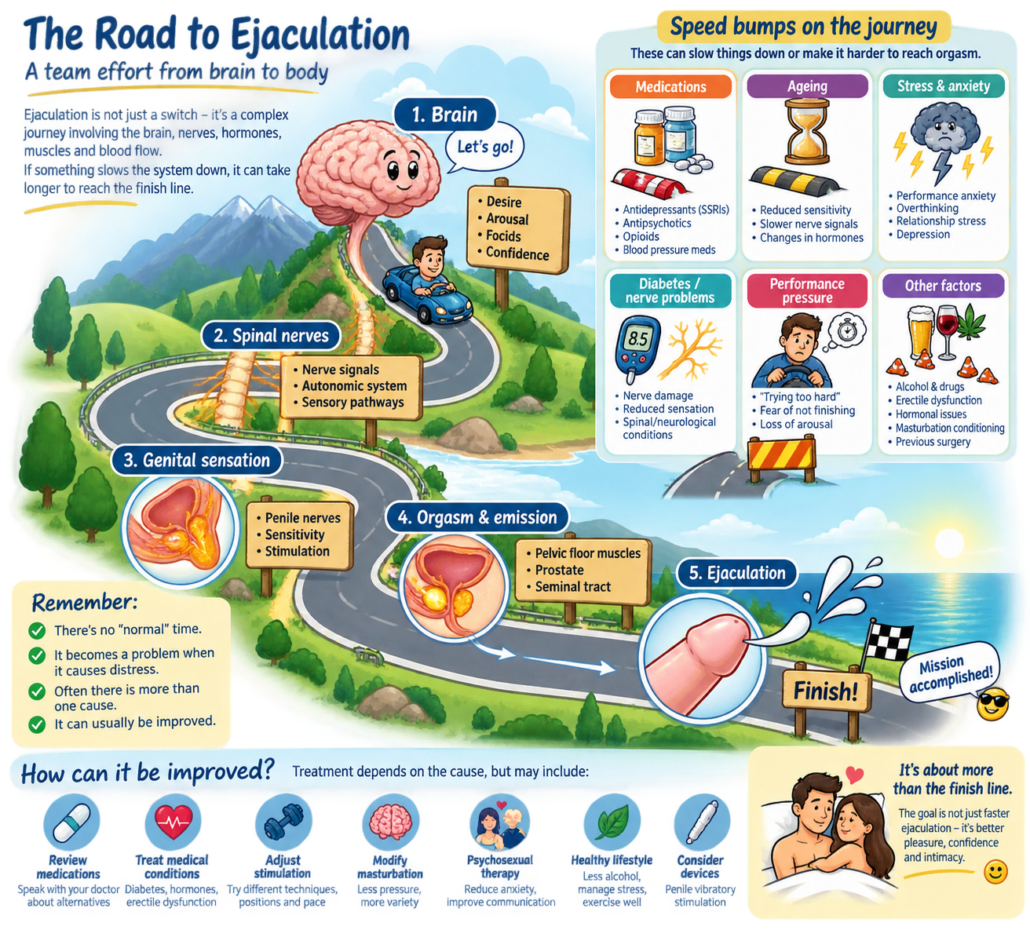
Delayed Ejaculation: When Getting There Takes Longer Than Expected
Delayed ejaculation is a male sexual difficulty in which it takes an unusually long time to reach orgasm and ejaculate, or ejaculation does not occur at all, despite adequate sexual stimulation and the desire to climax.
There is no stopwatch that defines what is “normal”. Some men naturally take longer than others. Delayed ejaculation becomes a problem when the delay is persistent, causes frustration or distress, interferes with sexual enjoyment, or affects a relationship.
At the extreme end of the spectrum, a man may be unable to ejaculate at all. This is known as anejaculation.
The important message is that delayed ejaculation is a genuine sexual health problem. It is often caused by several factors acting together, and in many men it can be improved.
How Long Is Too Long?
There is no universally accepted time limit.
Some clinical definitions have suggested ejaculation taking approximately 25–30 minutes or longer, but time alone does not make the diagnosis.
A man who takes 30 minutes and is perfectly happy may not have a problem. Another man who previously ejaculated within 5–10 minutes and now cannot reach orgasm despite prolonged stimulation may be considerably distressed.
The more useful question is:
“Is ejaculation taking substantially longer than you would like, or have you become unable to ejaculate when you want to?”
Delayed ejaculation may be:
Lifelong – the difficulty has been present since the beginning of a man’s sexual life.
Acquired – ejaculation was previously normal but has become progressively or suddenly more difficult.
It may also be:
Generalised – occurring during masturbation as well as partnered sexual activity.
Situational – occurring only in particular circumstances. For example, a man may be able to orgasm during masturbation but struggle during intercourse.
That distinction can provide an important clue to the underlying cause.
Ejaculation Is More Complicated Than It Looks
Ejaculation is not simply a penile reflex.
Successful orgasm and ejaculation require cooperation between the:
- brain
- spinal cord
- autonomic nervous system
- sensory nerves from the penis
- pelvic floor muscles
- prostate and seminal tract
- hormones
- erectile response
- psychological state
- sexual stimulation and arousal
Think of it as a rather complicated neurological relay race. If one runner slows down, the finish line may suddenly become surprisingly difficult to reach.
What Causes Delayed Ejaculation?
Frequently there is more than one contributing factor.
Medications
Medication is one of the most important reversible causes.
Particular attention should be given to antidepressants, especially selective serotonin reuptake inhibitors (SSRIs) and related medications. These drugs can be extremely effective treatments for depression and anxiety but may significantly delay orgasm and ejaculation.
Other medications that may contribute include certain:
- antidepressants
- antipsychotics
- anti-anxiety medications
- opioid pain medications
- blood pressure medications
- alpha-blockers
- medications acting on the central nervous system
If the problem started after beginning a new medication or increasing its dose, this is worth discussing with your doctor.
Do not stop antidepressants or other prescribed medications suddenly. Medication changes should be discussed with the prescribing doctor.
Ageing and Reduced Penile Sensation
Ejaculation often takes longer with increasing age.
Changes can include reduced penile sensitivity, slower nerve transmission, altered erectile quality and a greater amount of stimulation being required to achieve orgasm.
This does not mean that satisfactory sexual function has an expiry date. It may simply mean that the stimulation that worked at 30 may need some renovation at 60 or 70.
Diabetes and Nerve Problems
Ejaculation depends heavily on normal nerve function.
Conditions that can interfere with these pathways include:
- diabetes
- diabetic neuropathy
- multiple sclerosis
- spinal cord disease or injury
- pelvic nerve injury
- previous major pelvic surgery
- neurological disorders
Diabetes is particularly important because long-standing elevated blood glucose can damage the small autonomic and sensory nerves involved in erection, orgasm and ejaculation.
Hormonal Causes
Hormonal abnormalities occasionally contribute to delayed ejaculation or reduced orgasmic intensity.
These may include:
- testosterone deficiency
- thyroid abnormalities
- prolactin disorders
Low testosterone is more commonly associated with reduced sexual desire and arousal than isolated delayed ejaculation, but hormone testing may be appropriate when other symptoms are present.
Erectile Dysfunction
Erectile dysfunction and delayed ejaculation frequently overlap.
A man may be able to obtain an erection but gradually lose rigidity during prolonged intercourse. Attention then shifts from sexual pleasure to maintaining the erection:
“Am I losing it?”
That thought alone can interrupt arousal.
Treatment of associated erectile dysfunction can therefore sometimes make ejaculation easier.
Psychological and Relationship Factors
The brain is one of the most important sexual organs involved in ejaculation.
Stress, anxiety, depression and relationship difficulties can all interfere with the normal progression from sexual stimulation to arousal, orgasm and ejaculation.
Common contributors include:
- performance anxiety
- relationship conflict
- fear of disappointing a partner
- previous negative sexual experiences
- depression
- general anxiety
- excessive concentration on “trying to finish”
- reduced attraction or sexual excitement
- difficulty communicating sexual preferences
- cultural or religious inhibition surrounding sexuality
A particularly frustrating cycle can develop:
Difficulty ejaculating → trying harder → increased pressure → reduced arousal → even greater difficulty ejaculating.
Sex begins to feel like an examination rather than an experience.
Breaking that cycle can be an important part of treatment.
Masturbation Style and Sexual Conditioning
This is worth discussing openly because it is surprisingly common.
Some men develop a very specific masturbation technique involving a particular:
- pressure
- speed
- grip
- position
- fantasy
- visual stimulus
The nervous system becomes accustomed to that very specific form of stimulation.
Partnered sexual activity may then provide a different type or intensity of stimulation, making orgasm considerably more difficult.
This does not mean masturbation is harmful.
Rather, the issue may be a mismatch between the stimulation the brain has learned to associate with orgasm and the stimulation occurring during partnered sex.
Changing masturbation technique, reducing excessive pressure and introducing greater variation may help.
Alcohol and Recreational Drugs
Small amounts of alcohol may reduce inhibition, but larger quantities can impair:
- erection
- penile sensation
- arousal
- orgasm
- ejaculation
Reducing excessive alcohol intake may therefore improve sexual function.
Previous Pelvic or Prostate Surgery
Operations involving the prostate, bladder neck, pelvis or retroperitoneal nerves can alter ejaculation.
It is important, however, to distinguish delayed ejaculation from retrograde ejaculation or dry orgasm.
Following some prostate procedures, semen may travel backwards into the bladder rather than forwards through the penis.
Following radical prostatectomy, the prostate and seminal vesicles have been removed, so semen is no longer produced and ejaculation cannot occur, although orgasm may still be possible.
These are different conditions and require different counselling.
How Does Delayed Ejaculation Affect a Man?
The physical problem is only part of the story.
Men may experience:
- frustration
- reduced sexual confidence
- performance anxiety
- avoidance of sexual activity
- reduced enjoyment of sex
- difficulty achieving orgasm
- exhaustion during prolonged intercourse
- erection loss before ejaculation
- concerns about masculinity
- fertility difficulties
Some men eventually avoid intimacy because they anticipate another unsuccessful attempt.
That can allow a sexual problem to become a relationship problem.
How Does It Affect a Partner?
Delayed ejaculation can also be difficult for partners.
A partner may incorrectly wonder:
“Does he still find me attractive?”
or:
“Am I doing something wrong?”
Prolonged intercourse can also become physically uncomfortable or exhausting.
Partners may experience:
- frustration
- reduced sexual confidence
- feelings of rejection
- concern about attractiveness
- anxiety about sexual performance
- vaginal discomfort from prolonged intercourse
- reduced intimacy
- relationship tension
This is why communication is so important.
Delayed ejaculation usually should not be interpreted as a measure of attraction, love or the quality of a relationship.
Fertility
Delayed ejaculation can create difficulty when attempting to conceive, particularly when ejaculation cannot occur during vaginal intercourse.
Depending on the cause, options may include collecting semen through masturbation, penile vibratory stimulation or, in selected cases, assisted reproductive techniques.
Men experiencing fertility problems should discuss this specifically with their urologist or fertility specialist.
How Is Delayed Ejaculation Investigated?
The most important investigation is often a good conversation.
Your urologist may ask about:
- when the problem began
- whether it occurs every time
- ejaculation during masturbation
- ejaculation during intercourse
- orgasmic sensation
- penile sensation
- erectile function
- libido
- medications
- alcohol and recreational drugs
- diabetes and neurological conditions
- previous pelvic or prostate surgery
- psychological wellbeing
- relationship factors
- masturbation habits and sexual stimulation
A focused physical examination may also be appropriate.
Blood tests may include, where clinically indicated:
- testosterone
- blood glucose or HbA1c
- thyroid function
- prolactin
- other metabolic investigations
Not every man requires every test. Investigation should be directed by the history.
Can Delayed Ejaculation Be Treated?
Yes, but treatment needs to target the cause.
There is no single tablet that reliably “switches ejaculation back on”.
Management is therefore usually individualised.
1. Review Medications
This is one of the first steps.
If symptoms began after starting an antidepressant or another medication, the prescribing doctor may consider:
- reducing the dose
- changing medication
- altering the treatment regimen
- substituting an alternative drug
This should always be done under medical supervision.
2. Improve Sexual Stimulation
Sometimes the simplest changes are surprisingly useful.
Experimenting with different:
- sexual positions
- stimulation techniques
- pace
- pressure
- manual stimulation
- oral stimulation
- vibratory stimulation
- sexual settings
may increase arousal sufficiently to trigger orgasm.
The goal is not necessarily more stimulation. It is finding the right stimulation.
3. Modify Masturbation Technique
If orgasm is easy during masturbation but difficult with a partner, consider whether masturbation provides a type of stimulation that partnered sex cannot reproduce.
Reducing grip pressure, changing technique and introducing greater variety can sometimes help retrain the sexual response.
4. Penile Vibratory Stimulation
A penile vibrator can provide strong, consistent sensory stimulation and may be useful for selected men, particularly those with reduced penile sensation or neurological impairment.
This can sometimes be incorporated into partnered sexual activity rather than being viewed purely as a medical device.
5. Treat Erectile Dysfunction
If maintaining an erection is part of the problem, treating erectile dysfunction may improve the overall sexual response.
Depending on the individual, this may include lifestyle modification, oral erectile medications or other erectile dysfunction treatments.
6. Address Hormonal Problems
Testosterone replacement may be appropriate when genuine testosterone deficiency has been demonstrated and the patient has compatible symptoms.
Testosterone should not simply be prescribed as a general treatment for delayed ejaculation when testosterone levels are normal.
The Role of Psychology and Sex Therapy
Psychological input can be extremely valuable.
This does not mean the problem is imaginary.
Sexual function sits at the intersection of neurology, hormones, physical sensation, emotion, attention and relationships. Treating only one component can sometimes miss half the picture.
A psychologist or sex therapist experienced in sexual medicine can help address:
- performance anxiety
- excessive focus on ejaculation
- relationship difficulties
- communication
- sexual expectations
- anxiety or depression
- sexual inhibition
- mismatched sexual stimulation
- problematic sexual conditioning
Couples-based therapy can be particularly useful because delayed ejaculation frequently affects both partners.
One important therapeutic goal is to shift the focus away from:
“I have to ejaculate.”
and back towards:
“We are here to enjoy sexual intimacy.”
Paradoxically, removing the pressure to orgasm can sometimes make orgasm considerably easier.
Are There Medications Specifically for Delayed Ejaculation?
At present, there is no medication with strong evidence as a universally effective treatment for delayed ejaculation.
A number of medications have been investigated or used off-label, including drugs that influence dopamine, serotonin and other neurotransmitter systems.
However, evidence for these treatments remains limited and inconsistent.
For this reason, medication should generally be considered only after identifying and addressing reversible causes, and patients should understand the limitations and potential side effects.
Be cautious of internet advertisements promising a guaranteed pharmaceutical cure. Ejaculation has unfortunately not yet been reduced to an on/off button.
What Can I Do to Improve It?
A practical starting plan is:
- Review your medications with your doctor.
- Check for erectile dysfunction, diabetes, neurological or hormonal problems.
- Reduce excessive alcohol consumption.
- Stop timing yourself. Sexual performance is not an Olympic event.
- Discuss the problem openly with your partner.
- Experiment with different stimulation and sexual positions.
- Consider modifying a very intense or repetitive masturbation technique.
- Consider vibratory stimulation if additional penile stimulation is helpful.
- Address anxiety, stress and relationship issues.
- Consider psychosexual or couples therapy when psychological or relationship factors are contributing.
When Should I See a Urologist?
Consider seeking assessment if:
- ejaculation has become substantially slower than previously
- you frequently cannot ejaculate
- you can ejaculate during masturbation but not with a partner
- orgasm has become weaker or absent
- penile sensation has changed
- you have associated erectile dysfunction
- symptoms began after medication changes
- you have diabetes or neurological disease
- the problem is affecting your relationship
- you are trying to conceive
A sudden unexplained change in sexual function deserves medical assessment rather than simply being attributed to ageing.
Is There Hope?
Absolutely.
Delayed ejaculation can be frustrating precisely because the solution is not always a single medication or procedure. But that also means there are often several areas in which improvement can be made.
For some men, changing a medication makes a dramatic difference. For others, treating erectile dysfunction, improving penile stimulation, changing masturbation habits or addressing testosterone deficiency helps.
For many men, the greatest improvement comes from combining physical treatment with psychosexual strategies and better communication between partners.
The aim is not necessarily to achieve ejaculation within a particular number of minutes.
The aim is to restore pleasure, confidence, intimacy and control.
If ejaculation has become difficult, excessively delayed or impossible, speak with your GP, urologist or sexual medicine specialist. A careful assessment can often identify contributing factors and provide a pathway towards improvement.
This information is intended for general patient education and does not replace individual medical advice.


Leave a Reply
Want to join the discussion?Feel free to contribute!