
Vaginal Atrophy: How Menopause Can Affect the Bladder, Infections and Incontinence
Vaginal dryness after menopause is common, but it is not “just part of getting older” and does not need to be silently tolerated.
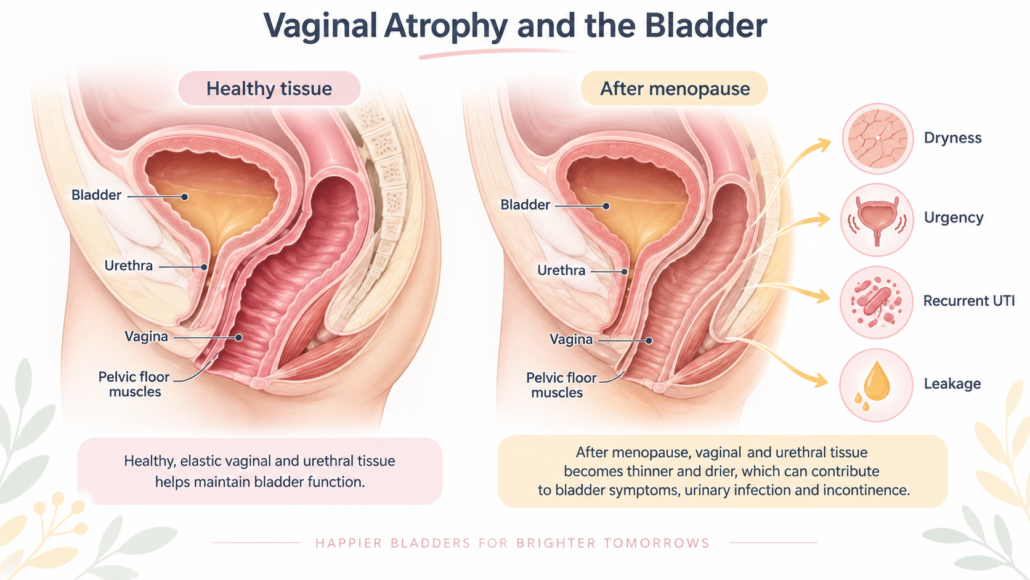
The modern medical term is genitourinary syndrome of menopause (GSM). This recognises that falling oestrogen levels affect not only the vagina and vulva, but also the urethra, bladder and pelvic floor. Symptoms may therefore include dryness or painful intercourse as well as urinary urgency, recurrent urinary tract infections and leakage.
GSM is usually a chronic condition. Unlike hot flushes, it often persists or gradually worsens without treatment. Fortunately, several effective management options are available.
What causes vaginal atrophy?
Before menopause, oestrogen helps keep the vaginal and lower urinary-tract tissues:
- Thick, elastic and well lubricated
- Well supplied with blood
- Naturally acidic
- Populated by protective Lactobacillus bacteria
- More resistant to irritation and infection
When oestrogen levels fall, most commonly during perimenopause and after menopause, the vaginal lining becomes thinner, drier and less elastic. The vaginal pH rises and the protective bacterial balance changes.
Similar changes can occur after removal of the ovaries, during breastfeeding, or following some treatments for breast or gynaecological cancer.
What symptoms can vaginal atrophy cause?
Symptoms vary considerably and may include:
Vaginal and vulval symptoms
- Dryness, burning or irritation
- Itching or tenderness
- Discomfort when sitting, walking or exercising
- Pain during or after intercourse
- Light bleeding following intercourse
- Reduced lubrication or altered sexual sensation
Bladder and urinary symptoms
- Urinary urgency
- Passing urine more frequently
- Waking at night to urinate
- Burning or stinging when passing urine
- Recurrent urinary tract infections
- Urge incontinence
- Worsening stress urinary incontinence in some women
These symptoms can overlap with infection, overactive bladder, pelvic-floor dysfunction, skin disorders and, occasionally, more serious conditions. Persistent or recurrent symptoms should therefore be properly assessed rather than repeatedly treated with antibiotics without confirmation.
Why can vaginal atrophy increase urinary infections?
The vagina, urethra and bladder are closely connected anatomically and hormonally.
After menopause, loss of protective vaginal bacteria and an increase in vaginal pH may make it easier for bowel bacteria, particularly E. coli, to colonise the vaginal opening and enter the urinary tract. Thinning around the urethra may further reduce its natural defence against infection.
Low-dose vaginal oestrogen can help restore healthier tissue and a more protective vaginal environment. For appropriately selected peri- and postmenopausal women with recurrent urinary tract infections, it can reduce the likelihood of further infections.
However, not every episode of burning or urgency is a UTI. Whenever practical, recurrent episodes should be confirmed with a midstream urine culture before antibiotics are prescribed.
How does vaginal atrophy affect continence?
Oestrogen-sensitive tissue is present around the urethra, bladder neck, vagina and pelvic floor. Oestrogen deficiency may contribute to:
- Increased bladder sensitivity
- Sudden urgency
- Increased urinary frequency
- Urge-related leakage
- Urethral irritation
- Reduced tissue support around the urethra
Treating GSM may improve urgency, frequency, discomfort and recurrent infection. Some women also report improved continence.
Vaginal oestrogen is not, however, a complete treatment for all urinary leakage. Stress incontinence: leakage with coughing, laughing, exercise or lifting, often requires pelvic-floor physiotherapy and sometimes additional medical or surgical management.
How is GSM assessed?
Assessment may include:
- A careful symptom and medical history
- Medication review
- Pelvic examination
- Urine testing and culture
- Bladder diary
- Assessment of pelvic-floor function
- Measurement of residual urine after voiding
- Evaluation for prolapse, skin conditions or urethral abnormalities
Further tests such as ultrasound, cystoscopy or urodynamic studies are not required for every woman. They may be recommended when symptoms are complicated, recurrent, associated with blood in the urine, or not responding as expected.
Any postmenopausal bleeding, unexplained blood-stained discharge, visible blood in the urine, pelvic mass, ulcer or persistent vulval lesion requires prompt assessment.
Management options
Treatment should be individualised according to the symptoms, examination findings, medical history and personal preferences.
Vaginal moisturisers
A vaginal moisturiser is used regularly, often several times per week, to improve ongoing hydration. It is different from a lubricant and may be sufficient for mild symptoms.
Avoid perfumed products, douches and harsh soaps, which can worsen irritation.
Lubricants
Water- or silicone-based lubricants can reduce friction during sexual activity. These provide short-term relief but do not reverse the underlying tissue changes.
Pelvic-floor physiotherapy
Pelvic-floor physiotherapy may assist women with:
- Stress or urge incontinence
- Pelvic-floor weakness
- Pelvic-floor overactivity or pain
- Painful intercourse
- Difficulty coordinating bladder control
Importantly, more squeezing is not always better. Some women have an overactive or painful pelvic floor and need relaxation and coordination work rather than simply stronger contractions.
Bladder-directed treatment
Persistent overactive-bladder symptoms may require bladder training, fluid and caffeine modification, medication, intravesical Botox or sacral neuromodulation. Stress incontinence may require additional treatments ranging from supervised physiotherapy to bulking injections or surgery.
Topical vaginal oestrogen: what role does it play?
Low-dose vaginal oestrogen is one of the most effective treatments for moderate or persistent GSM. It is available in different preparations, including vaginal cream, tablets or pessaries.
It acts mainly within the vagina and surrounding urinary tissues. Treatment may:
- Improve dryness, burning and irritation
- Restore tissue thickness and elasticity
- Reduce pain during intercourse
- Improve urethral discomfort
- Reduce urinary urgency and frequency in some women
- Lower the risk of recurrent UTIs
- Complement other treatments for bladder symptoms
Treatment commonly begins with a short loading phase followed by a lower-frequency maintenance schedule. The exact regimen depends on the product prescribed. Improvement may begin within several weeks, but the full benefit can take several months.
Because GSM is usually ongoing, symptoms commonly return when treatment is stopped.
Is topical vaginal oestrogen safe?
For most women, low-dose vaginal oestrogen has minimal absorption into the bloodstream and has a substantially different risk profile from systemic menopausal hormone therapy.
At standard low doses:
- A progestogen is generally not required solely to protect the uterus.
- It has not been shown to carry the same blood-clot risk as oral systemic oestrogen.
- Long-term treatment can be considered when symptoms persist, with periodic clinical review.
Possible adverse effects include local irritation, discharge, breast tenderness or spotting, although these are uncommon.
Unexpected postmenopausal bleeding should never simply be attributed to the oestrogen. It requires investigation.
What if I have had breast cancer?
This requires an individual discussion.
Non-hormonal treatments are usually considered first. If symptoms remain troublesome, low-dose vaginal oestrogen may sometimes be considered after shared decision-making with the patient’s treating team. Particular caution is required for women taking an aromatase inhibitor, because even small changes in circulating oestrogen may be clinically important.
Women should not stop cancer medication or commence vaginal hormones without discussing this with their oncologist, breast surgeon, GP or menopause specialist. Current specialist guidance recognises that low-dose vaginal oestrogen may be reasonable for selected women when non-hormonal measures have failed, but the decision must be personalised.
MonaLisa Touch laser therapy—and why it remains controversial
MonaLisa Touch is a branded fractional carbon-dioxide laser treatment applied inside the vagina. The laser delivers controlled thermal energy to the vaginal lining with the aim of stimulating healing, collagen formation and tissue remodelling.
It is commonly promoted as a “non-hormonal” treatment for vaginal dryness, burning, painful intercourse and some urinary symptoms. A course generally involves several treatments followed by possible maintenance sessions.
Although some women report improvement, vaginal laser therapy remains controversial.
Why has it become popular?
Vaginal laser treatment may appeal to women who:
- Prefer not to use vaginal oestrogen
- Have not improved with moisturisers or lubricants
- Have concerns about hormone treatment
- Have experienced symptoms following breast-cancer treatment
- Prefer a procedure rather than ongoing medication
Early uncontrolled studies reported encouraging improvements. However, uncontrolled studies cannot reliably separate the true treatment effect from placebo response, increased clinical attention, lubricants used during treatment or natural variation in symptoms.
The gap between marketing and evidence
The greatest controversy is the difference between strong commercial claims and the quality of the supporting clinical evidence.
Some clinics advertise vaginal laser therapy as “rejuvenation” or suggest it can restore vaginal tissue, improve sexual function, prevent infections and treat urinary incontinence. These claims are broader than the available evidence supports.
More rigorous randomised studies, particularly those comparing laser treatment with a sham procedure, have not consistently shown a clinically meaningful benefit. The 2025 joint AUA/SUFU/AUGS guideline concluded that fractional CO₂ laser may produce little or no difference in several GSM symptoms compared with sham treatment or vaginal oestrogen. AUA/SUFU/AUGS guideline
The RACGP also notes that the long-term effectiveness and safety of vaginal laser therapy have not been established.
Regulatory concerns
Regulators have raised concerns about energy-based vaginal treatments being promoted for indications that have not been adequately supported by clinical evidence.
A device being legally supplied or registered for a particular use does not necessarily mean that every advertised claim, such as treating incontinence, preventing UTIs or providing “vaginal rejuvenation”, has been independently proven.
Regulatory reviews in Australia and warnings internationally have focused on:
- Insufficient high-quality evidence of effectiveness
- Lack of reliable long-term safety information
- Promotion extending beyond authorised indications
- The possibility of women being exposed to an expensive procedure before established treatments have been tried
Patients should be cautious about phrases such as “TGA approved.” Inclusion of a device on the Australian Register of Therapeutic Goods does not amount to endorsement of every clinical or advertising claim.
Possible complications
Vaginal laser is often described as painless or risk-free, but possible adverse effects include:
- Burning or prolonged irritation
- Vaginal pain
- Bleeding or discharge
- Infection
- Pain during intercourse
- Urinary discomfort
- Tissue burns
- Scarring or narrowing of the vagina
- Persistence or worsening of the original symptoms
The true frequency of uncommon or delayed complications is uncertain because long-term data remain limited.
Does it treat urinary incontinence or prevent UTIs?
Evidence that vaginal laser reliably treats urinary incontinence is insufficient. Small studies have reported improvements, but many lacked sham controls, had short follow-up or used subjective outcomes.
It should not be presented as an established treatment for stress urinary incontinence, overactive bladder or recurrent UTIs. These conditions require an accurate diagnosis and may respond to better-supported treatments such as:
- Pelvic-floor physiotherapy
- Bladder training
- Low-dose vaginal oestrogen
- Overactive-bladder medication
- Continence procedures or surgery
- UTI-prevention strategies based on urine-culture results
What about women who cannot use oestrogen?
Vaginal laser is sometimes marketed directly to breast-cancer survivors. This is particularly controversial because these women may be vulnerable to claims that a costly procedure is their only non-hormonal option.
Non-hormonal moisturisers, lubricants, pelvic-floor therapy and multidisciplinary care should be considered first. Selected women with a history of breast cancer may also be able to use low-dose vaginal oestrogen after shared decision-making with their oncologist and treating specialists.
Laser should not automatically be assumed to be safer simply because it is “non-hormonal.” Hormonal exposure is avoided, but procedural risks and uncertainty about long-term effects remain.
Cost and conflicts of interest
Vaginal laser therapy is generally privately funded and may require an initial treatment course followed by maintenance sessions. Patients should be told the total likely cost and the possibility that any improvement may be temporary.
Some published studies have had small sample sizes, limited follow-up or connections with device manufacturers. This does not automatically invalidate the findings, but it reinforces the need for independent, sham-controlled and long-term research.
The UGSA and USANZ perspective
The Urogynaecological Society of Australasia (UGSA) and the Urological Society of Australia and New Zealand (USANZ) support evidence-based assessment and management of pelvic-floor and urinary disorders.
At the time of writing, publicly accessible UGSA or USANZ guideline specifically endorsing MonaLisa Touch for GSM, recurrent UTIs or urinary incontinence could not be found. The treatment should therefore not be described as endorsed by either organisation.
A balanced conclusion
Some women report meaningful improvement after MonaLisa Touch treatment, and research into vaginal energy-based therapy is continuing. These experiences should not be dismissed. However, individual improvement does not establish that the treatment is consistently effective, superior to placebo or safe over many years.
At present, MonaLisa Touch should not be considered first-line treatment for GSM, urinary incontinence or recurrent UTIs. If it is being considered, patients should receive balanced counselling that includes:
- The limited and conflicting evidence
- The absence of reliable long-term safety data
- Possible adverse effects
- Treatment costs and likely maintenance requirements
- Established alternatives, particularly low-dose vaginal oestrogen
- The clinician’s experience and any financial relationship with the device provider
Ideally, treatment should be provided by an appropriately trained medical practitioner following a proper pelvic and urinary assessment, with clear consent and structured follow-up. Participation in a well-designed clinical trial is preferable where available.
When should you seek medical advice?
Please arrange an assessment if you have:
- Recurrent or persistent UTI symptoms
- Blood in the urine
- Postmenopausal vaginal bleeding
- New or worsening urinary leakage
- Difficulty emptying the bladder
- Persistent vaginal, vulval or pelvic pain
- Pain during intercourse
- A lump, ulcer or skin change
- Symptoms that have not improved with simple measures
The take-home message
Vaginal atrophy is better understood as genitourinary syndrome of menopause because it can affect the vagina, urethra, bladder, continence and susceptibility to infection.
Low-dose vaginal oestrogen is an effective and generally safe treatment for most women and can be particularly valuable for recurrent UTIs and urinary symptoms associated with menopause. Women with previous hormone-sensitive cancer require individualised advice.
MonaLisa Touch and similar vaginal laser therapies remain less well supported. Their long-term benefits and safety are uncertain, and they should not replace proper assessment or established treatments.
This information is general and does not replace individual medical advice. Treatment should be selected after discussion with your GP, urologist, urogynaecologist, gynaecologist or menopause specialist.


Leave a Reply
Want to join the discussion?Feel free to contribute!