
Artificial Urinary Sphincter After Prostatectomy: Restoring Control After Male Stress Incontinence
Urinary leakage after prostate surgery can be frustrating, embarrassing and restrictive. When persistent leakage is caused by weakness of the urinary sphincter, an artificial urinary sphincter (AUS) is often the most reliable surgical treatment—particularly for moderate or severe stress urinary incontinence.
However, not every man who leaks after prostatectomy has the same problem. Before inserting an AUS, it is essential to establish why the leakage is occurring. An AUS treats sphincter weakness; it does not directly treat an overactive bladder.
Why can incontinence occur after prostatectomy?
Urinary continence normally depends on several structures working together:
- The external urinary sphincter closing the urethra
- Healthy supporting tissues around the urethra
- A bladder that stores urine at a safe pressure
- Coordinated bladder and sphincter function
- Adequate pelvic-floor muscle control
During radical prostatectomy, the prostate and part of the internal continence mechanism are removed. Although every effort is made to preserve the external sphincter, it may be weakened by surgical dissection, altered support, scarring or nerve injury.
Radiotherapy, previous urethral surgery, bladder-neck contracture and urethral stricture may further affect continence and tissue quality.
Stress incontinence or overactive bladder?
This distinction is critical because the treatments are different.
Stress urinary incontinence
Stress incontinence typically causes leakage with:
- Coughing or sneezing
- Standing from a chair
- Walking or exercising
- Lifting
- Bending
- Changing position
- A full bladder
- Sexual activity
The leakage is usually caused by inadequate closure of the urinary sphincter. This is the type of incontinence that an AUS is designed to treat.
Overactive bladder
Overactive bladder generally causes:
- A sudden, difficult-to-defer need to urinate
- Frequent urination
- Waking several times at night
- Leakage before reaching the toilet
- Leakage triggered by running water, arriving home or putting the key in the door
These symptoms may result from involuntary bladder contractions, reduced bladder capacity, bladder irritation, infection, obstruction or changes in bladder function that existed before the prostate operation.
Some men have mixed incontinence, with both stress leakage and urinary urgency. An AUS may improve the stress component while urgency, frequency or urge leakage persists and requires separate treatment.
Assessment before considering an AUS
A careful evaluation helps confirm that sphincter weakness is the principal cause of leakage and identifies conditions that should be treated before implantation.
Assessment may include:
- A detailed symptom and surgical history
- Physical examination
- Urinalysis and urine culture
- A bladder or voiding diary
- Pad-use assessment or a formal pad-weight test
- Measurement of urinary flow and residual urine
- Cystoscopy to examine the urethra, sphincter region and bladder neck
- Urodynamic studies in selected patients
Any urinary infection, bladder-neck contracture or urethral stricture should usually be treated and shown to be stable before an AUS is inserted.
The role of urodynamic studies
Urodynamics evaluates how the bladder stores and empties urine. It may help identify:
- Genuine stress urinary incontinence
- Detrusor overactivity or overactive bladder contractions
- Poor bladder compliance or unsafe storage pressures
- Reduced bladder capacity
- Weak bladder contraction
- Bladder-outlet obstruction
- Mixed stress and urgency incontinence
Urodynamics is not necessarily required for every straightforward case. Current guidelines support its selective use when the diagnosis is uncertain or when the findings could change management.
It is particularly useful when a man has:
- Marked urgency or urge leakage
- Difficulty emptying his bladder
- An elevated residual urine volume
- Previous radiotherapy
- Previous surgery for a urethral stricture or bladder-neck contracture
- Neurological disease
- Unexplained or mixed urinary symptoms
- Leakage that does not follow a typical stress-incontinence pattern
Finding detrusor overactivity does not automatically exclude AUS surgery. It allows the patient and surgeon to set realistic expectations and determine whether bladder-directed treatment should be given before or after the procedure.
What is an artificial urinary sphincter?
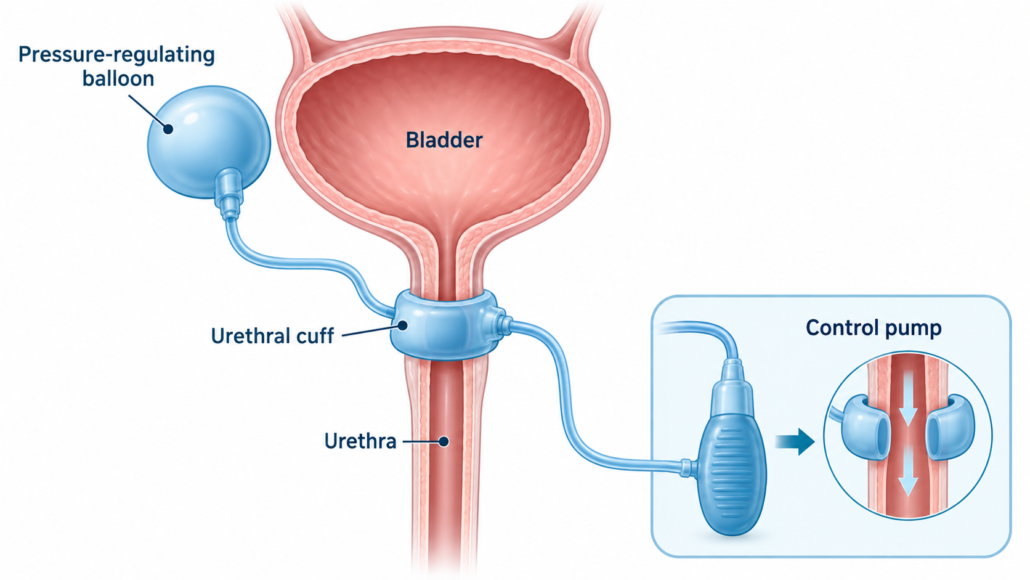
An AUS is a fluid-filled hydraulic device with three main components:
- Urethral cuff: placed around the urethra to keep it gently closed.
- Control pump: positioned inside the scrotum, where it can be felt and operated through the skin.
- Pressure-regulating balloon: usually placed in the lower abdomen or pelvis.
The cuff remains closed during normal activities and prevents urine from leaking. To urinate, the patient squeezes the scrotal pump. This temporarily transfers fluid out of the cuff, allowing the urethra to open. The cuff then automatically refills over the following few minutes.
The device is entirely internal. Nothing normally remains outside the body.
Who may benefit from an AUS?
An AUS may be considered when:
- Stress incontinence persists despite pelvic-floor rehabilitation
- Leakage significantly affects work, exercise, travel, sleep, relationships or quality of life
- Incontinence is moderate or severe
- The patient has undergone prostatectomy or other prostate treatment
- The urethra and bladder neck are open and stable
- Urinary infection has been excluded
- Bladder storage and emptying are sufficiently safe
- The patient understands that the implant may eventually require revision
- The patient has enough hand strength and dexterity to operate the pump
Guidelines recommend discussing AUS surgery with men experiencing persistent stress incontinence after prostate treatment, including selected men with mild leakage who prefer this option.
Surgery is usually deferred while natural recovery is still occurring. Incontinence that remains troublesome at approximately six months and is not improving may justify earlier discussion, while definitive surgery is commonly considered by 12 months after prostatectomy.
When may an AUS be unsuitable?
An AUS may not be appropriate when there is:
- Active urinary infection
- An untreated or unstable urethral stricture
- Recurrent bladder-neck obstruction
- Active urethral erosion
- Inability to operate the scrotal pump
- Severe cognitive impairment
- An unsafe, poorly compliant bladder that has not been addressed
- A continuing need for frequent urethral catheterisation or instrumentation
Previous pelvic radiotherapy does not necessarily prevent AUS implantation. However, radiated tissues may heal less reliably and have a higher risk of erosion, infection and future revision.
What happens during and after surgery?
The operation is performed under anaesthesia. The cuff is commonly placed around the bulbar urethra through an incision in the perineum, with the pump positioned in the scrotum and the balloon placed in the lower abdomen or pelvis.
The AUS is normally left deactivated while the tissues heal. It is commonly activated approximately four to six weeks later, depending on the patient’s recovery and the surgeon’s protocol.
Until activation, urinary leakage is expected to continue.
Patients are then taught how to:
- Locate and operate the pump
- Empty the bladder without repeatedly squeezing the pump
- Recognise whether the device has cycled normally
- Explain the implant to other healthcare providers
- Seek assistance if catheterisation or urinary procedures are required
How successful is an AUS?
The AUS is regarded as the standard surgical treatment for moderate-to-severe male stress incontinence after prostatectomy. Most men experience a substantial reduction in leakage and improvement in quality of life.
“Success” does not always mean being completely pad-free. Many men achieve social continence, generally described as using no more than one small security pad per day. Results vary according to previous radiotherapy, urethral surgery, tissue quality, severity of leakage and how success is defined.
An AUS is a mechanical implant rather than a permanent cure. Device survival decreases over time, and some men will eventually require revision or replacement.
Possible complications
Potential complications include:
- Bleeding, bruising or haematoma
- Temporary urinary retention
- Wound or device infection
- Difficulty locating or operating the pump
- Persistent stress leakage
- Ongoing urgency or urge incontinence
- Urethral cuff erosion
- Urethral tissue thinning or atrophy
- Mechanical malfunction or fluid leakage
- Pump or component migration
- Pain
- Need for revision, replacement or removal
Infection and erosion generally require removal of part or all of the device. A new AUS may sometimes be inserted after the urethra has healed, but repeat surgery can be more complex.
Warning signs of cuff erosion or device infection
Urethral erosion occurs when the cuff gradually damages or enters the urethral wall. It may develop months or years after implantation.
Seek prompt urological review if you notice:
- New pain or burning during urination
- Blood in the urine
- Recurrent urinary infections
- Increasing perineal, urethral or scrotal discomfort
- New swelling, redness, warmth or discharge around an incision
- Fever or feeling generally unwell
- Difficulty passing urine
- A noticeably weaker urinary stream
- Sudden urinary retention
- A sudden return or marked worsening of leakage
- The pump becoming unusually difficult to operate
- Part of the device becoming visible through the skin or urethra
Fever, urinary retention, marked swelling, severe pain or an exposed implant requires urgent medical assessment.
Important precautions after AUS implantation
Always tell healthcare providers about the AUS
A urethral catheter must not be inserted while the cuff is activated. Forcing a catheter through a closed cuff may damage the urethra and cause erosion.
Before catheterisation, cystoscopy or any procedure through the urethra:
- The AUS must be identified
- The cuff must be fully deactivated
- The smallest appropriate catheter should be used
- Prolonged urethral catheterisation should be avoided when possible
- The treating team should contact a urologist if they are unfamiliar with the device
Patients should consider carrying a medical alert card or wearing medical identification stating:
“Artificial urinary sphincter present, deactivate before urethral catheterisation.”
Protect the urethra and implant
Patients should also:
- Avoid operating the pump until instructed after surgery
- Follow restrictions on lifting, exercise, cycling and sexual activity during healing
- Avoid unnecessary urethral instrumentation
- Report urinary infections promptly
- Attend follow-up if leakage increases or the device behaves differently
- Tell their urologist about future pelvic procedures
- Never repeatedly squeeze the pump in an attempt to overcome urinary obstruction
What if the AUS fails?
The first step is to determine the reason. Recurrent leakage may be caused by:
- Mechanical device failure
- Loss of fluid from the system
- Incomplete cuff closure
- Urethral tissue thinning beneath the cuff
- Cuff erosion
- Device infection
- A urethral or bladder-neck obstruction
- Overactive bladder rather than sphincter failure
- Incorrect device use
Assessment may include examination of the pump, urinalysis, cystoscopy, imaging, pad testing and sometimes repeat urodynamics.
Depending on the cause, options include:
- Teaching or correcting pump technique
- Treating overactive bladder separately
- Revising or replacing a malfunctioning component
- Replacing the entire AUS
- Changing cuff size or position
- Moving the cuff to a healthier section of urethra
- Tandem-cuff or transcorporal techniques in carefully selected complex cases
- Removing the device when infection or erosion is present
- Allowing the urethra to heal before considering reimplantation
- Considering a male sling in selected men with mild recurrent stress leakage
- External collecting devices, continence clamps, absorbent products or long-term catheter options when further implant surgery is unsuitable
Men with prior radiotherapy, erosion or multiple urethral operations may require individualised reconstructive planning.
A final perspective
An artificial urinary sphincter can be life-changing for men with persistent stress urinary incontinence after prostatectomy. Its success depends on more than inserting a device: the correct cause of leakage must first be established.
Stress incontinence, overactive bladder, obstruction and poor bladder emptying can coexist. A careful history, objective assessment, cystoscopy and selective urodynamic testing allow treatment to be tailored to the individual patient.
Patients should understand that an AUS requires manual operation, lifelong precautions and possible future revision. With appropriate patient selection, careful surgery and ongoing follow-up, it remains one of the most effective treatments available for male post-prostatectomy stress incontinence.
So, if you suffer with post prostatectomy urinary incontinence, come see your Brisbane based functional urologist, Jo Schoeman to discuss this option.
References
- American Urological Association, GURS and SUFU. Incontinence after Prostate Treatment: Clinical Guideline, amended 2024.
- Breyer BN, Kim SK, Kirkby E, et al. Updates to Incontinence After Prostate Treatment: AUA/GURS/SUFU Guideline Amendment 2024. Journal of Urology. 2024.
- European Association of Urology. EAU Guidelines on Non-neurogenic Male Lower Urinary Tract Symptoms—Disease Management.
- European Association of Urology. EAU guidance: What happens when the artificial urinary sphincter fails?.
- Johnson A, Abraham N, Chughtai B. Artificial urinary sphincters for moderate post-prostatectomy incontinence: current research and proposed approach. Journal of Clinical Medicine. 2023.
- Desai TJ, Rozanski AT. Artificial urinary sphincter erosion and infection: a contemporary review of perioperative considerations and management. Translational Andrology and Urology. 2024.
- Continence Foundation of Australia. Male urinary incontinence.
This information is intended for general education and does not replace individual medical assessment. Suitability for an AUS should be discussed with a urologist experienced in male continence and reconstructive surgery.

Leave a Reply
Want to join the discussion?Feel free to contribute!