Testicular Torsion: When a Testicle Takes a Very Wrong Turn
Sudden testicular pain is an emergency. This is not a “wait until tomorrow and see how it goes” situation.
There are few occasions in life when being twisted is definitely not a good thing. Testicular torsion is one of them.
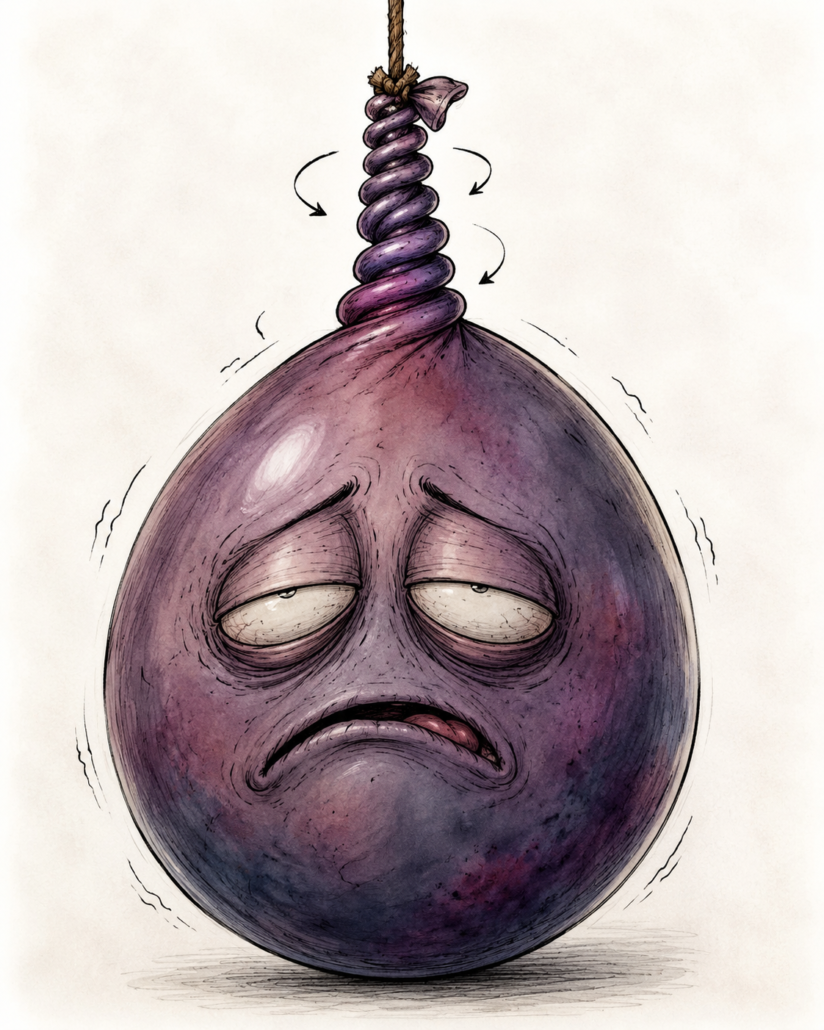
Testicular torsion occurs when a testicle rotates around the spermatic cord, twisting the blood vessels that supply it. Think of a garden hose being twisted until the water stops flowing, except this particular hose supplies a rather important piece of anatomy.
The result can be sudden, severe pain and, if the blood supply is not restored quickly enough, permanent damage or loss of the testicle.
The good news is that prompt treatment can often save the testicle. The important word here is prompt.
Sudden severe testicular pain should be treated as testicular torsion until proven otherwise. Go directly to an Emergency Department.
What exactly is testicular torsion?
Normally, each testicle has enough mobility to accommodate everyday movement without being able to rotate freely.
Some boys and men have an anatomical arrangement commonly called a “bell-clapper” deformity, in which the testicle is more mobile within the scrotum than usual. This allows it to rotate around the spermatic cord.
When the cord twists, venous drainage is obstructed first, followed by arterial blood flow. The testicle becomes swollen, increasingly painful and eventually starved of oxygen.
This is why testicular torsion is a time-critical surgical emergency.
Although torsion is particularly common in adolescents, it can occur at almost any age, including infancy and adulthood.
What does testicular torsion feel like?
The classic presentation is difficult to ignore:
- Sudden onset of severe pain in one testicle
- Rapidly increasing scrotal pain or swelling
- A testicle sitting higher than usual or lying at an unusual angle
- Lower abdominal or groin pain
- Nausea and vomiting
- Marked tenderness of the affected testicle
- Occasionally pain that wakes someone from sleep
Some patients experience previous episodes of sudden testicular pain that disappear spontaneously. This may represent intermittent torsion, where the testicle twists and then untwists itself.
A disappearing pain does not necessarily mean that the problem has disappeared.
The clock starts ticking immediately
With torsion, time matters.
The two major factors determining whether a testicle survives are how long it has been twisted and how tightly the spermatic cord has rotated. Current European Association of Urology guidance recommends surgical exploration as soon as possible and notes that the best outcomes occur with very early intervention, ideally within approximately 4–6 hours of symptom onset.
There isn’t a magical cliff at six hours where the testicle suddenly gives up and packs its bags. Salvage may still be possible later, which is precisely why patients should seek emergency treatment regardless of how long the pain has been present.
Don’t wait to see whether it gets better.
And perhaps more importantly:
Don’t be embarrassed.
Emergency doctors and urologists have seen testicles before. Quite a few of them.
How is testicular torsion diagnosed?
The diagnosis begins with the history and examination.
A doctor will examine the abdomen, groin and scrotum and assess the position, swelling and tenderness of the affected testicle.
A Doppler ultrasound can assess blood flow to the testicle and is extremely useful when the diagnosis is uncertain.
However, there is an important catch.
An ultrasound should not delay surgery when torsion is strongly suspected.
The EAU specifically recommends that Doppler ultrasound be used as an adjunct without delaying intervention.
In other words, when the clinical picture is shouting “torsion”, we shouldn’t spend precious time politely asking the ultrasound machine for a second opinion.
Can the testicle simply be untwisted?
Sometimes a doctor can attempt manual detorsion while arrangements for surgery are being made.
This involves carefully rotating the testicle in the direction that releases the twist. Relief of pain may be dramatic when successful.
But this is important:
Successful manual detorsion does not replace surgery.
Residual twisting may remain even when the pain improves, and the testicle can twist again. EAU guidance therefore states that manual detorsion may be attempted while awaiting surgery but must not delay surgical exploration.
Emergency surgery: scrotal exploration
Definitive treatment is an operation called scrotal exploration.
Under anaesthesia, the surgeon makes an incision in the scrotum and examines the affected testicle.
The spermatic cord is untwisted and the testicle is allowed time to recover its blood supply.
Sometimes a rather alarming blue or purple testicle gradually becomes reassuringly pink again. Few colour changes make a urologist happier.
If the testicle appears viable, it is preserved.
Orchiopexy: preventing another twist
If the testicle can be saved, it is secured inside the scrotum using an operation called an orchiopexy or orchidopexy.
The testicle is fixed so that it cannot freely rotate around the spermatic cord again.
But there is another important part of the operation.
We usually fix the other testicle too.
The anatomical predisposition that allowed one testicle to twist may also be present on the opposite side. Therefore, when torsion is confirmed, the unaffected testicle is commonly fixed during the same operation.
Current guidance recommends contralateral orchiopexy at the time of surgery rather than returning later for an elective procedure.
Think of it as discovering that one wheel on the car was loose and sensibly checking the other one while you’re already holding the spanner.
What if the testicle cannot be saved?
Unfortunately, sometimes the blood supply has been absent for too long and the testicular tissue is irreversibly damaged.
If the testicle is clearly non-viable or necrotic, it may need to be removed.
This operation is called an orchidectomy or orchiectomy.
Losing a testicle can understandably be upsetting, particularly for an adolescent or young man. Concerns about appearance, masculinity, testosterone, sexual function and fertility are extremely common.
These concerns deserve a proper conversation rather than a hurried reassurance.
The encouraging news is that one healthy testicle is generally sufficient to maintain normal testosterone production, sexual function and fertility.
What about fertility after testicular torsion?
This subject is more complicated than simply asking whether the testicle survived.
Torsion can damage sperm-producing tissue through the original loss of blood supply and potentially through ischaemia-reperfusion injury when circulation returns.
Long-term studies have therefore reported abnormalities in semen parameters in some men following torsion. The EAU notes reported rates of subfertility of approximately 36–39%, although study results vary considerably and long-term paternity may remain comparable with control populations.
Importantly, having had testicular torsion does not automatically mean that a man will be infertile.
Many men subsequently have normal fertility, particularly when the other testicle is healthy. Studies have also reported normal pregnancy rates following unilateral torsion, whether the affected testicle was preserved or ultimately removed.
For patients concerned about future fertility, particularly after severe torsion, testicular atrophy or problems involving the remaining testicle, subsequent assessment may include:
- Testicular examination and ultrasound
- Measurement of testicular volume
- Semen analysis when appropriate
- Testosterone and reproductive hormone testing
- Fertility counselling where indicated
Can a rescued testicle shrink later?
Unfortunately, yes.
A testicle may look viable during surgery and still subsequently undergo testicular atrophy, becoming smaller over the following months.
Current EAU guidance notes that testicular atrophy can occur even following timely detorsion and fixation, which is why appropriate follow-up is important.
This does not mean the operation failed. The initial period without adequate blood supply may simply have caused microscopic damage that wasn’t visible during surgery.
What about testosterone and sexual function?
For most patients with a normal opposite testicle, testosterone production remains adequate.
Long-term studies suggest that hormonal measurements may differ somewhat following torsion, but overall endocrine testicular function generally remains within the normal range.
Removal of one testicle therefore does not normally cause erectile dysfunction, loss of masculinity or the need for testosterone replacement.
The remaining testicle usually quietly gets on with the job.
Testicular prosthesis: replacing what has been lost
Some patients are bothered by the cosmetic asymmetry following removal of a testicle.
A testicular prosthesis can be placed inside the scrotum to restore a more natural appearance and feel.
The prosthesis does not produce sperm or testosterone. Its purpose is cosmetic and psychological rather than functional.
Depending upon the circumstances, a prosthesis may be inserted during the original operation or at a later date. Prosthesis placement is an established option following orchidectomy, and current EAU guidance recommends that patients undergoing removal of a testicle be offered the opportunity to discuss a testicular prosthesis.
The decision is entirely personal.
Some men want one.
Some don’t.
Both decisions are perfectly reasonable.
Recovery after torsion surgery
Most patients recover relatively quickly following uncomplicated orchiopexy.
There will usually be some swelling, bruising and discomfort for several days. Supportive underwear can be surprisingly valuable during this period. The humble pair of supportive briefs finally gets its moment of glory.
Patients are generally advised to avoid strenuous activity, heavy lifting, cycling and contact sports until healing is satisfactory.
Timing for returning to work, school, sport and sexual activity should be discussed with the treating surgeon because this varies according to the operation and individual recovery.
Could torsion happen again after orchiopexy?
It is unusual, but recurrent torsion after orchiopexy is possible.
The EAU guideline describes recurrence after fixation as rare, but documented.
Therefore, even someone who has previously undergone orchiopexy should seek urgent medical attention if they develop sudden severe testicular pain.
Previous surgery doesn’t grant a testicle diplomatic immunity.
The message worth remembering
Testicular torsion is one of the true emergencies in urology.
If you or your son develops sudden severe pain in one testicle, particularly when associated with swelling, nausea, vomiting or an abnormally positioned testicle:
Don’t wait.
Don’t Google for three hours.
Don’t go to bed hoping it will disappear.
Go to an Emergency Department.
When it comes to testicular torsion, hours matter.
Early surgery may mean the difference between fixing a testicle in place and having to remove it.
And in this particular corner of medicine, keeping both passengers on board is very much the preferred destination.
So, get to your local Emergency Department urgently. I operate out of The Wesley and St Andrews War Memorial hospitals where I am on the on call roster. Ask for your local Brisbane Urologist, Dr Jo Schoeman.
Medical disclaimer
This information is intended for general patient education and does not replace individual medical assessment. Acute or sudden testicular pain requires urgent medical evaluation. If testicular torsion is suspected, attend an Emergency Department immediately. Your local Brisbane Urologist is on an on-call roster at both the Wesley Hospital and St Andrews War Memorial Hospital. Don’t delay!


Leave a Reply
Want to join the discussion?Feel free to contribute!