
Dissolution Therapy for Uric Acid Kidney Stones: Can You Really Dissolve a Stone?
Most kidney stones need to be passed, fragmented or surgically removed. Uric acid stones are different.
Unlike calcium-based stones, a true uric acid stone can often be chemically dissolved inside the urinary tract simply by changing the acidity of the urine. This treatment is known as oral dissolution therapy, urinary alkalinisation or oral chemolysis.
For appropriately selected patients, it can mean avoiding ureteroscopy, laser treatment, shock-wave lithotripsy or percutaneous surgery altogether.
What is a uric acid stone?
Uric acid stones account for approximately 10% of urinary stones, although their frequency varies considerably between populations. They tend to develop when the urine remains persistently acidic, particularly at a urinary pH below approximately 5.5.
Risk factors include:
- persistently acidic urine
- low fluid intake and concentrated urine
- high intake of animal protein and purine-rich foods
- gout or elevated uric acid
- obesity and metabolic syndrome
- diabetes and insulin resistance
- chronic diarrhoea or intestinal disease
- high urinary uric acid excretion
- some haematological disorders and chemotherapy
Importantly, many people who form uric acid stones do not have dramatically elevated blood or urinary uric acid. The major problem is often simply that their urine is too acidic. This is why alkalinising the urine is usually more important than immediately prescribing allopurinol.
Why can uric acid stones be dissolved?
Uric acid is poorly soluble in acidic urine. As urinary pH rises, uric acid becomes increasingly ionised and substantially more soluble.
Think of the stone as a sugar cube sitting in the wrong cup of tea. Change the chemistry of the surrounding fluid and the solid material can gradually return into solution.
The aim of dissolution therapy is therefore to raise the urinary pH sufficiently and keep it elevated throughout the day, allowing the surface of the stone to gradually dissolve.
Current European Association of Urology guidance recommends oral chemolysis using alkaline citrate or sodium bicarbonate, with urine pH generally adjusted to approximately 7.0–7.2 during active dissolution therapy.
How is dissolution therapy performed?
The most commonly used medication is potassium citrate.
Alternative alkalinising agents include:
- sodium bicarbonate
- sodium citrate
- other citrate preparations
Potassium citrate is generally preferred when appropriate because sodium-containing preparations increase sodium intake and may increase urinary calcium excretion. Sodium-based treatment can nevertheless be useful when potassium therapy is unsuitable, particularly when there is concern regarding hyperkalaemia.
The exact dose needs to be individualised according to kidney function, serum electrolytes and, most importantly, the patient’s urinary pH response.
Monitoring your urine pH
This is a crucial part of treatment.
Patients are usually asked to measure their urinary pH at home using suitable pH strips or a pH meter, often at several points during the day.
The dose of alkalinising medication can then be adjusted to keep the urine within the desired range. The EAU specifically recommends teaching patients to monitor their urine pH and modify alkalinising medication accordingly.
The objective is not simply to swallow tablets. It is to achieve and maintain the correct urinary pH.
How effective is dissolution therapy?
When the stone really is composed predominantly of uric acid and urinary alkalinisation is successfully achieved, dissolution therapy can be remarkably effective.
A systematic review involving 1,075 patients reported:
| Outcome | Approximate rate |
|---|---|
| Complete dissolution | 61.7% |
| Partial dissolution | 19.8% |
| Complete or partial response | 80.5% |
| Treatment discontinued | 10.2% |
| Required surgical intervention | 15.7% |
These figures are encouraging, but they also make an important point: dissolution therapy does not work for everyone.
Success depends heavily on correct stone identification, adequate urinary alkalinisation, patient compliance and the size and burden of the stones.
How quickly will the stone disappear?
This varies considerably.
Small stones may respond relatively quickly, while larger stones can require treatment over several months. Dissolution is generally a gradual process rather than an overnight disappearing act.
One clinical series assessing stone volume found that response was associated with achieving a higher urinary pH during treatment, reinforcing the importance of adequate alkalinisation.
Follow-up imaging is therefore important to determine whether the stone is shrinking rather than simply assuming that treatment is working.
How do we know that the stone is uric acid?
This is one of the most important questions.
There is little benefit in trying to dissolve a calcium oxalate stone with urinary alkalinisation. It will remain stubbornly unimpressed.
Evidence suggesting a uric acid stone includes:
- previous analysis confirming a uric acid stone
- persistently acidic urinary pH
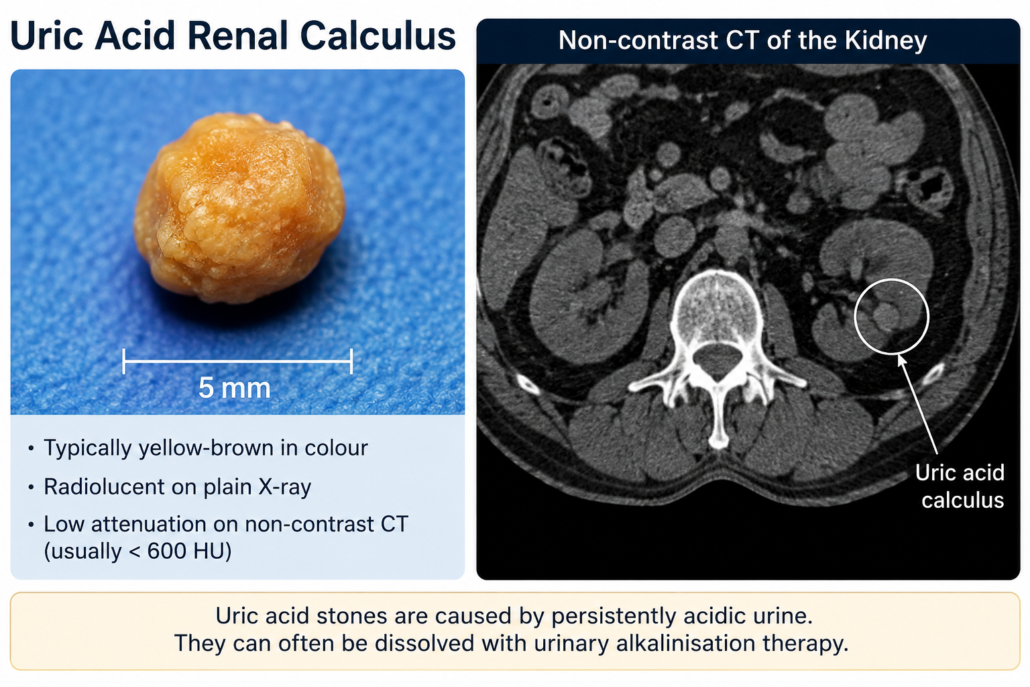
- radiolucency on plain X-ray
- relatively low density on non-contrast CT
- appropriate clinical and metabolic risk factors
Dual-energy CT can sometimes help differentiate uric acid from non-uric-acid stones.
Stone composition should therefore be assessed as accurately as possible before embarking on prolonged dissolution therapy.
Advantages of dissolution therapy
The biggest advantage is obvious: it is non-invasive.
Successful treatment may avoid anaesthesia and procedures such as ureteroscopy, laser lithotripsy, shock-wave lithotripsy or PCNL.
Other potential advantages include:
- no surgical incision
- no instrumentation of the urinary tract
- usually no hospital admission
- avoidance of anaesthetic risk
- potentially useful for patients with significant medical comorbidities
- treatment can simultaneously address the metabolic environment responsible for future uric acid stones
- relatively inexpensive compared with surgery
- can potentially treat multiple uric acid stones simultaneously
For the right patient, dissolution therapy can turn a surgical problem into a metabolic one.
What are the disadvantages?
The trade-off is that dissolution therapy requires time, patience and active participation.
Patients need to take medication consistently, maintain good fluid intake, monitor urinary pH and attend follow-up investigations.
Other disadvantages include:
- dissolution can take weeks or months
- treatment may fail
- the stone may only partially dissolve
- repeated imaging may be required
- incorrectly identified non-uric-acid stones will not dissolve
- excessively alkaline urine can encourage formation of calcium phosphate stones
- patients with obstruction or infection may require urgent intervention rather than simply waiting for dissolution
In the systematic review discussed above, approximately 15.7% of patients ultimately required an intervention despite attempting dissolution therapy.
Side effects of potassium citrate
Potassium citrate is generally well tolerated, but side effects can occur.
The most common are gastrointestinal and may include:
- nausea
- abdominal discomfort
- bloating
- diarrhoea
- vomiting
Taking the medication with food may improve gastrointestinal tolerance.
A more important potential complication is hyperkalaemia, meaning an excessively high potassium concentration in the blood.
This is particularly relevant in patients with:
- impaired kidney function
- medications that increase potassium
- significant cardiac disease
- other conditions affecting potassium regulation
For this reason, kidney function and electrolytes may need monitoring during therapy.
What about sodium bicarbonate?
Sodium bicarbonate can also effectively alkalinise the urine and is an alternative when potassium citrate is unsuitable.
However, the additional sodium load can be undesirable in patients with conditions such as hypertension, fluid retention or heart failure. Sodium-containing alkali may also increase urinary calcium excretion, which is one reason potassium citrate is generally preferred when clinically appropriate.
Can the urine become too alkaline?
Yes.
More alkaline is not endlessly better.
Although increasing urinary pH improves uric acid solubility, excessive alkalinisation can increase the risk of calcium phosphate stone formation. The EAU therefore recommends targeting rather than indiscriminately increasing urinary pH.
This is why home pH monitoring is so useful.
The aim is controlled chemistry, not turning the bladder into a miniature alkaline swimming pool.
What if the stone is obstructing the kidney?
An obstructed kidney requires more caution.
If a uric acid stone is causing significant obstruction, particularly in the presence of infection, deteriorating renal function or uncontrolled symptoms, simply waiting for the stone to dissolve may be inappropriate.
An infected obstructed urinary system is a urological emergency and requires urgent drainage.
Where an obstructing uric acid stone is otherwise suitable for dissolution, urinary drainage with a ureteric stent or nephrostomy may sometimes be performed first, followed by alkalinisation. The EAU recommends oral chemolysis together with urinary drainage where uric acid stones are obstructing the collecting system.
Does allopurinol dissolve uric acid stones?
Not directly in the same way that alkalinisation does.
Allopurinol reduces the production of uric acid and is particularly useful in patients with hyperuricosuria, gout or continued uric acid stone formation despite appropriate management.
However, most uric acid stone formers have excessively acidic urine as the dominant problem. The AUA therefore recommends potassium citrate as first-line therapy for urinary alkalinisation rather than routinely using allopurinol as first-line treatment for every patient with uric acid stones.
Allopurinol may be added when there is significant hyperuricosuria or recurrent stone formation despite appropriate urinary alkalinisation. The EAU similarly recommends allopurinol for hyperuricosuric urate stone formers.
Preventing the stone from coming back
Dissolving the existing stone is only half the job.
Uric acid stone formers are considered at high risk of recurrence, so the underlying metabolic environment should also be addressed.
Long-term prevention may include maintaining a generous fluid intake, moderating excessive animal protein and purine intake, weight and metabolic health management, continued urinary alkalinisation when indicated, and treatment of hyperuricosuria where appropriate.
A metabolic stone assessment, often including blood tests and 24-hour urine collections, can help identify the factors driving recurrent stone formation.
Dissolution therapy versus surgery
There is no universal winner.
Dissolution therapy is particularly attractive when:
- the stone is highly likely to be uric acid
- symptoms are controlled
- there is no untreated infection
- renal function is satisfactory
- immediate stone clearance is unnecessary
- the patient can reliably monitor urinary pH and attend follow-up
Surgical treatment may be preferable when:
- the diagnosis of uric acid stone is uncertain
- the stone is causing significant or persistent obstruction
- infection is present
- pain is difficult to control
- rapid stone clearance is required
- the stone fails to shrink despite adequate alkalinisation
- the patient prefers definitive treatment
The bottom line
Uric acid stones have one rather convenient weakness: their chemistry can be used against them.
By raising urinary pH with medications such as potassium citrate, genuine uric acid calculi can often be progressively dissolved without an operation. Published evidence suggests that approximately 80% of appropriately treated patients achieve at least partial dissolution, although complete dissolution occurs in a smaller proportion and some patients will ultimately require surgery.
Successful treatment depends on three things: correctly identifying the stone, achieving the appropriate urinary pH, and monitoring the response.
For selected patients, dissolution therapy offers something unusual in stone surgery: rather than breaking the stone, extracting it or blasting it with a laser, we may simply persuade it to disappear.
So, if you are a stone sufferer and you are in need of help, come see your Brisbane urologist, Uro-Jo at the Wesley or Caboolture private hospitals.
This information is intended for general patient education and does not replace individual assessment by a urologist. Treatment and urinary pH targets should be individualised, particularly in patients with renal impairment, infection, obstruction or electrolyte abnormalities.


Leave a Reply
Want to join the discussion?Feel free to contribute!