The Ascent and Descent of Man: What Urological Problems Can Teach Us About Being Men
When the body interrupts the life we thought we were living
Men spend a remarkable amount of their lives trying to move upward.
We grow up. We become stronger. We learn. We compete. We establish careers, relationships and families. We accumulate skills, responsibilities, possessions and, hopefully, a little wisdom along the way.
We build an identity.
Then, sometimes quite unexpectedly, life introduces the downward staircase.
A prostate cancer diagnosis. Erectile dysfunction. Urinary leakage after prostate surgery. An enlarged prostate. Infertility. Testicular cancer. Chronic pelvic pain. A catheter. The discovery that our bladder has apparently developed its own personality.
Suddenly the body that we hardly thought about has become impossible to ignore.
For many men, a health problem is therefore more than a medical diagnosis. It can challenge masculinity, independence, sexuality, confidence, relationships and our assumptions about ageing.
The writings of Franciscan priest and spiritual teacher Richard Rohr offer an interesting way of understanding this experience.
Rohr suggests that human development is not simply a continuous climb towards greater success, control and independence. Paradoxically, some of our deepest development may begin when that climb is interrupted.
Sometimes we grow by descending.
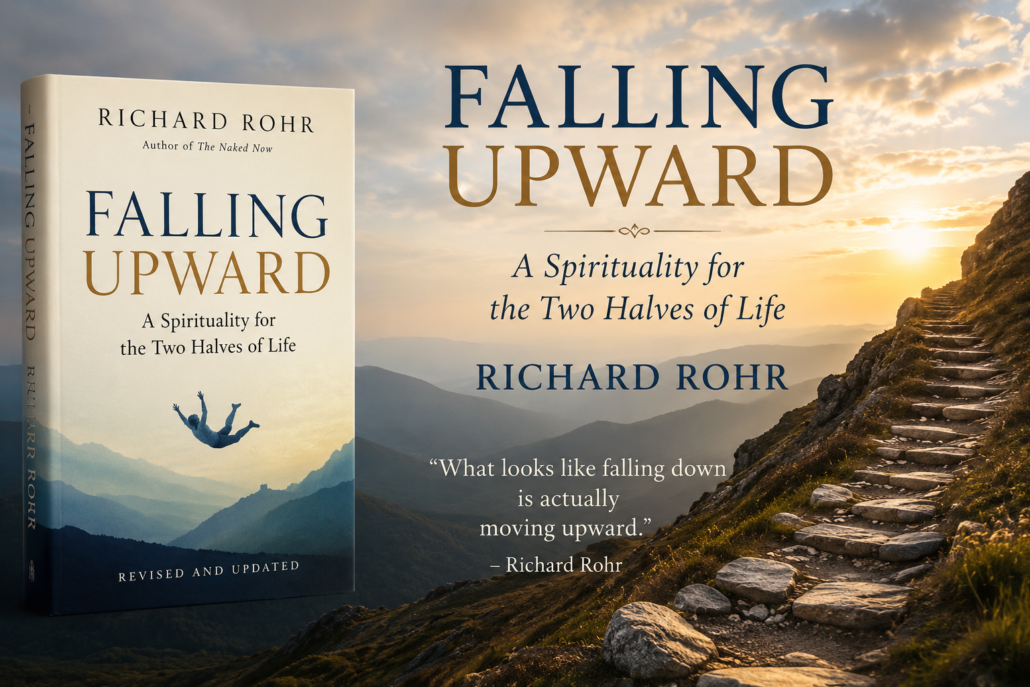
And sometimes what initially feels like falling down becomes a way of falling upward.
Who is Richard Rohr?
Richard Rohr is an American Franciscan friar, Catholic priest, author and ecumenical spiritual teacher. He founded the Center for Action and Contemplation (CAC) in Albuquerque, New Mexico, in 1987 and has spent decades teaching about Christian spirituality, contemplation, human development and transformation.
His books include Everything Belongs, Breathing Under Water, The Universal Christ, Immortal Diamond and perhaps most relevant to this discussion, Falling Upward: A Spirituality for the Two Halves of Life.
Rohr has also devoted considerable attention to male spirituality and the formation of men. His work has resonated with men trying to understand identity, fatherhood, vulnerability, ageing, suffering and what it means to mature beyond achievement and status.
His significance does not lie in providing medical or psychological theories. He is a spiritual teacher.
Rather, Rohr gives us a language for something medicine sees every day:
A man can be physically diminished by an experience while simultaneously becoming deeper because of it.
The Two Halves of Life
One of Rohr’s best-known ideas is that life contains what he calls the two halves of life.
These are not simply determined by age.
You do not automatically enter the second half of life on your 50th birthday, preferably after receiving a letter from your superannuation fund and discovering your prostate has doubled in size.
They describe different ways of understanding ourselves.
In the first half of life, our task is largely to construct an identity.
We establish:
- Who am I?
- What do I believe?
- Where do I belong?
- What am I good at?
- What can I achieve?
- How do other people see me?
- Can I provide for myself and my family?
Rohr describes this as constructing the container of our lives.
And it is necessary.
Young men need ambition, boundaries, confidence, competence and identity.
The problem arises when we mistake the container for its contents.
At some point the deeper question becomes:
What was I building all of this for?
Rohr describes the movement from the outer task towards this deeper inner task as characteristic of the second half of life. Importantly, this transition is not necessarily connected with chronological ageing.
The Ascent
The first part of life is often an ascent.
A boy becomes a man.
He develops strength and independence.
He studies.
He works.
He competes.
He finds a partner.
Perhaps he becomes a father.
He builds a career.
He becomes responsible for others.
There is nothing inherently wrong with this ascent.
Quite the opposite.
We need it.
The difficulty comes when our entire identity becomes attached to the things we have accumulated during the climb:
strength, sexual performance, status, productivity, physical appearance, money, professional success and control.
Then something happens.
Life refuses to follow the script.
The Descent
The descent may come through failure, divorce, bereavement, redundancy, ageing, disappointment or illness.
For many men, it comes through the body.
And this is where urology becomes surprisingly relevant.
Consider the man diagnosed with prostate cancer.
Yesterday he was working, exercising, travelling and planning his future.
Today he is discussing cancer staging, continence, erections and survival.
Or the man who develops erectile dysfunction.
Something that previously happened almost without thought suddenly requires tablets, injections, devices or surgery.
Or the man who leaks urine following prostate surgery.
A highly competent adult who has spent decades being independent may suddenly find himself discussing pads and pelvic-floor exercises.
These experiences can feel humiliating.
They can also expose something deeper.
“I Thought I Was in Control”
One of the hardest lessons illness teaches is remarkably simple:
We are not completely in control.
We can exercise.
We can eat well.
We can attend medical check-ups.
We can stop smoking.
We can monitor our PSA.
All of these things matter.
But none of them gives us a contract guaranteeing perfect health.
Rohr’s spirituality repeatedly returns to the idea that transformation often begins when our usual systems of control stop working. His image of “falling upward” describes the possibility that failure, suffering or loss can open a person to a broader and deeper understanding of life.
That does not mean illness is good.
Cancer is not a gift that someone ought to be grateful for.
Incontinence is not spiritually necessary.
Erectile dysfunction does not automatically make anyone wiser.
Suffering can simply hurt.
The important distinction is this:
We do not always choose what happens to us, but over time we may have some choice about what we allow the experience to teach us.
Urological Illness Strikes at Some Particularly Male Vulnerabilities
Urology deals with parts of the body closely connected with masculine identity.
The penis.
The testes.
The prostate.
Sexual function.
Fertility.
Urinary control.
Because of this, relatively small physical changes can have enormous psychological consequences.
A man may quietly interpret erectile dysfunction as:
“I am no longer a real man.”
He may interpret urinary leakage as:
“I have lost control.”
Infertility may become:
“I have failed.”
Prostate cancer may become:
“My body has betrayed me.”
After surgery he may think:
“My partner won’t see me in the same way.”
These conclusions can be far more damaging than the physical problem itself.
Part of good urological care is therefore separating the condition a man has from the man he believes he has become because of it.
Your Penis Is Important. It Is Not Your Entire Biography.
Men can attach an extraordinary amount of identity to sexual performance.
This is understandable.
Sexuality matters.
Intimacy matters.
Erections matter.
But erectile function is not a reliable measurement of masculinity.
An erection is a complicated neurovascular event involving the brain, nerves, blood vessels, hormones and psychological state.
It is physiology.
It is not a character reference.
A man can have erectile dysfunction and remain masculine, attractive, intimate, loving and sexually connected.
Likewise, losing a testicle does not make someone half a man.
Needing continence pads does not make someone childish.
Having prostate surgery does not remove masculinity.
And asking for help certainly does not diminish it.
These distinctions can be surprisingly difficult when we have spent decades unconsciously linking masculinity with strength, independence and sexual capability.
The Body Eventually Invites Every Man Down the Mountain
At 20, the body can feel indestructible.
At 40, it begins occasionally submitting complaints.
At 60, it starts sending formal correspondence.
And eventually most of us discover that ageing is not a design flaw.
Testosterone changes.
Prostates enlarge.
Erections may become less reliable.
Muscle mass decreases.
Bladders become more temperamental.
Recovery takes longer.
The male body gradually teaches a lesson the young man rarely wants to hear:
Strength is temporary.
Rohr’s challenge is not that we should despair about this.
It is that the second journey can lead somewhere the first cannot.
The goal changes from proving ourselves to knowing ourselves.
From achievement towards meaning.
From independence towards interdependence.
From certainty towards curiosity.
From controlling life towards participating in it.
The Descent Can Happen at Any Age
It would be a mistake to think Rohr’s “second half of life” begins only in old age.
A 28-year-old diagnosed with testicular cancer may confront mortality earlier than a healthy 75-year-old.
A young man experiencing infertility may suddenly question assumptions he has held since childhood.
A 40-year-old with erectile dysfunction may confront vulnerability for the first time.
A 55-year-old diagnosed with aggressive prostate cancer may completely reconsider his priorities.
A 70-year-old recovering from surgery may discover a depth of intimacy with his partner that he had never previously allowed.
Chronological age and emotional maturity are not the same thing.
The descent arrives according to its own timetable.
From Independence to Interdependence
Many men are taught:
Deal with it yourself.
This can be useful when a tyre needs changing.
It is considerably less useful when dealing with cancer.
Urological illness often forces men to accept help.
From a partner.
A doctor.
A nurse.
A physiotherapist.
A psychologist.
A friend.
Sometimes even from their children.
This can initially feel like weakness.
But perhaps mature masculinity is not independence.
Perhaps it is knowing when independence has reached its limits.
There is strength in competence.
There is another kind of strength in saying:
“I need some help with this.”
Intimacy After Urological Illness
Urological disease can also change relationships.
After prostate cancer treatment, for example, sexual intimacy may require patience, rehabilitation and experimentation.
Erections may be different.
Orgasm may feel different.
Ejaculation may disappear following prostate removal.
Urinary leakage may temporarily interfere with confidence.
Some couples withdraw from intimacy because neither partner knows how to begin the conversation.
Yet intimacy is much larger than erectile performance.
Touch.
Affection.
Humour.
Conversation.
Vulnerability.
Sexual experimentation.
Companionship.
Trust.
These can become increasingly important when the body no longer behaves exactly as it did at 25.
Paradoxically, some couples discover greater intimacy precisely because they can no longer rely on automatic sexual function.
They have to communicate.
The descent becomes an invitation to a different kind of closeness.
The Man Who Emerges
Rohr’s “falling upward” does not mean returning to exactly the person we were before the fall.
Sometimes we cannot.
The prostate is not coming back after radical prostatectomy.
A removed testicle cannot be restored.
Ageing cannot be reversed.
The challenge becomes something different:
Can I incorporate what has happened into a larger understanding of who I am?
The man who emerges may be less certain but more compassionate.
Less physically powerful but more emotionally available.
Less interested in impressing others.
More comfortable asking difficult questions.
More appreciative of his partner.
More aware of mortality.
More grateful for ordinary days.
Less frightened of appearing vulnerable.
That is not necessarily decline.
It may be maturation.
The Urologist’s Job Is Still to Treat the Problem
There is an important caution here.
Philosophy should never replace medicine.
If you have difficulty urinating, see your doctor.
If you have blood in the urine, have it investigated.
If you discover a testicular lump, seek medical attention promptly.
If erectile dysfunction develops, investigate the possible physical and psychological causes.
If your PSA is abnormal, discuss appropriate assessment.
If you are struggling psychologically following cancer or changes in sexual or urinary function, psychological support can be extremely valuable.
We should never romanticise illness when effective treatment is available.
Treat what can be treated. Rehabilitate what can be rehabilitated. Prevent what can be prevented.
And then recognise that sometimes medicine can repair the body without answering every question the experience has raised.
Perhaps There Is Another Kind of Men’s Health
We usually define men’s health through measurable things:
PSA.
Blood pressure.
Cholesterol.
Testosterone.
Weight.
Urinary flow.
Erectile function.
Cancer survival.
All are important.
But perhaps there is another dimension.
Can a man tolerate vulnerability?
Can he talk to his partner?
Can he ask for help?
Can he adapt when his body changes?
Can he distinguish sexual function from personal worth?
Can he remain connected when embarrassed?
Can he face ageing without believing that ageing makes him irrelevant?
Can he accept mortality without abandoning life?
These questions will never appear on a pathology request form.
But they matter.
From Ascent to Descent and Back Again
Richard Rohr’s Falling Upward proposes that the second half of the human journey can contain profound spiritual richness rather than simply representing decline. His central paradox is that what appears to be a fall may become movement into a larger and deeper life.
Urological illness gives this idea an unexpectedly practical setting.
A prostate cancer diagnosis.
Loss of erections.
Incontinence.
Infertility.
Testicular disease.
Ageing.
These experiences may temporarily take something away.
But they do not take away the person.
For the younger man, the lesson may be that masculinity is broader than performance.
For the middle-aged man, it may be that identity is larger than career, strength and sexuality.
For the older man, it may be discovering that physical decline does not necessarily mean personal decline.
And for every man, perhaps the invitation is similar.
Build.
Climb.
Achieve.
Love your strength while you have it.
But when life eventually asks you to descend, do not automatically assume you are travelling in the wrong direction.
Sometimes the road downward leads somewhere that the road upward could never reach.
Sometimes losing a little control allows us to discover what actually matters.
And sometimes, in Richard Rohr’s memorable language, we discover that we have been falling upward all along.
Richard Rohr’s Work in Australia: Centre for Men and Families
For Australian men interested in exploring these ideas beyond reading, the Centre for Men and Families (CFMF), formerly known as Centre for Men Australia, provides an important local connection to Richard Rohr’s work.
The organisation has supported men and families in Australia for more than 25 years, providing men’s groups, counselling, retreats, community programs and Men’s Rites of Passage (MROP).
Its Men’s Rites of Passage tradition has a direct connection with Richard Rohr and the Center for Action and Contemplation in the United States. The Australian program uses initiation, time in nature, reflection, ritual and the company of other men to explore masculinity, vulnerability, relationships, grief, purpose and the transition towards a more mature understanding of what it means to be a man.
This has particular relevance to the themes discussed in this article. A significant health event, including prostate cancer, loss of erectile function, infertility, incontinence or major surgery, can become an unexpected rite of passage of its own. Medicine treats the disease, but men may also need somewhere to explore what the experience has done to their sense of identity, masculinity, relationships and purpose.
The Centre welcomes men from a wide range of backgrounds and beliefs. Its programs are not limited to men who identify with a particular religious tradition.
Learn more:
Centre for Men and Families Australia
Men’s Rites of Passage:
Explore the Australian Men’s Rites of Passage program
Where Can Men Find Support?
Urological illness can affect much more than the urinary or reproductive system. It can touch confidence, masculinity, sexuality, relationships, identity and our sense of purpose.
Medical care remains essential, but sometimes men also benefit from having a place to talk, reflect and connect with other men.
Centre for Men and Families Australia
The Centre for Men and Families (CFMF), formerly Centre for Men Australia, provides programs designed to support men through different stages and transitions in life.
Through men’s circles, counselling, retreats and Men’s Rites of Passage, men can explore relationships, fatherhood, vulnerability, ageing, loss, purpose and what mature masculinity might look like when life does not follow the expected script.
Explore the Centre for Men and Families:
https://cfmf.org.au/
Men’s Rites of Passage:
https://cfmf.org.au/events/rites-of-passage/
For a man facing prostate cancer, erectile dysfunction, infertility, incontinence, major surgery or another significant health challenge, asking for support is not an admission of failure.
Sometimes the most important part of the journey is discovering that you do not have to make the descent alone.
Further reading
Richard Rohr, Falling Upward: A Spirituality for the Two Halves of Life.
Richard Rohr, Adam’s Return: The Five Promises of Male Initiation.
Richard Rohr, Immortal Diamond: The Search for Our True Self.
Richard Rohr, The Universal Christ.
The Center for Action and Contemplation provides further material on Rohr’s teachings concerning contemplation, male spirituality, transformation and the two halves of life.
Medical disclaimer
This article discusses the emotional, philosophical and spiritual dimensions that may accompany men’s health problems. It is not intended to suggest that illness is desirable or that spiritual reflection is a substitute for medical or psychological treatment. New or concerning urinary, genital or sexual symptoms should be assessed by an appropriately qualified healthcare professional.


Leave a Reply
Want to join the discussion?Feel free to contribute!