
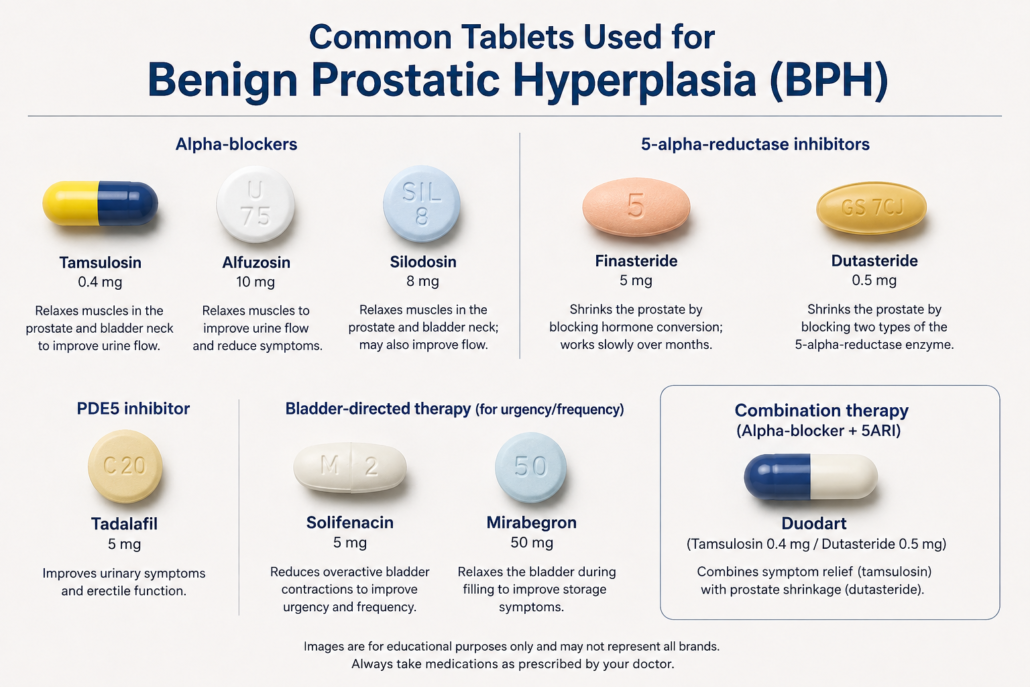
Medical Therapy for Benign Prostate Enlargement: What Are the Options?
Benign prostate enlargement, also called benign prostatic hyperplasia (BPH), is extremely common as men get older. An enlarged prostate can narrow the urinary channel and affect the way the bladder empties, producing what doctors call lower urinary tract symptoms (LUTS).
Typical symptoms include:
- A slow or weak urinary stream
- Difficulty starting urination
- Stopping and starting during urination
- Straining to pass urine
- A feeling that the bladder has not emptied completely
- Passing urine frequently
- Urgency to urinate
- Getting up several times during the night to urinate
- Occasionally, complete inability to pass urine, known as acute urinary retention
Importantly, urinary symptoms are not always proportional to prostate size. A relatively small prostate can cause significant obstruction, while some men with very large prostates have surprisingly few symptoms.
Medication is often the first active treatment when symptoms become bothersome. The best medication depends on the type and severity of symptoms, prostate size, PSA, urinary flow, residual urine volume, blood pressure, sexual function and risk of future prostate enlargement or urinary retention.
Before Starting Medication
Before assuming that urinary symptoms are simply caused by an enlarged prostate, an appropriate assessment is important.
Depending on the individual patient, this may include:
- Medical history and examination
- International Prostate Symptom Score (IPSS)
- Urinalysis
- PSA blood test
- Kidney function testing when indicated
- Ultrasound assessment of the prostate and bladder
- Measurement of post-void residual urine
- Urinary flow-rate testing (uroflowmetry)
- Bladder diary, particularly for frequency and nocturia
- Further investigations such as cystoscopy or urodynamic studies in selected men
The aim is not simply to prescribe a tablet, but to determine what is actually causing the urinary symptoms.
1. Alpha-Blockers: Relaxing the Prostate
For many men requiring medication, an alpha-blocker is the first treatment considered.
Common examples include:
- Tamsulosin
- Silodosin
- Terazosin and other less-selective alpha-blockers in selected circumstances
These medications relax smooth muscle around the prostate and bladder neck, reducing resistance to urinary flow.
How quickly do they work?
Alpha-blockers have a relatively rapid onset of action. Improvement can sometimes be noticed within days, although several weeks may be required to judge their full effect.
They may improve:
- Urinary flow
- Hesitancy
- Straining
- The sensation of incomplete emptying
- Some storage symptoms
What alpha-blockers do NOT do
Alpha-blockers do not significantly shrink the prostate.
They improve the dynamic component of prostate obstruction but do not substantially alter the underlying growth of the prostate. Therefore, they do not provide the same long-term protection against urinary retention and BPH-related surgery as 5-alpha-reductase inhibitors.
Side effects of alpha-blockers
Possible adverse effects include:
- Dizziness
- Light-headedness
- A fall in blood pressure when standing
- Fatigue
- Nasal congestion
- Ejaculatory problems
- Reduced or absent ejaculation, particularly with some prostate-selective agents
Men taking alpha-blockers should also tell their ophthalmologist before cataract surgery, as medications such as tamsulosin are associated with intraoperative floppy iris syndrome.
Do Alpha-Blockers Increase the Risk of Dementia?
The possible relationship between alpha-blockers and dementia has attracted attention, particularly with tamsulosin, which is one of the most commonly prescribed medications for prostate symptoms.
Some large observational studies have reported an association between tamsulosin or other alpha-blockers and a subsequent diagnosis of dementia or Alzheimer’s disease. One frequently cited retrospective study reported an approximately 17% higher relative rate of dementia among men taking tamsulosin compared with men with BPH receiving no medication.
However, this does not establish that tamsulosin causes dementia.
Subsequent studies have produced conflicting results. Some have found no increased risk, and others have suggested that apparent associations may be explained by differences in age, cardiovascular disease, diabetes, stroke, other medications, healthcare utilisation and the underlying BPH population itself.
A systematic review examining alpha-1 blockers and cognition found no convincing causal association between alpha-blocker treatment, including tamsulosin, and cognitive impairment or dementia.
More recent large-scale analyses have provided further reassurance. A network meta-analysis involving more than 3.6 million patients found that alpha-blockers were not significantly associated with an increased risk of dementia compared with no BPH treatment.
Therefore, based on the available evidence:
- Dementia is not considered an established adverse effect of alpha-blocker therapy.
- Earlier observational studies raised a possible association, particularly with tamsulosin.
- More recent studies and systematic reviews have not demonstrated a convincing causal relationship.
- Further long-term research is still appropriate, particularly because these medications are frequently prescribed to older men who already have a higher background risk of cognitive decline.
For men who already have mild cognitive impairment, dementia, significant frailty or a high risk of falls, medication choice deserves particular consideration. In this group, dizziness, postural hypotension and falls may themselves have important consequences, irrespective of whether alpha-blockers have any direct effect on cognition.
The decision to continue an alpha-blocker should therefore be based on the individual’s urinary benefit, cardiovascular status, fall risk, cognitive health and alternative treatment options.
2. 5-Alpha-Reductase Inhibitors: Shrinking the Prostate
The second major group of medications works very differently.
The two principal drugs are:
- Finasteride
- Dutasteride
Testosterone is converted within the prostate to the more potent androgen dihydrotestosterone (DHT) by the enzyme 5-alpha-reductase.
Finasteride predominantly inhibits type 2 5-alpha-reductase, while dutasteride inhibits both type 1 and type 2 enzymes.
Reducing DHT gradually causes the prostate to shrink.
Who benefits most?
These medications are particularly useful for men with an enlarged prostate and an increased risk of BPH progression.
Current guidance recommends considering a 5-alpha-reductase inhibitor in men with moderate-to-severe LUTS who have an increased risk of progression, particularly when the prostate is significantly enlarged.
How effective are they?
Over several years, 5-alpha-reductase inhibitors can:
- Reduce prostate volume by approximately 18–28%
- Improve urinary symptoms
- Improve urinary flow
- Reduce the risk of acute urinary retention
- Reduce the likelihood of eventually requiring BPH surgery
Unlike alpha-blockers, however, they work slowly. It may take three to six months or longer before a meaningful improvement becomes apparent.
An Important Point About PSA
Finasteride and dutasteride reduce serum PSA by approximately 50% after 6–12 months of treatment.
This does not mean that prostate cancer screening can simply be stopped.
Instead, the PSA result needs to be interpreted in the context of treatment. A PSA that subsequently rises while a man is taking a 5-alpha-reductase inhibitor warrants appropriate evaluation.
Side Effects of Finasteride and Dutasteride
Potential side effects include:
- Reduced libido
- Erectile dysfunction
- Reduced semen volume
- Ejaculatory dysfunction
- Breast tenderness
- Breast enlargement or gynaecomastia
Sexual adverse effects are among the most clinically relevant side effects of 5-alpha-reductase inhibitors.
Mood changes have also received increasing attention. Regulatory authorities have strengthened warnings concerning mood changes and suicidal ideation with finasteride, while the relationship between 5-alpha-reductase inhibitors and psychiatric symptoms continues to be studied.
What Is “Post-Finasteride Syndrome”?
Post-finasteride syndrome (PFS) is the term used to describe a collection of sexual, physical and psychological symptoms reported by some patients that persist after finasteride has been discontinued.
Reported symptoms have included:
- Persistent reduction in libido
- Erectile dysfunction
- Altered orgasm or ejaculation
- Reduced genital sensation
- Fatigue
- Problems with concentration or “brain fog”
- Anxiety
- Depressed mood
Persistent symptoms after finasteride treatment have been reported, and patients experiencing them should not have their symptoms dismissed. However, “post-finasteride syndrome” remains a controversial and incompletely understood clinical entity. Its incidence, biological mechanism, causality and predisposing factors have not been definitively established.
The possibility of sexual and psychological adverse effects should therefore be discussed before treatment, without presenting PFS as an inevitable or precisely quantified consequence of taking finasteride.
Any patient developing significant mood disturbance, depression or suicidal thoughts while taking a 5-alpha-reductase inhibitor should seek medical assessment promptly.
3. Stepping Up Treatment: Combination Therapy
Some men obtain good initial improvement from an alpha-blocker but have a prostate that remains significantly enlarged.
This creates two separate treatment objectives:
1. Improve symptoms now
Relax the prostate and bladder neck with an alpha-blocker.
2. Reduce future progression
Shrink the prostate and reduce the risk of retention and surgery with a 5-alpha-reductase inhibitor.
This is where combination therapy becomes particularly useful.
4. Duodart: Tamsulosin + Dutasteride in One Capsule
Duodart combines:
- Tamsulosin 400 micrograms
- Dutasteride 500 micrograms
in a single daily capsule.
Tamsulosin
Relaxes smooth muscle in the prostate and bladder neck and can provide relatively rapid improvement in urinary symptoms.
Dutasteride
Reduces DHT and gradually shrinks the prostate, reducing the longer-term risk of BPH progression.
Combination treatment is particularly appropriate in men with moderate-to-severe urinary symptoms plus a significantly enlarged prostate or other features suggesting an increased risk of progression.
Side Effects of Duodart
Because Duodart contains two medications, side effects from both drug classes can occur.
Potential side effects include:
Sexual side effects
- Reduced libido
- Erectile dysfunction
- Reduced semen volume
- Ejaculatory dysfunction or failure to ejaculate normally
Blood-pressure-related effects
- Dizziness
- Light-headedness
- Postural hypotension
- Occasionally fainting
Other possible effects
- Breast enlargement or tenderness
- Nasal congestion
- Gastrointestinal symptoms
- Sleep disturbance
- Palpitations
- Weakness
- Allergic reactions
Because Duodart contains tamsulosin, the same uncertainty regarding the possible association between alpha-blockers and dementia is relevant. At present, however, the evidence does not establish that tamsulosin or Duodart causes dementia.
Combination therapy generally produces more adverse effects than either medication alone, so the decision to escalate treatment should balance the likely long-term benefit against side effects and the patient’s priorities.
Is “post-finasteride syndrome” a risk with Duodart?
Strictly speaking, Duodart does not contain finasteride. It contains dutasteride.
Both drugs are 5-alpha-reductase inhibitors and have overlapping sexual adverse effects. Persistent symptoms following treatment with 5-alpha-reductase inhibitors have been reported, but the term post-finasteride syndrome specifically arose in relation to finasteride.
It is therefore more accurate when discussing Duodart to counsel patients about the possibility of sexual, psychological and other adverse effects associated with 5-alpha-reductase inhibition, rather than stating that Duodart causes “post-finasteride syndrome”.
5. Tadalafil: Particularly Useful When Erectile Dysfunction Is Also Present
Tadalafil 5 mg daily is another option for men with lower urinary tract symptoms, particularly when erectile dysfunction is also present.
Tadalafil can improve:
- Urinary symptoms
- Quality of life
- Erectile function
It does not significantly reduce prostate size or provide the same evidence for prevention of urinary retention and future BPH surgery as a 5-alpha-reductase inhibitor.
Tadalafil must not be combined with nitrate medication because of the potential for a dangerous fall in blood pressure.
Common side effects include:
- Headache
- Facial flushing
- Indigestion
- Nasal congestion
- Muscle or back discomfort
6. What If Urgency and Frequency Are the Main Problem?
Some men have predominantly bladder storage symptoms, including urgency, frequency, urge urinary incontinence and nocturia.
Once significant urinary retention has been excluded, additional bladder-directed medication may be appropriate.
Anticholinergic medications
Potential side effects include:
- Dry mouth
- Constipation
- Blurred vision
- Cognitive effects, particularly in older or cognitively vulnerable patients
- Increased residual urine or urinary retention in selected men
The potential cognitive effects of anticholinergic medications are particularly relevant when treating older men, and the patient’s overall anticholinergic medication burden should be considered.
Beta-3 agonists
These medications relax the bladder during filling and can improve urgency and frequency. They may have fewer dry-mouth, constipation and cognitive concerns than anticholinergic therapy, although they have their own contraindications and potential adverse effects.
The Bottom Line
There is no single “best prostate tablet”.
Alpha-blockers work relatively quickly and improve urinary flow but do not substantially shrink the prostate. Although some observational studies have suggested a possible association between alpha-blockers, particularly tamsulosin, and dementia, current evidence does not demonstrate that alpha-blockers cause dementia.
Finasteride and dutasteride work more slowly but shrink an enlarged prostate and can reduce the long-term risk of urinary retention and surgery.
Duodart combines dutasteride and tamsulosin, providing both relatively rapid symptom control and longer-term treatment of prostate enlargement in appropriately selected men.
Tadalafil is particularly attractive when urinary symptoms coexist with erectile dysfunction.
Bladder-directed medication may be added when urgency and frequency remain problematic, although anticholinergic medications require particular caution in older men because of their potential cognitive effects.
The goal is not simply to make the prostate smaller. It is to achieve comfortable urination, protect bladder and kidney function, minimise medication-related side effects and preserve quality of life.
This information is intended for general patient education and does not replace individual medical assessment. Medication choice, dose and combinations should be discussed with your treating doctor or urologist.


Leave a Reply
Want to join the discussion?Feel free to contribute!