
Sacral Neuromodulation for Urinary Incontinence and Bladder Dysfunction
Urinary incontinence and bladder control problems can have a significant effect on everyday life. Frequent trips to the toilet, sudden urgency, leakage, waking repeatedly at night or being unable to empty the bladder properly can interfere with work, exercise, travel, sleep and social activities.
For men and women whose symptoms have not responded adequately to conservative treatment or medication, sacral neuromodulation (SNM) can provide another treatment option.
Sacral neuromodulation is particularly useful because it can treat two apparently opposite bladder problems:
- an overactive bladder, where the bladder signals too frequently or contracts when it should not; and
- an underactive bladder or non-obstructive urinary retention, where the bladder does not empty effectively.
Rather than operating directly on the bladder, sacral neuromodulation works by modifying the nerve signals involved in bladder storage and emptying.
What is sacral neuromodulation?
The bladder, urethral sphincter, pelvic floor and brain communicate through a complex network of nerves. The sacral nerves, particularly those arising from the S3 region, form an important part of this communication system.
Sacral neuromodulation uses a small, implanted device to deliver mild electrical impulses to a sacral nerve. These impulses help modify abnormal signaling between the bladder, pelvic floor, spinal cord and brain.
A useful way of thinking about the treatment is that it attempts to recalibrate the communication system controlling the bladder, rather than simply forcing the bladder to contract or relax.
International Continence Society guidance recognises sacral neuromodulation as an established therapy for refractory urinary urgency and frequency, urgency urinary incontinence and non-obstructive urinary retention.
Importantly, SNM does not “cure” every patient with urinary incontinence. The aim is to achieve a meaningful and sustained reduction in symptoms and improvement in quality of life.
What conditions can sacral neuromodulation treat?
1. Overactive bladder
Overactive bladder (OAB) is characterised by urinary urgency, usually accompanied by increased frequency and nocturia, with or without urgency urinary incontinence.
Typical symptoms include:
- suddenly needing to pass urine;
- difficulty postponing urination;
- frequent urination during the day;
- waking several times at night to urinate;
- urinary leakage associated with urgency; and
- needing to know where the nearest toilet is whenever leaving home.
Some patients experience urgency and frequency without leakage, while others develop urgency urinary incontinence, where the urge is followed by involuntary loss of urine.
Sacral neuromodulation can be considered when symptoms remain troublesome despite appropriate conservative and/or medical treatment. Current AUA/SUFU guidance includes SNM among the minimally invasive treatment options that clinicians should offer to appropriately selected patients with OAB who have not achieved adequate improvement with behavioural or pharmacological therapy.
2. Urgency urinary incontinence
Urgency urinary incontinence is leakage associated with a sudden compelling desire to urinate.
This is different from stress urinary incontinence, where leakage occurs with coughing, sneezing, exercise or physical exertion.
Sacral neuromodulation is principally a treatment for urgency-related leakage. It is not a standard treatment for isolated stress urinary incontinence.
This distinction is particularly important in women who may have both stress and urgency incontinence and in men who develop stress incontinence following prostate surgery.
When both types of leakage are present, treatment needs to be tailored to determine which component is causing the greatest problem.
What about an underactive bladder?
The bladder does not always misbehave by being too active. Sometimes the problem lies at the other end of the spectrum.
Underactive bladder and urinary retention
An underactive bladder describes symptoms associated with inadequate bladder emptying, often related to reduced bladder contractility or impaired coordination between the bladder and urinary sphincter.
Symptoms can include:
- difficulty starting urination;
- a slow or interrupted urinary stream;
- prolonged urination;
- straining to urinate;
- feeling that the bladder has not emptied;
- recurrent urinary tract infections;
- a large residual volume of urine after voiding; and
- complete inability to empty the bladder without a catheter.
Some patients need to perform clean intermittent self-catheterisation several times each day.
However, poor bladder emptying does not automatically mean that sacral neuromodulation is appropriate.
Obstruction must first be excluded
In men, urinary retention may be caused by:
- benign prostate enlargement;
- urethral stricture;
- bladder neck obstruction; or
- scarring following previous prostate or urethral surgery.
In women, causes can include:
- previous continence surgery;
- urethral obstruction;
- pelvic organ prolapse; or
- functional outlet obstruction.
Sacral neuromodulation is primarily used for non-obstructive urinary retention rather than retention caused by a mechanical blockage.
The distinction may require urine flow testing, measurement of the post-void residual, cystoscopy and, in selected patients, urodynamic studies.
The AUA notes that sacral neuromodulation can be used in appropriately selected men and women with non-obstructive urinary retention, including patients with decreased bladder contractility.
Who may benefit from sacral neuromodulation?
SNM may be considered in appropriately selected men and women with:
- refractory overactive bladder;
- urinary urgency and frequency;
- urgency urinary incontinence;
- non-obstructive urinary retention;
- impaired bladder emptying in selected patients; or
- troublesome bladder dysfunction that has not responded adequately to other treatments.
In Australia, sacral neuromodulation is an established treatment option. The TGA describes implantable sacral nerve stimulation systems as devices used in conditions including overactive bladder, urinary retention and urinary incontinence.
It is generally not a first-line treatment. Australian TGA information relating to the InterStim X system specifically notes that the treatment is not first-line therapy and is intended for appropriately selected patients after conservative and medical management have been attempted.
What treatments are usually tried first?
The treatments used before considering SNM depend upon the underlying bladder problem.
For overactive bladder these may include:
- bladder retraining;
- modification of fluid and caffeine intake;
- pelvic floor physiotherapy;
- management of constipation and other contributing factors;
- antimuscarinic medication;
- beta-3 agonist medication;
- posterior tibial nerve stimulation; and
- bladder injections with botulinum toxin (Botox).
For an underactive bladder or urinary retention, treatment may include:
- treating an identifiable obstruction;
- reviewing medications that may impair bladder emptying;
- timed or double voiding in selected patients; and
- intermittent self-catheterisation.
The appropriate pathway varies considerably between patients.
Assessment before sacral neuromodulation
Successful treatment begins with establishing the correct diagnosis.
Assessment may include:
Medical history
Your urologist will establish whether the predominant problem is urgency, frequency, leakage, difficulty emptying the bladder or a combination of symptoms.
Bladder diary
A bladder diary can record:
- how frequently you urinate;
- urine volumes;
- fluid intake;
- urgency episodes;
- leakage episodes; and
- night-time urination.
Urine testing
Urinary infection should be excluded where appropriate.
Post-void residual measurement
An ultrasound can measure how much urine remains in the bladder after urination.
Uroflowmetry
Urinary flow testing can provide useful information about the strength and pattern of the urinary stream.
Cystoscopy
A cystoscopy may be required when obstruction, urethral narrowing, prostate-related obstruction or another bladder abnormality is suspected.
Urodynamic studies
Urodynamic testing is not required in every patient, but it can be particularly valuable when the diagnosis is uncertain, symptoms are complex, previous treatments have failed or poor bladder emptying needs further investigation.
How is sacral neuromodulation performed?
One of the most attractive features of sacral neuromodulation is that the treatment can usually be tested before committing to a permanent implant.
The procedure therefore generally takes place in two stages.
Stage 1: The test phase
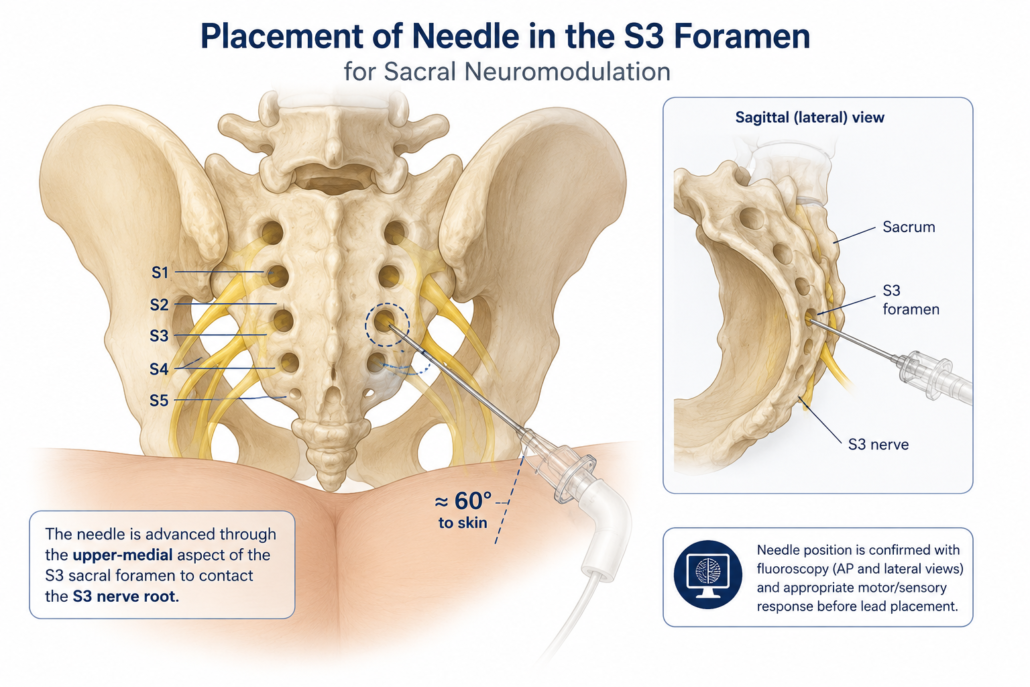
A thin electrode or tined lead is positioned through a small opening in the sacrum adjacent to a sacral nerve, most commonly the S3 nerve root.
The position is confirmed using anatomical landmarks, imaging and appropriate physiological responses during the procedure.
The lead is then connected to an external stimulator.
The patient goes home and uses the system during a trial period while recording symptoms in a bladder diary.
Depending upon the reason for treatment, we look for improvements such as:
- fewer urgency episodes;
- fewer episodes of urinary leakage;
- reduced urinary frequency;
- fewer night-time toilet visits;
- improved bladder emptying;
- lower residual urine volumes; or
- reduced need for intermittent catheterisation.
A meaningful improvement during the test phase, commonly around 50% or greater improvement in the target symptoms, is generally used to determine whether proceeding to permanent implantation is worthwhile.
Stage 2: Permanent implantation
If the trial is successful, a small pulse generator is implanted beneath the skin, usually in the upper buttock.
The device is connected to the previously positioned sacral lead.
Once the incision has healed, the device remains beneath the skin and is generally not visible, although a small contour may sometimes be noticeable.
The stimulator is programmed to provide electrical impulses tailored to the individual patient.
Patients are provided with a programmer or controller that allows appropriate adjustments within parameters established by the treating team.
What does the stimulation feel like?
Patients may notice a mild:
- tingling;
- tapping;
- pulling; or
- vibration-like sensation
in the pelvic, perineal, vaginal, scrotal or anal region.
The stimulation should not normally be painful.
The device can be reprogrammed during follow-up if symptoms change or stimulation becomes uncomfortable.
How successful is sacral neuromodulation?
Success depends on the condition being treated, patient selection and how success is defined.
The major advantage of SNM is that each patient effectively undergoes their own therapeutic trial before receiving the permanent implant.
For refractory overactive bladder, clinical studies demonstrate substantial improvement in appropriately selected patients. The 2024 AUA/SUFU guideline cites a randomised study in which 86% of patients allocated to SNM initially responded and 61% met the study’s definition of therapeutic success at six months.
For non-obstructive urinary retention, treatment may substantially improve bladder emptying and can reduce or sometimes eliminate the need for intermittent catheterisation in responders. AUA evidence reviewing SNM for non-obstructive retention reported a significant reduction in post-void residual urine following treatment.
Individual results vary, and improvement rather than complete cure is a more realistic treatment goal.
Sacral neuromodulation versus Botox
Both sacral neuromodulation and intravesical botulinum toxin are established advanced treatments for refractory overactive bladder.
Botox is injected into the bladder wall during cystoscopy and temporarily reduces excessive bladder contractions.
SNM instead modifies the neural pathways controlling bladder function.
Both can be effective. One practical difference is that Botox usually needs to be repeated as its effect wears off, whereas SNM uses an implanted device designed to provide ongoing treatment.
Botox also carries a risk of urinary retention and urinary tract infection. In the ROSETTA trial, women treated with botulinum toxin had higher rates of urinary tract infection and temporary catheterisation than those treated with SNM, although both treatments produced substantial improvement in urgency incontinence.
The best option depends upon the individual patient’s priorities and bladder function.
Advantages of sacral neuromodulation
Potential advantages include:
- treatment can be tested before permanent implantation;
- no major bladder reconstruction is required;
- it can reduce urgency and urgency incontinence;
- it can improve frequency and nocturia in selected patients;
- it may improve bladder emptying in non-obstructive retention;
- it may reduce dependence on intermittent catheterisation;
- stimulation can be individually programmed;
- treatment is adjustable over time; and
- the system can be removed if necessary.
Perhaps most importantly, SNM offers another option when conventional treatment has failed but major reconstructive surgery is undesirable.
What are the risks and possible complications?
Sacral neuromodulation is a surgical procedure and complications can occur.
These include:
- pain or discomfort around the implant;
- wound infection;
- bleeding or bruising;
- lead movement or migration;
- loss of effective stimulation;
- uncomfortable stimulation;
- change in the location of the stimulation sensation;
- failure to achieve adequate symptom improvement;
- technical problems with the lead or pulse generator;
- need for reprogramming;
- battery depletion; and
- need for revision, replacement or removal of the device.
In studies of SNM for overactive bladder, recognised device-related adverse events have included changes in stimulation, implant-site pain and infection.
Modern systems have improved considerably, but patients should understand that implantation begins a long-term relationship with the device rather than being a one-off operation.
What happens if the treatment stops working?
A reduction in benefit does not necessarily mean that the treatment has permanently failed.
The first step is often to check the device and change its programming.
If this does not restore benefit, further investigation may determine whether there has been:
- lead migration;
- lead damage;
- battery depletion;
- a change in bladder function; or
- another underlying urinary problem.
Occasionally, surgical revision or replacement of the lead or pulse generator is required.
Battery life and rechargeable devices
Different sacral neuromodulation systems and pulse generators are available, including rechargeable and non-rechargeable technologies.
Battery longevity depends on the particular device and the stimulation settings required.
A non-rechargeable generator eventually requires surgical replacement when its battery reaches the end of its useful life.
Rechargeable systems can potentially reduce the frequency of generator replacement but require the patient to recharge the device periodically.
The most appropriate system depends on factors such as age, lifestyle, dexterity, expected stimulation requirements and patient preference.
What about MRI scans?
MRI compatibility has historically been an important issue for patients with implanted neuromodulation devices.
Many modern SNM systems now provide substantially broader MRI access than older devices. However, MRI eligibility depends on the exact pulse generator, lead and implanted system.
Patients should therefore keep their implant identification information and tell radiology staff that they have a sacral neuromodulation device before undergoing an MRI.
Is sacral neuromodulation suitable for both men and women?
Yes.
Although much of the early research into urgency urinary incontinence involved women, sacral neuromodulation can be used in appropriately selected men and women.
In men, it is particularly important to distinguish non-obstructive bladder dysfunction from obstruction caused by prostate enlargement, urethral stricture or previous prostate surgery.
In women, pelvic organ prolapse and previous continence or pelvic surgery may also need to be considered.
The treatment therefore depends much more on the type of bladder dysfunction than on the patient’s sex.
Overactive versus underactive bladder: one treatment, two different problems
It can initially seem strange that the same treatment can help a bladder that is too active and one that does not empty adequately.
This is because sacral neuromodulation is not simply an electrical switch telling the bladder to contract or relax.
Instead, it modifies the complex sensory and motor signalling involved in bladder storage, awareness, pelvic floor coordination and emptying.
For an overactive bladder, this can reduce inappropriate urgency and bladder activity.
For non-obstructive urinary retention or selected underactive bladder dysfunction, neuromodulation may improve the coordination of the bladder outlet and neural pathways involved in effective voiding.
This ability to influence both storage and emptying disorders makes sacral neuromodulation unusual among treatments for lower urinary tract dysfunction.
When should sacral neuromodulation be considered?
Sacral neuromodulation may be worth discussing when:
Overactive bladder symptoms remain troublesome despite conservative and medical treatment
or
Non-obstructive urinary retention is causing significant symptoms or dependence on intermittent catheterisation.
The key is appropriate patient selection.
Before proceeding, it is important to establish why the bladder is malfunctioning. In particular, a mechanical obstruction should not be mistaken for an underactive bladder.
Once the diagnosis is established, the test phase provides a valuable opportunity to determine whether neuromodulation is likely to provide meaningful benefit before committing to a permanent implant.
The bottom line
Sacral neuromodulation is an established, minimally invasive surgical treatment for selected men and women with refractory overactive bladder, urgency urinary incontinence and non-obstructive urinary retention.
A small electrode placed near the sacral nerves modifies the neural signals involved in bladder storage and emptying. Because treatment is usually performed as a staged procedure, patients can assess their response during a test phase before deciding whether to proceed with permanent implantation.
For patients who have spent years planning their lives around the nearest toilet, coping with unpredictable leakage or relying on catheters to empty their bladder, sacral neuromodulation can offer a very different approach: treating the communication network controlling the bladder rather than simply treating the bladder itself.
Important information
This information is intended for general patient education and does not replace individual medical advice. The suitability of sacral neuromodulation depends on the cause of the bladder dysfunction, previous treatments, medical history and individual treatment goals. Assessment by a urologist with experience in urinary incontinence and voiding dysfunction is recommended.


Leave a Reply
Want to join the discussion?Feel free to contribute!