
Ureteric Stents: Why They Are Used, Side Effects, Complications and Treatment Options
A ureteric stent is a thin, flexible tube placed inside the ureter, the channel that carries urine from the kidney to the bladder. Stents are commonly used in urology to maintain drainage of urine from the kidney when the ureter is blocked, narrowed, injured or at risk of becoming obstructed.
Most ureteric stents are intended to be temporary. However, some patients with chronic or recurrent ureteric obstruction require long-term stenting, with either regular stent changes or specialised longer-term stents.
Although ureteric stents can be extremely effective at protecting kidney function, they can also cause bothersome urinary symptoms. Understanding why a stent is required, how long it needs to remain in place and what symptoms to expect can make the experience considerably easier.
What Does a Ureteric Stent Look Like?
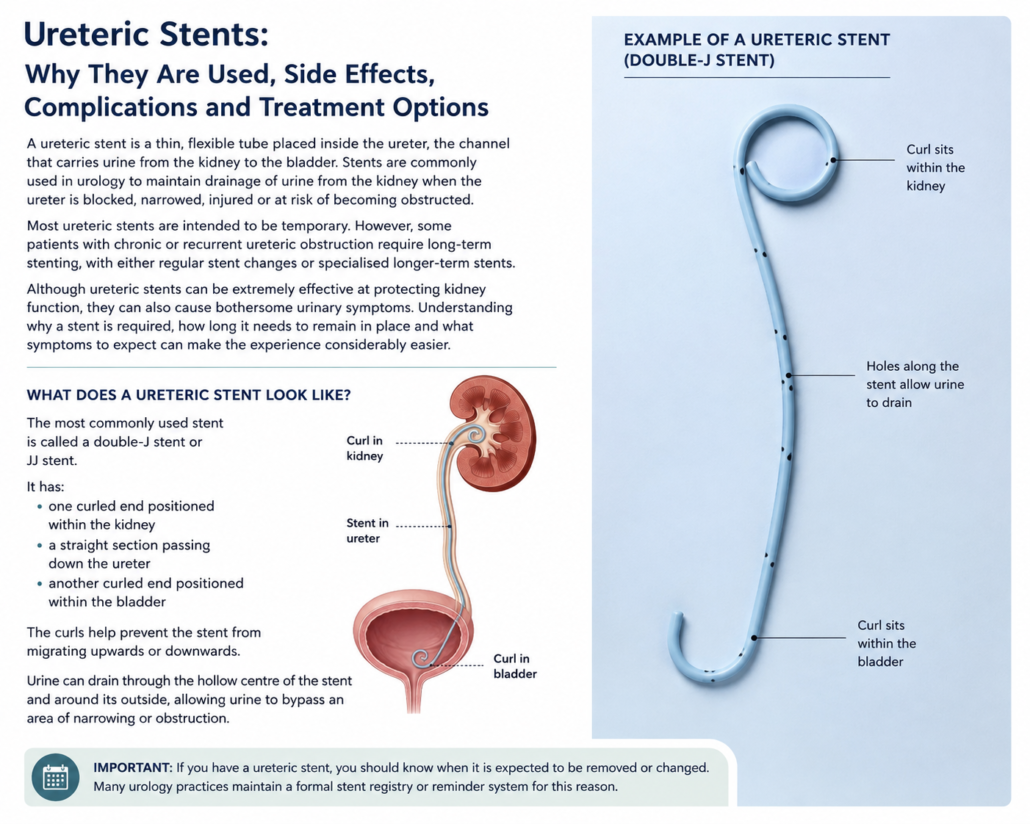
The most commonly used stent is called a double-J stent or JJ stent.
It has:
- one curled end positioned within the kidney
- a straight section passing down the ureter
- another curled end positioned within the bladder
The curls help prevent the stent from migrating upwards or downwards.
Urine can drain through the hollow centre of the stent and around its outside, allowing urine to bypass an area of narrowing or obstruction.
Why Might I Need a Ureteric Stent?
There are several reasons for inserting a ureteric stent.
1. Kidney and Ureteric Stones
Urinary stones are among the most common reasons for ureteric stent placement.
A stone lodged within the ureter can obstruct urine drainage and cause:
- severe renal colic
- swelling of the kidney, known as hydronephrosis
- deterioration in kidney function
- infection behind the obstruction
A stent may be inserted urgently to relieve the obstruction.
Stents are also commonly placed temporarily following ureteroscopy and laser treatment of urinary stones, particularly when there has been swelling, instrumentation or trauma to the ureter.
2. Infection Associated With an Obstructed Kidney
An obstructed and infected kidney can represent a urological emergency.
Patients may develop:
- fever
- chills or rigors
- flank pain
- nausea or vomiting
- low blood pressure
- sepsis
Urgent drainage of the kidney may be required using either:
a ureteric stent
or
a percutaneous nephrostomy tube, which drains the kidney externally through the back.
The infection is generally treated before definitive treatment of the underlying stone or obstruction.
3. Ureteric Stricture
A ureteric stricture is an abnormal narrowing of the ureter.
It may occur following:
- previous surgery
- stone disease
- ureteroscopy
- radiotherapy
- inflammation
- endometriosis
- retroperitoneal fibrosis
- previous ureteric injury
A stent can maintain drainage while the underlying problem is investigated or treated.
4. Following Ureteric Surgery
Stents are frequently placed after surgery involving the ureter to allow healing while maintaining urinary drainage.
Examples include:
- ureteroscopy
- ureteric reconstruction
- ureteric reimplantation
- pyeloplasty
- treatment of ureteric injuries
The stent effectively acts as an internal splint while the ureter heals.
5. Cancer-Related Ureteric Obstruction
Tumours within the pelvis or abdomen can compress or invade the ureters.
Examples include cancers involving the:
- prostate
- bladder
- cervix
- uterus
- ovary
- bowel
- lymphatic system
Ureteric obstruction can also occur from metastatic disease or enlarged lymph nodes.
In these circumstances, long-term ureteric drainage may be required to preserve kidney function.
6. Retroperitoneal Fibrosis
Retroperitoneal fibrosis is an uncommon condition in which inflammatory or fibrotic tissue develops around structures behind the abdominal cavity.
This tissue can surround and compress one or both ureters.
Some patients require prolonged ureteric stenting while the underlying condition is treated.
What Does Having a Ureteric Stent Feel Like?
Experiences vary considerably.
Some patients hardly notice their stent.
Others experience significant symptoms.
Collectively, these are often referred to as ureteric stent-related symptoms.
Common symptoms include:
Urinary frequency
You may need to urinate more frequently than normal.
Urinary urgency
There may be a sudden and sometimes uncomfortable urge to urinate.
Bladder discomfort
The lower end of the stent can irritate the bladder and produce discomfort or pressure.
Blood in the urine
A small amount of blood in the urine is common, particularly following physical activity.
The urine may vary from slightly pink to more obviously blood-stained.
Kidney or flank discomfort
Some patients experience discomfort in the kidney when urinating.
This can occur because bladder pressure during urination may be transmitted back towards the kidney along the stent.
Pain during or after urination
Discomfort may occur in the bladder, groin, urethra or kidney.
Symptoms may fluctuate and are often worse following strenuous physical activity.
Managing Ureteric Stent Symptoms
Treatment depends upon the severity and type of symptoms.
Maintain Appropriate Hydration
Maintaining normal hydration is generally helpful.
Excessive fluid intake, however, can sometimes worsen urinary frequency, urgency and kidney discomfort. The aim is usually adequate rather than excessive hydration, unless your doctor has advised otherwise.
Simple Pain Relief
Paracetamol or anti-inflammatory medication may be appropriate for some patients.
Anti-inflammatory medications are not suitable for everyone, particularly patients with certain kidney, stomach, cardiovascular or bleeding problems.
Your treating doctor can advise which medications are appropriate.
Alpha-Blockers
Medications such as tamsulosin may reduce stent-related discomfort in selected patients.
These medications relax smooth muscle within the urinary tract and may improve:
- flank discomfort
- urinary frequency
- urinary urgency
- pain associated with the stent
Possible side effects include dizziness and lowering of blood pressure.
Medication for Bladder Overactivity
When urinary urgency and frequency are particularly troublesome, medications used for an overactive bladder may occasionally help.
These include selected:
- antimuscarinic medications
- beta-3 agonists
The appropriate medication depends upon the patient’s symptoms and other medical conditions.
Adjusting Physical Activity
Exercise is usually safe with a ureteric stent unless your surgeon advises otherwise.
However, strenuous exercise may increase:
- blood in the urine
- flank discomfort
- bladder irritation
Reducing the intensity of activity temporarily can sometimes make symptoms considerably more manageable.
Possible Complications of Ureteric Stents
Most stents function without major problems, but complications can occur.
Urinary Infection
A stent is a foreign body within the urinary tract and bacteria may colonise its surface.
Seek medical attention if you develop:
- fever
- chills or rigors
- worsening flank pain
- feeling significantly unwell
- persistent burning during urination
Urine testing and antibiotics may be required.
Stent Migration
Occasionally a stent moves from its intended position.
It can migrate towards the kidney or bladder and may no longer provide adequate drainage.
Imaging and repositioning or replacement may be required.
Stent Blockage
Stents can occasionally become blocked by:
- blood clots
- stone fragments
- urinary debris
- encrustation
If obstruction is significant, the stent may need to be replaced.
Encrustation and Stone Formation
Minerals within the urine gradually deposit onto the surface of a stent.
This process is known as encrustation.
The risk increases the longer a stent remains in place.
Severe encrustation can make stent removal considerably more complicated and may require additional endoscopic or stone procedures.
The Forgotten Stent
One of the most important complications is a stent inadvertently being left in place for much longer than intended.
A forgotten stent may become:
- heavily encrusted
- blocked
- infected
- fragmented
- surrounded by stone formation
Removal can then require several procedures.
If you have a ureteric stent, you should know when it is expected to be removed or changed.
Many urology practices maintain a formal stent registry or reminder system for this reason.
When Should You Seek Urgent Medical Attention?
Contact your treating team or seek urgent medical assessment if you develop:
- fever or rigors
- severe or increasing kidney pain
- inability to pass urine
- persistent heavy bleeding or blood clots
- persistent vomiting
- significant deterioration in your general condition
- severe pain that is not controlled with prescribed medication
Fever associated with an obstructed urinary system requires particularly prompt assessment.
How Long Can a Ureteric Stent Stay In?
There is no single answer because it depends upon:
- why the stent was inserted
- the type and material of the stent
- stone-forming tendency
- infection
- pregnancy
- cancer treatment
- kidney function
- the manufacturer’s recommended indwelling time
Some temporary stents remain in place for only a few days or weeks.
Other stents designed for longer-term drainage may remain for several months before planned replacement.
A stent should therefore never simply be assumed to be safe indefinitely. Follow the removal or replacement schedule provided by your urologist.
Temporary Ureteric Stents
The majority of ureteric stents are temporary polymer JJ stents.
They may be used:
- after stone surgery
- following ureteroscopy
- after reconstructive surgery
- while ureteric inflammation settles
- while awaiting definitive treatment of an obstruction
Once the ureter has healed or the underlying obstruction has been treated, the stent is removed.
How Is a Ureteric Stent Removed?
Short-term stents may occasionally have a fine string attached to the end of the stent. This allows removal without another cystoscopic procedure in appropriately selected patients.
Most stents without strings are removed using flexible cystoscopy.
A small flexible telescope is passed through the urethra into the bladder. The lower end of the stent is identified, grasped and gently removed.
This is commonly performed as a short outpatient procedure using local anaesthetic gel.
What if Long-Term or Permanent Drainage Is Required?
Some causes of ureteric obstruction cannot easily be corrected.
In these circumstances, maintaining kidney drainage becomes a long-term management issue.
Options include:
Regularly Changed Polymer Stents
A conventional JJ stent can remain a long-term solution provided it is changed at appropriate intervals.
The disadvantage is the need for repeated procedures.
Long-Term or Metallic Ureteric Stents
Specialised metallic or reinforced stents may be considered in selected patients with chronic ureteric obstruction.
These are designed to resist external compression and, depending upon the particular device and clinical circumstances, may allow longer intervals between changes.
They can be particularly useful in selected cases of:
- malignant ureteric obstruction
- retroperitoneal fibrosis
- recurrent benign ureteric strictures
They are not suitable for every patient and still require ongoing urological surveillance.
Percutaneous Nephrostomy
When a ureteric stent cannot be inserted, repeatedly fails or does not provide adequate drainage, a nephrostomy tube may be required.
This is inserted through the skin directly into the kidney and drains urine externally into a collection bag.
Definitive Reconstructive Surgery
For suitable patients with benign obstruction, correcting the underlying problem may be preferable to lifelong stenting.
Depending upon the location and length of the obstruction, options may include:
- pyeloplasty
- ureteric reimplantation
- ureteroureterostomy
- bladder flap reconstruction
- bowel interposition
- other specialised ureteric reconstruction
The aim is to restore natural urinary drainage and eliminate the need for a permanent stent.
Temporary Versus Long-Term Stenting
| Temporary Stent | Long-Term Stenting | |
|---|---|---|
| Typical indication | Stones, surgery, temporary obstruction | Chronic benign or malignant obstruction |
| Common stent | Polymer JJ stent | Regularly changed polymer or specialised long-term stent |
| Duration | Days to months | Potentially years with planned surveillance/exchange |
| Replacement required? | Usually removed once no longer needed | Yes, according to stent type and clinical situation |
| Main concern | Symptoms, infection, migration | Encrustation, blockage, infection and repeated procedures |
| Alternative | Removal after definitive treatment | Reconstruction or nephrostomy in selected patients |
Is There Really a “Permanent” Ureteric Stent?
The term permanent stent can be misleading.
A patient may require permanent ureteric drainage, but this does not necessarily mean that the same stent remains in place permanently.
Most long-term stent strategies require:
- regular clinical review
- monitoring of kidney function
- periodic imaging when appropriate
- surveillance for infection or obstruction
- planned stent exchange according to the type of device being used
The objective is not simply to keep a stent in indefinitely, but to maintain safe and reliable drainage of the kidney.
Living With a Ureteric Stent
A ureteric stent can be an extremely useful device. It can relieve obstruction, control an emergency situation and protect kidney function while allowing definitive treatment to be planned.
Unfortunately, stents are not always comfortable.
Urinary frequency, urgency, blood in the urine and intermittent bladder or kidney discomfort are relatively common. These symptoms do not necessarily mean something is wrong with the stent, and several strategies and medications can make them easier to tolerate.
The most important questions to know after having a stent inserted are:
Why was my stent inserted?
When should it be removed or changed?
What symptoms should prompt me to seek medical attention?
If you are uncertain about any of these, contact your urologist or treating team.
This information is intended for general patient education and does not replace individual medical advice. The appropriate type and duration of ureteric stenting depends upon the cause of obstruction, kidney function, infection risk and individual patient circumstances.


Leave a Reply
Want to join the discussion?Feel free to contribute!