
How a Stroke Can Affect Bladder Function
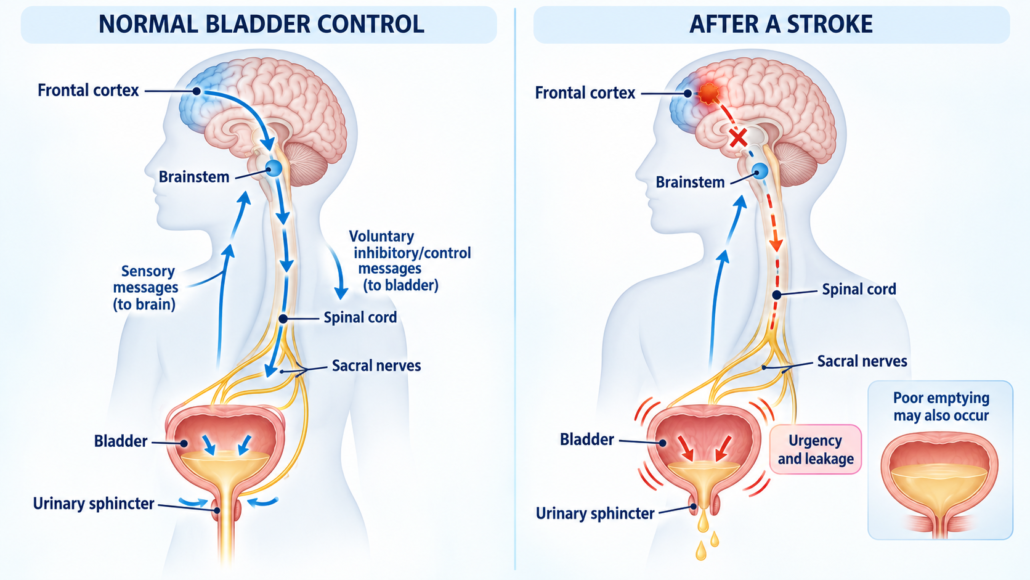
A cerebrovascular accident (CVA), more commonly called a stroke, can affect much more than movement and speech. It can also disrupt the communication between the brain and bladder, leading to urgency, urinary leakage, difficulty emptying the bladder—or a combination of these problems.
Bladder difficulties are common after stroke, particularly during the early stages of recovery. They can cause embarrassment, interfere with rehabilitation, disturb sleep and increase the risks of falls, skin problems and urinary tract infection. Fortunately, many patients improve as the brain recovers, and persistent symptoms can usually be managed with an individualised bladder rehabilitation and treatment plan.
How does the brain normally control the bladder?
The bladder stores urine at a low pressure until it is convenient to empty. This depends on coordinated communication between:
- The frontal lobes, which help recognise bladder filling and suppress urination until an appropriate time.
- Deeper brain centres involved in bladder sensation and behavioural control.
- The pontine micturition centre in the brainstem, which coordinates contraction of the bladder with relaxation of the urinary sphincter.
- The spinal cord and peripheral nerves that carry messages between the brain, bladder and sphincter.
A stroke may interrupt one or more of these pathways. The resulting bladder problem depends on the location and extent of the stroke, the patient’s previous bladder function and the presence of other conditions such as prostate enlargement, diabetes, constipation or reduced mobility.
What bladder problems can occur after a stroke?
Urgency and urge urinary incontinence
The most common problem is a sudden, compelling need to pass urine that may be difficult to postpone. Some patients leak before reaching the toilet.
This often results from detrusor overactivity, in which the bladder muscle contracts involuntarily during filling because the brain is no longer suppressing it normally.
Associated symptoms can include:
- Passing urine frequently.
- Waking several times at night to urinate.
- Sudden urgency.
- Leakage associated with urgency.
- Bedwetting.
- Reduced warning before urination.
Difficulty emptying the bladder
Some patients develop a weak or poorly coordinated bladder contraction and cannot empty effectively. This may cause:
- Difficulty starting urination.
- A slow or interrupted urinary stream.
- Straining to pass urine.
- A sensation of incomplete emptying.
- Frequent passage of small amounts.
- Overflow leakage from an overfilled bladder.
- Recurrent urinary infections.
Urinary retention may be more likely during the acute phase of stroke because of reduced consciousness, immobility, constipation, medication effects, pain, infection or a pre-existing obstruction such as an enlarged prostate.
Functional incontinence
Not every episode of leakage is caused by abnormal bladder contractions. A patient may recognise the need to urinate but be unable to reach or use the toilet because of:
- Weakness or paralysis.
- Poor balance or slow mobility.
- Visual impairment.
- Difficulty removing clothing.
- Communication problems.
- Confusion, memory loss or reduced awareness.
- An inaccessible toilet or lack of timely assistance.
This is called functional incontinence. Treating the bladder alone will not solve it; the physical and environmental barriers must also be addressed.
Loss of bladder awareness
A stroke can reduce awareness of bladder filling. The patient may not recognise the need to urinate until leakage occurs—or may remain unaware that the bladder is full.
Stress urinary incontinence
Leakage with coughing, sneezing, standing or exertion is not usually caused directly by stroke, but pre-existing pelvic-floor weakness may become more noticeable when mobility and general muscle function decline.
Nocturia and nighttime incontinence
Nighttime urination may be caused by an overactive bladder, sleep disturbance, leg swelling, obstructive sleep apnoea, medication timing or increased nighttime urine production. It is important because repeated attempts to reach the bathroom can significantly increase the risk of falls.
Does the site of the stroke predict the bladder problem?
There are broad associations between the area of brain injury and the type of bladder dysfunction, but the relationship is not exact enough to base treatment on the brain scan alone.
Frontal and subcortical strokes are frequently associated with urgency and detrusor overactivity. Brainstem strokes can interfere with coordination between the bladder and urinary sphincter, while larger strokes may impair bladder sensation, mobility and awareness.
The bladder pattern can also change during recovery. This is why treatment should be based on the patient’s current symptoms and objective bladder assessment rather than the location of the stroke alone.
How is bladder dysfunction assessed?
Assessment should consider the bladder, the patient’s neurological recovery and the practical circumstances surrounding each episode of leakage.
Medical and medication history
Important questions include:
- Was urgency, nocturia or poor urinary flow present before the stroke?
- When did the symptoms begin?
- Is the patient aware of bladder filling?
- Can the patient reach and use the toilet independently?
- Is there constipation, pain, visible blood in the urine or fever?
- What fluids, caffeine and alcohol are being consumed?
- Could medication be contributing?
Diuretics, sedatives, opioids and some medications with anticholinergic effects can aggravate urinary symptoms, confusion or retention.
Bladder diary
A bladder diary records fluid intake, the time and volume of each urination, urgency and leakage episodes. It can help distinguish reduced bladder capacity from excessive urine production or predominantly functional incontinence.
Physical examination
The assessment may include examination of the abdomen, genital area, prostate where appropriate, pelvic floor, mobility, cognition, sensation and neurological function.
Urine testing
Urinalysis—and urine culture when clinically indicated, can identify infection or blood in the urine. Bacteria in the urine without urinary symptoms do not automatically require antibiotics.
Bladder scan and post-void residual
A painless ultrasound bladder scan measures the urine remaining after urination. This is particularly useful when there is a weak stream, retention, recurrent infection, overflow leakage or before treatments that could make emptying more difficult.
Additional investigations
Depending on the circumstances, evaluation may include:
- Kidney function blood tests.
- Urinary flow testing.
- Ultrasound of the kidneys and bladder.
- Cystoscopy when there is haematuria, suspected obstruction or another appropriate indication.
- Urodynamic studies.
Are urodynamic studies always necessary?
No. Many patients with straightforward urgency or functional incontinence can begin conservative treatment after clinical assessment, urine testing and measurement of the post-void residual.
Urodynamic studies may be helpful when:
- The symptoms and clinical findings do not agree.
- Both urgency and poor emptying are present.
- There is persistent or unexplained urinary retention.
- Initial treatment has failed.
- An invasive treatment such as bladder Botox is being considered.
- There is concern about obstruction, weak bladder contraction or poor bladder compliance.
- Previous prostate, bladder or continence surgery complicates the diagnosis.
Urodynamics can distinguish an overactive bladder from impaired bladder contractility, obstruction or sphincter discoordination. This helps avoid giving treatment that reduces bladder contractions to someone who already empties poorly.
Treatment options
Treatment should be based on the bladder abnormality, the patient’s functional ability and their personal goals. Family members, continence nurses, physiotherapists, occupational therapists, rehabilitation physicians and urologists may all contribute.
Treat reversible factors
The first step is to identify problems that may be aggravating bladder control, including:
- Urinary infection.
- Constipation or faecal impaction.
- Excessive caffeine or alcohol.
- Excessive or poorly timed fluid intake.
- Uncontrolled diabetes.
- Leg swelling and nighttime fluid redistribution.
- Medication side effects.
- Prostate obstruction.
- Reduced access to the toilet.
Adequate hydration remains important. Simply restricting fluid can produce concentrated urine, constipation and bladder irritation.
Prompted or timed toileting
Scheduled toileting can be very effective, particularly when memory, mobility or awareness is impaired.
Options include:
- Timed voiding: visiting the toilet at regular planned intervals.
- Prompted voiding: a carer reminds and assists the patient to use the toilet.
- Habit retraining: the schedule is matched to the patient’s usual bladder pattern.
- Bladder training: gradually increasing the interval between toilet visits when the patient can recognise and suppress urgency.
Easy-to-remove clothing, a bedside commode, urinal, improved lighting and a clear path to the toilet can make a considerable difference.
Pelvic-floor rehabilitation
Pelvic-floor muscle training may improve urinary control in appropriately selected patients who can identify and contract these muscles. A continence or pelvic-floor physiotherapist can adapt the program for weakness, impaired coordination or cognitive limitations following stroke.
Medication for urgency and overactive bladder
Medication may be considered when conservative measures are insufficient.
Antimuscarinic medication
Medicines such as solifenacin, darifenacin, oxybutynin or trospium can reduce involuntary bladder contractions. Possible adverse effects include:
- Dry mouth.
- Constipation.
- Blurred vision.
- Difficulty emptying the bladder.
- Confusion or cognitive deterioration.
These medicines should be selected cautiously after stroke, particularly in older patients, those with cognitive impairment, constipation, glaucoma or an elevated post-void residual. The total anticholinergic burden from all medications should be reviewed.
Beta-3 agonists
Mirabegron relaxes the bladder during filling and may have fewer dry-mouth and cognitive adverse effects than antimuscarinic treatment. Blood pressure should be checked because mirabegron may worsen hypertension. Residual urine should also be monitored when there is concern about poor emptying.
Vibegron is another beta-3 agonist, although availability and funding can vary.
Management of incomplete emptying or retention
Treatment depends on the cause and severity.
Options may include:
- Reviewing medicines that impair bladder contraction.
- Treating constipation and infection.
- Managing prostate or urethral obstruction when present.
- Double voiding.
- Intermittent catheterisation.
Clean intermittent catheterisation is generally preferred when the bladder cannot empty safely and the patient or carer can perform it. An indwelling urethral catheter may sometimes be necessary during the acute phase, but prolonged unnecessary use should be avoided because of infection, urethral trauma and bladder-stone risks.
A suprapubic catheter may be considered when long-term catheter drainage is unavoidable and urethral catheterisation is unsuitable.
Botulinum toxin injections into the bladder
Botulinum toxin A, commonly called bladder Botox, can reduce severe detrusor overactivity when medication has been ineffective or poorly tolerated.
It may significantly improve urgency and leakage, but it can also weaken bladder emptying. The patient must understand that intermittent catheterisation may be required, sometimes for several months. Careful selection, measurement of residual urine and appropriate follow-up are essential.
Neuromodulation
Posterior tibial nerve stimulation may help some patients with urgency and overactive bladder symptoms. It is minimally invasive but usually requires repeated treatment sessions.
Sacral neuromodulation can be effective in selected people with refractory urinary urgency, urge incontinence or non-obstructive retention. Evidence specifically in post-stroke patients is more limited than in the general overactive-bladder population. The patient’s neurological stability, cognition, mobility, ability to operate the device and need for future MRI examinations should be considered.
Continence products and skin care
Pads, absorbent underwear, mattress protection and external collecting devices can preserve dignity while recovery and treatment continue. They should support—not replace—proper assessment and rehabilitation.
Regular skin care is important, particularly when mobility is limited. Condom drainage systems may help selected men, but correct fitting and skin monitoring are essential.
Can bladder control improve after a stroke?
Yes. Many patients experience substantial improvement during the first weeks and months as consciousness, mobility, communication and neurological control recover.
Persistent urinary incontinence, however, can be a marker of a more severe stroke and may be associated with greater disability. It should not be dismissed as an inevitable consequence of ageing or brain injury. Early assessment and an active continence program can improve independence, participation in rehabilitation and quality of life.
When should medical help be sought urgently?
Prompt medical assessment is required for:
- Complete inability to pass urine.
- A painful or visibly swollen lower abdomen.
- Fever, chills, confusion or suspected urinary infection.
- Visible blood in the urine.
- New flank pain.
- Recurrent infections.
- Increasing residual urine.
- New leg weakness, numbness or loss of bowel control.
- Sudden new neurological symptoms, which may represent another stroke.
In Australia, sudden facial weakness, arm weakness or speech disturbance should be treated as an emergency—call 000 immediately.
The key message
Bladder problems following a stroke are common, but they are not all the same. Leakage may result from an overactive bladder, impaired awareness, poor mobility, urinary retention, obstruction or several factors acting together.
Successful management begins by determining why the problem is occurring. A combination of bladder rehabilitation, environmental assistance, pelvic-floor therapy, carefully selected medication, catheterisation or specialist intervention can then be tailored to the individual patient.
So, if you or a loved one has suffered a stroke and your bladder has not recovered, come see your local Brisbane urologist, Dr Jo Schoeman to discuss management options
References
- Agapiou E, et al. Lower urinary tract dysfunction following stroke. Bladder. 2024. PubMed Central
- Agapiou E, et al. Bladder dysfunction following stroke: an updated review on diagnosis and management. Bladder. 2024. PubMed Central
- European Association of Urology. EAU Guidelines on Neuro-Urology. 2026. EAU Neuro-Urology Guideline
- Stroke Foundation Australia. Incontinence after stroke. Stroke Foundation patient fact sheet
- Stroke Foundation Australia. Urinary continence and stroke—resources for health professionals. InformMe
- Canadian Stroke Best Practices. Bladder and Bowel Function Following Stroke. Heart & Stroke Foundation of Canada
- National Institute for Health and Care Excellence. Stroke rehabilitation in adults (NG236). Updated 2023. NICE recommendations
- National Institute for Health and Care Excellence. Urinary incontinence in neurological disease: assessment and management (CG148). NICE guideline
- American Urological Association and Society of Urodynamics, Female Pelvic Medicine & Urogenital Reconstruction. Adult Neurogenic Lower Urinary Tract Dysfunction Guideline. AUA/SUFU guideline
- Intercollegiate Stroke Working Party. National Clinical Guideline for Stroke: Rehabilitation and recovery—activity and participation. National Clinical Guideline for Stroke
This article provides general educational information and does not replace individual medical assessment. Treatment should be tailored to the type of bladder dysfunction, other medical conditions, current medications and the patient’s rehabilitation goals.








Leave a Reply
Want to join the discussion?Feel free to contribute!