
Sexually Transmitted Infections in Men: What You Need to Know
More than just an uncomfortable infection
Sexually transmitted infections (STIs) are extremely common and can affect people of any age who are sexually active.
For men, an STI may present with something obvious such as penile discharge, burning when passing urine, genital ulcers or warts. However, there is an important catch:
Many sexually transmitted infections cause no symptoms at all.
Chlamydia, for example, is frequently asymptomatic. A man may therefore carry and transmit an infection without knowing it.
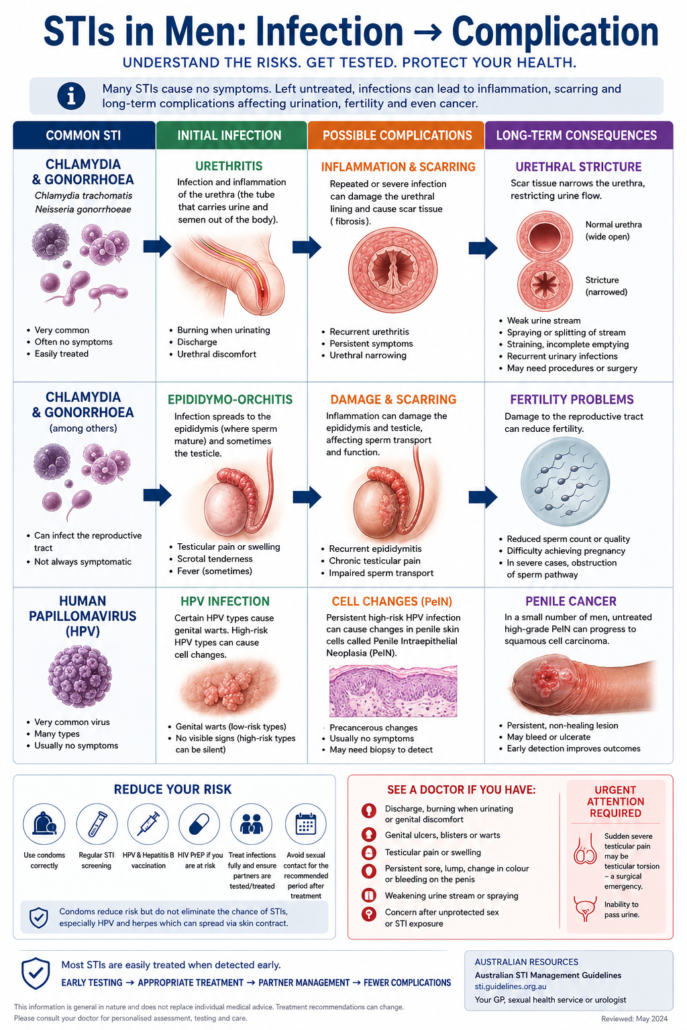
Most STIs can be successfully treated or controlled. The reason they should not be ignored is that untreated infection can occasionally lead to significant complications, including:
- epididymitis or epididymo-orchitis
- chronic testicular or pelvic discomfort
- urethritis
- urethral scarring and stricture disease
- impaired fertility
- transmission to sexual partners
- increased susceptibility to other infections
- and, in the case of persistent high-risk HPV infection, an increased risk of penile and other cancers.
The good news is that modern STI testing is generally straightforward, discreet and highly accurate.
What exactly is an STI?
An STI is an infection that can be transmitted during sexual contact.
Transmission does not necessarily require penetrative intercourse. Depending upon the infection, transmission can occur through:
- vaginal intercourse
- anal intercourse
- oral sex
- genital-to-genital skin contact
- contact with infected genital lesions
- sharing sex toys
- exposure to infected blood.
Some infections, particularly HPV and herpes, can be transmitted by intimate skin-to-skin contact even when condoms are used correctly.
Common STIs affecting men
Chlamydia
Chlamydia trachomatis is one of the most frequently diagnosed STIs in Australia and is particularly common in younger sexually active people. Most infections produce few or no symptoms.
When symptoms occur, men may notice:
- burning or stinging when urinating
- clear or cloudy penile discharge
- urethral irritation
- testicular discomfort
- epididymal pain or swelling.
Untreated infection can occasionally progress to epididymo-orchitis, where infection and inflammation involve structures around the testicle.
This is particularly relevant to fertility because the epididymis is part of the pathway through which sperm travel.
Gonorrhoea
Gonorrhoea is caused by Neisseria gonorrhoeae.
It classically produces:
- significant burning during urination
- yellow, white or green penile discharge
- urethral discomfort
- occasionally testicular pain.
However, gonorrhoea can also occur in the throat or rectum and may be asymptomatic.
Diagnosis is usually made with a nucleic acid amplification test (NAAT/PCR). Culture may also be obtained, particularly because monitoring antibiotic resistance is increasingly important.
Untreated gonorrhoea may lead to persistent urethritis and occasionally epididymo-orchitis.
Historically, severe gonococcal urethritis was also an important cause of urethral stricture disease.
Mycoplasma genitalium
Mycoplasma genitalium, often shortened to M. genitalium, is another cause of sexually acquired urethritis.
Men may experience:
- burning during urination
- penile discharge
- urethral discomfort
- persistent or recurrent urethritis.
It becomes particularly relevant when symptoms continue despite apparently appropriate treatment for more common infections.
Treatment needs to be carefully selected because antibiotic resistance has become an important issue.
Syphilis
Syphilis is caused by Treponema pallidum.
It has sometimes been called the “great imitator” because it can produce an extraordinary range of symptoms.
Early infection may cause a painless genital ulcer or chancre.
Later symptoms can include:
- rash
- swollen lymph nodes
- fever
- neurological symptoms
- cardiovascular complications.
Importantly, the initial ulcer can disappear without treatment.
That does not mean the infection has gone away.
Diagnosis usually involves blood tests, although PCR/NAAT testing may sometimes be performed directly from suitable lesions.
Syphilis remains an important STI in Australia. Treatment protocols depend upon the stage of infection and individual circumstances. Australian STI guidelines should be followed because treatment recommendations and medication availability can change.
Genital herpes
Genital herpes is caused predominantly by herpes simplex virus type 1 or type 2 (HSV-1 and HSV-2).
Symptoms may include:
- clusters of painful blisters
- genital ulcers
- burning
- tingling
- painful urination
- swollen groin lymph nodes
- flu-like symptoms during an initial infection.
The virus subsequently remains dormant within sensory nerves and may reactivate.
Some people experience frequent outbreaks, while others have few or no further symptoms.
Antiviral medications such as valaciclovir, aciclovir or famciclovir can reduce the duration and severity of outbreaks. Suppressive antiviral therapy can be considered for frequent or troublesome recurrences.
There is currently no treatment that completely eliminates HSV from the body.
HPV and genital warts
Human papillomavirus, or HPV, deserves particular attention in men’s urological health.
There are more than 200 recognised HPV types. Some predominantly cause benign genital warts, while persistent infection with certain high-risk HPV types can contribute to cancer.
Genital warts can appear as:
- small raised bumps
- flat lesions
- clusters of lesions
- cauliflower-like growths
- lesions around the penile shaft, foreskin, glans, urethral opening, pubic region or anus.
Treatment options can include topical medication, cryotherapy, diathermy, laser treatment or surgical removal depending upon their location and extent.
Does HPV cause penile cancer?
This is an important question.
Certain high-risk HPV infections are associated with penile cancer.
Persistent infection with oncogenic HPV can produce precancerous cellular changes known as penile intraepithelial neoplasia (PeIN), which in some men may eventually progress to squamous cell carcinoma.
WHO recognises persistent high-risk HPV infection as being associated with cancers of the penis as well as the anus and mouth/throat.
This does not mean that having HPV means you will develop penile cancer.
HPV infection is extraordinarily common and, in most people, the immune system controls the infection without it causing cancer.
However, a penile lesion that:
- does not heal
- repeatedly bleeds
- becomes ulcerated
- changes colour
- gradually enlarges
- produces persistent discharge
- or remains despite treatment
should be examined by a doctor.
Persistent penile lesions occasionally require biopsy rather than repeated creams and crossed fingers.
HPV vaccination matters for men too
HPV vaccination is not simply a cervical cancer vaccine.
Vaccination can reduce the risk of acquiring important HPV types associated with genital warts and HPV-related cancers.
Australian STI guidelines recommend considering HPV vaccination in appropriate patients who have not previously been vaccinated. Importantly, the vaccine does not treat an existing wart, but may provide protection against future acquisition of other vaccine-covered HPV types.
Your GP or sexual health clinician can advise whether vaccination is appropriate for you.
Can an STI cause infertility?
Yes, although this is not inevitable.
The male reproductive tract is rather like a carefully organised plumbing system. Sperm have to travel from the testicle through the epididymis and vas deferens before eventually joining the ejaculatory pathway.
Inflammation or infection along that pathway can occasionally interfere with sperm transport or testicular function.
Chlamydia, for example, is recognised as a potential cause of epididymo-orchitis and infertility.
Epididymo-orchitis
STIs such as chlamydia and gonorrhoea may cause inflammation of the epididymis and sometimes the testicle.
Symptoms can include:
- unilateral testicular pain
- scrotal swelling
- tenderness
- urinary symptoms
- urethral discharge
- occasionally fever.
Severe or recurrent inflammation can potentially damage the reproductive tract.
Bilateral disease is of greater concern for fertility.
A very important warning
Sudden severe testicular pain should never simply be assumed to be an STI.
Testicular torsion can produce similar symptoms and is a surgical emergency. A suddenly painful testicle requires urgent medical assessment.
STIs and urethral strictures
One of the less frequently discussed long-term complications of severe or recurrent urethritis is urethral stricture disease.
A urethral stricture is an area of scar tissue that narrows the urethra, the tube carrying urine from the bladder through the penis.
Repeated inflammation can injure the urethral lining. Healing may subsequently produce fibrosis and scarring.
The result can be rather like replacing a wide garden hose with a drinking straw.
Symptoms of a urethral stricture include:
- weakening urinary stream
- spraying or splitting of the stream
- straining to urinate
- prolonged urination
- incomplete bladder emptying
- recurrent urinary infections
- dribbling
- urinary retention.
In modern Australian practice, sexually transmitted infection is only one of several potential causes of urethral strictures. Previous urethral instrumentation, catheterisation, trauma, surgery and inflammatory conditions such as lichen sclerosus are also important causes.
How is a urethral stricture investigated?
Depending upon the symptoms, investigation may include:
Uroflowmetry
The patient urinates into a specialised flow meter to measure the strength and pattern of the urinary stream.
Bladder ultrasound
An ultrasound can measure how much urine remains in the bladder after urination.
Flexible cystoscopy
A small flexible telescope is passed into the urethra to identify the location and severity of narrowing.
Retrograde urethrogram
Contrast is introduced into the urethra and X-rays are obtained to demonstrate the length and position of the stricture.
Treatment depends upon the length, location and severity of the narrowing and may include dilation, endoscopic urethrotomy or reconstructive surgery (urethroplasty).
How are STIs diagnosed?
There is no single universal “STI test.”
Testing is selected according to your symptoms, sexual history and sites of sexual exposure.
Testing may include:
Urine testing
A first-pass urine sample can be tested using NAAT/PCR for infections such as:
- chlamydia
- gonorrhoea.
Swabs
Depending upon sexual practices and symptoms, swabs may be taken from:
- urethra
- throat
- rectum
- genital ulcers or lesions.
Testing only the urine can therefore miss an infection elsewhere.
Australian STI guidelines recommend site-specific testing according to sexual exposure.
Blood tests
Blood testing may be recommended for:
- HIV
- syphilis
- hepatitis B
- hepatitis C in appropriate circumstances.
Examination and biopsy
Genital warts are often diagnosed clinically.
Persistent, unusual, pigmented, ulcerated or suspicious penile lesions may require biopsy to exclude PeIN, penile cancer or another dermatological condition.
What happens if an STI is diagnosed?
Management depends entirely upon the infection.
Bacterial infections such as chlamydia, gonorrhoea and syphilis can usually be treated with appropriate antibiotics.
Viral infections such as HSV and HPV behave differently. Treatment may control symptoms, outbreaks or visible lesions rather than completely eliminating the virus.
Depending upon the infection, management may also involve:
1. Treating the infection
Use the recommended antibiotic or antiviral therapy and complete treatment exactly as prescribed.
2. Partner notification
Current or recent sexual partners may require testing and treatment.
This is important because treating only one person can create an unfortunate game of microbial ping-pong, with infection repeatedly passing between partners.
3. Temporarily avoiding sexual contact
Your treating clinician will advise when sexual activity can safely resume.
4. Testing for other STIs
Finding one STI may indicate exposure to others, so broader testing may be appropriate.
5. Repeat testing
Some infections require repeat testing or retesting after an appropriate interval.
What about HIV?
Modern HIV prevention and treatment have changed dramatically.
People at increased risk of HIV may benefit from pre-exposure prophylaxis (PrEP).
After a significant recent exposure, post-exposure prophylaxis (PEP) may also be appropriate and should be sought urgently because treatment needs to begin promptly.
People living with HIV who receive effective antiretroviral treatment can achieve an undetectable viral load. HIV care should be coordinated through clinicians experienced in HIV medicine.
When should I see a doctor?
Arrange medical assessment if you develop:
- penile discharge
- burning when urinating
- genital ulcers
- genital blisters
- genital warts
- unexplained penile lumps
- persistent redness of the glans or foreskin
- testicular discomfort
- scrotal swelling
- persistent urethral discomfort
- weakening urinary stream
- or concern following unprotected sexual contact.
Seek urgent medical attention for:
Sudden severe testicular pain
This may represent testicular torsion rather than infection.
Inability to pass urine
This may indicate severe obstruction.
A persistent ulcer, lump or abnormal area on the penis
Particularly if it is enlarging, bleeding or failing to heal.
“But I feel completely normal”
This is one of the most important messages about STIs:
No symptoms does not necessarily mean no infection.
Australian STI guidelines specifically recognise that STIs can exist without producing symptoms.
Testing may therefore be sensible after:
- a new sexual partner
- multiple partners
- condomless sex
- notification from a sexual partner
- known STI exposure
- or when recommended as part of routine sexual health screening.
The type and frequency of testing should reflect your individual circumstances rather than embarrassment, assumptions or relationship status.
Prevention
Reducing STI risk may involve several complementary strategies:
- using condoms appropriately
- regular STI screening when indicated
- HPV vaccination
- hepatitis B vaccination where appropriate
- HIV PrEP for people at increased risk
- prompt testing following symptoms or partner notification
- treating infections completely
- ensuring relevant partners are tested or treated
- avoiding sexual contact for the recommended period following treatment.
No strategy other than abstaining from sexual contact eliminates every possible STI risk, particularly because HPV and herpes can spread through areas of skin not covered by a condom.
A urologist’s perspective
Most STIs are diagnosed and managed very effectively by GPs and sexual health clinics.
A urologist becomes particularly useful when the infection has left something behind.
This may include:
- persistent urethral symptoms
- recurrent epididymitis
- chronic testicular pain
- suspected obstruction of the reproductive tract
- fertility concerns
- urethral stricture
- recurrent urinary infections
- genital lesions requiring biopsy
- suspected penile intraepithelial neoplasia
- or possible penile cancer.
In these circumstances, treating the original infection may only be part of the solution. The structural or functional consequences also need assessment.
The bottom line
Sexually transmitted infections are common, and having one should be regarded as a health issue rather than a moral judgement.
The greatest problems often arise not from the initial infection but from an infection that remains undiagnosed or untreated.
For men, potentially important consequences include urethritis, epididymo-orchitis, fertility problems and urethral stricture disease. Persistent infection with certain high-risk HPV types is also associated with penile cancer.
If something looks different, burns, discharges, ulcerates, grows, hurts or simply does not seem right, getting it checked is usually far easier than spending three weeks consulting Dr Google at midnight.
Early testing → appropriate treatment → partner management → fewer complications.
Australian resources
The Australian STI Management Guidelines provide evidence-based recommendations for STI testing, diagnosis and treatment in Australia.
Australian STI Management Guidelines
Medical disclaimer
This information is intended for general patient education and does not replace individual medical advice, examination or diagnosis. STI treatment recommendations can change, particularly because of antimicrobial resistance and medication availability. Patients with symptoms or concerns about possible exposure should discuss appropriate testing and treatment with their GP, sexual health service or urologist.


Leave a Reply
Want to join the discussion?Feel free to contribute!