
Advanced and Metastatic Prostate Cancer: Modern Treatment and New Hope
A diagnosis of advanced or metastatic prostate cancer can be frightening. However, the treatment landscape has changed dramatically over the past decade.
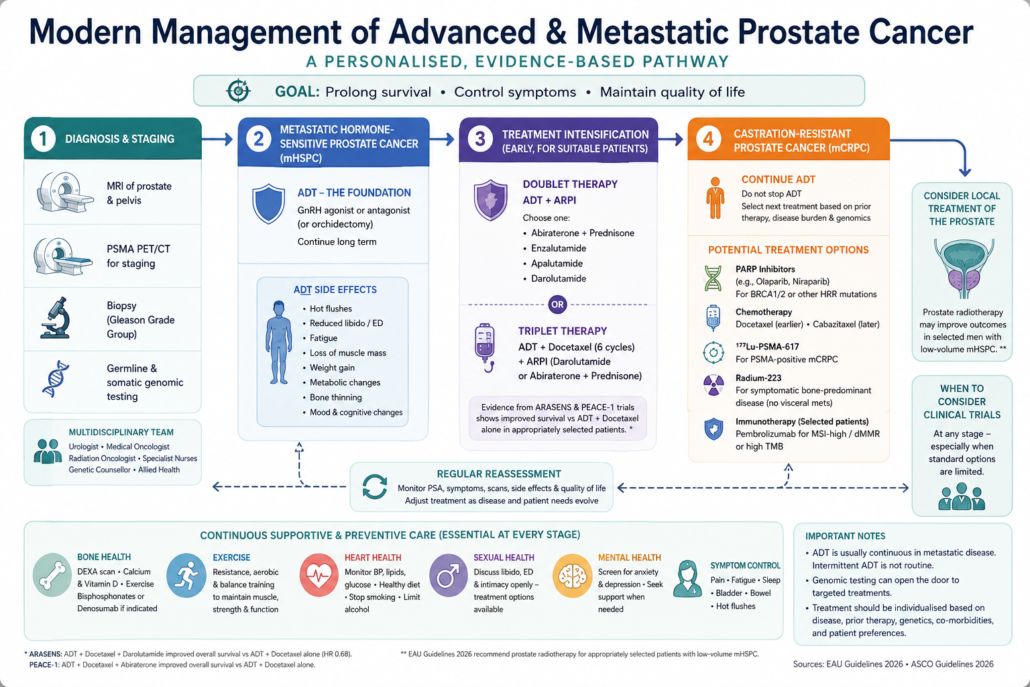
Where doctors once relied mainly on testosterone-lowering treatment, we now have combinations of androgen deprivation therapy (ADT), modern androgen-receptor medicines, chemotherapy, targeted treatments, radioligand therapy and, for selected cancers, immunotherapy.
Importantly, these treatments are increasingly being used earlier and in combination, rather than waiting for one treatment to fail before introducing the next.
The aim is not simply to lower the PSA. It is to control the cancer for as long as possible while maintaining quality of life.
What does “advanced” prostate cancer mean?
Advanced prostate cancer is not one single condition.
Locally advanced prostate cancer
The cancer has grown beyond the prostate or into nearby structures but has not necessarily spread to distant organs.
Metastatic hormone-sensitive prostate cancer
The cancer has spread elsewhere in the body, commonly to:
- lymph nodes
- bones
- lungs
- liver or other organs
but remains sensitive to testosterone suppression.
This is often abbreviated to mHSPC or metastatic hormone-sensitive prostate cancer.
Metastatic castration-resistant prostate cancer
Over time, prostate cancer cells may learn to grow despite very low testosterone levels.
This is called metastatic castration-resistant prostate cancer (mCRPC).
“Castration resistant” does not mean that there are no further treatments available. Quite the opposite. We now have several effective treatment classes that can be used at this stage.
1. Androgen Deprivation Therapy: The Foundation of Treatment
Prostate cancer cells are usually heavily dependent on male hormones, particularly testosterone.
Androgen deprivation therapy (ADT) reduces testosterone to very low levels.
This can be achieved with regular injections or implants using GnRH/LHRH agonists or antagonists. Surgical removal of the testosterone-producing portion of the testes, called an orchidectomy, remains effective but is now used less frequently.
ADT remains the backbone of treatment for metastatic prostate cancer.
However, an important change in modern prostate cancer management is that ADT alone is usually no longer considered adequate initial treatment for a fit man presenting with metastatic hormone-sensitive disease.
Current EAU recommendations favour combining ADT with another effective systemic treatment whenever the patient is sufficiently fit.
2. Double Therapy
One approach combines ADT with a modern androgen-receptor pathway inhibitor (ARPI).
Examples include:
Abiraterone + prednisone
Abiraterone blocks androgen production not only from the testes but also from the adrenal glands and within the cancer itself.
Potential side effects include:
- high blood pressure
- low potassium
- fluid retention
- abnormal liver function
- cardiac problems in susceptible patients
- steroid-related effects
Enzalutamide
This blocks signalling through the androgen receptor.
Possible side effects include fatigue, hypertension, falls, cognitive effects and, rarely, seizures.
Apalutamide
Another potent androgen-receptor inhibitor. Side effects may include fatigue, rash, hypertension, falls and thyroid abnormalities.
Darolutamide
Darolutamide also inhibits androgen-receptor signalling and has relatively limited penetration into the central nervous system, which may be advantageous for some patients.
Current EAU guidance strongly supports treatment intensification rather than ADT alone in suitable patients with metastatic hormone-sensitive disease.
3. Triple Therapy: Three Treatments From the Starting Line
One of the biggest developments in metastatic prostate cancer has been triplet therapy.
Instead of:
ADT alone
or:
ADT + one additional treatment
selected patients may receive:
ADT + chemotherapy + an androgen-receptor pathway inhibitor
Two landmark trials helped establish this approach.
ARASENS
The phase III ARASENS trial investigated:
ADT + docetaxel + darolutamide
compared with:
ADT + docetaxel + placebo
The addition of darolutamide reduced the risk of death by approximately 32.5%, with a hazard ratio for death of 0.68.
Four-year overall survival was approximately 62.7% with triplet therapy compared with 50.4% in the control group.
PEACE-1
The PEACE-1 trial investigated the addition of abiraterone to standard treatment in men with newly diagnosed metastatic prostate cancer.
Among patients receiving ADT and docetaxel, adding abiraterone improved both radiographic progression-free survival and overall survival.
These studies have fundamentally changed how we approach a fit patient presenting with metastatic prostate cancer.
Who may benefit from triple therapy?
Triplet therapy is particularly considered in men who:
- present initially with metastatic disease
- have a significant metastatic burden
- are medically fit enough to receive chemotherapy
- have an expected lifespan sufficient to benefit from treatment intensification.
Treatment nevertheless needs to be individualised.
The EAU now recommends that when docetaxel is used for first-line metastatic hormone-sensitive disease, it should generally be given as part of combination treatment with ADT plus abiraterone or darolutamide in patients fit enough for chemotherapy.
One important scientific caveat remains: trials clearly demonstrated that triplet treatment is superior to ADT + docetaxel, but direct randomised evidence comparing triplet therapy against ADT + a modern ARPI without chemotherapy remains limited.
4. Chemotherapy
Docetaxel
Docetaxel remains an important chemotherapy for advanced prostate cancer.
It damages rapidly dividing cancer cells and is commonly given intravenously every three weeks for a defined number of cycles when used in hormone-sensitive metastatic disease.
Potential side effects include:
- fatigue
- temporary hair loss
- lowered white blood cell count
- infection
- febrile neutropenia
- anaemia
- altered taste
- nail changes
- peripheral neuropathy
- fluid retention.
Modern supportive treatment has made chemotherapy considerably more manageable than many patients expect.
Cabazitaxel
Cabazitaxel is generally used later, particularly when metastatic castration-resistant cancer has progressed following docetaxel and androgen-receptor pathway treatment.
Current ASCO recommendations include cabazitaxel as an important later-line treatment following appropriate prior ARPI and docetaxel therapy.
5. Should ADT Ever Be Intermittent?
This is an important question because ADT has significant long-term effects.
With intermittent ADT, treatment is stopped after a good PSA response and restarted when the PSA or cancer activity rises again.
The attraction is obvious: periods away from treatment may allow testosterone recovery and improvements in:
- sexual function
- hot flushes
- energy
- mood
- muscle strength
- metabolic health.
However, metastatic disease is different from some non-metastatic situations.
The large SWOG 9346 study could not establish that intermittent treatment was non-inferior to continuous ADT in metastatic disease. Consequently, a small survival disadvantage from intermittent therapy cannot be excluded.
The 2026 EAU guideline therefore notes that intermittent ADT has largely been superseded by continuous ADT-based combination therapy for metastatic disease.
For most men with metastatic prostate cancer, therefore, continuous hormonal suppression remains the standard.
Intermittent treatment may occasionally be considered in carefully selected circumstances after detailed discussion of the potential quality-of-life benefits and oncological uncertainty.
6. What Happens When the Cancer Becomes Castration Resistant?
A rising PSA despite very low testosterone does not automatically mean treatment has “stopped working.”
Rather, it tells us that the biology of the cancer has changed.
Importantly, ADT is usually continued even after castration resistance develops.
The next treatment depends heavily upon what the patient has already received.
Options can include:
- docetaxel
- cabazitaxel
- abiraterone
- enzalutamide
- PARP inhibitors
- radioligand therapy
- radium-223
- selected immunotherapy
- clinical trials.
Simply moving repeatedly from one androgen-receptor drug to another is becoming less attractive because of significant cross-resistance.
7. Genetic Testing Has Become Part of Treatment
One of the most important changes in advanced prostate cancer management is the move toward precision medicine.
Men with metastatic disease should increasingly be considered for tumour genomic testing and, where appropriate, germline genetic testing.
Important abnormalities include mutations involving:
BRCA1, BRCA2 and other homologous recombination repair (HRR) genes.
These mutations may make the cancer susceptible to PARP inhibitors.
Examples include:
- olaparib
- niraparib
- talazoparib
- rucaparib in appropriate settings.
Some PARP inhibitors can now be combined with androgen-receptor treatments in appropriately selected patients.
The 2026 EAU guidelines specifically recommend testing metastatic patients for somatic or germline HRR abnormalities because the results may directly change treatment.
In other words, we increasingly need to know not only where the prostate cancer has spread, but what is driving it genetically.
8. Immunotherapy: Exciting, But Not for Everyone
Immunotherapy has transformed several cancers, but prostate cancer has proved more resistant to conventional immune checkpoint therapy.
For the average patient with metastatic prostate cancer, immunotherapy is not currently routine first-line treatment.
However, there is an important exception.
Pembrolizumab
A small proportion of prostate cancers have abnormalities known as:
- MSI-high
- mismatch-repair deficient (dMMR)
- or, in relevant jurisdictions, sufficiently high tumour mutational burden.
These cancers may respond to the immune checkpoint inhibitor pembrolizumab.
ASCO’s 2026 living guideline recognises clinical activity of pembrolizumab in selected MSI-high/mismatch-repair-deficient metastatic castration-resistant prostate cancer.
This is another reason why molecular testing has become important.
For unselected prostate cancer patients, however, large trials combining pembrolizumab with treatments such as docetaxel, enzalutamide or olaparib have not demonstrated the hoped-for survival improvement.
Immunotherapy therefore currently works best as a biomarker-selected treatment rather than a universal prostate cancer therapy.
Possible immune-related side effects include inflammation of normal organs, including:
- thyroid dysfunction
- skin inflammation
- colitis and diarrhoea
- hepatitis
- pneumonitis
- adrenal or pituitary abnormalities.
Although uncommon, some immune complications can be serious and require corticosteroid treatment.
9. PSMA Radioligand Therapy
Another major advance is lutetium-177 PSMA radioligand therapy, often written as ¹⁷⁷Lu-PSMA-617.
The treatment uses a molecule that recognises PSMA on prostate cancer cells and carries a radioactive isotope directly to those cells.
It is therefore rather like delivering radiation with a molecular address label attached.
For appropriately selected men with PSMA-positive metastatic castration-resistant prostate cancer, it can provide another life-prolonging systemic treatment option.
The exact timing of ¹⁷⁷Lu-PSMA therapy is evolving rapidly as clinical trial evidence matures and regulatory indications change. Current EAU and ASCO recommendations include it among established systemic options for appropriately selected mCRPC patients.
Potential side effects include:
- fatigue
- dry mouth
- nausea
- reduced blood counts
- anaemia
- thrombocytopenia.
10. Radium-223 for Bone-Dominant Disease
Prostate cancer has a particular tendency to spread to bone.
Radium-223 is a radioactive treatment that preferentially targets areas of increased bone turnover.
It may be appropriate for selected men with symptomatic bone-predominant metastatic castration-resistant prostate cancer without visceral metastases.
Its role needs to be carefully coordinated with other treatments and bone-health management.
11. Don’t Forget the Prostate Itself
It may seem strange to treat the prostate once cancer has already spread.
However, clinical studies have demonstrated that treating the primary prostate tumour with radiotherapy can improve outcomes in selected men presenting with low-volume metastatic disease.
The EAU therefore recommends prostate radiotherapy for appropriately selected patients presenting with low-volume metastatic hormone-sensitive prostate cancer.
This does not mean every man with metastatic prostate cancer should have prostate surgery or radiation. The benefit depends on the pattern and burden of metastatic disease.
12. Side Effects of Long-Term Hormonal Treatment
Because men may now live for many years with advanced prostate cancer, treatment side effects deserve almost as much attention as the cancer itself.
Long-term ADT may cause:
Sexual effects
Reduced libido, erectile dysfunction and loss of spontaneous erections are common.
Hot flushes
These can range from mildly annoying to profoundly disruptive.
Muscle loss
Testosterone suppression causes loss of muscle mass and strength unless actively countered.
Weight gain
Fat tends to accumulate particularly around the abdomen.
Metabolic changes
ADT can increase the risk of:
- insulin resistance
- diabetes
- abnormal cholesterol
- cardiovascular disease.
Bone thinning
Long-term ADT accelerates osteoporosis and increases fracture risk.
Current EAU guidance recommends formal assessment of osteoporosis risk, including DEXA scanning when commencing long-term ADT, together with appropriate bone protection.
Mood and cognition
Some men experience:
- fatigue
- low mood
- reduced motivation
- sleep disturbance
- difficulty concentrating.
These symptoms deserve recognition and treatment rather than being dismissed as simply part of ageing.
Exercise Is Part of Cancer Treatment
Regular exercise is one of the most useful supportive treatments for men receiving long-term ADT.
A programme incorporating:
resistance training + aerobic exercise + balance work
can help preserve muscle, bone strength, cardiovascular fitness and independence.
Nutrition, weight management, smoking cessation, alcohol moderation and optimisation of cardiovascular risk factors should form part of long-term prostate cancer care.
Bone Health Matters
Men receiving prolonged ADT should have their fracture risk assessed.
Depending on bone density and metastatic involvement, treatment may include:
- calcium and vitamin D when appropriate
- resistance and weight-bearing exercise
- bisphosphonates
- denosumab.
Men receiving denosumab or bisphosphonates require appropriate calcium monitoring and usually dental assessment because of the uncommon but important risk of osteonecrosis of the jaw.
A New Way of Thinking About Metastatic Prostate Cancer
The old treatment pathway was fairly linear:
ADT → wait for progression → chemotherapy → another treatment.
Modern treatment looks very different.
It is increasingly:
Diagnose → accurately stage → molecularly profile → intensify treatment early → continuously reassess → select the next therapy according to previous treatment and tumour biology.
For some patients this means:
ADT + ARPI
For others:
ADT + docetaxel + darolutamide
or:
ADT + docetaxel + abiraterone
And later, depending on the tumour:
chemotherapy → PARP inhibition → PSMA radioligand therapy → radium-223 → selected immunotherapy or clinical trials.
There is no longer a single treatment pathway that suits every patient.
The Bottom Line
Advanced prostate cancer remains a serious disease, but its treatment has undergone a remarkable transformation.
The strongest contemporary evidence supports early treatment intensification for suitable men with metastatic hormone-sensitive prostate cancer rather than relying on ADT alone.
The ARASENS and PEACE-1 trials established an important role for triplet therapy in appropriately selected patients, while modern guidelines increasingly emphasise genomic testing, targeted treatment, radioligand therapy and careful sequencing of chemotherapy and androgen-receptor treatments.
Intermittent ADT is attractive from a quality-of-life perspective but is not the routine standard for metastatic disease, where continuous ADT-based combination treatment remains preferred.
Perhaps most importantly, treatment should not focus exclusively on the PSA.
Bone health, cardiovascular health, muscle strength, sexual health, psychological wellbeing and maintaining independence are all part of successful prostate cancer treatment.
For many men, metastatic prostate cancer can now be controlled for years through carefully planned sequences and combinations of treatment.
This information is intended for general patient education. Treatment of advanced prostate cancer should be individualised through discussion with a urologist, medical oncologist and radiation oncologist experienced in prostate cancer management.







Leave a Reply
Want to join the discussion?Feel free to contribute!