
Penile Cancer: Symptoms, Diagnosis and Treatment in Australia
Penile cancer is rare, but early diagnosis matters
Penile cancer is an uncommon cancer affecting the skin and tissues of the penis. In Australia, approximately 165 men were estimated to be diagnosed with penile cancer in 2025, with the average age at diagnosis around 68 years. About 95% of penile cancers are squamous cell carcinomas (SCC).
Although the diagnosis can understandably be frightening, there is an important message:
When penile cancer is detected early, treatment is frequently curative and, in many men, much or all of the penis can be preserved.
Modern treatment has therefore moved increasingly towards penile-preserving therapy whenever this can be achieved safely.
Treatment in Australia will depend on:
- whether the abnormality is precancerous or invasive cancer
- the size and location of the tumour
- how deeply it has invaded
- the grade of the cancer
- whether lymph nodes in the groin are involved
- whether cancer has spread elsewhere
- the man’s general health and personal preferences.
Because penile cancer is rare, patients with invasive or complicated disease benefit from discussion by a multidisciplinary team (MDT) involving urology, medical oncology, radiation oncology, radiology, pathology and specialist nursing.
What causes penile cancer?
There is rarely one single identifiable cause.
Important risk factors include:
- infection with human papillomavirus (HPV)
- smoking
- phimosis, where the foreskin cannot be retracted
- chronic inflammation of the penis
- penile intraepithelial neoplasia (PeIN)
- increasing age
- some chronic penile skin disorders
- immunosuppression.
HPV plays an important role in a proportion of penile cancers, although penile cancer can certainly occur without HPV infection.
What symptoms should men look for?
Penile cancer often begins as a visible or palpable abnormality, particularly involving the glans or foreskin.
Symptoms can include:
- a red or discoloured area that does not disappear
- persistent irritation or inflammation
- thickening of the skin
- a lump
- a wart-like growth
- an ulcer or sore that does not heal
- bleeding
- persistent discharge
- an unpleasant smell from beneath the foreskin
- increasing difficulty retracting the foreskin
- pain or tenderness
- swelling of the end of the penis
- a lump beneath the foreskin
- enlarged lymph nodes or lumps in the groin.
More advanced disease can occasionally cause difficulty passing urine, fatigue or unexplained weight loss.
A persistent penile lesion deserves examination
Most rashes, spots and lumps on the penis are not cancer. Infection, inflammation, dermatitis and benign skin conditions are much more common.
The important issue is persistence.
A penile ulcer, lump, bleeding area or unusual skin change that does not resolve should not be hidden away in the hope that it will disappear.
Embarrassment is considerably easier to treat than advanced cancer.
How is penile cancer diagnosed?
Examination
The first step is careful examination of the penis and foreskin.
The urologist will assess:
- the site of the lesion
- its size
- whether it involves the glans, foreskin or shaft
- whether deeper tissues appear involved
- whether the foreskin can be retracted
- whether there are enlarged lymph nodes in either groin.
Both groins are particularly important because penile cancer usually spreads first through the lymphatic system to the inguinal lymph nodes.
Biopsy
The diagnosis usually requires a biopsy.
A small piece of the abnormal tissue is removed and examined by a pathologist.
Depending upon the lesion, this may be:
- a punch biopsy
- an incisional biopsy, taking part of the lesion
- an excisional biopsy, removing the whole small lesion.
A biopsy determines whether cancer is present and, importantly, identifies the type and grade of the tumour.
Histological confirmation is particularly important before treatments such as topical therapy, laser treatment or radiotherapy.
What is PeIN?
Penile intraepithelial neoplasia (PeIN) is a precancerous or very early cancerous change confined to the surface epithelium.
It has previously been described using terms such as carcinoma in situ.
PeIN is important because it can progress to invasive squamous cell carcinoma. Current European guidelines estimate progression to invasive disease despite treatment in approximately 2.6–13% of patients.
The good news is that PeIN can often be treated without removing part of the penis.
Treatment: from creams to major surgery
There is no single operation or treatment for penile cancer.
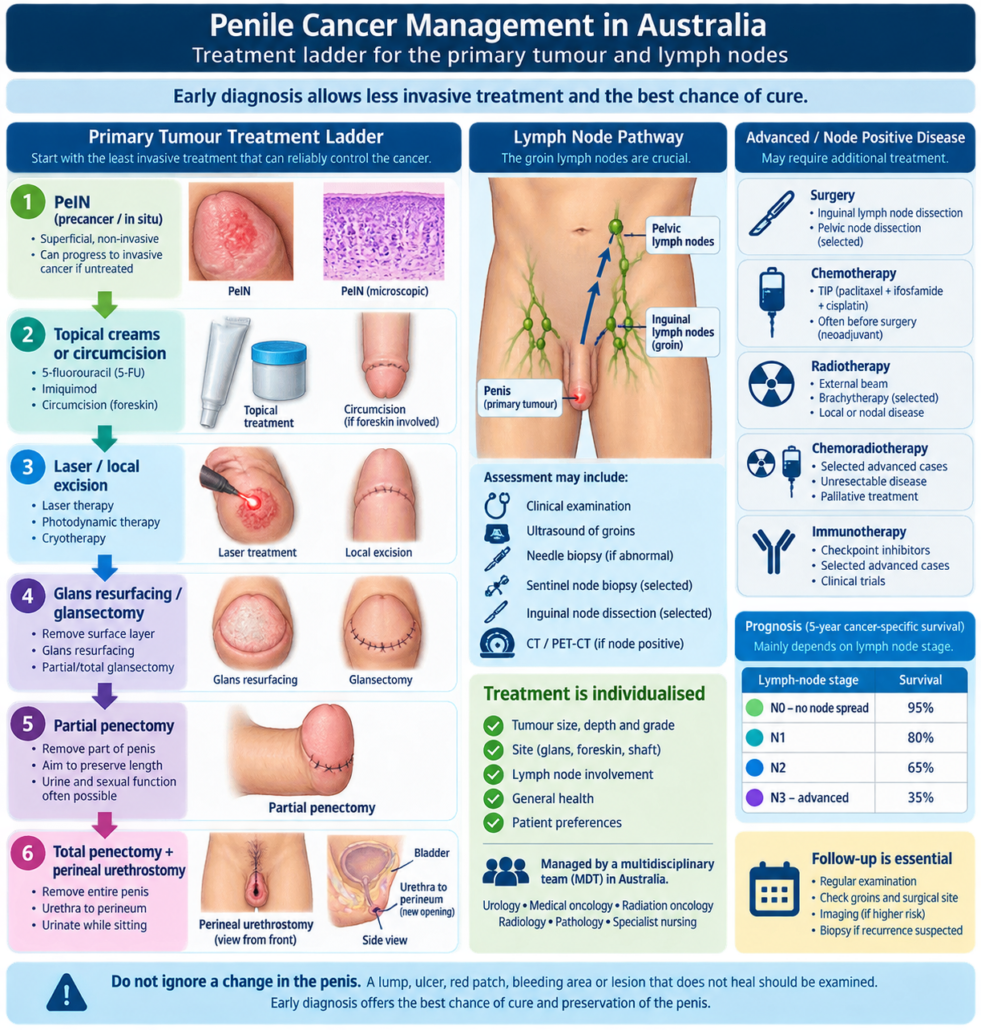
Modern management follows a ladder, beginning with the least invasive treatment capable of reliably controlling the cancer.
1. Circumcision
For abnormalities confined to the foreskin, circumcision may remove the lesion completely.
Circumcision is also frequently an important first step when PeIN involves the glans and foreskin because it allows the glans to be properly examined and treated.
For superficial disease, contemporary guidelines regard circumcision as an important primary surgical treatment.
2. Treatment with creams
Selected cases of biopsy-confirmed PeIN can be treated with medication applied directly to the penis.
The two most commonly used treatments are:
5-fluorouracil (5-FU)
5-FU is a topical chemotherapy medication.
It destroys abnormal rapidly dividing cells in the superficial layers of the penis.
Treatment usually produces inflammation of the treated area, which can include:
- redness
- burning
- crusting
- discomfort
- erosion of the surface skin.
Imiquimod
Imiquimod is different. Rather than being conventional chemotherapy, it stimulates the local immune system to attack abnormal cells.
It can similarly cause substantial redness, swelling, ulceration or crusting during treatment.
These reactions can look alarming but often indicate that the medication is producing its intended biological effect.
Current EAU-ASCO guidance supports either 5-FU or imiquimod for appropriately selected biopsy-confirmed PeIN.
Importantly, the area must be reassessed after treatment.
If the abnormality persists, repeat biopsy or alternative treatment may be necessary. Repeated courses of topical treatment should not simply continue indefinitely when the lesion has failed to respond, because invasive cancer may be hiding beneath the surface.
3. Laser and other local treatments
Very superficial lesions can sometimes be treated using laser therapy.
Depending upon expertise and availability, other local treatments such as photodynamic therapy or cryotherapy have also been used.
These approaches can preserve the penis but require careful long-term surveillance because local recurrence is possible.
4. Penile-preserving surgery
One of the major changes in penile cancer surgery has been the move away from automatically removing a substantial portion of the penis.
Whenever oncologically safe, the aim is:
remove the cancer, obtain clear margins and preserve as much normal penis as possible.
Operations may include:
Wide local excision
The cancer and a margin of surrounding tissue are removed.
The defect may be closed directly or reconstructed with a skin graft.
Glans resurfacing
The abnormal surface layer of the glans is removed while preserving the deeper erectile tissue.
A skin graft is then placed over the glans.
This can be particularly useful for extensive superficial disease.
Glansectomy
If cancer is confined to the glans but is too extensive or invasive for simpler treatment, part or all of the glans may be removed.
Reconstruction can then be performed, often using a skin graft to create a new glans-like surface.
Current guidelines favour organ-preserving surgery for appropriately selected PeIN and T1–T2 tumours involving the glans or prepuce, provided the patient understands the need for careful follow-up.
5. Partial penectomy
More deeply invasive cancer may require removal of part of the penis.
This is called a partial penectomy.
The surgeon attempts to retain enough penile length to permit comfortable urination and, where possible, sexual function.
This may be necessary when cancer extends more deeply into the erectile tissues and cannot be reliably removed using penile-preserving techniques.
6. Total penectomy
Occasionally a cancer is too large, too proximal or too deeply invasive for part of the penis to be safely preserved.
A total penectomy may then provide the best opportunity for cure.
This understandably sounds confronting. It is generally reserved for circumstances in which less radical treatment would compromise cancer control.
Current EAU-ASCO recommendations support total penectomy with perineal urethrostomy for large invasive tumours that cannot safely be treated by partial penectomy.
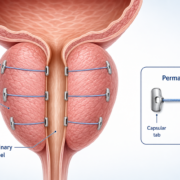
What is a perineal urethrostomy?
This is sometimes mistakenly referred to as a “perineotomy”.
Following total removal of the penis, urine still needs a pathway from the bladder to the outside world.
The urethra is therefore brought to the skin of the perineum, the area between the scrotum and anus.
This opening is called a:
Perineal urethrostomy
The patient subsequently passes urine through this opening while sitting on the toilet.
A catheter is generally left temporarily while the area heals.
Once healed, most men can empty their bladder normally through the new opening and do not require a permanent catheter.
Potential problems include:
- narrowing or stenosis of the opening
- spraying
- infection
- wound complications
- occasionally the need for further surgery.
A perineal urethrostomy does not mean that the bladder or kidneys have stopped functioning. It simply changes the final few centimetres of the urinary plumbing.
The lymph nodes are extremely important
Treating the penis itself is only one half of penile cancer management.
The other half is determining whether cancer has reached the inguinal lymph nodes in the groin.
Penile cancer generally spreads in a predictable sequence:
Penis → inguinal lymph nodes → pelvic lymph nodes → distant organs
Lymph-node involvement is the single most important prognostic factor in penile cancer.
What if there are no enlarged lymph nodes?
Unfortunately, normal-feeling groins do not completely exclude microscopic cancer.
Men with higher-risk primary tumours may therefore require further lymph-node assessment despite having no palpable lumps.
This may involve:
- ultrasound of the groins
- ultrasound-guided needle biopsy of abnormal nodes
- dynamic sentinel lymph-node biopsy
- inguinal lymph-node dissection in selected circumstances.
Current EAU-ASCO guidance recommends surgical lymph-node staging for patients at significant risk of microscopic metastatic disease, particularly T1b disease or higher.
What if a groin lymph node is enlarged?
An abnormal lymph node may be assessed using ultrasound and needle biopsy.
If metastatic penile cancer is confirmed, treatment may involve:
- inguinal lymph-node dissection
- pelvic lymph-node dissection in selected patients
- chemotherapy
- radiotherapy
- combinations of these treatments.
Patients with clinically node-positive disease are generally staged with CT or FDG-PET/CT to assess pelvic and distant disease before definitive treatment.
Early treatment of lymph-node disease is extremely important.
Radiation therapy
Radiotherapy has an important but selective role in penile cancer.
Treatment of the primary cancer
Selected smaller T1 or T2 cancers can potentially be treated with radiation instead of surgery.
Treatment can involve:
External beam radiotherapy
Radiation is directed at the tumour from outside the body.
Brachytherapy
Radioactive sources are temporarily positioned within or very close to the tumour, allowing a concentrated radiation dose to be delivered while limiting exposure to surrounding tissues.
Radiotherapy may therefore provide another means of preserving the penis in appropriately selected patients.
Potential complications can include:
- skin irritation
- ulceration
- fibrosis
- narrowing of the urethra
- changes in penile sensation
- erectile dysfunction
- tissue damage or necrosis in uncommon circumstances.
Radiotherapy is also used in selected patients for regional lymph-node disease, as part of chemoradiotherapy for advanced disease, or for palliation of symptoms from metastatic cancer.
Chemotherapy
Chemotherapy is generally reserved for more advanced penile cancer, particularly when significant lymph-node disease or metastatic disease is present.
In Australia, contemporary treatment may involve platinum-based combination chemotherapy.
One regimen used in advanced disease is:
TIP: paclitaxel + ifosfamide + cisplatin
Australia’s eviQ cancer treatment resource includes TIP as an option in neoadjuvant, adjuvant and metastatic penile cancer settings.
For bulky or fixed inguinal lymph-node disease or pelvic lymph-node involvement, chemotherapy may be given before surgery.
This is called neoadjuvant chemotherapy.
The aim is to:
- treat microscopic disease throughout the body,
- shrink the cancer in the lymph nodes,
- determine whether the cancer is responding,
- make subsequent surgery more effective or technically achievable.
Current international guidance recommends cisplatin- and taxane-based neoadjuvant chemotherapy for suitable patients with extensive inguinal or pelvic nodal disease, followed by surgery when appropriate.
Chemoradiotherapy
Radiotherapy and chemotherapy can sometimes be combined.
This may be considered for selected patients with:
- locally advanced disease
- unresectable cancer
- extensive lymph-node disease
- disease where major surgery is unsuitable
- palliative treatment requirements.
The evidence is evolving, and these decisions should generally be made through a specialist penile cancer MDT.
What about immunotherapy?
Immunotherapy is an exciting area of cancer treatment, but its role in penile cancer is still developing.
Checkpoint inhibitors such as pembrolizumab and related drugs have demonstrated activity in some patients with advanced penile cancer, and newer combinations of chemotherapy and immunotherapy are being investigated.
However, response rates to checkpoint inhibitors alone are relatively modest and there is not yet sufficient evidence to use biomarkers such as HPV or PD-L1 routinely to determine which penile cancer patients should receive immunotherapy.
Clinical trials are particularly important for men whose cancer progresses despite standard platinum-based chemotherapy.
What happens to sexual function?
This depends enormously on treatment.
After topical treatment, circumcision, laser therapy, glans resurfacing or limited local excision, satisfactory sexual function may often be preserved.
After glansectomy or partial penectomy, intercourse may remain possible depending upon remaining penile length, erectile function and reconstruction.
After total penectomy, penetrative intercourse using the penis is no longer possible.
This does not mean that intimacy, sexual sensation or orgasm automatically disappears.
Sexual rehabilitation, psychological support and discussion with the patient and his partner can be an important component of recovery.
These conversations should ideally begin before treatment, not after it.
What is the prognosis?
Penile cancer is potentially highly curable when diagnosed before it has spread to lymph nodes.
The most important predictor of survival is not simply the size of the penile lesion but whether cancer has reached the lymph nodes.
Current EAU-ASCO data report approximate five-year cancer-specific survival according to nodal stage of:
| Lymph-node stage | Approximate 5-year cancer-specific survival |
|---|---|
| N0 – no lymph-node metastases | 95% |
| N1 | 80% |
| N2 | 65% |
| N3 – advanced nodal disease | 35% |
These are population figures, not predictions for an individual patient.
Prognosis depends upon the tumour’s stage and grade, lymph-node involvement, response to treatment, general health and other pathological features.
The figures do, however, demonstrate why early diagnosis and appropriate assessment of the groin lymph nodes are so important.
Follow-up after treatment
Penile cancer requires ongoing surveillance.
Follow-up may include:
- examination of the penis or reconstructed area
- examination of both groins
- assessment of the perineal urethrostomy where applicable
- imaging in higher-risk patients
- biopsy of suspicious recurrent lesions
- monitoring urinary and sexual function
- psychological and sexual-health support.
Penile-preserving treatment requires particularly careful surveillance because local recurrence can occur.
Importantly, a local recurrence identified early can often still be successfully treated.
Do not ignore a change in the penis
Penile cancer is uncommon, and most penile skin problems are benign.
Nevertheless, a persistent:
lump, ulcer, red patch, bleeding area, discharge, thickened foreskin or lesion that simply will not heal deserves examination.
There should be no embarrassment in asking your GP or urologist to have a look.
For early disease, treatment may be surprisingly conservative: sometimes circumcision, a cream, laser treatment or limited surgery is all that is required.
Even when invasive cancer is present, modern penile cancer surgery increasingly focuses on preserving penile tissue, urinary function and quality of life whenever this can be achieved without compromising cure.
For advanced disease, treatment becomes more complex and may involve partial or total penectomy, perineal urethrostomy, lymph-node surgery, radiotherapy and chemotherapy.
The crucial message is simple:
The earlier penile cancer is diagnosed, the greater the opportunity to cure it while preserving the penis.
Australian and international resources
Cancer Council Australia: Penile Cancer
Cancer Institute NSW: Penile Cancer
eviQ Australian Penile Cancer Chemotherapy Protocol
2026 EAU-ASCO Penile Cancer Guidelines
This information is intended for patient education and does not replace individual medical assessment. Treatment of penile cancer should be tailored to the tumour stage, pathology, lymph-node status, general health and preferences of the individual patient.




Leave a Reply
Want to join the discussion?Feel free to contribute!