
Persistent sperm after vasectomy: does this mean the procedure has failed?
Finding sperm in a semen sample after vasectomy can be worrying. However, a positive result does not always mean that the vasectomy has failed.
Sperm may remain in the reproductive tract for several weeks or months after the procedure. The most important questions are:
- How long has it been since the vasectomy?
- How many sperm are present?
- Are any of the sperm still moving?
- Is the sperm count decreasing on repeat testing?
A vasectomy does not work immediately
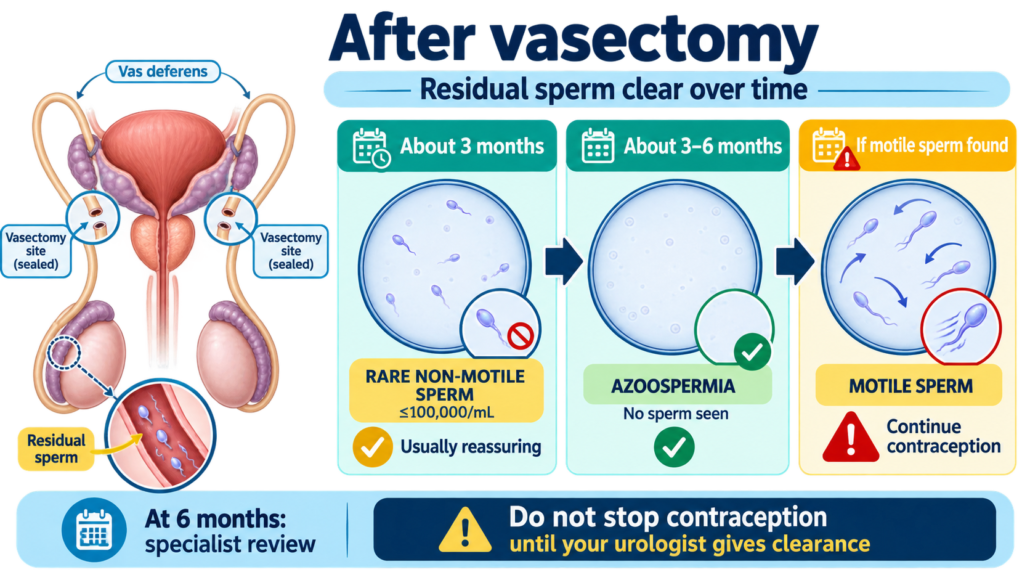
During a vasectomy, the two vas deferens, the tubes carrying sperm from the testicles, are divided and sealed. Sperm already present beyond the site of the vasectomy may remain in the seminal tract and appear in subsequent ejaculations.
It can take several months and approximately 20 ejaculations to clear these remaining sperm. Australian patient guidance commonly recommends the first post-vasectomy semen analysis at approximately three months. International guidelines generally allow testing within about 8–16 weeks, depending on the surgeon’s protocol.
Another form of contraception must be used until your surgeon has reviewed the semen result and formally confirmed clearance.
What is a post-vasectomy semen analysis?
A post-vasectomy semen analysis, or PVSA, examines the semen for:
- The presence or absence of sperm
- The number of sperm present
- Whether the sperm are motile or non-motile
The desired result is azoospermia, meaning that no sperm are detected. However, complete azoospermia is not always necessary for a vasectomy to be considered successful.
When should azoospermia occur?
Many men are azoospermic by approximately three months after vasectomy, particularly if they have ejaculated regularly. Others take longer to clear their residual sperm.
Delayed clearance may be associated with:
- A relatively low number of ejaculations
- Individual differences in reproductive-tract anatomy
- Older age
- A long interval between ejaculations
- Laboratory technique and the timing of sample examination
- Temporary early recanalisation of the vasectomy site
Persistent sperm at the first test should therefore not automatically be interpreted as surgical failure. The type of sperm and the trend on repeat testing are more informative.
What does an “immotile sperm count” mean?
Immotile or non-motile sperm are sperm that are present but show no movement when examined under the microscope.
Following vasectomy, this commonly represents old residual sperm that have not yet been completely cleared. Non-motile sperm have extremely limited capacity to cause pregnancy, particularly when present in very small numbers.
The generally accepted categories are:
| Semen-analysis result | Usual interpretation |
|---|---|
| No sperm detected | Azoospermia, vasectomy clearance can usually be given |
| No motile sperm and ≤100,000 non-motile sperm/mL | Rare non-motile sperm, generally regarded as successful vas occlusion |
| More than 100,000 non-motile sperm/mL | Repeat testing and assessment of the trend are required |
| Any motile sperm | Clearance should not be given; repeat testing is required |
The report should be interpreted carefully because some laboratories report the concentration per millilitre, while others may report a total number or simply state that “occasional sperm” were seen.
A fresh sample is important when assessing motility. If examination is substantially delayed, sperm that were initially moving may have stopped, potentially producing a misleading “non-motile” result.
What are rare non-motile sperm?
Rare non-motile sperm, often abbreviated as RNMS, usually means that no moving sperm are seen and the concentration is no more than 100,000 non-motile sperm per millilitre.
Current Australian and American guidance generally regards either azoospermia or RNMS at or below this threshold as evidence of successful vas occlusion. Depending on the laboratory method and local protocol, your surgeon may provide clearance after one satisfactory sample or request another confirmatory sample.
The estimated risk of pregnancy after clearance based on azoospermia or RNMS is approximately 1 in 2,000. Vasectomy is therefore extremely reliable, but no method of contraception is completely infallible.
What happens if sperm are detected at three months?
Management depends on the result.
A small number of non-motile sperm
This is usually reassuring. If the count is no more than 100,000/mL and no motile sperm are present, clearance may be appropriate according to the treating surgeon’s protocol.
More than 100,000 non-motile sperm/mL
Continue contraception and repeat the semen analysis. A steadily decreasing count suggests delayed clearance rather than vasectomy failure.
Motile sperm
Continue contraception and arrange another semen analysis. Motile sperm early after vasectomy do not invariably mean that a repeat operation will be required, particularly if the number is low and decreasing. Persistent or increasing motile sperm are more concerning for incomplete occlusion or recanalisation.
What is recommended at six months?
Six months is an important decision point.
Motile sperm persisting at six months
If any motile sperm remain at six months, the vasectomy should generally be regarded as an occlusive failure. A repeat vasectomy should be discussed.
Possible explanations include:
- One vas deferens was not successfully divided
- An unusual or duplicated vas deferens was present
- The divided ends have reconnected
- A small channel has developed across the vasectomy site
More than 100,000 non-motile sperm/mL at six months
This result requires individual assessment rather than an automatic decision.
The surgeon will consider:
- Whether the count is decreasing, stable or increasing
- Whether motile sperm were present in earlier samples
- The reliability and timing of sample collection
- The vasectomy technique used
- The couple’s tolerance for even a very small pregnancy risk
- Whether further semen analyses are likely to provide clarity
Repeat vasectomy, continued contraception or further surveillance may be considered through shared decision-making.
Fewer than 100,000 non-motile sperm/mL at six months
If no motile sperm are present and the count is at or below 100,000/mL, most contemporary guidance considers this compatible with successful vasectomy. Formal clearance must nevertheless come from the treating surgeon.
When should a repeat vasectomy be considered?
A repeat procedure is usually considered when:
- Motile sperm persist at six months
- Motile sperm counts increase on consecutive tests
- There is no meaningful reduction in the sperm count
- More than 100,000 non-motile sperm/mL persist beyond six months and the results remain concerning
- A pregnancy occurs after the vasectomy
- Clinical or operative findings suggest that one vas deferens may not have been successfully occluded
Repeat vasectomy is required in no more than approximately 1% of procedures when an effective occlusion technique has been used.
Is repeat vasectomy the same as vasectomy reversal?
No. A repeat vasectomy aims to divide and seal the vas deferens again because the first procedure has not produced reliable contraception.
A vasectomy reversal is a different microsurgical procedure that attempts to restore fertility by reconnecting the vas deferens.
What should I do while waiting for another test?
Until formal clearance has been provided:
- Continue using reliable contraception
- Ejaculate regularly if comfortable
- Follow the laboratory’s collection instructions carefully
- Collect the entire sample
- Record the collection time accurately
- Deliver the sample within the laboratory’s required timeframe
- Do not assume that “non-motile” automatically means that clearance has been granted
The important message
Persistent sperm after vasectomy does not necessarily mean that the procedure has failed.
A small number of non-motile sperm is common and may be compatible with successful vasectomy. Motile sperm, a persistently high non-motile count or a count that is increasing requires continued contraception and further assessment.
At six months, persistent motile sperm generally prompts consideration of repeat vasectomy. Persistent non-motile sperm above 100,000/mL requires review of serial results and an individual discussion with the treating urologist.
Do not stop contraception until your surgeon has confirmed in writing that your post-vasectomy semen analysis meets the required clearance criteria.
This information is intended for general education and does not replace individual medical advice or interpretation of your laboratory result.
References and further information
- Royal College of Pathologists of Australasia—post-vasectomy semen analysis
- Healthdirect Australia—vasectomy
- No Scalpel Vasectomy Australia—procedural standards
- American Urological Association—Vasectomy Guideline
- British laboratory guidelines for post-vasectomy semen analysis


Leave a Reply
Want to join the discussion?Feel free to contribute!