
Bladder neck contracture after TURP or laser prostate surgery
Why it happens, why it can recur, and how it may be treated
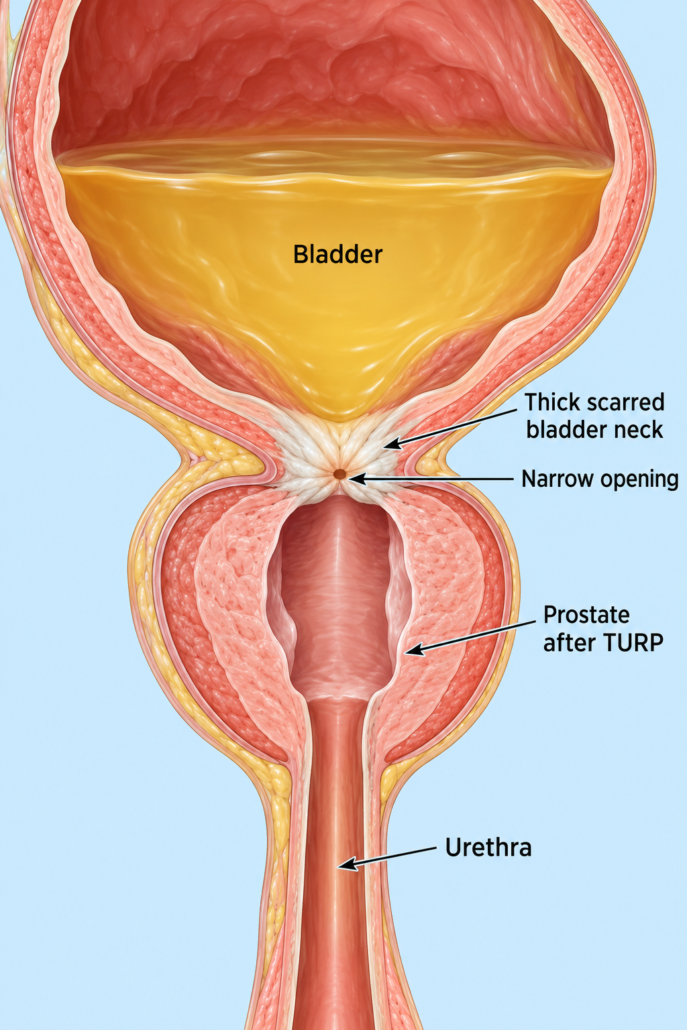
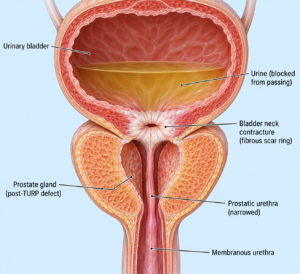
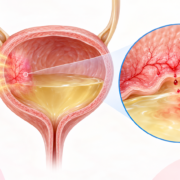
Transurethral resection of the prostate (TURP) and laser procedures such as photoselective vaporisation (PVP) or transurethral vaporisation (TUVP) are used to improve urine flow when an enlarged prostate obstructs the bladder outlet. In a small number of men, healing after surgery causes scar tissue to tighten at the bladder neck: the opening between the bladder and the prostate/urethra. This is called a bladder neck contracture (BNC) or bladder neck stenosis.
A BNC can cause a return of urinary symptoms after an initially successful operation. It is treatable, although some contractures return after treatment and a small group of men need several procedures or specialist reconstructive surgery.
This information is general and is not a substitute for assessment by your GP or urologist. The most suitable option depends on the exact site and length of narrowing, bladder function, previous procedures, continence, and general health.
How common is it?
The reported rate varies with the operation, the definition used, follow-up time, and the patients studied. A recent systematic review of randomised trials with at least two years of follow-up estimated BNC in about 3% after TURP and 9% after photo-selective laser vaporisation (PVP). The confidence intervals were wide, especially for PVP, so these figures should not be treated as a precise prediction for an individual patient. The European Association of Urology (EAU) guideline cites a broader range of approximately 0.3–9.7% for bladder neck stenosis after transurethral prostate surgery.[1,2]
“TUVP” is used for more than one vaporisation technique. Studies of older electrovaporisation, bipolar vaporisation and modern laser PVP are not interchangeable. For example, one small early study of transurethral vaporisation reported BNC in 3 of 30 patients; that result is too small and old to represent the risk from current laser surgery.[3] Your surgeon can explain which procedure was used and what the evidence for that specific technique shows.
Why can it develop?
The bladder neck can heal with excess scar tissue after surgical trauma, heat, or inflammation. The exact cause is not always clear. Factors associated with BNC in published studies include a smaller prostate or less tissue removed, infection around the time of surgery, smoking, diabetes or cardiovascular disease, longer operating time, and extensive treatment near the bladder neck. These are associations: they do not mean that a particular factor caused an individual person’s contracture.[2,4]
BNC often becomes apparent during the first months after surgery, but it can present later. Symptoms may include:
- a weaker, slower or interrupted stream;
- straining, hesitancy, or taking longer to pass urine;
- a feeling that the bladder has not emptied;
- frequent or urgent urination, or getting up at night;
- recurrent urinary infections; or
- inability to pass urine, which needs urgent medical attention.
These symptoms can also be caused by prostate regrowth, urethral narrowing, infection, an underactive bladder, or other bladder conditions. Testing is needed to identify the cause.
How is it assessed?
Assessment commonly includes a history, examination, urine testing, measurement of urine flow (uroflowmetry) and the amount left in the bladder after voiding (post-void residual). Cystoscopy, a small camera passed through the urethra, usually confirms whether the bladder neck is narrowed and whether a scope can pass. Depending on the situation, imaging such as a retrograde urethrogram or a bladder/urethral contrast study may help map the narrowing. Kidney and bladder imaging or kidney blood tests may be appropriate if there is significant retention, infection, or concern about the upper urinary tract.
Treatment options
Treatment is tailored to the narrowing and the person’s symptoms and priorities. A short, non-obliterated contracture is usually approached differently from a long, dense scar or a bladder neck that has closed completely.
Dilatation
A narrow area can sometimes be gently stretched with instruments or a balloon. This is relatively straightforward and can improve flow, but the scar may tighten again. In some cases a planned programme of intermittent self-catheterisation is discussed to help keep the opening stable. It is not suitable or acceptable for everyone.
Endoscopic incision or resection
A surgeon can use a small endoscope to cut (incise) the scar, or remove some of the scar tissue, using an electrical knife or laser. This is a common first treatment for a non-obliterated BNC. A catheter is often left temporarily while the area heals.
A first treatment may be enough, but recurrence is a recognised problem. EAU evidence summaries report patency after the first endoscopic treatment of about 58% following transurethral resection and 72% following incision in the cited studies. Those results come from varied, generally small observational series and should not be taken as a guaranteed personal outcome.[5] Repeated incision or dilation may be reasonable for some men with a passable narrowing; it can relieve symptoms or stabilise the opening, but each recurrence needs reassessment. A completely obliterated bladder neck is unlikely to be cured by routine endoscopic cutting and blind attempts can be unsafe.[5]
Scar-modulating injections
Steroid or mitomycin C injections have been used with endoscopic incision in selected recurrent cases. Evidence is mixed and largely based on retrospective series. Mitomycin C is not a routine, risk-free add-on: a multicentre study reported serious complications in 7% of treated patients, including tissue injury and fistula, with some requiring major further treatment.[6] If considered, the potential benefit and uncommon but significant risks should be discussed explicitly with a reconstructive urologist.
Bladder neck reconstruction
When a contracture repeatedly returns, is long or dense, or is completely closed, a reconstructive operation may be considered. The goal is to create a wider, durable outlet while protecting the bladder, ureters and continence mechanism as much as possible. The choice depends on the site and extent of scar, previous operations or radiotherapy, bladder function, continence, and surgeon expertise.
Options include a Y–V or T-plasty, in which healthy bladder tissue is rearranged to widen the outlet, with scar tissue released or removed as needed. The EAU guideline reports patency rates of 83–100% in published series, with follow-up of 14–45 months; new incontinence was reported in up to 14%. These results are from selected patients and small observational studies, not randomised comparisons.[5]
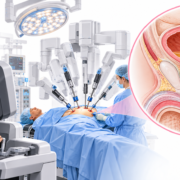
In selected complex cases, reconstruction can be performed with a robot-assisted approach. The magnified view and instruments that articulate inside the pelvis may help the surgeon work precisely around the bladder neck. Robotic reconstruction is specialised surgery, not a guarantee against recurrence or incontinence. In a systematic review of ten small case series (119 men with different causes and techniques), pooled patency was 80%; new incontinence was reported in 17% of the subset with suitable continence data. Follow-up was relatively short and the evidence was heterogeneous, so longer-term results remain important.[7]
Buccal mucosa graft reconstruction: an emerging option
Buccal mucosa is the moist lining inside the cheek. It can be taken as a graft and used to augment a narrowed or damaged urinary passage. For a severe bladder neck defect, a graft may be placed as an onlay/inlay to create a wider channel rather than simply cutting the scar again. The graft is harvested from the mouth, so temporary cheek soreness, altered mouth sensation, or tightness are possible in addition to the risks of the urinary reconstruction.
A/Prof Devang Desai and colleagues in Toowoomba have reported a robot-assisted reconstruction for complete bladder neck obliteration after TURP using two cheek grafts, one placed anteriorly and one posteriorly, to create a “double-faced” repair. In their reported case, the patient was voiding without incontinence at seven months, with a maximum flow of 23 mL/s. This is an innovative case report and conference abstract, not yet evidence that the technique is superior to established reconstruction or that results will be the same for other patients. The authors themselves note that longer follow-up is needed.[8,9]
This approach may be discussed by a reconstructive urologist for selected men with a complex or completely obliterated bladder neck, particularly after less invasive treatments have failed. It is not needed for most BNCs, and access to the technique depends on specialist experience and individual circumstances.
Catheter drainage and other options
If the bladder cannot empty, a urethral catheter or a suprapubic catheter (placed through the lower abdominal wall) may be needed, temporarily or longer term. A suprapubic catheter can be a practical choice while planning further treatment or when reconstruction is unsuitable or not wanted. In very complex cases, especially when the bladder itself is severely damaged, other forms of urinary diversion may be considered, but this is uncommon for BNC after routine TURP or vaporisation.
Continence and the possibility of further treatment
Opening a tight bladder neck can reveal leakage that was previously masked by the obstruction, or can worsen existing urinary incontinence. This may happen after endoscopic treatment as well as reconstruction. Some men remain dry; others may need continence treatment later. Before proceeding, ask your urologist how the contracture, any previous prostate surgery or radiotherapy, and your existing continence affect the plan.
A recurrence does not mean that you have done anything wrong. Scar healing is variable. If narrowing returns, the next step should be based on updated assessment rather than automatically repeating the same procedure. A reconstructive urologist can help weigh another endoscopic treatment against reconstruction, catheter drainage, or other options.
When to seek urgent help
Seek urgent medical care if you are unable to pass urine, develop fever or shaking chills with urinary symptoms, or have severe lower abdominal pain. Acute retention can require prompt bladder drainage.
References
- Mac Curtain BM, et al. Bladder neck contracture post-treatment for benign prostatic hyperplasia: a systematic review and meta-analysis of randomized clinical studies. International Urology and Nephrology. 2025. https://doi.org/10.1007/s11255-025-04648-2
- European Association of Urology. EAU Guidelines on Urethral Strictures: Definition, epidemiology, aetiology and prevention. https://uroweb.org/guidelines/urethral-strictures/chapter/definition-epidemiology-aetiology-and-prevention
- Chang PL, et al. Clinical outcome at 3 months after transurethral vaporization of prostate for benign prostatic hyperplasia. PubMed. https://pubmed.ncbi.nlm.nih.gov/9255294/
- Gül M, et al. Bladder neck contracture following transurethral surgery of prostate: a retrospective single-center study. PubMed. https://pubmed.ncbi.nlm.nih.gov/38189837/
- European Association of Urology. EAU Guidelines on Urethral Strictures: Disease management in males—posterior urethral stenosis and bladder neck stenosis. https://uroweb.org/guidelines/urethral-strictures/chapter/disease-management-in-males
- Redshaw JD, et al. Intralesional injection of mitomycin C at transurethral incision of bladder neck contracture may offer limited benefit: TURNS Study Group. Journal of Urology. https://pubmed.ncbi.nlm.nih.gov/25200807/
- Zhang TR, et al. Summarizing the evidence for robotic-assisted bladder neck reconstruction: systematic review of patency and incontinence outcomes. Asian Journal of Urology. 2024;11(3):341–347. https://doi.org/10.1016/j.ajur.2023.08.007
- Desai D, Munien K, Namdarian B. Robotic bladder neck reconstruction using a double-faced buccal mucosal graft: a novel approach to complete bladder neck obliteration. Urology Video Journal. 2023. https://doi.org/10.1016/j.urolvj.2023.100247
- Desai D, Munien K, Namdarian B. Robotic bladder neck reconstruction using a double-faced buccal mucosal graft—a novel approach to complete bladder neck obliteration. BJU International. 2025;135(Suppl 2): abstract. https://doi.org/10.1111/bju.16629
This article is for general education and does not replace an individual consultation. Treatment choices, likely outcomes and risks should be discussed with the treating urologist.

Leave a Reply
Want to join the discussion?Feel free to contribute!