
Urodynamic Studies: Understanding How Your Bladder Works
Bladder problems are not always as straightforward as they appear.
Two people may both complain of urinary urgency, leakage or difficulty emptying their bladder, yet the underlying causes can be completely different. One bladder may be contracting when it should be relaxing, another may not contract strongly enough, and sometimes the bladder is behaving perfectly well while the outlet is causing all the trouble.
This is where urodynamic studies, often simply called urodynamics, can help.
Think of urodynamics as a stress test for the bladder. Rather than simply looking at its anatomy, we observe how the bladder fills, stores urine and empties while simultaneously measuring pressures, urine flow and sometimes pelvic floor activity.
The aim is not merely to produce a collection of colourful graphs. The important question is:
What is the bladder actually doing, and will knowing this change the treatment?
What Are Urodynamic Studies?
Urodynamics refers to a group of tests that assess the function of the bladder, urethra and urinary sphincter.
Depending on the clinical situation, testing may evaluate:
- How much urine the bladder can comfortably hold
- Bladder sensation during filling
- Whether the bladder remains relaxed while filling
- Whether involuntary bladder contractions occur
- Whether urinary leakage occurs and why
- The pressure required to store urine
- The strength of the bladder muscle during urination
- Whether there is obstruction to urinary flow
- Whether the bladder empties completely
- How the urinary sphincter and pelvic floor behave during filling and voiding
Urodynamics therefore investigates function rather than simply structure.
An ultrasound or cystoscopy may show us what the urinary tract looks like. Urodynamics tells us what it is doing.
Who May Need Urodynamic Testing?
Not every patient with urinary symptoms requires urodynamics.
For many straightforward urinary problems, the diagnosis can be made from the history, examination, bladder diary, urine testing, flow studies and ultrasound.
Urodynamics becomes particularly useful when the diagnosis is uncertain, symptoms are complex, previous treatments have failed, neurological disease is present, or an invasive treatment is being considered where understanding bladder function may alter the choice of treatment.
Common indications include:
Urinary Incontinence
Urodynamics may be useful when assessing:
- Stress urinary incontinence
- Urgency urinary incontinence
- Mixed urinary incontinence
- Persistent leakage following previous continence surgery
- Incontinence following prostate surgery
- Complex or unexplained urinary leakage
In straightforward female stress urinary incontinence, urodynamics is not necessarily required before treatment. It becomes more useful when symptoms and clinical findings do not agree or when there are complicating factors.
Overactive Bladder
Patients with overactive bladder may experience:
- Urinary urgency
- Frequent urination
- Nocturia
- Urgency urinary incontinence
Urodynamics can sometimes demonstrate detrusor overactivity, where the bladder muscle contracts involuntarily during filling.
Importantly, a normal urodynamic study does not necessarily exclude overactive bladder. Symptoms and urodynamic findings do not always travel together.
Difficulty Emptying the Bladder
Patients may report:
- Poor urinary flow
- Hesitancy
- Straining
- Intermittent flow
- Incomplete emptying
- Urinary retention
The challenge is determining why.
Is there an obstruction?
Or is the bladder muscle simply not contracting strongly enough?
The symptoms can look remarkably similar, but the treatments can be very different.
Men With Lower Urinary Tract Symptoms
In men with prostate enlargement, urodynamics may help distinguish between:
Bladder outlet obstruction
and
Detrusor underactivity, where the bladder muscle has insufficient strength to empty effectively.
This distinction may be particularly valuable before prostate surgery when there is uncertainty about whether removing the obstruction will improve urinary flow.
Neurological Bladder Dysfunction
Urodynamics has an especially important role in patients with neurological conditions such as:
- Spinal cord injury
- Multiple sclerosis
- Parkinson’s disease
- Spina bifida
- Stroke
- Certain spinal disorders
In these patients, we are interested not only in urinary symptoms but also in whether bladder pressures could potentially damage the kidneys.
Before or After Certain Urinary Procedures
Urodynamics may also be considered:
- Before complex continence surgery
- Following unsuccessful continence surgery
- Before some bladder outlet procedures
- Following prostate surgery when symptoms persist
- When considering treatments such as bladder Botox or sacral neuromodulation in selected complex patients
What Happens During a Urodynamic Study?
The test is usually performed as an outpatient procedure.
It generally takes approximately 30–60 minutes, although this varies depending on the type of study being performed.
You can usually eat, drink and take your normal medications unless specifically instructed otherwise.
Step 1: Arriving With a Comfortably Full Bladder
You may be asked to arrive with a reasonably full bladder.
You will urinate into a special toilet called a uroflowmeter.
This measures:
- Urine volume
- Maximum urinary flow rate
- Average flow rate
- The shape of the urinary flow curve
- How long urination takes
An ultrasound may then measure how much urine remains in the bladder.
This is called the post-void residual.
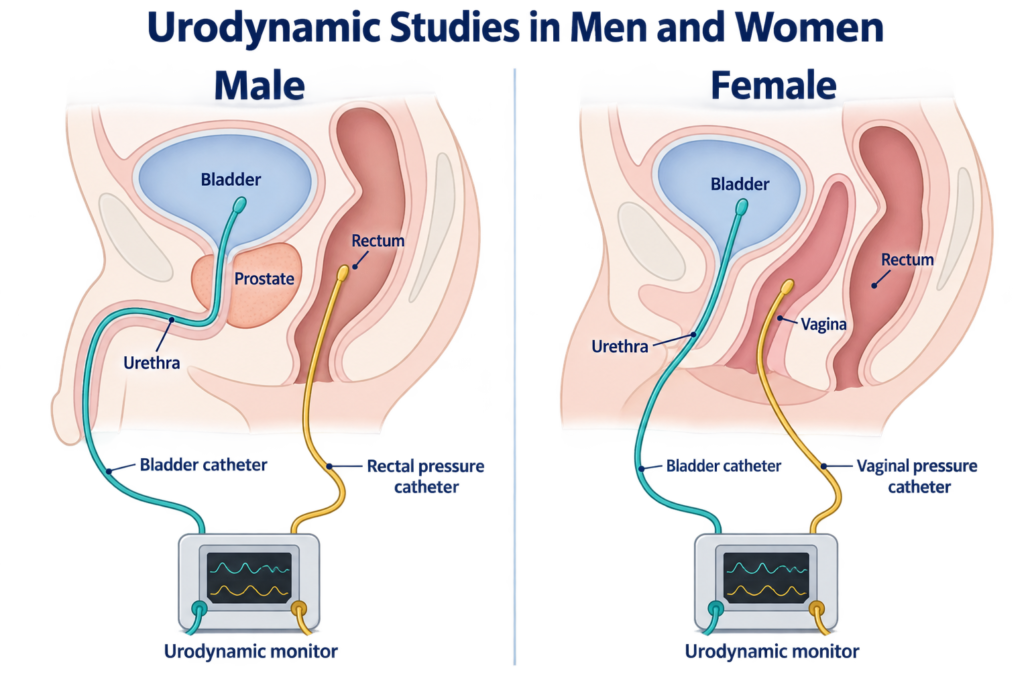
Step 2: Placement of Small Catheters
A very fine catheter is gently passed through the urethra into the bladder.
A second small pressure catheter is usually placed into the rectum, or occasionally the vagina.
Why two pressure measurements?
Because pressure inside the abdomen affects pressure inside the bladder.
By measuring both, the computer can calculate the pressure generated specifically by the bladder muscle:
Detrusor pressure = bladder pressure − abdominal pressure
This simple equation sits at the heart of conventional urodynamics.
Step 3: Filling the Bladder
The bladder is slowly filled with sterile fluid.
During filling, you will be asked to describe what you feel.
We may record:
- First sensation of bladder filling
- First desire to urinate
- Strong desire to urinate
- Maximum bladder capacity
The pressure inside the bladder is continuously monitored.
Normal filling cystometrogram


Normal filling cystometrogram. During filling, the bladder accommodates increasing volume while detrusor pressure (Pdet) remains relatively stable. Coughs cause corresponding rises in Pves and Pabd without a true detrusor contraction. Sensations such as first sensation, first desire and strong desire can be marked on the tracing.
Step 4: Provocative Testing
You may be asked to:
- Cough
- Strain
- Stand
- Change position
- Listen to running water
These manoeuvres are not designed to make the test unnecessarily theatrical. They help reproduce the circumstances under which your symptoms normally occur.
If urinary leakage occurs during coughing without an involuntary bladder contraction, this may demonstrate urodynamic stress incontinence.
Step 5: Voiding
Once the bladder is comfortably full, you will be asked to urinate.
During urination we simultaneously measure:
- Urinary flow
- Bladder pressure
- Abdominal pressure
- Detrusor pressure
This is called a pressure-flow study.
It can be extremely useful when determining whether poor urinary flow is caused by obstruction or weak bladder contraction.
What Does Urodynamics Measure?
Bladder Sensation
We assess when you first become aware that the bladder is filling and when the desire to urinate becomes stronger.
Sensation may be:
- Normal
- Increased
- Reduced
- Absent
Abnormal bladder sensation may occur in several neurological and functional bladder disorders.
Bladder Capacity
The amount of urine the bladder can comfortably hold is measured.
A small functional capacity may occur with conditions such as severe urgency or bladder hypersensitivity, although capacity must always be interpreted in clinical context.
Bladder Compliance
A healthy bladder should behave rather like a flexible reservoir.
As it fills, its volume should increase without a major rise in pressure.
Poor bladder compliance means pressure rises excessively as the bladder fills.
This is particularly important in some neurological bladder disorders because persistently elevated storage pressures can potentially threaten the upper urinary tract.
Detrusor Overactivity
If the bladder muscle contracts involuntarily during filling, this is called:
Detrusor overactivity.
It may be associated with:
- Urgency
- Urgency incontinence
- Frequency
- Nocturia
When associated with an underlying neurological condition, it may be described as neurogenic detrusor overactivity.
Examples of terminal, phasic, wet and dry detrusor overactivity.


Detrusor overactivity. During bladder filling there is an involuntary increase in Pdet that cannot be explained by a corresponding increase in abdominal pressure. The contraction may be associated with urgency and, when leakage occurs, urgency urinary incontinence.
View the LABORIE-based detrusor-overactivity tracings
Stress Urinary Incontinence
If urine leaks when coughing or straining without a detrusor contraction, this supports a diagnosis of:
Urodynamic stress incontinence.
Additional measurements such as leak-point pressures may occasionally contribute to assessment in selected patients.
Bladder Outlet Obstruction
During urination, a pattern of:
High bladder pressure + low urinary flow
may suggest obstruction.
In men, benign prostate enlargement is a common cause.
Other causes include:
- Urethral stricture
- Bladder neck obstruction
- Previous continence surgery
- Dysfunctional voiding
Bladder outlet obstruction: pressure-flow study


Bladder outlet obstruction. During voiding the bladder generates a relatively high detrusor pressure, but urinary flow remains reduced. This high-pressure, low-flow relationship is characteristic of increased bladder outlet resistance.
In men, pressure-flow studies allow calculation of the Bladder Outlet Obstruction Index (BOOI):
BOOI = PdetQmax − 2(Qmax)
For men, BOOI >40 is generally classified as obstructed, 20–40 as equivocal and <20 as unobstructed.
Detrusor Underactivity
Sometimes the urinary flow is poor because the bladder muscle does not generate sufficient pressure.
This is known as:
Detrusor underactivity.
This distinction matters.
Operating on the prostate of a patient whose main problem is a very weak bladder may not produce the expected improvement in urinary flow.
Urodynamics can therefore occasionally prevent us from treating the wrong end of the plumbing.
Dysfunctional Voiding
Some patients involuntarily contract their pelvic floor or urinary sphincter while attempting to urinate.
Instead of the outlet opening smoothly, it intermittently closes.
Pelvic floor electromyography may help identify this pattern in selected patients.
Understanding the Urodynamic Tracing
A urodynamic report typically contains several pressure and flow curves.
At first glance, the tracing can resemble an enthusiastic seismograph.
The important measurements usually include:
Pves: pressure measured inside the bladder.
Pabd: pressure measured within the abdomen.
Pdet: pressure generated by the bladder muscle.
Flow: the rate at which urine leaves the bladder.
The relationship between these measurements allows us to understand what is happening during bladder filling and emptying.
Common Findings and What They May Mean for Treatment
| Urodynamic Finding | Possible Interpretation | Potential Treatment Direction |
|---|---|---|
| Normal storage and emptying | Normal urodynamic study | Treatment guided by symptoms and other investigations |
| Detrusor overactivity | Overactive bladder physiology | Bladder training, medication, Botox, neuromodulation |
| Stress leakage | Stress urinary incontinence | Pelvic floor therapy, bulking agents, sling or other continence surgery |
| High pressure + low flow | Bladder outlet obstruction | Treatment of obstruction where appropriate |
| Low pressure + low flow | Detrusor underactivity | Emptying strategies, intermittent catheterisation or selected treatments |
| Poor compliance | High-pressure storage | Pressure-reducing treatment and upper urinary tract surveillance |
| Pelvic floor activation during voiding | Dysfunctional voiding | Pelvic floor physiotherapy/biofeedback |
| Significant residual urine | Incomplete bladder emptying | Identify obstruction versus impaired bladder contraction |
The urodynamic result is not a treatment plan by itself.
It must be interpreted alongside symptoms, examination findings, bladder diaries, ultrasound, cystoscopy and other investigations where appropriate.
How Urodynamics Can Guide Treatment
If Detrusor Overactivity Is Found
Initial treatment may include:
- Bladder training
- Fluid modification
- Pelvic floor physiotherapy
- Antimuscarinic medication
- Beta-3 agonist medication
For persistent symptoms, options may include:
- Intravesical Botox injections
- Sacral neuromodulation
- Other specialist treatments in selected patients
If Stress Incontinence Is Demonstrated
Treatment depends on severity, sex, previous surgery and individual circumstances.
Options may include:
- Pelvic floor rehabilitation
- Continence devices
- Peri-urethral bulking agents
- Sling procedures
- Colposuspension in selected women
- Male sling following prostate surgery
- Artificial urinary sphincter in appropriate men
If Bladder Outlet Obstruction Is Demonstrated
Treatment depends on the underlying cause.
For benign prostate enlargement, options may include:
- Medication
- Minimally invasive prostate treatments
- Laser prostate surgery
- Transurethral prostate surgery
- Other surgical procedures appropriate to prostate size and anatomy
A urethral stricture or bladder neck obstruction requires a different treatment strategy.
If the Bladder Muscle Is Weak
Treatment may involve:
- Double voiding
- Timed voiding
- Reviewing medications
- Treating reversible causes
- Intermittent self-catheterisation when necessary
- Long-term catheterisation in selected circumstances
- Sacral neuromodulation in carefully selected patients with non-obstructive urinary retention
The key issue is avoiding unnecessary outlet surgery when obstruction is not actually the problem.
If Bladder Storage Pressures Are High
This is particularly important in neurological bladder disease.
Treatment may include:
- Medication
- Intermittent catheterisation
- Intravesical Botox
- Regular renal imaging
- Monitoring kidney function
- Repeat urodynamic assessment
- Reconstructive bladder surgery in uncommon severe cases
Here the objective extends beyond improving symptoms. We may also be trying to protect kidney function over the long term.
Are Urodynamic Studies Uncomfortable?
Most patients tolerate the investigation well.
Passing the small catheter can cause brief discomfort, and there may be some mild burning when urinating afterwards.
Having an audience while your bladder performs under laboratory conditions is admittedly not anyone’s preferred afternoon entertainment, but the clinical staff performing these studies do this routinely and will make the process as private and comfortable as possible.
Possible Side Effects and Complications
Urodynamic testing is generally safe.
Possible side effects include:
- Temporary burning during urination
- Urinary urgency
- Minor urethral discomfort
- A small amount of blood in the urine
- Urinary tract infection
- Temporary difficulty urinating
Significant complications are uncommon.
Patients should seek medical advice if they develop fever, chills, worsening urinary symptoms, significant bleeding or an inability to urinate following the test.
Does Everyone With Bladder Symptoms Need Urodynamics?
No.
This is an important point.
Urodynamics should generally be performed when the result is likely to answer a clinically relevant question or potentially alter management.
The investigation is particularly valuable when:
- Symptoms are complex
- The diagnosis remains uncertain
- Symptoms and examination findings disagree
- Previous treatment has failed
- Neurological bladder dysfunction is suspected
- There is significant urinary retention
- Complex surgery is being considered
- Understanding bladder pressure or contractility could change treatment
Testing simply because “we haven’t done one yet” is not a particularly compelling indication.
Urodynamics: Turning Symptoms Into Physiology
Patients often arrive describing urgency, leakage, poor flow or difficulty emptying their bladder.
These symptoms tell us what is happening.
Urodynamics can sometimes tell us why.
By measuring how the bladder stores and releases urine, we can distinguish between problems involving the bladder muscle, urinary sphincter, pelvic floor and bladder outlet.
Most importantly, urodynamics can help ensure that treatment is directed at the underlying problem rather than simply the symptom.
The Bottom Line
Urodynamics is not necessary for every bladder problem. But when the diagnosis is uncertain or treatment decisions depend on understanding bladder function, it can provide exceptionally useful information.
A good urodynamic study does more than generate graphs.
It helps answer the question that matters most:
What treatment is most likely to work for this particular bladder?
This information is intended for general patient education and does not replace individual medical assessment. The need for urodynamic testing and interpretation of results should be discussed with your treating urologist or continence specialist.






Leave a Reply
Want to join the discussion?Feel free to contribute!