
Parkinson’s Disease and the Bladder: When the Brain–Bladder Signal Misbehaves
Parkinson’s disease is best known for tremor, stiffness and slowed movement, but it can also affect many automatic body functions: including bladder control. Urinary symptoms may disturb sleep, restrict social activities and increase the risk of falls when someone rushes to the toilet.
The reassuring message is that bladder symptoms can usually be improved. The important first step is to identify what the bladder is doing, because not every urinary problem in a person with Parkinson’s is caused by Parkinson’s itself.
How does Parkinson’s affect the bladder?
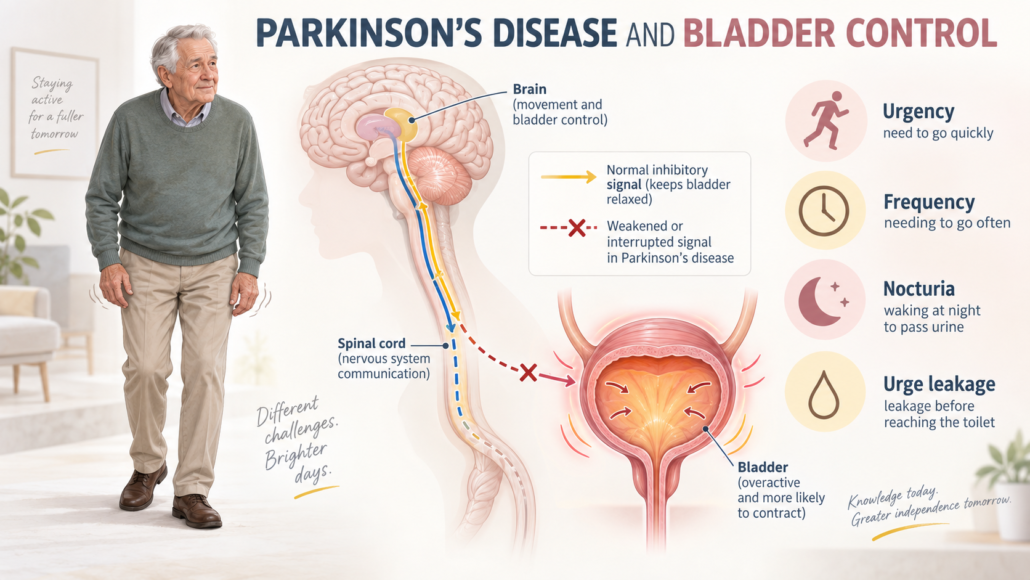
The bladder normally stores urine quietly and empties only when the brain decides that the time and place are appropriate. Dopamine-dependent circuits in the brain help suppress unwanted bladder contractions during filling.
Parkinson’s can weaken this “hold on” signal. The bladder muscle may contract before it is full, a condition called detrusor overactivity. This produces the familiar overactive-bladder symptoms of urgency, frequency and urge incontinence.
This is a form of neurogenic lower urinary tract dysfunction; bladder or sphincter function altered by disease of the nervous system. However, Parkinson’s does not create one single bladder pattern. Age-related bladder changes, prostate enlargement, pelvic-floor problems, constipation, diabetes, mobility limitations and medications may all contribute.
Common urinary symptoms
People may experience:
- a sudden, difficult-to-defer need to pass urine;
- frequent urination during the day;
- waking several times at night to urinate (nocturia);
- leakage before reaching the toilet (urge incontinence);
- bedwetting;
- hesitancy, a slow stream or straining;
- a feeling that the bladder has not emptied; or
- recurrent urinary infections.
Some apparent bladder leakage is partly functional: the person recognises the urge but rigidity, slow movement, poor balance or difficulty managing clothing prevents timely access to the toilet.
Difficulty emptying can occur, but substantial urinary retention is less typical of uncomplicated Parkinson’s disease. It may indicate prostate or urethral obstruction, an underactive bladder, medication effects, severe constipation, pelvic-organ prolapse, or another neurological disorder. Prominent retention, erectile dysfunction or severe postural blood-pressure problems early in a parkinsonian illness may warrant neurological review for conditions such as multiple system atrophy.
How is the bladder evaluated?
A careful assessment is more useful than assuming that every symptom is “just the Parkinson’s”. It may include:
- History and medication review: urinary symptoms, fluid intake, bowel function, mobility, cognition, falls and all prescribed and non-prescribed medicines.
- Bladder diary: usually recording drinks, voided volumes, urgency and leakage for three days. This is particularly helpful for nocturia.
- Examination: abdominal, neurological and, when appropriate, prostate or pelvic assessment.
- Urine test: to look for infection or blood.
- Post-void residual measurement: a bladder ultrasound after urination shows whether emptying is adequate.
- Uroflowmetry: measures the strength and pattern of the urinary stream.
- Further tests when indicated: renal function, ultrasound, cystoscopy or prostate assessment according to the clinical findings.
Blood in the urine, pain, fever, recurrent infection or a sudden major change in bladder function needs separate investigation and should not automatically be attributed to Parkinson’s.
Are urodynamic studies always necessary?
No. A patient with straightforward urgency and urge leakage, a normal urine test and a low residual volume can often begin conservative treatment without invasive testing.
Urodynamics may be particularly useful when:
- symptoms and initial test results do not agree;
- there is a high or rising post-void residual;
- weak flow, retention or obstruction is suspected;
- symptoms persist despite appropriate treatment;
- the diagnosis is uncertain—for example, overactivity versus poor bladder contraction;
- previous prostate, bladder or continence surgery complicates the picture; or
- Botox or another invasive treatment is being considered and the result would alter management.
During urodynamics, thin catheters measure bladder and abdominal pressure while the bladder fills and empties. The test may demonstrate detrusor overactivity, impaired contraction, obstruction or, less commonly, unsafe storage pressure. It should answer a specific clinical question—not simply be performed because Parkinson’s is present.
First steps: practical and behavioural treatment
Management should be individualised and, where helpful, involve the urologist, neurologist, Parkinson’s nurse, continence physiotherapist, occupational therapist and carer.
Useful measures include:
- treating urinary infection and constipation;
- reviewing diuretics and other medicines with the prescribing doctor;
- spreading fluid intake through the day while avoiding dehydration;
- reducing late-evening fluids, caffeine and alcohol when nocturia is troublesome;
- timed or prompted voiding;
- bladder training when cognition and mobility permit;
- pelvic-floor physiotherapy where appropriate;
- improving toilet access, lighting, clothing and mobility aids; and
- using a bedside urinal or commode when falls are a concern.
Nocturia is not always caused solely by an overactive bladder. Leg swelling, sleep apnoea, excessive urine production overnight and disturbed sleep may require different treatment.
Medication options
Antimuscarinic medicines
Medicines such as solifenacin, darifenacin, tolterodine, fesoterodine, oxybutynin or trospium can reduce involuntary bladder contractions. They may improve urgency, frequency and urge leakage.
The trade-off is important in Parkinson’s disease. Anticholinergic burden may worsen dry mouth, constipation, blurred vision, urinary retention, confusion or memory. Older people, those with cognitive impairment, glaucoma or poor bladder emptying need particular caution. Oxybutynin can be especially troublesome cognitively in susceptible patients. Drug choice should consider the person’s complete medication list and residual urine.
Beta-3 agonists
Mirabegron relaxes the bladder during filling without adding the same anticholinergic burden and has shown benefit in people with Parkinson’s and overactive-bladder symptoms. Blood pressure should be checked because it can rise, and interactions and cardiac history should be reviewed. Vibegron is another beta-3 agonist available for overactive bladder in Australia; Parkinson-specific evidence is more limited.
Combination treatment may be considered in selected patients when one medicine provides incomplete relief, with monitoring of blood pressure, side effects and bladder emptying.
If emptying is the main problem
Treatment depends on the cause. Prostate medication or surgery will help only if genuine bladder-outlet obstruction is present. An alpha-blocker may worsen dizziness or postural hypotension, already common in Parkinson’s. If significant residual urine persists, clean intermittent self-catheterisation, performed by the patient or a carer where feasible, is generally preferable to a long-term urethral catheter. A suprapubic catheter may be considered when intermittent catheterisation is not practical.
Botox injections into the bladder
Botulinum toxin A (Botox) can be effective for troublesome detrusor overactivity or overactive-bladder symptoms that have not responded to, or cannot tolerate, tablets. It is injected through a cystoscope into multiple areas of the bladder wall, usually as a day procedure.
Benefits may include fewer urgency episodes, fewer leaks and better sleep and quality of life. The effect is temporary, commonly lasting several months, so repeat treatment may be required.
Important risks include:
- urinary infection;
- blood in the urine or short-lived discomfort;
- incomplete bladder emptying or urinary retention; and
- the possible need for temporary—or occasionally ongoing—intermittent catheterisation.
Before treatment, the patient’s hand function, cognition and support network matter: could the patient or carer perform catheterisation if retention occurred? Measuring residual urine before and after treatment is essential. Urodynamics is often helpful if the underlying bladder behaviour or emptying ability is uncertain, although it is not mandatory in every otherwise clear case.
Can sacral neuromodulation be used in Parkinson’s disease?
Yes—in carefully selected patients. Sacral neuromodulation (SNM) sends mild electrical impulses to the sacral nerves involved in bladder control. It can be considered for refractory urgency, frequency, urge incontinence and, in selected circumstances, non-obstructive urinary retention.
Treatment begins with a test or staged phase. A temporary or tined lead is used to assess whether symptoms improve meaningfully, commonly by at least 50%, before a permanent battery is implanted. This trial is particularly valuable because Parkinson’s symptoms and bladder patterns differ between patients.
Small observational studies and systematic reviews suggest that some people with Parkinson’s achieve worthwhile improvement. However, the Parkinson-specific evidence is less extensive than the evidence for non-neurogenic overactive bladder, and response cannot be guaranteed.
Points to consider include:
- confirming that infection, obstruction and severe retention have been addressed;
- whether symptoms are likely to be modulated by SNM;
- the person’s ability, or carer support, to operate and attend follow-up for the device;
- falls, mobility and future disease progression;
- possible lead movement, pain, infection, device revision or battery replacement; and
- future MRI requirements. Modern systems may be MRI-conditional, but the exact device and scanning conditions must always be checked.
SNM is therefore not automatically excluded because a person has Parkinson’s. It is best considered through shared decision-making after appropriate evaluation and failure or intolerance of simpler measures.
Botox or sacral neuromodulation?
| Feature | Bladder Botox | Sacral neuromodulation |
|---|---|---|
| How it works | Temporarily reduces bladder-muscle overactivity | Modulates sacral nerve signalling |
| Treatment pathway | Cystoscopic injections, repeated when effect wears off | Test phase followed by an implant if successful |
| Main advantage | No permanent implant; established effect on detrusor overactivity | Testable before permanent implantation; no routine bladder injections |
| Main limitation | UTI and retention; intermittent catheterisation may be required | Implant surgery, programming, revisions and battery management |
| Parkinson-specific evidence | Supportive but based mainly on relatively small studies | Promising but still limited; careful selection is essential |
| Particularly important question | Could the patient or carer catheterise if necessary? | Can the patient manage the device and follow-up as Parkinson’s progresses? |
Neither option is universally “better”. The choice depends on bladder-emptying ability, infection history, dexterity, cognition, mobility, MRI needs, willingness to have repeat procedures or an implant, and the individual’s priorities.
When should you seek prompt medical attention?
Contact a doctor urgently for inability to pass urine, fever with urinary symptoms, flank pain, visible blood in the urine or a sudden neurological or bladder deterioration. New persistent incontinence also deserves assessment rather than simply adding pads.
The take-home message
Bladder symptoms are common and often overlooked in Parkinson’s disease. Urgency, frequency, nocturia and urge leakage are the usual pattern, but obstruction and poor emptying must not be missed. Most patients do not require urodynamics at the outset; it becomes valuable when the diagnosis is uncertain, emptying is impaired, treatment has failed or an invasive procedure is being planned.
Treatment progresses from practical measures and medication to Botox or sacral neuromodulation in suitable patients. The best plan balances symptom control with cognition, blood pressure, constipation, mobility, manual dexterity and the likely course of Parkinson’s disease.
Patient information: This article provides general education and is not a substitute for an individual medical assessment. Do not stop Parkinson’s, blood-pressure or bladder medication without discussing it with your treating doctor.
So, if you suffer with Parkinsons and your bladder is playing up, come see your Brisbane urologist, Dr Jo Schoeman to discuss options
References and further reading
- European Association of Urology. EAU Guidelines on Neuro-Urology. 2026.
- Ginsberg DA, et al. AUA/SUFU Guideline on Adult Neurogenic Lower Urinary Tract Dysfunction. J Urol. 2021; amendment 2024.
- Li FF, et al. Prevalence of lower urinary tract symptoms, urinary incontinence and retention in Parkinson’s disease: a systematic review and meta-analysis. Front Aging Neurosci. 2022;14:977572.
- Sakakibara R, et al. A guideline for the management of bladder dysfunction in Parkinson’s disease and other gait disorders. Neurourol Urodyn. 2016;35:551–563.
- Cho SY, et al. Mirabegron for treatment of overactive bladder symptoms in patients with Parkinson’s disease: a randomised, placebo-controlled trial. Neurourol Urodyn. 2021.
- Greenberg DR, et al. Sacral nerve stimulation in Parkinson’s disease patients with overactive bladder symptoms. Urology. 2020;144:99–105.
- Smith MD, et al. Neuromodulation for storage lower urinary tract symptoms in Parkinson disease: a systematic review. Neuromodulation. 2022.







Leave a Reply
Want to join the discussion?Feel free to contribute!