
Multiple Sclerosis and the Bladder: Symptoms, Tests and Treatment Options
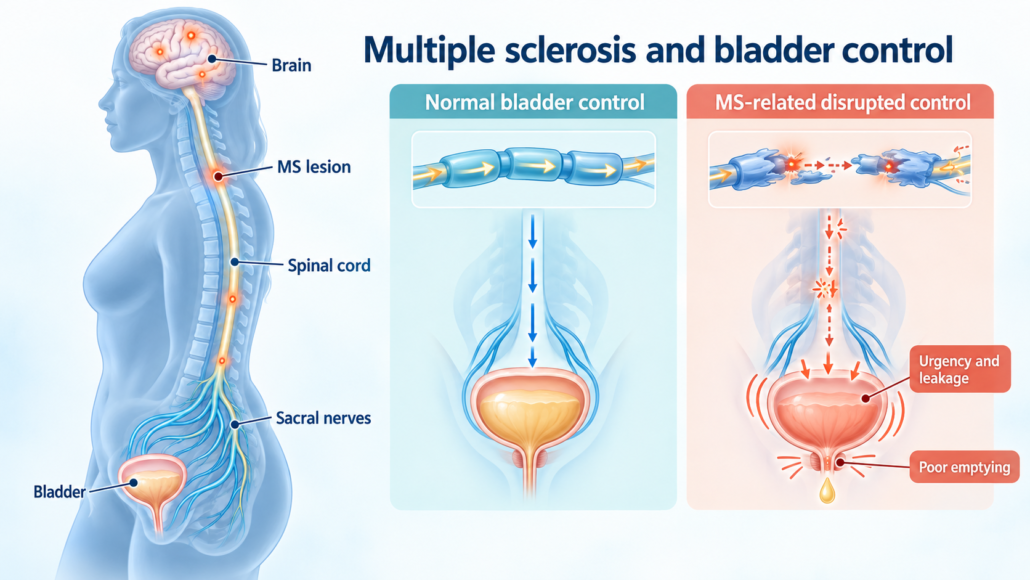
Multiple sclerosis (MS) affects the brain and spinal cord, the same nervous system pathways that coordinate bladder storage, bladder emptying and urinary sphincter control. As a result, bladder symptoms are common and may change as MS changes.
The important message is that “an MS bladder” is not one single condition. Some people develop an overactive bladder, some cannot empty properly, and others have a mixture of both. Treatment should therefore be based on the individual bladder pattern, not simply on the diagnosis of MS.
How does MS affect bladder control?
Normally, the bladder stores urine at low pressure while the urinary sphincter stays closed. When it is convenient to urinate, the brain allows the bladder muscle (detrusor) to contract while the sphincter relaxes.
MS plaques can interrupt these signals in different places. This may cause:
- Neurogenic detrusor overactivity: the bladder contracts unexpectedly during filling, causing urgency, frequency, nocturia and urge incontinence.
- Detrusor sphincter dyssynergia: the bladder contracts while the sphincter fails to relax properly, rather like pressing the accelerator and brake together. This may produce poor flow, straining, incomplete emptying, high bladder pressure and recurrent urinary infection.
- Detrusor underactivity: the bladder contraction is too weak or does not last long enough, causing slow emptying or retention.
- A mixed pattern: urgency and leakage can coexist with a significant residual urine volume.
The European Association of Urology (EAU) reports that approximately 75% of people develop voiding dysfunction within ten years of MS. Reported urodynamic patterns include neurogenic detrusor overactivity in 43–65%, detrusor sphincter dyssynergia in about 35%, and detrusor underactivity in about 25%. These patterns can overlap and can change over time.
Symptoms that deserve assessment
Bladder symptoms may include:
- sudden urgency and difficulty postponing urination;
- frequent urination by day or night;
- leakage before reaching the toilet;
- hesitancy, interrupted or weak urinary flow;
- straining to urinate;
- a feeling of incomplete emptying;
- recurrent urinary tract infections (UTIs);
- new bedwetting or unexpected leakage; and
- an inability to pass urine.
Seek prompt medical review for fever, flank pain, visible blood in the urine, severe bladder pain, inability to urinate, or a sudden major change in bladder function. A UTI can temporarily worsen neurological MS symptoms (a pseudo-relapse), while a true neurological relapse can also alter bladder function.
How is the bladder assessed?
Assessment is tailored to symptoms, disability, MS course and previous treatment. It may include:
- A detailed urinary, neurological, bowel, medication and mobility history.
- A three-day bladder diary recording fluid intake, voids, urgency, leakage and catheter volumes.
- Urinalysis and urine culture when infection is suspected.
- Measurement of post-void residual urine with a bladder scan.
- Kidney-function blood tests where appropriate.
- Urinary tract ultrasound in selected patients, particularly where retention, recurrent infection, stones or upper-tract risk is suspected.
- Uroflowmetry, which measures the strength and pattern of the urinary stream.
- Urodynamic studies when the result is likely to clarify the diagnosis or change treatment.
Urodynamic studies: useful, but used selectively
Urodynamics measures bladder pressure, abdominal pressure, urine flow and sphincter activity during filling and emptying. It can distinguish urgency caused by detrusor overactivity from poor emptying caused by detrusor weakness, outlet obstruction or detrusor–sphincter dyssynergia. Video urodynamics can additionally show the bladder outlet, reflux and anatomical changes.
Urodynamics is especially useful when:
- symptoms and residual urine measurements do not tell the same story;
- both storage and emptying symptoms are present;
- recurrent UTIs, retention or raised bladder pressures are suspected;
- invasive treatment such as bladder Botox is being considered;
- previous treatment has failed or produced unexpected problems;
- there is concern about kidney or upper urinary tract safety; or
- bladder function has changed significantly.
Precautions before and during urodynamics
- Active symptomatic UTI should be treated before an elective invasive study.
- The team should know about antibiotics, anticoagulants, allergies, pregnancy possibility and previous difficulty with catheterisation.
- Mobility, spasms, fatigue, cognition, hand function and transfer needs should be planned for in advance.
- Catheter placement and rapid filling can alter the result; artefacts must be recognised and the study interpreted alongside the person’s normal symptoms and bladder diary.
- A single study is a snapshot. Results may vary, and repeat testing may be appropriate when findings are inconsistent or the clinical situation changes.
- Autonomic dysreflexia is mainly a concern in susceptible people with high spinal cord lesions rather than typical MS, but blood pressure and heart rate must be monitored whenever an individual is considered at risk.
- Preventive antibiotics are not automatically required for every patient; use should be individualised according to urine findings and infection risk.
Treatment: matching the solution to the bladder problem
The aims are to improve continence and quality of life, empty the bladder safely, reduce infections, protect the kidneys and preserve independence.
Everyday measures
Useful first steps may include:
- timed voiding or bladder training;
- adjusting excessive, poorly timed fluid intake without becoming dehydrated;
- reducing caffeine, alcohol or other individual bladder irritants;
- treating constipation;
- improving toilet access, clothing and mobility support;
- pelvic-floor physiotherapy where muscle control and the bladder pattern make this appropriate; and
- continence pads, sheaths or other products as support, not as a substitute for investigating retention.
Medication for urgency and neurogenic overactive bladder
Antimuscarinic medicines can reduce involuntary bladder contractions and improve capacity. Possible side effects include dry mouth, constipation, blurred vision and impaired bladder emptying. Cognitive burden is relevant, particularly where fatigue, memory concerns or multiple anticholinergic medicines are already present.
Beta-3 agonists, may improve urgency and frequency with less dry mouth and constipation. Blood pressure and drug interactions require consideration. In neurogenic detrusor overactivity, symptom improvement does not necessarily mean that bladder pressures have normalised.
Before and after starting storage medication, the residual urine may need checking because suppressing bladder contractions can reveal or worsen incomplete emptying. Combination therapy is sometimes used under specialist supervision.
An alpha-blocker may occasionally be used to reduce outlet resistance in selected patients with voiding difficulty, although it will not correct every cause of neurogenic retention.
Catheterisation and intermittent self-catheterisation (ISC)
If the bladder cannot empty safely, intermittent catheterisation is often preferred to leaving a catheter in continuously. A small catheter is passed at planned intervals and removed once the bladder is empty.
ISC may:
- reduce residual urine and overflow leakage;
- improve bladder-pressure control;
- make storage medicines or Botox safer; and
- protect the upper urinary tract in selected patients.
However, it must be practical. Hand dexterity, tremor, spasticity, vision, fatigue, cognition, body position, urethral anatomy, bathroom access and carer support all matter. Training by an experienced continence nurse is valuable, and adaptive equipment or a different catheter may make a major difference.
Possible difficulties include discomfort, urethral trauma, bleeding, false passage and UTI. Bacteria in the urine without symptoms do not always require antibiotics. The EAU emphasises shared decision-making because ISC can increase treatment burden; one cited MS study found a higher UTI rate after starting intermittent catheterisation without a corresponding improvement in quality of life or symptom score.
If ISC is impossible and drainage is essential, an indwelling urethral or suprapubic catheter may be considered. Long-term catheters carry risks including infection, blockage, encrustation, leakage, bladder stones and urethral damage. When long-term drainage is necessary, a suprapubic catheter may offer practical advantages for selected patients, but it is not complication-free.
Bladder Botulinum Toxin injections
Botulinum toxin type A is injected through a cystoscope into multiple areas of the bladder wall. It reduces the nerve signals that trigger involuntary detrusor contractions and is well supported for MS-related neurogenic detrusor overactivity when tablets are ineffective or poorly tolerated.
Benefits may include fewer urgency-incontinence episodes, improved bladder capacity and lower storage pressure. The effect is temporary, commonly lasting several months, so successful treatment usually requires repeat injections.
The main precautions are:
- UTI must be excluded or treated around the procedure according to local protocol.
- Botox may weaken bladder emptying and cause urinary retention.
- A patient who does not already catheterise must be willing and physically able to perform ISC, or have reliable help, if retention develops.
- UTIs, temporary blood in the urine and discomfort can occur; generalised muscle weakness is rare.
- Residual urine and symptoms require follow-up, and urodynamics may occasionally be repeated to confirm safe bladder pressures.
Dose and injection technique are individualised. In MS patients who still void spontaneously, a lower dose may reduce—but does not eliminate—the likelihood of needing catheterisation.
Sacral neuromodulation (SNM)
SNM delivers mild electrical stimulation to the sacral nerves, usually via a lead placed near the S3 nerve root and connected to a small implanted pulse generator. It can be considered in carefully selected patients with refractory urgency, urgency incontinence, frequency or non-obstructive urinary retention.
A major advantage is that treatment can be tested first. During a trial phase, symptom diaries help determine whether stimulation produces a meaningful improvement before the permanent battery is implanted.
Important considerations in MS include:
- the evidence base is smaller and less disease-specific than the evidence supporting Botox for neurogenic detrusor overactivity;
- results may be less predictable if neurological disease progresses or the bladder pattern changes;
- implantation requires a procedure and ongoing programming;
- pain, infection, lead movement, loss of effect, device malfunction and future revision or replacement can occur; and
- people with MS commonly require future MRI scans. Modern systems may be MRI-conditional, but the exact lead and generator combination and the scanner conditions must be verified before implantation and before every MRI.
SNM does not remove the need to monitor residual urine, infection risk or upper-tract safety when clinically indicated.
Botox versus sacral neuromodulation in MS
| Feature | Bladder Botox | Sacral neuromodulation |
|---|---|---|
| Main role | Neurogenic detrusor overactivity with urgency and urge incontinence after medication is inadequate or poorly tolerated | Selected refractory urgency, urge incontinence, frequency or non-obstructive retention |
| MS-specific evidence | Stronger; supported by randomised trials in neurogenic detrusor overactivity | Promising, but fewer MS-specific studies and less certainty about ideal candidates |
| How it works | Temporarily reduces detrusor nerve activity and contractions | Modulates sacral nerve signalling to the bladder and pelvic floor |
| Procedure | Cystoscopic injections into the bladder | Trial lead followed by permanent implant if successful |
| Reversibility | Effect wears off over months | Stimulation can be adjusted or switched off; device can be removed |
| Repeat treatment | Usually repeat injections are required | Programming and eventual battery/device revision or replacement may be required |
| Retention/ISC risk | Important; new ISC may become necessary | Generally less likely to cause retention; may also treat selected non-obstructive retention |
| Infection considerations | UTI is a common adverse event; urinary infection should be addressed before treatment | Surgical-site or device infection can require antibiotics or device removal |
| MRI considerations | No implanted device restriction | Confirm that the complete implanted system is MRI-conditional and follow device-specific conditions |
| Best fit | Proven high-pressure or overactive bladder where reducing contractions is the priority and catheterisation is feasible if needed | A carefully selected patient who values a test phase, has suitable symptoms and accepts an implant and follow-up |
| Key limitation | Temporary effect and possible urinary retention | Implant-related complications and less certain outcomes as MS evolves |
Which is better?
Neither treatment is universally “better.” Botulinum Toxin is often favoured when urodynamics demonstrates neurogenic detrusor overactivity and the main goal is to suppress involuntary bladder contractions or unsafe storage pressure. SNM may be attractive in a carefully selected patient with refractory urgency or non-obstructive retention who wants a testable, adjustable treatment and wishes to avoid the higher catheterisation risk associated with Botox.
The decision should consider urodynamic findings, current residual urine, ability to perform ISC, recurrent UTIs, hand function, mobility, expected MRI needs, disease stability, patient preference and access to long-term follow-up.
Other interventional and surgical options
For selected patients, posterior tibial nerve stimulation may improve overactive bladder symptoms without an implant, although evidence in MS is less robust. When severe high-pressure bladder dysfunction remains unsafe despite medication, catheterisation and minimally invasive treatment, reconstructive options such as augmentation cystoplasty or urinary diversion may be considered in a specialist neuro-urology service. These are major procedures reserved for carefully selected cases and require lifelong follow-up.
Follow-up matters
MS and bladder function can both evolve. Review may include symptom assessment, bladder diary, urinalysis when symptomatic, residual urine measurement, renal function, urinary tract imaging and repeat urodynamics according to risk and clinical change.
A useful treatment plan is therefore not simply “stop the leakage.” It should answer four questions:
- Is the bladder storing urine at a safe pressure?
- Is it emptying adequately?
- Is the treatment practical and sustainable for this patient?
- Are the kidneys and quality of life being protected over time?
Take-home message
Bladder problems in MS are common, treatable and often more complex than the symptoms suggest. Urgency does not exclude retention, and leakage does not prove that the bladder empties well. A structured assessment, including a residual urine measurement and selective use of urodynamics, allows treatment to be matched to the actual dysfunction.
Medication, ISC, Botox and sacral neuromodulation all have valuable roles. The best choice is the one that safely addresses the individual bladder pattern while fitting the person’s abilities, priorities, MS course and future care needs.
This article provides general information and does not replace individual medical assessment. Treatment availability, indications and funding vary. Patients should discuss their symptoms with their GP, neurologist, continence clinician or urologist.
References and further reading
- European Association of Urology. EAU Guidelines on Neuro-urology. Current online guideline: https://uroweb.org/guidelines/neuro-urology/chapter/the-guideline
- National Institute for Health and Care Excellence. Urinary incontinence in neurological disease: assessment and management (CG148). https://www.nice.org.uk/guidance/cg148
- Gajewski JB, Schurch B, Hamid R, et al. An International Continence Society report on the terminology for adult neurogenic lower urinary tract dysfunction. Neurourology and Urodynamics. 2018;37(3):1152–1161.
- Ginsberg D, Gousse A, Keppenne V, et al. Phase 3 efficacy and tolerability study of onabotulinumtoxinA for urinary incontinence from neurogenic detrusor overactivity. Journal of Urology. 2012;187(6):2131–2139.
- Cruz F, Herschorn S, Aliotta P, et al. Efficacy and safety of onabotulinumtoxinA in patients with urinary incontinence due to neurogenic detrusor overactivity. European Urology. 2011;60(4):742–750.
- American Urological Association/Society of Urodynamics, Female Pelvic Medicine & Urogenital Reconstruction. Adult Neurogenic Lower Urinary Tract Dysfunction Guideline. https://www.auanet.org/guidelines-and-quality/guidelines/adult-neurogenic-lower-urinary-tract-dysfunction





Leave a Reply
Want to join the discussion?Feel free to contribute!