
Focal Therapy for Prostate Cancer: Treating the Cancer, Preserving the Prostate
For many years, treatment of localised prostate cancer largely involved choosing between active surveillance and treatment of the whole prostate gland with surgery or radiotherapy.
Modern multiparametric MRI, targeted transperineal biopsy and increasingly accurate image-guided treatment have opened a third pathway for carefully selected men: focal therapy.
Rather than treating or removing the entire prostate, focal therapy aims to identify the clinically significant cancer and destroy that area together with an appropriate safety margin, while leaving as much normal prostate tissue as possible.
A useful analogy is treating the troublesome patch rather than replacing the entire lawn.
The attraction is obvious: if the cancer can be controlled without treating the whole prostate, it may be possible to reduce the risks of urinary incontinence, erectile dysfunction and other quality-of-life effects associated with radical treatment.
However, focal therapy is not suitable for every prostate cancer, and it comes with an important trade-off: long-term cancer-control evidence is less mature than it is for radical prostatectomy and radiotherapy. Current European guidance therefore remains cautious, recommending focal therapy within clinical trials or well-designed prospective registries until stronger long-term comparative evidence becomes available.
What is focal therapy?
Focal therapy treats a selected region of the prostate containing clinically significant cancer rather than treating the entire gland.
Depending on the size and location of the tumour, treatment may involve:
- Focal ablation of an individual lesion
- Hemi-ablation, treating approximately one side of the prostate
- Quadrant or zonal ablation
- A wider “hockey-stick” ablation where disease distribution requires a larger treatment field
The treatment zone normally includes both the visible tumour and a planned margin around it.
The challenge is that prostate cancer is frequently multifocal. The largest or most biologically significant lesion is often referred to as the index lesion, but smaller cancer deposits may exist elsewhere in the gland.
For this reason, careful imaging, biopsy and follow-up are fundamental to a successful focal therapy program.
Who may be suitable for focal therapy?
The ideal candidate is generally a man with localised, clinically significant prostate cancer that can be accurately identified and safely targeted.
Potential candidates may include men with:
- Disease confined to the prostate
- A clearly identifiable lesion on multiparametric MRI
- Cancer confirmed by targeted and systematic or mapping transperineal biopsy
- Favourable intermediate-risk disease, commonly ISUP Grade Group 2 / Gleason 3+4, in an appropriate anatomical distribution
- Selected higher-volume Grade Group 1 disease where active surveillance is considered unsuitable or unacceptable
- Occasionally carefully selected Grade Group 3 disease in experienced centres, although the evidence is less established
- A lesion that can be treated with an adequate margin without unacceptable injury to the urethra, sphincter, rectum or neurovascular structures
- A strong preference to minimise the potential urinary and sexual consequences of whole-gland treatment
The decision should ideally follow review of the MRI, biopsy pathology, PSA, PSA density, prostate volume, tumour location and overall risk profile, rather than simply asking whether a particular machine can reach the tumour.
Who is generally NOT a good candidate?
Focal treatment becomes less attractive when there is:
- Extensive multifocal clinically significant cancer
- Significant bilateral disease
- High-volume high-grade cancer
- Extracapsular extension
- Seminal vesicle invasion
- Lymph-node involvement
- Metastatic disease
- Cancer that cannot be reliably seen or mapped
- Disease immediately adjacent to structures that cannot safely be included in the treatment margin
- A patient preference for the treatment with the longest-established oncological follow-up
Some men with very low-risk disease may also be better served by active surveillance rather than focal treatment, avoiding treatment altogether until there is evidence that treatment is actually necessary.
How do we determine whether focal treatment is appropriate?
Successful focal therapy begins with accurate cancer mapping.
Assessment will usually include:
Multiparametric MRI
MRI identifies suspicious lesions and helps establish their size, location and relationship to the urethra, capsule, sphincter and neurovascular bundles.
Transperineal prostate biopsy
MRI alone is not enough.
Targeted biopsy confirms the grade and extent of the MRI-visible lesion, while systematic or mapping biopsies help determine whether significant cancer exists elsewhere in the prostate.
PSA and PSA density
PSA remains useful, although interpretation after focal therapy differs from interpretation following radical prostatectomy because normal prostate tissue remains behind.
PSMA PET/CT
PSMA PET may be useful in selected patients, particularly those with higher-risk characteristics or when there is concern about disease outside the proposed treatment area.
What focal therapy options are available?
Several technologies can destroy a selected area of prostate tissue.
These include:
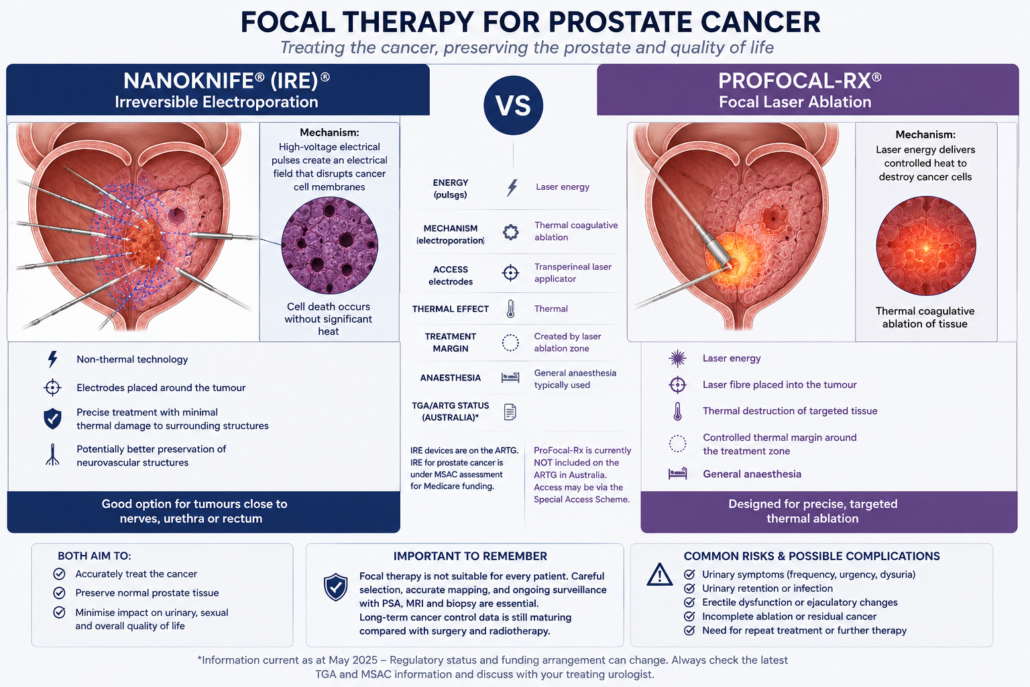
Irreversible Electroporation: NanoKnife
NanoKnife® is a system used to perform irreversible electroporation, or IRE.
Several fine needle electrodes are inserted through the perineum around the tumour under imaging guidance. Very short, high-voltage electrical pulses are passed between the electrodes.
Rather than primarily heating or freezing the tissue, the electrical field creates irreversible disruption of cell membranes, resulting in cell death.
IRE is therefore principally considered a non-thermal ablative technology.
Focal Laser Ablation
A laser fibre is placed directly into the target lesion and laser energy produces controlled thermal destruction of cancerous tissue.
ProFocal-Rx® is an Australian-developed focal laser technology designed specifically for targeted prostate treatment.
High-Intensity Focused Ultrasound
HIFU focuses ultrasound energy within the prostate, heating and destroying the targeted tissue without requiring needles to be placed directly throughout the treatment zone.
Cryotherapy
Needles are placed into the prostate and tissue is repeatedly frozen and thawed, producing cellular destruction.
Other technologies
Photodynamic therapy, radiofrequency ablation, focal brachytherapy and other energy-based approaches have also been investigated.
The Prostate Cancer Foundation of Australia notes that focal therapies including IRE/NanoKnife, laser ablation, HIFU and other technologies have been investigated or used in Australia, although availability varies.
NanoKnife versus ProFocal Laser Therapy
Both technologies attempt to achieve the same broad objective: destroy the cancer while preserving as much normal prostate and surrounding function as possible.
They achieve this in very different ways.
| NanoKnife / IRE | ProFocal-Rx Laser | |
|---|---|---|
| Energy | High-voltage electrical pulses | Laser energy |
| Mechanism | Irreversible electroporation | Thermal coagulative ablation |
| Thermal treatment | Principally non-thermal | Yes |
| Access | Transperineal needles/electrodes | Transperineal laser applicator |
| Treatment planning | Electrode geometry surrounds treatment zone | Laser applicator positioned within/adjacent to target |
| MRI/TRUS planning | Yes | Yes |
| Tissue effect | Cell membrane disruption | Controlled heating and tissue necrosis |
| Treatment margin | Created by electrical field between electrodes | Created by laser ablation zone |
| Near neurovascular structures | Potential theoretical advantage of non-thermal mechanism | Requires careful thermal planning |
| Anaesthesia | General anaesthesia with profound muscle relaxation generally required | General anaesthesia typically used |
| Cardiac synchronisation | Required with IRE | Not required in the same manner |
| Repeat treatment | Possible in selected cases | Potentially possible |
| Long-term oncological evidence | Growing medium-term evidence | Earlier-stage clinical evidence |
| Australian regulatory status | IRE devices are represented on the ARTG; specific device/indication should be checked | ProFocal is currently not included on the ARTG |
NanoKnife: potential advantages
The major attraction of IRE is that it does not rely primarily upon heating or freezing the prostate.
The electrical field disrupts cell membranes while potentially allowing relative preservation of extracellular structures. This makes IRE particularly interesting when treating cancers close to delicate structures.
Potential advantages include:
- Precise treatment planning
- No ionising radiation
- No prostate removal
- Preservation of untreated prostate tissue
- Low reported rates of significant urinary incontinence
- Potentially better preservation of erectile function compared with whole-gland treatment
- Ability to consider repeat focal treatment in selected patients
- Radical surgery or radiotherapy may remain possible if subsequent clinically significant cancer develops
Australian and international experience with IRE is considerably more mature than that of many newer focal technologies, although long-term comparative data against radical prostatectomy and radiotherapy are still developing. Published reviews cited by the AUA report residual or recurrent clinically significant cancer after focal ablation across all technologies, reinforcing the need for surveillance rather than considering focal therapy a “treat it and forget it” procedure.
NanoKnife: disadvantages and potential complications
IRE is still an invasive procedure.
Potential complications include:
- Temporary urinary frequency and urgency
- Dysuria
- Haematuria
- Perineal bruising or discomfort
- Urinary retention
- Temporary catheter requirement
- Urinary tract infection
- Prostatitis
- Urethral injury or stricture
- Erectile dysfunction
- Ejaculatory changes
- Rare urinary incontinence
- Incomplete tumour ablation
- Residual cancer within the treated field
- Development or recognition of cancer elsewhere in the prostate
- Need for repeat focal treatment
- Subsequent need for radical prostatectomy or radiotherapy
Because IRE uses high-voltage electrical pulses, treatment requires appropriate anaesthesia, muscle relaxation and cardiac synchronisation.
ProFocal-Rx: focal laser therapy
ProFocal-Rx is a targeted laser ablation system developed in Australia.
A treatment applicator is placed transperineally into the prostate tumour. Laser energy is then delivered into the planned treatment area, producing controlled thermal destruction.
Early Australian studies have evaluated the feasibility and safety of this approach, including clinical trials of targeted treatment for MRI-localised prostate cancer.
Potential attractions include:
- Highly localised treatment
- Direct placement of the treatment fibre into the tumour
- Relatively small treatment volumes
- Preservation of surrounding prostate tissue
- Short treatment and recovery pathways
- Potential preservation of urinary continence
- Potential preservation of erectile and ejaculatory function
However, ProFocal remains a newer technology with substantially less long-term oncological follow-up than radical prostatectomy, radiotherapy and even some other focal therapy platforms.
ProFocal: potential risks and limitations
Because laser treatment is thermal, careful treatment planning is required to prevent unintended heat injury.
Possible complications include:
- Urinary frequency or urgency
- Dysuria
- Haematuria
- Temporary urinary retention
- Infection
- Perineal discomfort
- Urethral thermal injury
- Erectile dysfunction
- Ejaculatory changes
- Rectal injury, although uncommon with appropriate treatment planning
- Incomplete ablation
- Residual clinically significant cancer
- Cancer developing or being detected elsewhere in the prostate
- Need for repeat treatment
- Need for subsequent radical prostatectomy or radiotherapy
An important additional consideration is simply the maturity of the evidence. Early results can be encouraging without necessarily predicting cancer control at 10, 15 or 20 years.
What is the TGA status in Australia?
This point deserves particular clarity.
The Australian Register of Therapeutic Goods (ARTG) is the TGA’s public register of therapeutic products that can legally be supplied in Australia, subject to applicable exemptions and special-access pathways.
IRE / NanoKnife
Irreversible electroporation technology is available in Australia and is being used clinically for selected prostate cancers. The Medical Services Advisory Committee currently has an application assessing IRE using the NanoKnife system for prostate tumour tissue, including a proposed Medicare Benefits Schedule item. That MSAC application remains under assessment rather than representing an established Medicare item.
It is important not to confuse TGA/ARTG regulatory status with Medicare funding or with endorsement of focal therapy as oncologically equivalent to prostatectomy or radiotherapy. These are separate questions.
ProFocal-Rx
As of August 2026, the manufacturer’s Australian website specifically states that:
ProFocal is not included on the TGA’s ARTG in Australia.
TGA documents also demonstrate previous Australian patient access to ProFocal-Rx through the Special Access Scheme, which is a pathway for accessing an unapproved therapeutic good in particular circumstances and is not the same as general ARTG inclusion.
This distinction is important when discussing ProFocal with Australian patients.
Regulatory status can change, so the current ARTG should always be checked when treatment is being considered.
Does focal therapy cure prostate cancer?
It can achieve local control of appropriately selected prostate cancers, but the word “cure” needs to be used carefully.
Unlike radical prostatectomy, focal therapy deliberately leaves much of the prostate behind.
There are therefore two important potential sites of future cancer:
In-field recurrence
Cancer persists or recurs within the treated area.
Out-of-field cancer
Clinically significant cancer is subsequently detected elsewhere in the untreated prostate.
Neither necessarily means that focal therapy was inappropriate, but patients need to understand from the outset that continued prostate cancer surveillance is part of the treatment strategy.
The AUA’s salvage guideline notes clinically significant cancer following focal treatment across different modalities and emphasises that recurrence remains an important consideration after focal ablation.
Follow-up after focal therapy
Focal therapy does not end prostate cancer surveillance.
Follow-up typically involves a combination of:
- Regular PSA testing
- Clinical review
- Multiparametric MRI
- Repeat targeted and systematic biopsy
- Additional imaging where clinically indicated
A common strategy is to establish a new PSA baseline after treatment and combine PSA behaviour with MRI and scheduled biopsy rather than relying on PSA alone.
This is important because the remaining normal prostate continues to produce PSA. Unlike after radical prostatectomy, the PSA is therefore not expected to become undetectable.
What happens if the cancer returns?
One of the advantages of focal treatment is that further treatment options usually remain available.
Depending upon the location, grade and extent of recurrent disease, options may include:
- Continued surveillance for insignificant disease
- Repeat focal therapy
- Radical prostatectomy
- External-beam radiotherapy
- Other appropriate salvage treatment
Patients should nevertheless understand that salvage surgery after previous focal therapy may be technically more challenging because of fibrosis and altered tissue planes.
For clinically significant recurrence following focal ablation, AUA salvage guidance recommends that men considering definitive salvage treatment be offered whole-gland treatment with radical prostatectomy or radiotherapy.
Focal therapy versus radical treatment
Focal therapy occupies an increasingly interesting middle ground.
Active surveillance aims to avoid treatment until treatment becomes necessary.
Focal therapy aims to treat the clinically significant cancer while preserving the remainder of the prostate.
Radical prostatectomy or radiotherapy aims to treat the entire prostate and therefore both known and potentially occult cancer within the gland.
There is no universally “best” choice.
The appropriate treatment depends upon:
- Cancer grade
- Cancer volume
- MRI findings
- Biopsy distribution
- PSA and PSA density
- Age and life expectancy
- Baseline urinary function
- Baseline erectile function
- Other medical conditions
- Individual attitude towards cancer risk
- Willingness to undergo continued MRI and biopsy surveillance
- Personal priorities regarding continence and sexual function
The key question: are we treating the right cancer?
The success of focal therapy depends less on the glamour of the machine and more on patient selection, accurate imaging, meticulous biopsy mapping, treatment planning and rigorous follow-up.
NanoKnife, laser, HIFU and cryotherapy are different tools. The most important step occurs before any of them are switched on: establishing exactly where the clinically significant cancer is and whether disease elsewhere in the prostate has been adequately excluded.
For the appropriately selected man, focal therapy offers an attractive possibility:
Treat the cancer that needs treatment while preserving as much of the prostate, urinary function and sexual function as possible.
For other men, active surveillance, radical prostatectomy or radiotherapy will remain the safer oncological strategy.
Important perspective
Focal therapy is an exciting and rapidly evolving field, but it should not be presented as a universally equivalent replacement for established prostate cancer treatments.
Current evidence suggests good functional outcomes in appropriately selected patients, while definitive long-term comparative oncological evidence remains incomplete. European guidelines consequently continue to recommend focal therapy within clinical trials or prospective registries.
The decision is therefore best made after a detailed discussion with a urologist experienced in prostate MRI, transperineal biopsy, focal therapy and established radical treatment options.
Australian regulatory note
At the time of writing in August 2026, ProFocal-Rx is not included on the Australian ARTG, while IRE/NanoKnife technology is available in Australia and IRE for prostate cancer is currently undergoing an MSAC assessment relating to proposed Medicare funding. Regulatory status and funding arrangements may change and should be confirmed before treatment.
This information is intended for general patient education and does not replace individual medical advice. Suitability for focal therapy requires assessment of the patient’s pathology, imaging, prostate anatomy, overall health and personal treatment priorities.



Leave a Reply
Want to join the discussion?Feel free to contribute!