Peyronie’s Disease: When a Curved Erection Becomes a Medical Problem
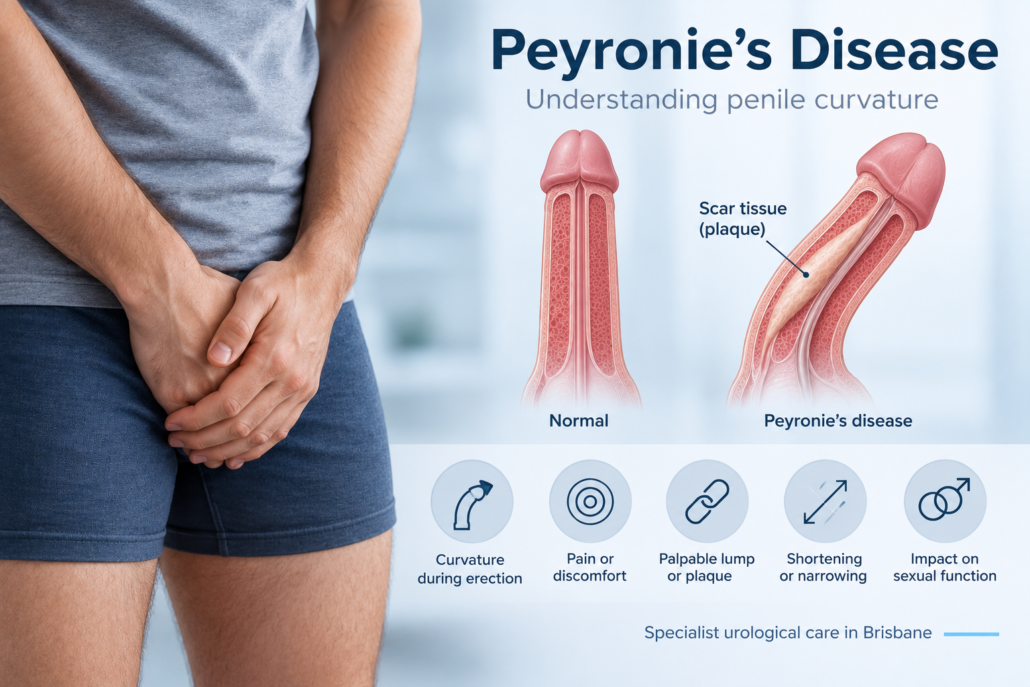
Peyronie’s disease is a condition in which scar tissue develops within the penis, causing it to bend or curve during an erection.
A slight natural curve can be completely normal. Peyronie’s disease is different because the change is usually new, may worsen over time, and can sometimes cause pain or make sexual intercourse difficult.
What causes Peyronie’s disease?
The exact cause is not always clear.
In many cases, the condition may develop after repeated minor injury or trauma to the penis. This can lead to the formation of fibrous scar tissue, known as a plaque.
The plaque does not stretch normally during an erection, causing the penis to bend toward the affected area.
Some men do not remember any specific injury.
Common symptoms
Symptoms of Peyronie’s disease can include:
- A new bend or curve in the penis
- A hard area or plaque beneath the skin
- Pain during erections
- Shortening of the penis
- Narrowing or indentation of the shaft
- Difficulty with sexual intercourse
- Erectile dysfunction
The severity can vary considerably between patients.
Does Peyronie’s disease get worse?
Peyronie’s disease commonly develops in phases.
During the early or active phase, the curvature may continue to change and erections may be painful.
After a period of time, the condition often becomes more stable.
In some men the pain settles, while the curvature remains.
When should you see a urologist?
A new or worsening penile curvature should be assessed, particularly when it causes pain, affects erections or interferes with sexual activity.
A urologist can assess the degree of curvature, check for plaque formation and determine whether treatment is necessary.
Not every patient requires surgery.
Treatment options
Treatment depends on the severity of the condition, how long it has been present and whether it is affecting sexual function.
Options may include:
- Observation
- Medication in selected cases
- Penile traction therapy
- Injection treatments
- Surgical correction
Surgery is generally considered when the condition is stable and the curvature significantly affects sexual intercourse.
Peyronie’s disease and erectile dysfunction
Some men with Peyronie’s disease also develop erectile dysfunction.
This may occur because of changes in penile structure, blood flow or anxiety related to pain and curvature.
Assessment is therefore important so that both problems can be considered together.
Specialist assessment in Brisbane
Peyronie’s disease can be uncomfortable to discuss, but it is a recognised medical condition and treatment options are available.
If you have noticed a new change in penile shape, persistent pain during erections or difficulty with sexual activity, speak with your GP or arrange an assessment with a urologist.



Leave a Reply
Want to join the discussion?Feel free to contribute!