Laser Vaporisation for Benign Prostate Enlargement
A Modern, Low-Bleeding Treatment for an Enlarged Prostate
Benign prostate enlargement, also called benign prostatic hyperplasia (BPH), is extremely common as men get older. As the prostate enlarges around the urethra, it can gradually restrict urinary flow, rather like slowly tightening a collar around the urinary pipe.
Symptoms may include:
- A slow or weak urinary stream
- Difficulty starting urination
- Straining to urinate
- Intermittent or stop-start flow
- A feeling that the bladder has not emptied properly
- Urinary frequency and urgency
- Getting up several times at night to urinate
- Episodes of urinary retention
Many men can initially be managed with lifestyle modification or medication. When symptoms become troublesome, complications develop, or medication is no longer effective or desirable, surgery may be considered.
One well-established minimally invasive surgical option is GreenLight laser photoselective vaporisation of the prostate (PVP).
What Is GreenLight Laser Prostate Surgery?
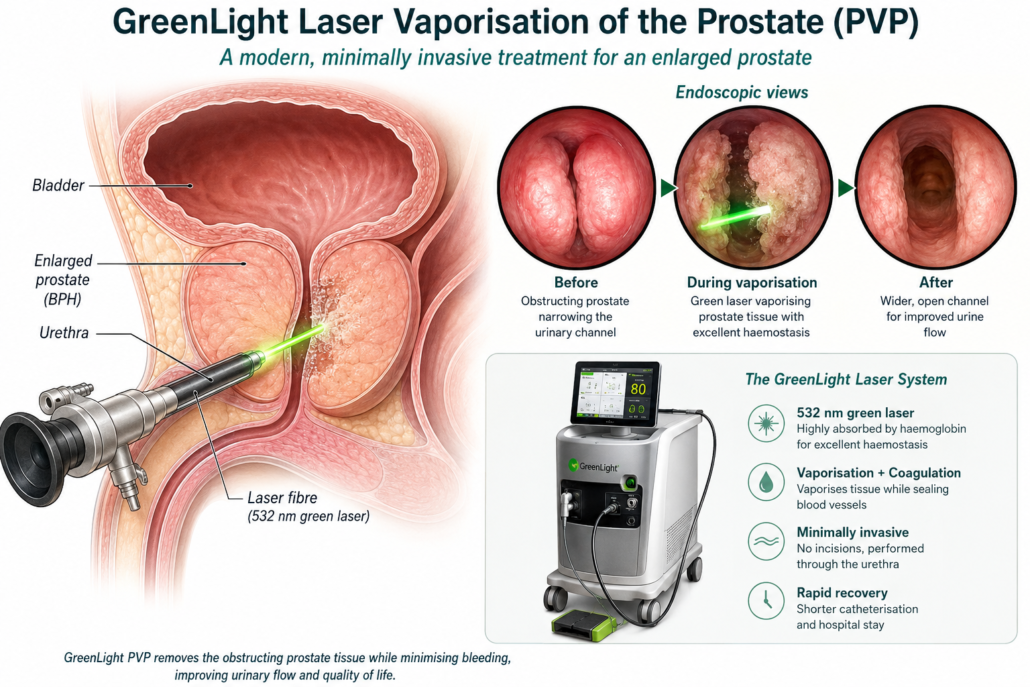
GreenLight PVP is an endoscopic procedure performed through the urethra. There are no abdominal incisions.
A telescope is passed through the urethra to the prostate. A specialised laser fibre is then used to progressively vaporise the obstructing prostate tissue and create a wider channel through which urine can flow.
Unlike TURP, where pieces of prostate tissue are physically cut away, GreenLight treatment predominantly converts the obstructing tissue into vapour while simultaneously sealing blood vessels.
The result is a combination of tissue removal and excellent haemostasis.
What Laser Is Used?
The GreenLight system uses a 532-nanometre green laser.
Modern GreenLight systems commonly use a lithium triborate (LBO) crystal to generate the 532 nm wavelength, with the contemporary high-powered platform delivering up to 180 watts.
Earlier systems included:
| Generation | Laser | Maximum power |
|---|---|---|
| Early GreenLight | KTP | 80 W |
| GreenLight HPS | LBO | 120 W |
| GreenLight XPS | LBO | 180 W |
The current European Association of Urology guideline describes the 180 W system as the contemporary standard platform for GreenLight PVP.
Why Is the Laser Green?
The colour is not merely decorative.
The 532 nm wavelength is strongly absorbed by haemoglobin, the pigment contained within red blood cells. It is much less strongly absorbed by water.
This property allows the laser energy to be preferentially absorbed by the vascular prostate tissue.
The laser has a relatively shallow tissue penetration of approximately 0.8 mm, producing rapid vaporisation while creating a limited zone of coagulation underneath the treated surface.
This gives GreenLight its two particularly useful characteristics:
Vaporisation + haemostasis
As prostate tissue is vaporised, small blood vessels are simultaneously coagulated.
This is why the operative field can remain remarkably clear and why GreenLight surgery generally produces less bleeding than traditional TURP.
Who May Benefit from GreenLight Laser Surgery?
GreenLight PVP may be considered for men with moderate to severe urinary symptoms caused by benign prostatic obstruction, particularly when conservative or medical treatment has not provided adequate relief.
Surgery may also be recommended when BPH results in complications such as:
- Recurrent urinary retention
- Dependence on a urinary catheter
- Recurrent urinary tract infections associated with obstruction
- Bladder stones
- Recurrent visible haematuria attributable to BPH
- Progressive bladder dysfunction
- Significant residual urine
- Upper urinary tract deterioration or renal impairment secondary to obstruction
Surgery is also reasonable when symptoms remain sufficiently troublesome despite medication, or when a patient does not wish to continue long-term medical therapy.
What Size Prostate Can Be Treated?
GreenLight PVP is particularly well established for prostates approximately 30–80 mL in volume.
The 2026 European Association of Urology guidelines recommend 532 nm GreenLight PVP as an alternative to TURP for men with moderate-to-severe LUTS and benign prostatic obstruction in this prostate-size range.
Larger prostates can certainly be treated by experienced GreenLight surgeons, but the operation becomes progressively more time-consuming as prostate volume increases.
Importantly, evidence supporting PVP in prostates above approximately 100 mL is less robust than the evidence supporting anatomical enucleation procedures such as HoLEP.
The AUA guideline similarly notes that PVP may be less effective in very large prostates and that retreatment becomes an increasingly important consideration.
For a very large prostate, HoLEP or robotic-assisted simple prostatectomy/enucleation may therefore provide more complete adenoma removal.
What Happens During GreenLight PVP?
The operation is usually performed under general or spinal anaesthesia.
A telescope is passed through the penis and urethra until the obstructing prostate is visualised.
The laser fibre is introduced through the telescope.
The surgeon progressively vaporises the obstructing prostate tissue, generally working from the bladder neck towards the apex of the prostate while carefully protecting the urinary sphincter.
The goal is not necessarily to remove the entire prostate.
Instead, the obstructing transition-zone tissue is removed sufficiently to create a wide, low-resistance urinary channel.
A urinary catheter is usually placed at the end of the operation.
Because bleeding is generally limited, catheterisation and hospitalisation can often be shorter than following conventional TURP.
Some appropriately selected patients can undergo the procedure as day surgery.
Advantages of GreenLight Laser Surgery
Less bleeding
This is arguably GreenLight’s greatest strength.
Because the 532 nm wavelength is absorbed by haemoglobin, tissue vaporisation and coagulation occur simultaneously.
Compared with TURP, studies have demonstrated lower transfusion rates and less bleeding.
Particularly useful when bleeding risk matters
GreenLight may be attractive in older patients or men with cardiovascular disease who require antiplatelet or anticoagulant medication.
The EAU guidelines specifically recognise GreenLight PVP as an option in selected patients receiving anticoagulant or antiplatelet therapy, although individual management of these medications still needs to be determined before surgery.
Shorter catheterisation
Many patients can have their catheter removed relatively quickly after surgery.
Shorter hospital stay
GreenLight surgery is frequently suitable for overnight or even day-case treatment in appropriately selected patients.
No external incision
The entire procedure is performed through the urethra.
No TUR syndrome
GreenLight PVP uses saline irrigation and does not carry the classical dilutional hyponatraemia or “TUR syndrome” associated with older monopolar TURP techniques.
Effective symptom improvement
GreenLight PVP can produce substantial improvements in:
- Urinary flow
- Bladder emptying
- IPSS symptom scores
- Quality of life
Randomised trials of contemporary GreenLight PVP have demonstrated symptom and flow improvements broadly comparable with TURP over short- to medium-term follow-up.
What Are the Side Effects?
Most men experience some temporary urinary irritation during the recovery period.
Burning or stinging when urinating
This is common initially and usually improves as the prostatic urethra heals.
Urinary frequency and urgency
The bladder may remain irritable for several weeks.
It is important to remember that removing the obstruction does not instantly reset a bladder that may have been struggling against that obstruction for many years.
Blood in the urine
Small amounts of bleeding can occur intermittently during healing, despite the excellent haemostatic properties of the laser.
Temporary difficulty urinating
Occasionally swelling after surgery means that the catheter needs to remain in place longer or needs to be reinserted.
Urinary infection
As with any endoscopic urinary procedure, urinary infection can occur.
Retrograde Ejaculation
One of the most important issues to discuss before surgery is ejaculation.
Following conventional GreenLight PVP, semen may travel backwards into the bladder rather than forwards through the penis during orgasm.
This is called retrograde ejaculation.
The orgasm usually remains present, but little or no semen may be produced.
This is particularly important for younger men concerned about fertility or preservation of ejaculation.
GreenLight should therefore not automatically be described as an “ejaculation-preserving” operation.
Does GreenLight Cause Erectile Dysfunction?
For most men, erectile function is preserved.
Current evidence does not demonstrate a major difference in erectile-function outcomes between GreenLight PVP and conventional TURP.
Sexual function, however, is influenced by many factors including age, vascular health, diabetes, medications and pre-existing erectile function.
Less Common Complications
Potential complications include:
- Significant bleeding
- Urinary tract infection
- Temporary urinary retention
- Urethral stricture
- Bladder-neck contracture
- Temporary urinary incontinence
- Rare persistent urinary incontinence
- Persistent urgency or overactive bladder symptoms
- Incomplete removal of obstructing tissue
- Recurrent prostate enlargement
- Requirement for further prostate surgery
One Important Limitation: There Is Usually No Tissue for Pathology
This is an important difference between GreenLight PVP and TURP or HoLEP.
With TURP, prostate chips are removed.
With HoLEP, the enucleated adenoma is morcellated and retrieved.
With GreenLight PVP, much of the treated tissue is vaporised.
Consequently, there may be little or no prostate tissue available for histological examination.
For this reason, appropriate assessment for prostate cancer should be undertaken before GreenLight surgery when clinically indicated, using PSA, examination, MRI and/or prostate biopsy where appropriate.
GreenLight vs TURP vs HoLEP vs Robotic-Assisted Simple Prostatectomy
There is no single “best” prostate operation for every man.
The appropriate procedure depends on:
prostate size + prostate anatomy + bleeding risk + bladder function + patient priorities + surgeon expertise.
| Feature | GreenLight PVP | TURP | HoLEP | Robotic Simple Prostatectomy / Enucleation |
| Approach | Transurethral | Transurethral | Transurethral | Abdominal robotic |
| Energy | 532 nm laser | Electrical | 2,140 nm holmium laser | Robotic dissection ± energy |
| Tissue treatment | Vaporisation | Resection | Anatomical enucleation | Anatomical enucleation |
| Tissue for pathology | Limited/none | Yes | Yes | Yes |
| Bleeding | Very low | Low-moderate | Very low | Low-moderate |
| Best established size | ~30–80 mL | ~30–80 mL | Virtually size-independent | Large/very large prostates |
| Large prostate >100 mL | Possible, but less ideal | Less attractive | Excellent option | Excellent option |
| Catheter duration | Usually short | Short | Usually short | Usually longer |
| Hospital stay | Short | Short | Short | Generally longer |
| Anticoagulation advantage | Good | Less favourable | Good | Less favourable |
| Learning curve | Moderate | Familiar technique | Significant | Significant |
| Durability in very large glands | Less certain | Good | Excellent | Excellent |
| Incisions | None | None | None | Abdominal port incisions |
GreenLight vs TURP
TURP has traditionally been regarded as the benchmark operation against which newer BPH procedures are compared.
GreenLight achieves broadly similar improvements in urinary symptoms and flow for appropriately selected prostates.
Its principal advantages over TURP are:
- Less perioperative bleeding
- Lower transfusion requirements
- Shorter catheterisation
- Shorter hospitalisation
- Excellent visibility during surgery
- Potential advantages in patients at increased bleeding risk
Its disadvantages include:
- Longer operating time in some patients
- Lack of tissue for histology
- Potentially higher retreatment rates over longer follow-up
- Reduced efficiency as prostate size becomes very large
Long-term population data suggest that although reoperations for bleeding are less common after PVP, overall cumulative reoperation may be higher than after TURP.
So GreenLight’s strength is low perioperative morbidity, while TURP retains excellent durability and provides tissue for histology.
GreenLight vs HoLEP
HoLEP is fundamentally different.
GreenLight predominantly vaporises the obstructing prostate.
HoLEP enucleates the adenoma anatomically from the surgical capsule, rather like removing the inside of an orange while leaving the peel behind.
HoLEP uses a pulsed 2,140 nm holmium laser, which is strongly absorbed by water rather than haemoglobin.
The major advantage of HoLEP is that it is essentially prostate-size independent.
A 40 mL prostate can be enucleated.
So can a 100, 150 or even 200+ mL prostate in experienced hands.
The AUA guideline specifically recognises HoLEP as a prostate size-independent surgical option.
HoLEP also removes a larger proportion of the obstructing adenoma and provides tissue for histological examination.
Its principal disadvantages are its technical complexity, significant learning curve and potential for temporary postoperative stress urinary incontinence, particularly following treatment of very large glands.
For very large prostates, HoLEP will generally provide more complete anatomical adenoma removal than conventional GreenLight vaporisation.
GreenLight vs Robotic-Assisted Prostate Enucleation
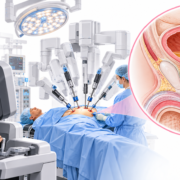
For very large benign prostates, another option is robot-assisted simple prostatectomy (RASP), sometimes described as robotic prostate adenoma enucleation.
This is very different from a robotic radical prostatectomy performed for prostate cancer.
The entire prostate is not removed.
Instead, the enlarged benign adenoma is dissected away from the remaining prostate capsule.
It essentially achieves the same anatomical objective as HoLEP but approaches the prostate through the abdomen and bladder or prostate capsule rather than through the urethra.
Robotic simple prostatectomy is particularly attractive for very large or anatomically complex prostates, particularly when associated bladder pathology can be addressed simultaneously.
Its disadvantages include:
- Abdominal surgery
- Robotic port incisions
- Longer catheterisation
- Longer hospital stay
- Greater surgical invasiveness
- Higher resource utilisation
Recent comparative evidence suggests that both robotic simple prostatectomy and laser enucleation provide excellent outcomes for prostates ≥80 mL, while endoscopic laser enucleation generally provides faster perioperative recovery.
So Which Operation Is Best?
A useful way of thinking about these procedures is not as competitors, but as different tools for different prostates.
GreenLight PVP
Particularly attractive for:
- Small-to-moderately enlarged prostates
- Approximately 30–80 mL glands
- Patients where minimising bleeding is particularly important
- Older or medically complex patients
- Patients requiring rapid recovery and short catheterisation
TURP
Remains an excellent option for:
- Small-to-moderately enlarged prostates
- Conventional benign prostatic obstruction
- Situations where prostate tissue for histology is desirable
- Centres with extensive TURP experience
HoLEP
Particularly attractive for:
- Moderate, large and extremely large prostates
- Men requiring maximal adenoma removal
- Recurrent BPH after previous surgery
- Patients where long-term durability is particularly important
- Patients wishing to avoid abdominal surgery despite a very large prostate
Robotic-Assisted Simple Prostatectomy
Particularly attractive for:
- Very large prostates
- Complex prostate anatomy
- Large intravesical adenomas
- Patients with associated bladder pathology requiring treatment
- Situations where endoscopic enucleation expertise is unavailable or a robotic approach offers anatomical advantages
The Bottom Line
GreenLight laser photoselective vaporisation is an effective, minimally invasive surgical treatment for benign prostate enlargement.
Its 532 nm laser is selectively absorbed by haemoglobin, allowing prostate tissue to be vaporised while simultaneously achieving excellent haemostasis.
Its particular strengths are:
less bleeding, short catheterisation, short hospitalisation and rapid recovery.
For appropriately selected men with moderate-sized prostates, symptom improvement is broadly comparable with TURP.
As prostate size increases, however, anatomical enucleation becomes increasingly attractive. HoLEP and robotic-assisted simple prostatectomy remove the adenoma more completely and are particularly effective for very large prostates. HoLEP achieves this endoscopically, whereas robotic surgery achieves it through an abdominal approach.
The choice therefore should not simply be:
“Which operation is newest?”
A better question is:
“Which operation best suits this prostate, this bladder and this patient?”
Prostate size and shape, urinary symptoms, bladder function, bleeding risk, medications, general health, PSA assessment, sexual priorities and the surgeon’s experience should all contribute to the final decision.
This information is intended for general patient education and does not replace individual assessment and discussion with a urologist.



Leave a Reply
Want to join the discussion?Feel free to contribute!