
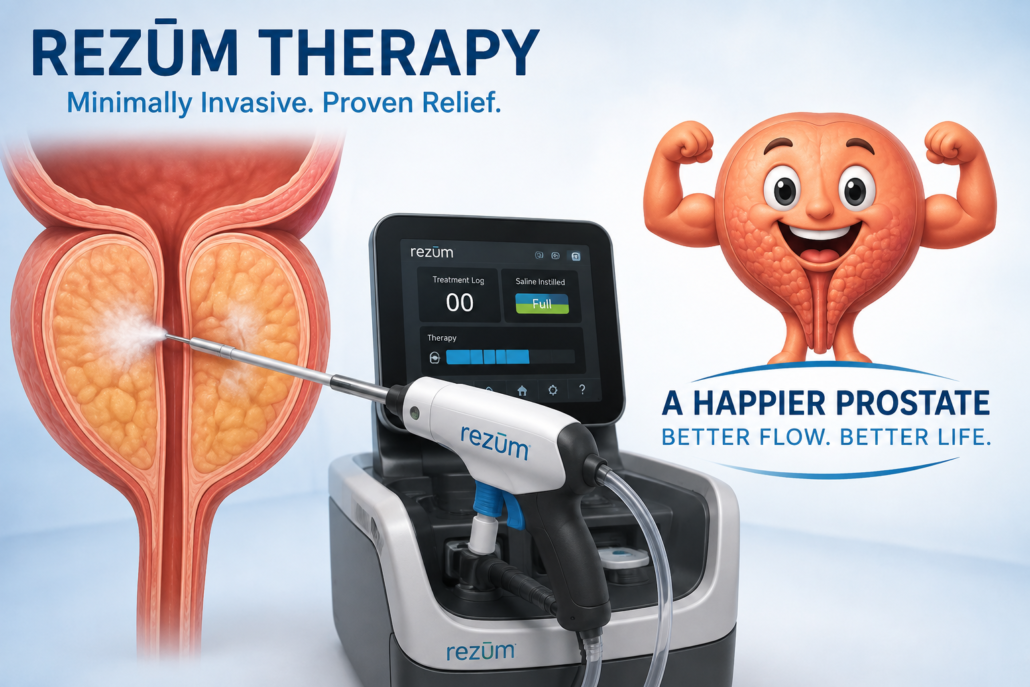
Benign Prostate Enlargement and Water-Vapour Therapy: A Patient Guide
Benign prostate enlargement, also called benign prostatic hyperplasia or BPH becomes more common as men age. Enlargement may narrow the urethra, increase resistance to urinary flow and affect the way the bladder stores or empties urine.
Not every enlarged prostate causes symptoms, and not every urinary symptom is caused by the prostate. Treatment should therefore begin with an assessment of the likely cause, the effect on quality of life and whether complications are present.
This article explains BPH and the role of transurethral water-vapour therapy as one of several possible treatments. It does not recommend a particular product, device, clinician or health service.
What symptoms can BPH cause?
Lower urinary tract symptoms may include:
- a slow or weak urinary stream
- difficulty starting urination
- stop–start flow
- straining to urinate
- a feeling that the bladder has not emptied
- passing urine frequently
- urgency
- waking at night to urinate
- dribbling after urination
- urinary retention
The size of the prostate does not always match symptom severity. A large prostate may cause few problems, while a smaller prostate can obstruct flow because of its shape, a tight bladder neck or a prominent median lobe.
What else can cause urinary symptoms?
Similar symptoms may arise from:
- urinary tract infection
- overactive bladder
- urethral stricture
- bladder stones
- impaired bladder-muscle contraction
- neurological disease
- prostate or bladder cancer
- medicines that affect bladder function
- excessive fluid, caffeine or alcohol intake
- constipation or sleep disorders
Visible blood in the urine, recurrent infection, kidney impairment, bladder stones, persistent retention or rapidly worsening symptoms require appropriate investigation.
How is BPH assessed?
Assessment may include:
- a urinary, medical and medication history
- a validated symptom questionnaire
- physical examination
- digital rectal examination
- urine testing
- PSA testing after discussion of its benefits and limitations
- kidney-function testing when indicated
- urinary flow measurement
- ultrasound assessment of prostate size and post-void residual urine
- a bladder diary
- cystoscopy or urodynamic testing in selected cases
It is particularly important to distinguish bladder-outlet obstruction from weak bladder contraction. Opening the prostate outlet may not restore normal emptying if the bladder muscle is unable to contract adequately.
Does every man with BPH need treatment?
No. Men with mild, non-bothersome symptoms and no complications may choose observation with periodic review.
Conservative measures may include:
- moderating excessive evening fluid intake
- reducing caffeine or alcohol when these worsen symptoms
- treating constipation
- reviewing relevant medicines
- avoiding habitual “just in case” voiding where appropriate
- managing diabetes, sleep apnoea or leg swelling when they contribute to nocturia
Fluid should not be restricted excessively, particularly in hot weather or when dehydration is a risk.
What treatment options are available?
Depending on symptoms, anatomy and risk, options may include:
- monitoring and lifestyle measures
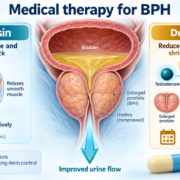
- prescription medicines
- minimally invasive surgical therapies
- transurethral resection or vaporisation
- laser enucleation
- other endoscopic enucleation techniques
- simple prostatectomy for selected very large glands
Each option differs in speed of improvement, durability, anaesthetic requirements, catheter time, bleeding risk, sexual effects and likelihood of retreatment.
What is transurethral water-vapour therapy?
Water-vapour therapy is a minimally invasive treatment intended to reduce selected areas of benign prostate tissue that are contributing to obstruction.
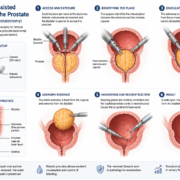
A specialised instrument is passed through the urethra. A needle delivers controlled water vapour into planned areas of prostate tissue. As the vapour condenses, thermal energy disrupts the targeted cells. The body then gradually reabsorbs treated tissue over the following weeks and months.
Unlike resection or enucleation, obstructing tissue is not physically removed during the procedure. Improvement is therefore delayed while inflammation settles and treated tissue reduces.
The exact device, intended purpose, contraindications and instructions for use should be confirmed from the current Australian Register of Therapeutic Goods entry and manufacturer-approved documentation.
Who might be considered?
Water-vapour therapy may be discussed with selected men whose bothersome symptoms are likely to arise from benign prostate obstruction and who understand the alternatives and likelihood of retreatment.
Assessment may consider:
- symptom severity and quality-of-life impact
- prostate volume and shape
- lateral-lobe or median-lobe obstruction
- urinary flow and residual urine
- bladder contractility
- previous urinary retention
- coexisting bladder or urethral disease
- anaesthetic and bleeding risk
- the importance of preserving ejaculation
- the patient’s preference regarding recovery, durability and retreatment
The pivotal randomised study enrolled a defined group of men, including prostate volumes between 30 and 80 mL. Evidence outside the studied population is less mature and may rely on observational data.
Larger prostates, catheter-dependent retention or previous prostate procedures do not automatically determine suitability, but the expected results and evidence may differ. A tissue-removing operation may provide more predictable or faster relief in some patients.
When may it be unsuitable?
Reasons to avoid or reconsider water-vapour therapy may include:
- active urinary infection
- suspected prostate or bladder cancer requiring investigation
- urethral stricture preventing safe access
- poor bladder contractility
- symptoms caused mainly by overactive bladder rather than obstruction
- bladder stones or another condition better treated during a different operation
- anatomy unlikely to be treated adequately
- severe obstruction or complications requiring rapid, predictable decompression
- a contraindication in the approved instructions for the proposed device
Suitability must be decided individually. A median lobe is not necessarily an exclusion, but its anatomy and treatment plan require careful assessment.
How is the procedure performed?
The procedure is performed through the urethra, without an external incision. The device is positioned within the prostatic urethra, and treatment is delivered to selected areas according to prostate length, volume and shape.
Anaesthesia and perioperative care vary by patient and facility. The procedure is often performed as day surgery, but same-day discharge is not guaranteed.
Patients should receive individual instructions about:
- fasting and anaesthesia
- urine testing
- antibiotics where clinically indicated
- anticoagulant and antiplatelet medicines
- transport and activity after the procedure
- catheter care
- symptoms requiring urgent review
Anticoagulant or antiplatelet medicines must not be stopped without advice from the clinician who manages them.
Will a catheter be needed?
Many patients need a temporary urinary catheter because treatment initially causes swelling. Catheter duration varies with prostate anatomy, baseline bladder emptying, pre-existing retention and the clinical course.
Some patients cannot pass urine after the catheter is removed and require reinsertion or intermittent catheterisation. Urgent review is needed if a patient cannot urinate and develops increasing lower-abdominal pain.
When might symptoms improve?
Water-vapour therapy does not usually provide immediate improvement. Urgency, frequency, discomfort or flow may temporarily worsen because of inflammation and swelling.
Improvement may begin over several weeks and continue for several months. The timing and degree of benefit vary, and some patients obtain inadequate relief.
Possible short-term effects
Common or expected effects can include:
- burning or discomfort when urinating
- blood in the urine
- blood or discolouration in the semen
- urinary frequency or urgency
- a temporarily weaker stream
- pelvic or perineal discomfort
- catheter-related discomfort
- temporary urinary retention
Patients should follow the written aftercare advice from their treating team.
Other risks and complications
Possible complications include:
- urinary tract infection
- prostatitis or systemic infection
- bleeding
- persistent urinary retention
- worsening urgency or incontinence
- urethral stricture or bladder-neck narrowing
- ejaculatory change
- erectile or sexual symptoms
- chronic pelvic or urinary discomfort
- failure to improve symptoms
- need for repeat treatment or another prostate operation
Serious complications are uncommon but possible. Fever, chills, inability to urinate, heavy bleeding, severe pain or feeling systemically unwell require prompt assessment.
What about ejaculation and erections?
Preserving sexual and ejaculatory function is an important goal for many patients considering minimally invasive treatment. Clinical studies have reported relatively low rates of new sexual dysfunction after water-vapour therapy in selected populations.
However:
- preservation cannot be guaranteed
- changes in ejaculation can occur
- erectile function may change for reasons unrelated to the procedure
- trial definitions and selected participants may not reflect every patient
- comparison with other procedures depends on technique, anatomy and baseline function
Sexual priorities should be discussed before treatment, along with the more established risk of ejaculatory change after tissue-removing operations.
What did the pivotal five-year study find?
Five-year follow-up from a sham-controlled randomised study reported sustained average improvement in symptoms and urinary flow among study participants who received water-vapour therapy. Reported outcomes included an approximate 48% improvement in symptom score and a 4.4% surgical retreatment rate over five years.
These figures require context:
- they are group averages, not a prediction for an individual
- the trial used defined eligibility criteria
- follow-up does not show what happens over a lifetime
- some participants did not obtain adequate relief
- “surgical retreatment” does not capture every medication restart, investigation or non-surgical intervention
- results may differ with larger prostates, retention, previous surgery or different anatomy
The evidence supports water-vapour therapy as a possible option for selected men; it does not establish it as the best treatment for all men with BPH.
Can the prostate continue to grow?
Yes. The procedure treats selected obstructing tissue present at the time. It does not stop the biological process of benign prostate growth.
Symptoms may remain controlled, recur because of further growth, or persist for another reason such as bladder dysfunction. Younger patients should consider the possibility of needing additional treatment during their lifetime.
How does it compare with tissue-removing surgery?
Water-vapour therapy generally involves less immediate tissue removal and slower improvement than transurethral resection or enucleation.
Potential reasons a patient might consider it include a preference for a less invasive approach and a desire to reduce the chance of ejaculatory change. Potential disadvantages include delayed benefit, postoperative irritation, catheterisation, uncertainty in less-studied anatomies and the possibility of retreatment.
Tissue-removing surgery may be more suitable when there is:
- severe or recurrent urinary retention
- very large or complex obstructing anatomy
- bladder stones
- recurrent infection caused by poor emptying
- kidney or upper-tract effects from obstruction
- substantial bleeding attributable to BPH
- a need for faster or more predictable relief
No procedure is best for every patient.
Follow-up
Review may assess:
- urinary symptoms and quality of life
- urinary flow
- post-void residual urine
- infection or retention
- catheter-related problems
- sexual or ejaculatory effects
- need for continuing BPH medicine
- whether another diagnosis or treatment should be considered
Persistent or worsening symptoms should prompt reassessment rather than repeated reassurance that improvement will eventually occur.
Questions to discuss with a urologist
- Are my symptoms caused by prostate obstruction?
- Is my bladder contracting adequately?
- What is my prostate size and anatomy?
- Do I have complications that favour a more definitive operation?
- What are the alternatives, including observation and medicines?
- How quickly is each option likely to help?
- What are the risks to ejaculation, erections and continence?
- How long might I need a catheter?
- What is the likelihood of needing another procedure?
- Is the exact proposed device included in the ARTG for this use?
- What out-of-pocket costs may apply?
Australian regulatory considerations
The Australian Register of Therapeutic Goods (ARTG) records therapeutic goods that may be legally supplied in Australia, unless an exemption or authorised access pathway applies. Inclusion is specific to the sponsor, device and intended purpose; it is not a recommendation that the device is suitable or superior for an individual patient.
Device status, instructions for use, contraindications, reimbursement and availability can change. These should be checked at the time treatment is considered.
The bottom line
BPH is common, but urinary symptoms require assessment because prostate obstruction is only one possible cause.
Transurethral water-vapour therapy is one minimally invasive option for selected men. It may improve urinary symptoms while offering a different balance of recovery, sexual effects and retreatment risk from tissue-removing surgery. Improvement is gradual, catheterisation is common, benefit is not guaranteed and further treatment may be needed.
The choice should follow an informed discussion of observation, medicines, minimally invasive treatments and established surgical options, taking account of prostate anatomy, bladder function, complications and personal priorities.
This article provides general disease education and does not replace individual medical advice. It does not promote or recommend a particular therapeutic device, brand, clinician or health service.
References and further reading
- Therapeutic Goods Administration — About the Australian Register of Therapeutic Goods
- Therapeutic Goods Administration — Advertising health products
- European Association of Urology — Management of Non-neurogenic Male Lower Urinary Tract Symptoms
- Healthdirect Australia — Enlarged prostate
- McVary KT et al. Final five-year outcomes of the multicentre randomised sham-controlled trial of convective water-vapour therapy for lower urinary tract symptoms secondary to BPH. Journal of Urology. 2021
- The current Australian instructions for use for any device proposed to the individual patient



Leave a Reply
Want to join the discussion?Feel free to contribute!