
Clips for Benign Prostatic Enlargement: A Minimally Invasive Treatment That Preserves Ejaculation
Benign prostatic hyperplasia, or BPH, is a non-cancerous enlargement of the prostate. As the prostate enlarges, its lateral lobes may compress the urethra and obstruct the flow of urine from the bladder.
Common lower urinary tract symptoms include:
- A weak or interrupted urinary stream
- Difficulty starting urination
- Straining to pass urine
- Urinary frequency and urgency
- Getting up repeatedly at night
- Dribbling after urination
- A feeling that the bladder has not emptied properly
Medication is usually the first treatment offered to men with troublesome symptoms. However, tablets may provide insufficient relief or cause dizziness, tiredness, reduced libido, erectile problems or altered ejaculation.
The UroLift procedure, also called a prostatic urethral lift or PUL, is a minimally invasive surgical therapy, or MIST, that may provide an alternative to long-term medication and conventional prostate surgery.
What is a MIST procedure?
Minimally invasive surgical therapies are designed to improve urinary symptoms with less tissue damage, less bleeding and a shorter recovery than conventional procedures such as TURP or prostate laser surgery.
Different MIST procedures work in different ways. Some use steam or other forms of energy to destroy prostate tissue. Some temporarily remodel the urinary passage. UroLift mechanically moves the obstructing prostate tissue away from the urethra using small permanent implants.
Its principal attractions are:
- No cutting or removal of prostate tissue
- No heat, laser or steam
- Rapid improvement in many patients
- Usually brief catheterisation, if any
- Short recovery
- A low reported risk of new erectile or ejaculatory dysfunction
The trade-off is that symptom improvement is generally more modest than after a tissue-removing operation, permanent implants remain within the prostate, and some patients will eventually require further treatment.
How does Clips work?
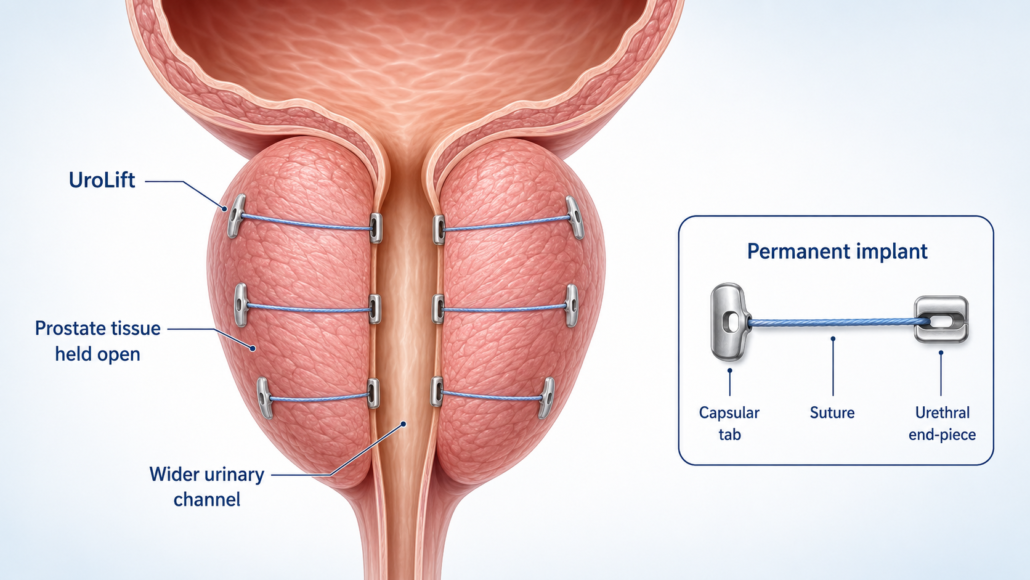
The UroLift system uses small implants to hold the enlarged lateral lobes of the prostate away from the urethra.
Each implant consists of:
- A small capsular tab placed on the outside of the prostate
- A stainless-steel urethral end-piece
- A permanent suture connecting the two components
The implant compresses and retracts the obstructing prostate tissue, widening the urinary channel without cutting, burning or removing tissue.
Most patients require several implants. The exact number depends on the length, size and shape of the prostate and the degree of obstruction. These implants remain permanently in position.
Who may benefit from Clips?
UroLift may be considered for men who:
- Have moderate or severe urinary symptoms caused by BPH
- Have obtained inadequate relief from medication
- Cannot tolerate the side effects of BPH medication
- Prefer not to take daily medication indefinitely
- Want a less invasive alternative to TURP or laser surgery
- Place a high priority on preserving forward ejaculation
- Want a relatively rapid return to normal activities
- Have prostate anatomy suitable for a prostatic urethral lift
- Understand the possibility of future retreatment
It is particularly attractive for sexually active men who wish to improve their urinary symptoms while minimising the risk of dry or retrograde ejaculation.
What prostate size is suitable?
Clinical guidelines and manufacturer labelling are not identical.
Current European Association of Urology guidance recommends offering prostatic urethral lift to men interested in preserving ejaculation who have prostates smaller than 70 mL and no obstructing middle lobe.
American Urological Association guidance supports the procedure for selected men with prostates approximately 30–80 mL and without an obstructing middle lobe.
Manufacturer and regulatory indications may extend to prostates as large as 100 mL and may include selected median-lobe anatomy in some jurisdictions. However, treatment outside the populations best supported by clinical guidelines requires careful patient selection and counselling.
Prostate volume alone does not determine suitability. The shape of the prostate, length of the prostatic urethra, bladder-neck anatomy, degree of obstruction and strength of the bladder muscle must also be considered.
What about an obstructing median lobe?
The median lobe is prostate tissue that projects upwards towards the bladder and may act like a ball valve over the bladder outlet.
UroLift can be used to treat selected obstructing median lobes, and the MedLift study reported encouraging outcomes. Nevertheless, major guideline recommendations remain more conservative because the strongest long-term randomised evidence relates mainly to lateral-lobe obstruction.
A large, mobile or unusually shaped median lobe may be better treated with TURP, laser surgery, Rezūm, Aquablation or another procedure capable of removing or reducing the obstructing tissue.
This is an important anatomical caveat to discuss before choosing UroLift.
Assessment before treatment
Not every urinary symptom is caused by BPH. Infection, urethral stricture, bladder weakness, overactive bladder, neurological disease, medication and prostate or bladder cancer may produce similar symptoms.
Assessment may include:
- Medical history and examination
- International Prostate Symptom Score
- Urine testing
- PSA testing when appropriate
- Urinary-flow measurement
- Ultrasound measurement of residual urine
- Prostate imaging or ultrasound
- Flexible cystoscopy
- Urodynamic testing in selected patients
Cystoscopy may be particularly useful because it allows the urologist to assess the lateral lobes, bladder neck, median lobe and length of the obstructing prostate.
Any urinary infection should be treated before the procedure.
Patients taking aspirin, warfarin, clopidogrel, apixaban, rivaroxaban or other blood-thinning medication require an individual plan. Do not stop blood-thinning medication without instructions from your prescribing doctor and urologist.
How is the UroLift procedure performed?
UroLift is usually performed as a day procedure under local anaesthetic with sedation or a short general anaesthetic.
A cystoscope and specialised delivery device are passed through the urethra. No external incision is required.
The urologist:
- Examines the urethra, prostate and bladder.
- Positions the delivery device within the prostatic urethra.
- Moves the obstructing prostate tissue away from the urinary channel.
- Deploys an implant to hold the tissue in its new position.
- Repeats the process at selected points until an adequate channel has been created.
- Inspects the bladder outlet and controls any bleeding.
The procedure commonly takes less than an hour, although this varies with prostate anatomy and the number of implants required.
Because no prostate tissue is removed, there is usually no specimen for laboratory examination.
Will I need a catheter?
Many men can pass urine after the procedure and go home without a catheter. A catheter may nevertheless be required if there is:
- Significant prostate swelling
- Inability to pass urine
- Pre-existing urinary retention
- A weak bladder muscle
- Bleeding or clot formation
- A high residual urine volume
When required, the catheter is usually temporary. Patients with chronic retention or poor bladder function have a greater risk of failing an early trial without a catheter.
What should I expect after UroLift?
Temporary urinary irritation is common during the first few days.
You may experience:
- Burning or stinging when passing urine
- Urinary urgency and frequency
- Pelvic, perineal or penile discomfort
- Light blood in the urine
- Bladder spasms
- A temporarily weaker or more irregular stream
- Increased night-time urination
- A feeling of incomplete emptying
These symptoms generally improve over several days, although urinary irritation may occasionally persist for a few weeks.
Some men notice an improved stream soon after treatment. For others, the benefit develops over the following two to six weeks as swelling and irritation settle.
Managing pain and urinary discomfort
Discomfort after UroLift is usually mild to moderate.
Management may include:
Paracetamol
Paracetamol is commonly sufficient for mild discomfort. Take it according to the instructions provided by your doctor or the directions on the packet.
Avoid accidentally taking additional paracetamol contained in cold, influenza or combination pain medicines.
Anti-inflammatory medication
Ibuprofen or another anti-inflammatory medicine may help when medically appropriate. These medicines may not be suitable for patients with kidney impairment, stomach ulcers, certain heart conditions, bleeding disorders, anti-inflammatory-sensitive asthma or anticoagulant medication.
Check with your doctor or pharmacist before taking an anti-inflammatory medicine.
Medication for urinary symptoms
An alpha blocker may be continued temporarily to assist urine flow while swelling settles. Medication for bladder spasm or urinary burning may occasionally be prescribed.
Practical measures
It may help to:
- Maintain normal hydration without forcing excessive fluids
- Limit coffee, tea, alcohol, fizzy drinks and energy drinks
- Avoid constipation
- Avoid heavy lifting and vigorous exercise for several days
- Take pain relief before discomfort becomes severe
Severe or worsening pain should be reported rather than simply tolerated.
Possible complications
Most side effects are mild and temporary, but complications can occur.
Common temporary effects
These include:
- Pain or burning during urination
- Blood in the urine
- Urinary urgency
- Increased frequency
- Pelvic discomfort
- Temporary urinary leakage associated with urgency
Urinary retention
Some men cannot pass urine after the procedure and require temporary catheterisation. The risk may be greater in patients with high residual urine volumes, chronic retention, severe obstruction or a weak bladder muscle.
Urinary tract infection
Infection may cause worsening burning, cloudy or offensive urine, fever, chills or feeling generally unwell. Antibiotics may be required.
Bleeding
Light haematuria is common. Significant bleeding, clot retention or the need for further intervention is uncommon but possible.
Implant-related problems
Potential implant complications include:
- Incorrect placement
- Implant exposure within the bladder
- Encrustation or stone formation
- Migration or loosening
- Persistent pelvic discomfort
- The need to remove an implant
- Difficulty or irritation during later prostate surgery
Implants placed too close to or within the bladder are more likely to develop encrustation and may require endoscopic removal.
Persistent symptoms
UroLift treats obstruction but does not correct every cause of lower urinary tract symptoms. Urgency, frequency and nocturia may persist when they are caused by bladder overactivity, excessive night-time urine production, sleep apnoea, fluid intake, diabetes or other medical conditions.
Need for further treatment
Some patients obtain insufficient relief or develop recurrent symptoms as the prostate continues to enlarge. Further treatment may involve medication, additional implants, removal of exposed implants or another procedure such as TURP, GreenLight laser, HoLEP, Rezūm or Aquablation.
When should I seek urgent help?
Contact your urologist or attend an emergency department if you:
- Cannot pass urine
- Develop fever, shaking or chills
- Feel generally unwell or confused
- Pass large blood clots
- Have heavy or persistent bright-red bleeding
- Develop severe or increasing pelvic pain
- Cannot keep fluids down
- Experience pain that is not controlled by the recommended treatment
Does UroLift affect erections or ejaculation?
Preserving sexual function is one of the main reasons patients choose UroLift.
The pivotal L.I.F.T. study reported no new sustained erectile or ejaculatory dysfunction during five years of follow-up. Because the bladder neck, prostate tissue and ejaculatory pathways are not routinely cut or heated, the risk of retrograde ejaculation is substantially lower than with conventional TURP and many tissue-removing procedures.
However, no treatment can guarantee unchanged erections, sensation, orgasm or ejaculation in every patient.
Men who already have erectile or ejaculatory difficulties should not assume that UroLift will correct those problems. It is primarily a treatment for urinary obstruction.
How effective are Clips?
Clinical studies show meaningful average improvement in:
- Urinary symptom scores
- Quality of life
- Peak urinary-flow rate
- The patient’s perception of urinary function
Symptoms may improve quickly because the urethra is mechanically opened during the procedure.
However, the average improvement in urinary flow and symptoms is generally less than that achieved with TURP or prostate enucleation. UroLift is therefore best understood as a compromise: less invasive treatment and better preservation of ejaculation in exchange for more modest de-obstruction and a greater chance of later retreatment.
How long do Clips last?
The implants are permanent, but the symptom relief is not necessarily lifelong.
The pivotal L.I.F.T. study demonstrated sustained average improvements for five years. The reported surgical retreatment rate was approximately 13.6% over five years, or roughly 2–3% per year.
Retreatment estimates vary among studies and real-world populations. The need for further treatment may be influenced by:
- Prostate size and anatomy
- Median-lobe obstruction
- Implant position
- Severity of the original obstruction
- Bladder function
- Continued prostate growth
- The definition of retreatment used in a study
Patients should distinguish between an implant remaining in position and the treatment continuing to control symptoms. A permanent implant does not guarantee permanent symptom relief.
MRI considerations
UroLift implants are classified as MR Conditional, meaning MRI can generally be performed under specified scanner conditions. Patients should tell the radiology service that they have UroLift implants and provide the implant information card whenever possible.
The metallic components can create image artefact, particularly during prostate MRI. This may obscure portions of the prostate and reduce the diagnostic quality of an MRI used to investigate suspected prostate cancer.
This caveat is particularly relevant for:
- Younger men with a long future need for prostate surveillance
- Patients with an elevated or rising PSA
- Men already undergoing prostate cancer monitoring
- Patients likely to require prostate MRI or targeted biopsy
Appropriate prostate cancer assessment should be completed before UroLift when clinically indicated.
Can prostate surgery still be performed later?
Yes. TURP, laser surgery, HoLEP and other BPH procedures can be performed after UroLift.
However, the surgeon must account for the permanent implants. Clips may be encountered during resection or enucleation, may affect instruments or laser fibres, and may require removal. Some surgeons therefore consider later surgery technically more complex than treatment of an implant-free prostate.
UroLift does not close the door to future treatment, but it does leave permanent material that the future surgeon must manage.
Who should not undergo a Clip procedure?
Manufacturer contraindications include:
- Active urinary tract infection
- Current visible or gross haematuria
- Urinary incontinence caused by an incompetent urinary sphincter
- A urethral condition that prevents safe insertion of the delivery device
- A prostate larger than the maximum permitted by the applicable product labelling
UroLift may also be unsuitable or less predictable in men with:
- Severe chronic urinary retention
- A poorly contracting bladder
- Very high residual urine volumes
- Urethral stricture disease
- Bladder stones
- Recurrent urinary infections
- Significant ongoing bleeding
- A very high bladder neck
- A large or unfavourably shaped median lobe
- A very large prostate
- Suspected or untreated prostate cancer
- Symptoms primarily caused by overactive bladder rather than obstruction
- A need for maximal and durable removal of obstructing tissue
Advantages of Clips
Potential advantages include:
- Minimally invasive day procedure
- No prostate tissue removed
- No laser, heat or steam
- Rapid relief in many patients
- Short recovery
- Catheter often avoided
- Low reported risk of new erectile dysfunction
- Low reported risk of dry or retrograde ejaculation
- Future BPH treatments remain possible
Limitations and important caveats
Patients should understand that:
- Several permanent implants remain inside the prostate
- Symptom and flow improvements are usually less than after TURP or enucleation
- Retreatment is more common than after tissue-removing surgery
- Not all median lobes are suitable
- UroLift does not prevent continued prostate growth
- Urgency and nocturia may persist if they have a bladder or medical cause
- The implants may reduce the quality of future prostate MRI
- Later prostate surgery remains possible but may be technically more complicated
- Prostate cancer should be appropriately assessed before treatment
- UroLift does not provide prostate tissue for laboratory examination
Are Clips the right option for me?
UroLift can be an excellent option for a carefully selected man who wants meaningful improvement in urinary symptoms, a rapid recovery and a low risk of ejaculatory dysfunction.
It may be less suitable for someone with severe obstruction, chronic retention, weak bladder function, unfavourable median-lobe anatomy or a need for the most powerful and durable improvement possible.
The decision should take account of:
- Prostate size and shape
- Presence of a median lobe
- Severity of symptoms and obstruction
- Bladder strength and residual urine
- PSA and prostate cancer risk
- Previous treatment
- General health and medication
- Importance of preserving ejaculation
- Acceptance of permanent implants
- Willingness to undergo future retreatment
A urological assessment allows UroLift to be compared fairly with medication, iTind, Rezūm, Aquablation, TURP, GreenLight laser, HoLEP and other appropriate options.
This information is intended for general education and does not replace individual medical advice. Treatment suitability, availability and costs vary. Always follow the instructions provided by your treating urologist.
References
- European Association of Urology: Management of non-neurogenic male lower urinary tract symptoms.
- American Urological Association: BPH clinical guideline.
- Roehrborn CG, et al. Five-year results of the prospective randomised controlled prostatic urethral L.I.F.T. study. Canadian Journal of Urology. 2017;24:8802–8813.
- Rukstalis D, et al. Prostatic urethral lift for the treatment of an obstructive median lobe: 12-month results of the MedLift study. Prostate Cancer and Prostatic Diseases. 2019;22:411–419.
- UroLift manufacturer safety information.
- Benidir T, et al. Impact of the UroLift device on prostate magnetic resonance image quality. Journal of Urology. 2023.



Leave a Reply
Want to join the discussion?Feel free to contribute!