
Enlarged Prostate (BPH): Understanding Prescription Combination Therapy
Benign prostatic hyperplasia (BPH), also called benign prostate enlargement, becomes more common as men get older. An enlarged prostate may narrow the urethra or affect the way the bladder works.
Possible symptoms include:
- a slow or intermittent urinary stream
- difficulty starting urination
- straining to urinate
- a feeling that the bladder has not emptied fully
- urinary frequency or urgency
- waking at night to urinate
- dribbling after urination
- urinary retention
These symptoms are not always caused by an enlarged prostate. Infection, overactive bladder, urethral narrowing, bladder stones, neurological conditions and prostate or bladder cancer can sometimes produce similar symptoms. An appropriate clinical assessment is therefore important before treatment is selected.
What treatments are available?
Management depends on symptom severity, prostate size, bladder emptying, general health and personal preferences. Options may include:
- monitoring and lifestyle measures
- prescription medicines
- minimally invasive procedures
- prostate surgery
No single option is best for every patient. A treatment that improves symptoms in one man may be unsuitable for another.
How prescription combination therapy works
For selected men, a doctor may prescribe two types of medicine together:
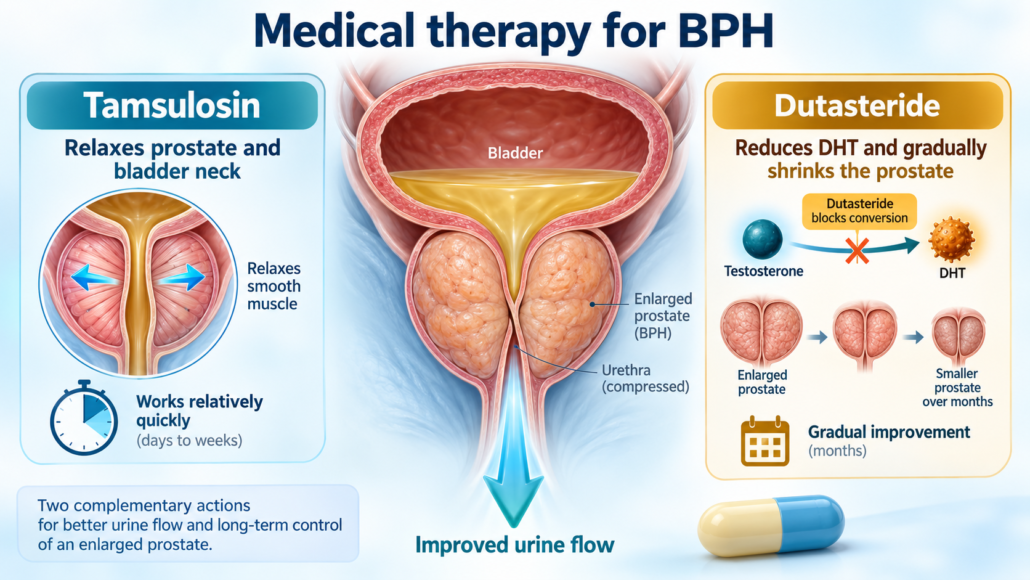
- An alpha blocker, such as tamsulosin, relaxes smooth muscle in the prostate and bladder neck. This may improve urine flow and symptoms relatively quickly, although response varies.
- A 5-alpha-reductase inhibitor, such as dutasteride or finasteride, alters the hormonal pathway involved in prostate growth. Over time, it may reduce prostate volume and lower the risk of urinary retention or BPH-related surgery in appropriately selected men.
These medicines are available only on prescription. They may be prescribed separately or, in some circumstances, in a fixed-dose combination. This article does not recommend a particular medicine or brand.
The prostate-reducing component acts gradually. Any benefit is generally assessed over months rather than days. Combination therapy is commonly considered as a longer-term treatment, but regular review remains important.
Who might be considered for combination therapy?
A doctor may consider combination treatment for a man who has moderate-to-severe urinary symptoms associated with a demonstrably enlarged prostate and an increased risk of BPH progression.
The decision may take account of:
- how troublesome the symptoms are
- prostate size and shape
- PSA results, interpreted in clinical context
- urinary flow rate
- the amount of urine left in the bladder after voiding
- previous urinary retention
- the expected benefits, limitations and adverse effects of treatment
- other illnesses and medicines
- the patient’s preferences, including the importance of preserving sexual and ejaculatory function
Prostate size alone should not determine treatment. Some men with large prostates have few symptoms, while a smaller prostate can still cause obstruction because of its shape, a tight bladder neck or another condition.
Assessment before treatment
Depending on the individual, assessment may include:
- a urinary, medical and medication history
- a validated symptom questionnaire
- physical examination, which may include a digital rectal examination
- urine testing
- PSA testing after discussion of its benefits and limitations
- kidney-function blood tests
- urinary flow measurement
- ultrasound assessment of prostate size and post-void residual urine
- a bladder diary
- cystoscopy or urodynamic testing in selected cases
The purpose is to confirm the likely cause of the symptoms and identify complications or conditions that require a different approach.
Possible benefits and limitations
An alpha blocker may improve urine flow and some symptoms within days or weeks. It does not substantially shrink the prostate.
A 5-alpha-reductase inhibitor works more slowly. In men with prostate enlargement, it may reduce prostate volume and lower the long-term risk of acute urinary retention or BPH-related surgery. Not every patient will experience a worthwhile improvement.
Combination treatment may improve symptoms more than either medicine alone in appropriately selected patients, but it also exposes the patient to the adverse effects of both medicine classes. It controls BPH rather than permanently curing it. Symptoms may recur or progress, and a procedure may still be required.
Clinical-trial averages cannot predict an individual patient’s result. Benefits and harms should be reviewed with the prescribing doctor.
Possible adverse effects
Adverse effects differ between people. The Consumer Medicine Information supplied with the prescribed medicine should be read, and new or troublesome symptoms should be discussed with the prescriber or pharmacist.
Sexual and ejaculatory effects
Possible effects include:
- reduced semen volume or absent ejaculation
- semen passing backwards into the bladder
- reduced sexual desire
- difficulty achieving or maintaining an erection
- changes in fertility or semen characteristics
Some sexual adverse effects have been reported to persist after a 5-alpha-reductase inhibitor is stopped, although their frequency, cause and predictors remain uncertain. Persistent symptoms deserve appropriate assessment.
Dizziness and low blood pressure
Alpha blockers may cause dizziness, light-headedness, weakness or, less commonly, fainting—particularly when standing up. The risk may be greater when treatment begins or when combined with other medicines that lower blood pressure. Patients who become dizzy should take care to avoid falls and seek medical advice.
Breast and other changes
5-alpha-reductase inhibitors may cause breast tenderness or enlargement. A breast lump, nipple discharge or persistent one-sided change requires medical assessment rather than being assumed to be a medicine effect.
Other reported adverse effects can include headache, tiredness, palpitations, nasal congestion, gastrointestinal discomfort, skin reactions, testicular symptoms and mood changes. The exact safety information depends on the medicine prescribed.
Seek urgent help
Urgent medical attention is appropriate for symptoms such as:
- swelling of the face, tongue or throat, or difficulty breathing
- collapse or fainting
- a painful, prolonged erection
- a severe blistering or peeling skin reaction
- suicidal thoughts or severe psychological distress
- inability to pass urine, especially with increasing lower abdominal pain
In Australia, call Triple Zero (000) in an emergency. Lifeline is available on 13 11 14 for crisis support. These services do not replace assessment by the treating clinician.
PSA monitoring
5-alpha-reductase inhibitors commonly lower PSA. This does not eliminate the possibility of prostate cancer.
A new PSA baseline may need to be established after treatment begins. Later results must be interpreted with knowledge that the patient is taking this type of medicine. A confirmed increase from the lowest PSA reached may require further assessment, even if the result falls within a laboratory’s usual reference range.
Patients should tell any clinician ordering or interpreting a PSA test about all current and recent prostate medicines.
Cataract or glaucoma surgery
Tamsulosin and some other alpha blockers are associated with intraoperative floppy iris syndrome, which may complicate cataract or glaucoma surgery.
Patients should tell their ophthalmologist about current or previous alpha-blocker use. They should not stop a prescribed medicine solely for an eye operation unless advised by the relevant treating clinicians, because stopping it may not remove the surgical risk.
Mood and persistent symptoms
Sexual, cognitive and mood symptoms have been reported during or after treatment with 5-alpha-reductase inhibitors. The evidence about persistent syndromes, their frequency and causation continues to evolve.
This uncertainty should be discussed without either assuming that persistent symptoms will occur or dismissing symptoms that a patient experiences. New depression, marked anxiety or sexual dysfunction should be reviewed. Suicidal thoughts require urgent assistance.
Monitoring treatment
Follow-up may include review of:
- symptom response and quality of life
- dizziness and postural blood pressure
- sexual and ejaculatory function
- mood changes
- urinary flow and post-void residual urine
- PSA results
- kidney function when clinically indicated
Lack of early improvement does not necessarily mean the slower-acting component has failed. However, severe or worsening symptoms should not be managed by continuing medicine indefinitely without reassessment.
When might a procedure or surgery be considered?
A procedure may be discussed when there is:
- recurrent or persistent urinary retention
- catheter dependence
- recurrent infection associated with poor bladder emptying
- bladder stones
- recurrent visible bleeding attributed to BPH
- kidney or upper urinary tract effects from obstruction
- a high or increasing post-void residual volume
- persistent troublesome symptoms despite appropriate conservative treatment
- unacceptable medicine adverse effects
- a preference for a procedural option after informed discussion
Procedural choices include established operations and selected minimally invasive treatments. Suitability depends on prostate anatomy, bladder function, general health, bleeding risk, expected durability and the importance of preserving ejaculation. Each option has potential benefits, limitations and complications.
Questions to discuss with your doctor
- What is the most likely cause of my urinary symptoms?
- Is my prostate enlarged, and am I at risk of progression?
- What are the reasonable alternatives, including observation, medicines and procedures?
- How likely is each option to help in my circumstances?
- What sexual, ejaculatory, blood-pressure and mood effects should I consider?
- How will treatment affect the interpretation of my PSA?
- When should treatment be reviewed or changed?
- Which symptoms require urgent assessment?
The bottom line
Prescription combination therapy can be one option for selected men with bothersome urinary symptoms, prostate enlargement and a risk of BPH progression. It is not suitable for every urinary problem and does not guarantee that surgery will be avoided.
The choice should follow an individual assessment and a balanced discussion of expected benefit, possible harm, alternatives and the option of no immediate treatment. Do not start, stop or change a prescription medicine without advice from the prescribing clinician.
This article provides general educational information. It is not medical advice and does not promote or recommend a particular prescription medicine or brand. Treatment decisions should be made with an appropriately qualified health professional after individual assessment.
References and further reading
- Therapeutic Goods Administration — Advertising health products
- Therapeutic Goods Administration — Australian Register of Therapeutic Goods
- European Association of Urology — Management of Non-neurogenic Male Lower Urinary Tract Symptoms
- Healthdirect Australia — Enlarged prostate
- The current Australian Product Information and Consumer Medicine Information for any medicine prescribed to the individual patient







Leave a Reply
Want to join the discussion?Feel free to contribute!