
Intravesical BCG for High-Risk Bladder Cancer
What is BCG treatment?
BCG, short for Bacillus Calmette–Guérin, is one of the most effective treatments available for high-risk non-muscle-invasive bladder cancer (NMIBC).
BCG is best known as a vaccine originally developed against tuberculosis. In bladder cancer, however, it is used in a very different way. Rather than being injected as a vaccination, a solution containing BCG is placed directly into the bladder through a fine urinary catheter.
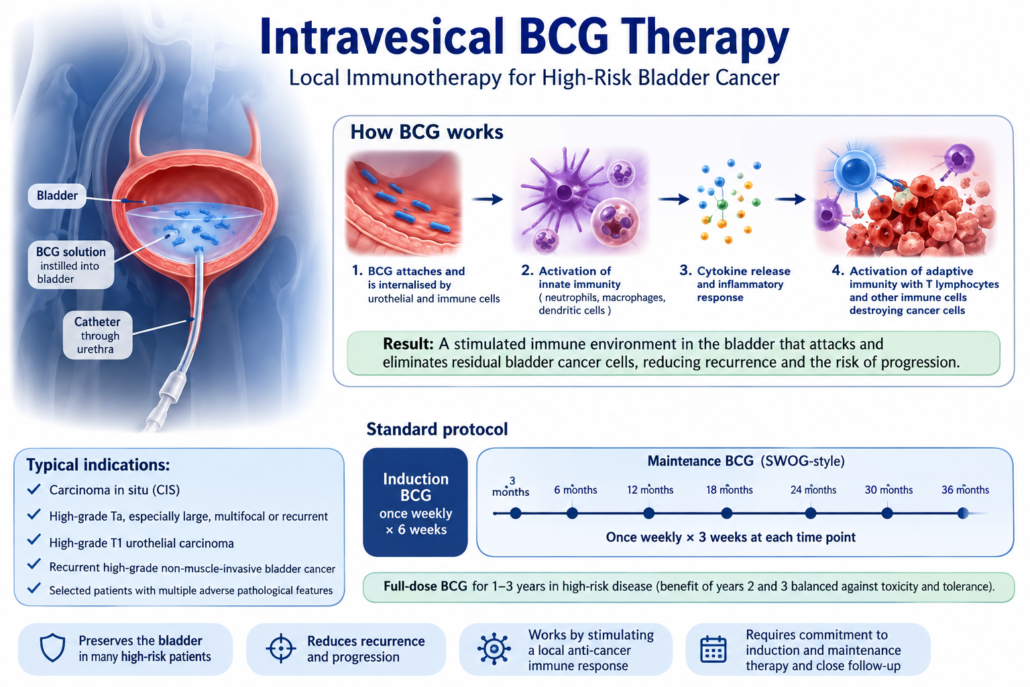
BCG is not conventional chemotherapy. It is a form of local immunotherapy. Its purpose is to stimulate the body’s immune system inside the bladder so that immune cells recognise and attack remaining bladder cancer cells.
For appropriately selected patients, BCG can significantly reduce the risk of bladder cancer returning and, importantly, reduce the risk of progression to more invasive disease.
Which bladder cancers are treated with BCG?
BCG is primarily used for high-risk or locally aggressive non-muscle-invasive urothelial carcinoma following adequate transurethral resection of the bladder tumour (TURBT).
Typical indications include:
- Carcinoma in situ (CIS or Tis)
- High-grade Ta urothelial carcinoma, particularly when large, multifocal or recurrent
- High-grade T1 urothelial carcinoma
- Recurrent high-grade non-muscle-invasive bladder cancer
- Selected patients with multiple adverse pathological features
- Selected patients with urothelial CIS involving the prostatic urethra as part of a bladder-preserving strategy
Current international guidelines recommend a six-week induction course of BCG for high-risk NMIBC, followed by maintenance treatment in patients who respond.
BCG is generally not required for a solitary low-risk, low-grade Ta bladder tumour. These cancers have a different biological behaviour and are usually managed with TURBT, sometimes combined with immediate intravesical chemotherapy and subsequent surveillance.
Why is BCG particularly important for carcinoma in situ?
Carcinoma in situ (CIS) deserves special attention.
Unlike the familiar papillary bladder tumour that projects into the bladder cavity, CIS can appear as a relatively flat, red or velvety abnormality of the bladder lining. Despite looking less dramatic, it is biologically aggressive.
CIS has a significant risk of recurrence and progression to muscle-invasive bladder cancer if inadequately treated. It cannot simply be “scraped away” by TURBT and forgotten.
For this reason, CIS generally requires either:
BCG immunotherapy
or, in selected very-high-risk circumstances,
radical cystectomy.
BCG produces substantially better response rates for CIS than intravesical chemotherapy in appropriate patients and has been shown to reduce the risk of progression.
How does BCG actually work?
The mechanism is fascinating because BCG does not simply poison cancer cells in the way traditional chemotherapy does.
Think of it less as dropping a bomb on the tumour and more as turning on the bladder’s local security system.
After BCG is introduced into the bladder, organisms interact with the urothelial surface and tumour cells. This produces a strong local inflammatory and immune response.
The process includes:
BCG attachment and internalisation
BCG interacts with urothelial cells, tumour cells and immune cells within the bladder.
Activation of innate immunity
Neutrophils, macrophages, dendritic cells and other immune cells are recruited into the bladder.
Cytokine release
A complex inflammatory signalling response develops, involving multiple cytokines and chemokines.
Activation of adaptive immunity
T lymphocytes and other components of the immune system become involved in recognising and destroying malignant urothelial cells.
The end result is an intentionally stimulated immune environment that makes the bladder a considerably less comfortable neighbourhood for residual cancer cells.
Before starting BCG
Successful BCG treatment starts with adequate staging and tumour clearance.
Patients will usually have undergone TURBT with pathological assessment confirming the tumour grade and stage.
In high-grade T1 disease, a repeat or second-look TURBT is frequently recommended to ensure complete resection and exclude previously unrecognised muscle-invasive disease.
Depending upon the tumour characteristics, assessment may also include:
- Urine cytology
- CT urography or other upper urinary tract imaging
- Repeat cystoscopy
- Re-resection of the original tumour site
- Assessment of the prostatic urethra in selected patients
- Review of pathology where variant histology or unusual findings are present
Very-high-risk cases are increasingly appropriate for multidisciplinary discussion because some patients may benefit more from early radical cystectomy than prolonged attempts at bladder preservation.
How is BCG given?
BCG is administered as an outpatient procedure.
A small catheter is gently passed through the urethra into the bladder. After the bladder has been drained, the BCG solution is instilled through the catheter.
The catheter is then removed unless there is a particular reason for it to remain temporarily.
The BCG solution is generally retained within the bladder for approximately two hours, where tolerated.
Patients receive specific instructions regarding fluid intake before treatment and safe handling of urine afterwards because BCG contains live attenuated Mycobacterium bovis.
The standard induction course
The traditional induction course consists of:
BCG once weekly for six weeks
This remains the standard initial regimen for high-risk disease.
Importantly, attempts to substantially reduce the number of induction and maintenance instillations have resulted in inferior cancer control. The six-week induction course therefore remains an important part of established treatment.
What happens after the first six treatments?
Following induction BCG, the bladder is reassessed.
This will generally involve:
- Cystoscopy
- Urinary cytology
- Biopsy or repeat TURBT if an abnormality is detected
- Additional investigation when cytology remains suspicious despite a normal-looking bladder
The key question is simple:
Has the cancer responded?
If it has, the next step is usually maintenance BCG.
Maintenance BCG
BCG works better in high-risk bladder cancer when appropriate maintenance treatment is added rather than simply giving six doses and stopping.
A widely used maintenance schedule consists of:
Induction
Once weekly × 6 weeks
followed by:
Maintenance
Once weekly × 3 weeks at:
- 3 months
- 6 months
- 12 months
- 18 months
- 24 months
- 30 months
- 36 months
This is often referred to as a SWOG-style maintenance schedule.
Current European guidance recommends full-dose BCG for one to three years in high-risk disease, with the benefit of years two and three balanced against toxicity, patient tolerance and BCG availability. Three years of maintenance provides additional protection against recurrence in high-risk patients compared with one year.
Not every patient will receive every planned dose. Treatment may need to be delayed, reduced or discontinued because of side effects, infection, BCG availability or changes in the cancer.
When should BCG NOT be given?
Because BCG contains live attenuated bacteria, certain precautions are essential.
BCG should not be administered:
- Within the first two weeks after TURBT
- When there is visible haematuria
- Following traumatic catheterisation
- In the presence of a symptomatic urinary tract infection
Treatment should instead be delayed until it can be administered safely.
Additional caution is required in significantly immunocompromised patients, and individual circumstances should be discussed with the treating urologist.
Common side effects of BCG
BCG deliberately produces inflammation within the bladder, so some urinary symptoms are expected.
The most common side effects include:
Urinary frequency and urgency
Patients may feel the need to urinate frequently or suddenly.
Burning during urination
Mild-to-moderate dysuria is common for a day or two following treatment.
Blood in the urine
A small amount of haematuria can occur.
Bladder discomfort
Some patients describe suprapubic discomfort, cramping or a sensation resembling cystitis.
Flu-like symptoms
Fatigue, muscle aches, chills and a low-grade temperature can occur as the immune system responds to treatment.
These symptoms usually settle within approximately 24–48 hours.
The bladder may complain rather loudly about BCG, but mild short-lived irritation is usually part of the intended inflammatory response rather than evidence that something has gone wrong.
When should you contact your urologist?
Patients should contact their treating team if symptoms are unusually severe or fail to settle.
Particular attention should be paid to:
- Persistent fever
- High fever or rigors
- Severe urinary symptoms
- Inability to pass urine
- Persistent or heavy haematuria
- Significant deterioration in general wellbeing
- Symptoms continuing substantially longer than expected
Persistent fever after BCG deserves particular attention.
Serious complications of BCG
Serious complications are uncommon, but they are important because BCG contains viable attenuated bacteria.
Potential complications include:
Severe BCG cystitis
Persistent bladder inflammation may occasionally become sufficiently troublesome that treatment needs to be delayed or discontinued.
Granulomatous prostatitis
BCG can produce an inflammatory reaction within the prostate. This can occasionally produce an abnormal prostate examination or elevated PSA and may mimic prostate cancer clinically.
Epididymo-orchitis
Rarely, BCG-related inflammation or infection can involve the epididymis or testis.
Upper urinary tract involvement
Granulomatous infection of the kidney is uncommon but recognised.
BCG infection
Localised or systemic infection with Mycobacterium bovis can occur.
BCG sepsis
This is a rare but potentially life-threatening complication.
A patient who becomes systemically unwell with persistent high fever, rigors, hypotension, respiratory symptoms or other features of sepsis following BCG requires urgent medical assessment.
Treatment may require hospital admission, infectious diseases involvement, anti-mycobacterial therapy and other supportive treatment.
BCG should therefore be respected. It is an extraordinarily useful treatment, but it is not simply another bladder wash.
What if BCG is poorly tolerated?
Treatment does not always have to proceed according to the calendar regardless of symptoms.
Depending upon severity, management can include:
- Postponing the next instillation
- Symptomatic treatment
- Investigation for bacterial urinary infection
- Assessment for BCG-related infection
- Dose modification in selected circumstances
- Discontinuation of BCG when toxicity becomes unacceptable
Persistent significant symptoms should be assessed rather than repeatedly giving further BCG and hoping the bladder eventually stops protesting.
What if the cancer returns after BCG?
This is one of the most important aspects of BCG treatment.
Not every recurrence after BCG means the same thing. The timing, pathology and amount of previous BCG exposure all matter.
Terms such as:
- BCG-exposed
- BCG-relapsing
- BCG-refractory
- BCG-unresponsive
describe different clinical situations.
Of these, BCG-unresponsive disease is particularly important because these tumours are unlikely to benefit from simply giving more BCG.
Current guidelines recommend radical cystectomy as the oncologically preferred treatment for appropriate patients with BCG-unresponsive high-grade disease.
When should radical cystectomy be considered?
BCG is intended to preserve the bladder, but preserving the bladder should never become more important than controlling the cancer.
Early radical cystectomy should be discussed in patients with very-high-risk features such as:
- Persistent high-grade T1 disease
- Recurrent high-grade disease despite adequate BCG
- BCG-unresponsive disease
- T1 disease associated with CIS
- Certain variant histologies
- Lymphovascular invasion
- Extensive or multifocal high-grade disease
- Other features suggesting a particularly high risk of progression
For very-high-risk NMIBC, current EAU guidance recommends discussing radical cystectomy upfront. BCG for one to three years remains an option for appropriately selected patients, particularly those who decline cystectomy or are medically unsuitable for major surgery.
Delaying cystectomy in a biologically aggressive tumour that is clearly failing BCG may compromise cancer outcomes.
Are there alternatives when BCG fails?
For patients with BCG-unresponsive disease who are unable or unwilling to undergo radical cystectomy, bladder-preserving alternatives are evolving rapidly.
Depending upon availability, tumour characteristics and local regulatory approval, options may include:
- Sequential intravesical gemcitabine/docetaxel
- Other intravesical chemotherapy combinations
- Novel intravesical therapies
- Systemic immunotherapy for selected CIS
- Gene-based intravesical therapy in jurisdictions where available
- Device-assisted intravesical therapy
- Clinical trials
These treatments should not automatically be considered equivalent substitutes for radical cystectomy in a surgically fit patient with genuinely BCG-unresponsive aggressive disease. The risk of progression needs to remain at the centre of the decision.
Surveillance after BCG
BCG treatment does not eliminate the need for careful surveillance.
High-risk bladder cancer requires long-term follow-up because recurrence can occur even after an excellent initial response.
Follow-up generally involves:
Cystoscopy + urine cytology
initially at approximately 3 months, with subsequent surveillance determined by tumour risk and previous findings.
High-risk patients typically undergo frequent cystoscopy during the first two years, with gradually increasing intervals thereafter if they remain disease-free.
Periodic upper urinary tract imaging is also appropriate because high-risk urothelial carcinoma can occasionally develop within the ureters or kidneys.
Surveillance is usually long term and, for high-risk disease, often lifelong.
A practical BCG pathway
A typical pathway for high-risk non-muscle-invasive urothelial carcinoma is:
TURBT
↓
Histological confirmation of high-risk NMIBC
↓
Repeat TURBT when indicated, particularly high-grade T1 disease
↓
BCG induction: weekly × 6
↓
Cystoscopy + cytology and assessment of response
↓
If responding:
Maintenance BCG
3 weekly treatments at 3, 6 and 12 months, with continued maintenance to as long as 36 months in appropriate high-risk patients.
↓
Long-term cystoscopic surveillance
If persistent or recurrent high-grade disease:
Re-stage the bladder and determine whether the tumour represents BCG-unresponsive disease.
↓
Discuss radical cystectomy versus carefully selected bladder-preserving alternatives/clinical trials where appropriate.
The bottom line
Intravesical BCG remains a cornerstone of treatment for high-risk non-muscle-invasive urothelial carcinoma of the bladder.
Its strength lies in stimulating a powerful local immune response that reduces recurrence and helps prevent progression of aggressive superficial bladder cancer.
The usual treatment begins with six weekly instillations, followed by maintenance therapy for appropriately responding high-risk patients.
But BCG is not appropriate for every bladder tumour, and it should not be continued indefinitely when aggressive cancer is clearly failing treatment.
The most important principle is therefore not simply:
“Can we preserve the bladder?”
It is:
“Can we preserve the bladder safely without compromising cancer control?”
For patients with very-high-risk or BCG-unresponsive disease, timely discussion of radical cystectomy can be every bit as important as the BCG treatment itself.
This information is intended as general patient education and does not replace individual assessment by a urologist. BCG protocols, product availability and management of BCG-resistant disease may vary between patients and treatment centres.


Leave a Reply
Want to join the discussion?Feel free to contribute!