
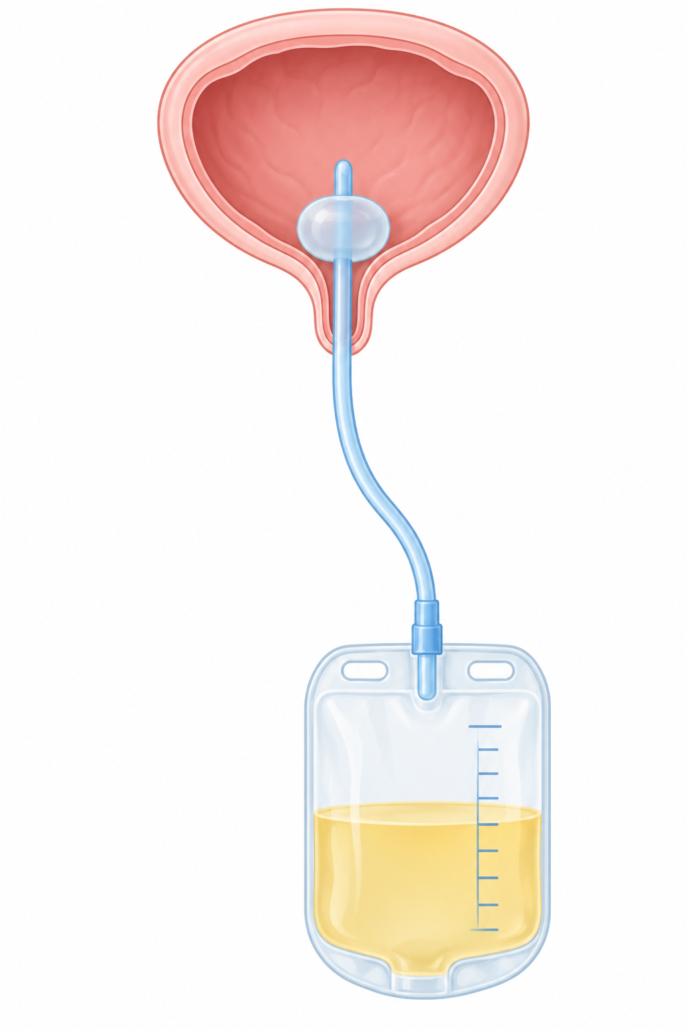
Living with an indwelling urethral catheter
An indwelling urethral catheter is a soft tube passed through the urethra into the bladder. A small balloon holds it in place and urine drains into a bag. It may be needed for a few days after an operation or for longer when the bladder cannot empty safely. The reason for the catheter and a plan for review should be clear to the patient and the people helping with their care.[1, 2]

Why might a catheter be needed?
Common reasons include acute urinary retention, an obstruction to urine flow, temporary drainage after surgery, and selected cases of chronic retention when other options are unsuitable. In hospital, a catheter may be used to monitor urine output in a critically ill person or manage bleeding and clots. It can occasionally support comfort at the end of life. A urethral catheter is generally not the first response to urinary leakage alone.[1]
When practical, the team should discuss whether the catheter can be removed after a trial of void, whether intermittent self-catheterisation is possible, or whether a suprapubic catheter may be more suitable for longer-term drainage. The best choice depends on bladder function, dexterity, the underlying condition and the person’s wishes.[1, 3]
What might it feel like, and what can go wrong?
Some people notice discomfort or a sense of needing to pass urine after insertion. Bladder spasms can cause cramping or urine to leak around the tube. Leakage can also mean that the catheter is kinked or blocked, so it should be checked rather than simply treated as incontinence. Other possible problems include blood in the urine after insertion or a change, skin irritation, accidental pulling or displacement, blockage from debris or encrustation, and infection.[2, 3]
A long-term urethral catheter can also cause pressure or trauma at the urethral opening; persistent soreness or a change in its appearance deserves review. Bladder stones and repeated blockages are further reasons to reassess the drainage plan. The longer a catheter remains, the more opportunity there is for bacteria to colonise it, so it should stay in place only while needed.[3, 4]
How often should a long-term catheter be changed?
There is no single safe change interval for every catheter and every patient. The plan depends on the catheter material and manufacturer’s instructions, local nursing policy, comfort, drainage, and whether it repeatedly blocks or becomes encrusted. Some community protocols plan changes approximately every four to eight weeks, but an individual plan may differ. The interval should not exceed the relevant product’s recommended duration.[1, 3]
Changing a catheter more frequently just to prevent infection has not been shown to help. A catheter may instead need an earlier change if it is blocked, damaged, displaced, causing problems, or as part of managing a symptomatic infection. People with a history of difficult insertion, urethral injury or bleeding should have a specific plan for who can safely perform the change.[1, 3]
At each review, it is worth asking: Is the catheter still necessary? Could a trial without it or another drainage method be considered?[1]
Day-to-day care at home
Keep the drainage bag below bladder level, avoid kinks in the tubing, and secure the catheter so it does not pull. Wash your hands before and after handling the bag. Follow the nurse’s instructions for emptying it and for cleaning the area where the catheter enters the body. Ordinary hygiene is usually enough; do not disconnect the closed drainage system, flush the catheter or take preventive antibiotics unless your treating team has given a specific instruction.[3, 5]
Drink according to your usual health advice. If you have a fluid restriction for heart or kidney disease, follow that plan rather than trying to drink extra to “flush” the catheter. Ask your nurse which supplies to keep at home and whom to call after hours if drainage stops.[2]
Bacteria in urine: when are antibiotics needed?
With a catheter in place, bacteria commonly grow on the catheter surface. After a month, bacteriuria is found in nearly everyone with a long-term catheter. A positive urine culture without symptoms usually reflects colonisation, not an infection requiring antibiotics. Routine screening or treatment of asymptomatic bacteriuria is generally discouraged because antibiotics can cause side effects and encourage resistant bacteria. Exceptions include pregnancy and certain invasive urological procedures, where the treating team will advise on testing and treatment.[4, 6]
Seek clinical assessment for possible infection if you develop fever, rigors, new pelvic or flank pain, feel distinctly unwell, or have other new symptoms that could indicate infection. In a frail person, a new change in function or confusion warrants assessment of several possible causes rather than automatically assuming a UTI. Cloudy or strong-smelling urine, sediment, or a positive dipstick on its own does not usually justify antibiotics.[4, 6, 7]
When a symptomatic catheter-associated UTI is suspected, a clinician should assess you and arrange a properly collected urine specimen if indicated—not from the drainage bag. Treatment is chosen in light of symptoms, culture results, allergies and local guidance. If the catheter has been in place for more than two weeks and still needs to remain, changing it as part of treatment is commonly recommended. Routine antibiotics at every scheduled catheter change are not recommended.[7, 8]
When to get help promptly
Contact your nurse or doctor promptly if urine stops draining, the catheter falls out, you have significant pain or new bleeding, or urine is leaking around the catheter with little in the bag. Check for a kink or a full bag, but do not forcefully flush or reinsert a catheter yourself unless specifically trained and instructed. Seek urgent medical care if drainage has stopped and you have a painful or swollen lower abdomen, or if you have fever, shaking chills or feel seriously unwell.[2]
Catheter support in Bundaberg
Some people can have catheter assessment and planned changes at home through a community nursing service. Ozcare and BlueCare provide home nursing in the Bundaberg area; whether a nurse can provide catheter care for an individual depends on referral, staffing, clinical needs, service area and funding arrangements. Ask the provider directly about availability and costs before relying on a visit.[9, 10]
For my Bundaberg patients, Sandra Ilett, a continence nurse with Community Nurse Service, is another local contact for bladder and catheter-related care. Sandra and her colleague Carla Kerr have also seen patients at the nurse-led clinic at The Friendlies Medical Suites. Patients can discuss a suitable referral and whether a home visit or clinic appointment is available. Community Nurse Service: (07) 4126 2002.[11] This mention recognises local nursing support; it is not a claim that one service is preferable for every patient.
A written catheter plan should record the reason for drainage, catheter details, the planned review or change, who will provide care, and whom to call if problems arise. Community nurses, the GP and urology team can then coordinate care across visits.
This article provides general information. Follow your individual catheter plan and seek clinical advice for new symptoms or a catheter that is not draining.
References
- Queensland Health. Urinary catheter insertion or change: indications and review.
- Healthdirect Australia. Catheter problems.
- Queensland Spinal Cord Injuries Service. Indwelling catheters.
- US Centers for Disease Control and Prevention. Indwelling urinary catheter culture stewardship.
- US Centers for Disease Control and Prevention. CAUTI prevention: summary of recommendations.
- Infectious Diseases Society of America. Management of asymptomatic bacteriuria.
- Queensland Spinal Cord Injuries Service. Management of urinary tract infection.
- US Centers for Disease Control and Prevention. Catheter urine culture collection guidance.
- Ozcare Bundaberg: home nursing and service area.
- BlueCare: community nursing at home; Bundaberg community service listing.
- Dr Jo Schoeman. Nurse-led urology clinic in Bundaberg: Sandra Ilett and Carla Kerr.






Leave a Reply
Want to join the discussion?Feel free to contribute!