
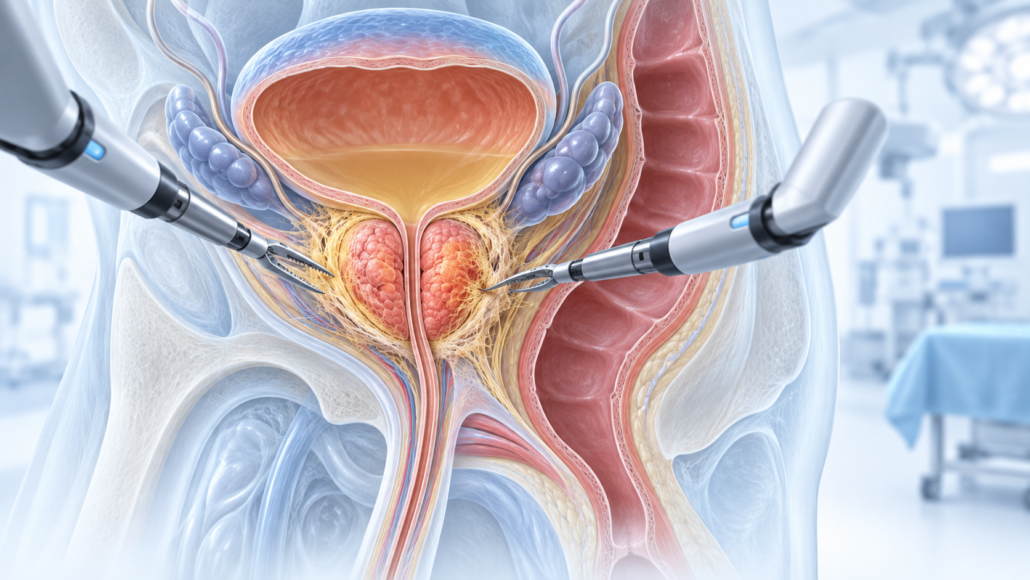
Radical Prostatectomy After Radiation Therapy for Prostate Cancer
When prostate cancer returns after radiotherapy
Radiotherapy, whether external-beam radiation or brachytherapy can provide excellent long-term control of localised prostate cancer. However, a rising prostate-specific antigen (PSA) after treatment may indicate that the cancer has returned.
This does not automatically mean that the cancer is still in the prostate, nor does every PSA rise require immediate treatment. Recurrence may be confined to the prostate, present in lymph nodes or bones, or involve more than one site. Some recurrences also progress slowly enough that surveillance may be appropriate.
When clinically significant cancer is proven to have returned within the irradiated prostate, with no evidence of spread elsewhere, removal of the prostate may still offer a chance of cure. This operation is called a salvage radical prostatectomy.
What is a salvage radical prostatectomy?
A salvage radical prostatectomy removes the entire prostate and seminal vesicles after previous prostate radiotherapy. Depending on the cancer and imaging findings, pelvic lymph nodes may also be removed.
The operation may be performed using robotic-assisted or open surgery. A robotic approach can improve magnification and access, but it does not remove the biological effects of previous radiation. Surgeon and centre experience are therefore more important than the label attached to the surgical technique.
Salvage surgery is technically more difficult than a prostatectomy performed before radiotherapy. Radiation can cause:
- scarring and fibrosis around the prostate;
- loss of the normal tissue planes between the prostate, bladder and rectum;
- reduced tissue blood supply;
- poorer tissue healing; and
- pre-existing damage to urinary, erectile or bowel function.
For these reasons, salvage prostatectomy should generally be undertaken in a centre with specific experience in complex prostate cancer surgery and access to multidisciplinary care.
When might salvage surgery be considered?
The aim is to identify a man who has a meaningful risk from his recurrent cancer, but whose disease still appears curable with local treatment. Possible indications include:
- a rising PSA after radiotherapy, commonly assessed using the Phoenix definition: a PSA rise of at least 2 ng/mL above the lowest PSA reached after treatment;
- prostate cancer confirmed on biopsy after radiotherapy;
- imaging suggesting that the recurrence is confined to the prostate or immediate surrounding tissues;
- no evidence of distant metastatic disease;
- a life expectancy long enough to benefit from curative treatment, often more than 10 years;
- good general health and fitness for major surgery;
- acceptable baseline bladder function; and
- willingness to accept a higher risk of urinary and sexual side effects than with a primary prostatectomy.
Factors such as the PSA level, PSA doubling time, interval since radiotherapy, biopsy Grade Group, clinical stage and the original cancer characteristics help estimate whether salvage treatment is likely to be worthwhile.
Assessment before considering surgery
A rising PSA is the beginning of the assessment—not the final diagnosis. Investigations commonly include:
Review of the original treatment
The radiation dose and field, use of brachytherapy, previous androgen-deprivation therapy, original biopsy grade and pre-treatment imaging should all be reviewed.
Multiparametric MRI
MRI can help identify the site and extent of a local recurrence, assess the seminal vesicles, bladder neck and rectal interface, and guide biopsy. Interpretation after radiation can be challenging and benefits from specialist radiological expertise.
PSMA PET/CT
PSMA PET/CT is used to look for disease in lymph nodes, bones or other organs. Finding metastatic disease usually changes the treatment plan and may mean that removing the prostate would not provide the expected benefit. Very small-volume disease can still be below the resolution of any scan.
Prostate biopsy
Major guidelines recommend pathological confirmation before potentially morbid local salvage therapy. Biopsy can confirm viable cancer, determine its grade and help distinguish clinically important recurrence from post-radiation change. Both targeted and systematic sampling may be considered.
Urinary-function assessment
Assessment may include symptom scores, urine testing, urinary-flow measurement, residual urine ultrasound and cystoscopy. Urodynamic testing may be helpful when there is significant urgency, leakage, poor flow, retention or uncertainty about bladder function.
Who may not be a good candidate?
Salvage prostatectomy is less likely to be appropriate when:
- metastatic or extensive nodal disease is present;
- the cancer is unlikely to be completely removable;
- life expectancy is limited by age, frailty or other illness;
- the recurrence is low risk and unlikely to threaten health;
- severe urinary or bowel damage already exists after radiation; or
- the anticipated harms of surgery outweigh the probability of cancer control.
These are not absolute rules. Individual circumstances should be reviewed by a multidisciplinary team involving urology, radiation oncology, medical oncology, radiology and pathology.
What are the potential benefits?
For carefully selected men, salvage prostatectomy can:
- remove the recurrent cancer and provide complete pathological staging;
- provide durable PSA control without immediately committing the patient to lifelong hormonal therapy; and
- offer a possibility of cure when disease is truly confined to the prostate.
Published results vary considerably because most evidence comes from retrospective series involving highly selected patients. The European Association of Urology reports five-year biochemical recurrence-free estimates broadly around 41–52% in a large contemporary systematic review, while older selected series have reported ranges of approximately 47–82%. A broader meta-analysis of all local salvage approaches found roughly 50–60% five-year recurrence-free survival, without clear evidence that one approach was oncologically superior. These figures should not be interpreted as a personal prediction.
Cancer control is generally more favourable when the PSA is lower, the recurrent tumour is organ-confined, the cancer grade is lower, the PSA doubling time is longer and there is no nodal or distant disease.
Side effects and complications
Complication rates vary with baseline function, radiation type and dose, disease extent, surgical technique, definitions used in studies and surgeon experience. Results from specialist centres may not apply everywhere.
Urinary incontinence
Loss of urinary control is one of the most important risks. Radiation may already have affected the sphincter, bladder and urethral tissues, and surgery removes the prostate through which the urethra passes.
Leakage may range from mild stress incontinence to severe continuous leakage. Pelvic-floor rehabilitation can help, but some men may later require a male sling or artificial urinary sphincter. Continence outcomes reported in the literature vary widely because studies use different definitions; the risk of significant or persistent leakage is clearly higher than after primary prostatectomy.
Erectile dysfunction
Erectile function is often already impaired by radiotherapy, age, vascular disease or hormonal treatment. Preservation of the erectile nerves may be unsafe or technically impossible because of tumour location and radiation fibrosis. Consequently, erectile dysfunction after salvage prostatectomy is very common and recovery of unassisted erections is uncommon.
Rehabilitation and treatment options include tablets, vacuum devices, penile injections and penile prosthesis surgery. As with any radical prostatectomy, ejaculation and natural fertility are lost because the prostate and seminal vesicles are removed.
Bladder-neck contracture or urethral narrowing
Scar tissue may develop where the bladder is reconnected to the urethra. This can cause a weak stream, straining, incomplete emptying, retention or recurrent infection. Treatment may require endoscopic incision or dilatation, sometimes more than once. Repeated procedures can worsen incontinence.
Urine leak and delayed healing
The new bladder-to-urethra join may heal slowly because irradiated tissues have reduced blood supply. A urinary catheter may need to remain in place longer, and imaging may be required before its removal. Persistent leakage can require drainage or further intervention.
Rectal injury and urinary fistula
The rectum can be densely adherent to the prostate after radiotherapy. Rectal injury is uncommon in expert contemporary practice but occurs more often than during primary prostatectomy and can be serious. It may require repair, temporary bowel diversion or, rarely, more extensive surgery. An abnormal connection between the urinary tract and rectum—a rectourinary fistula—is rare but particularly difficult to treat.
Other surgical risks
Other possible complications include bleeding or transfusion, infection, blood clots, lymphocele after lymph-node dissection, injury to nearby structures, anaesthetic complications, chronic pelvic pain and the need for further procedures.
Cancer may still recur
Even when preoperative imaging suggests local disease, microscopic cancer may already exist outside the prostate. PSA may therefore remain detectable or rise again after surgery. Further treatment—such as hormonal therapy, systemic therapy or selected metastasis-directed treatment—may still be required.
Are there alternatives?
Depending on the cancer, previous treatment, anatomy, urinary function and patient priorities, alternatives may include:
- active monitoring for a slow or low-risk recurrence;
- androgen-deprivation therapy, sometimes with additional systemic treatment;
- salvage brachytherapy or stereotactic re-irradiation;
- cryotherapy;
- high-intensity focused ultrasound (HIFU); or
- focal salvage treatment in carefully selected cases.
No single salvage treatment is best for every patient. Available studies are mostly non-randomised and use differing definitions. A large meta-analysis found broadly similar five-year cancer control among local salvage methods, but severe urinary toxicity was higher after salvage prostatectomy than after modern re-irradiation approaches. Treatment should therefore be selected through shared decision-making rather than on cancer-control figures alone.
The bottom line
Radical prostatectomy after prostate radiotherapy is possible and can be curative, but it is not a routine operation. The best candidate is generally a fit man with biopsy-proven, clinically significant recurrence confined to the prostate, no metastatic disease on appropriate staging, a meaningful life expectancy and a clear understanding of the potential functional consequences.
Accurate staging, confirmation by biopsy, assessment of baseline urinary function and review by an experienced multidisciplinary team are essential. The decision must balance the chance of durable cancer control against the higher risks of urinary incontinence, erectile dysfunction, urinary narrowing, poor healing and rectal complications.
This article provides general information and does not replace individual medical advice. Recommendations should be tailored to the pathology, imaging, previous radiation treatment, general health and preferences of each patient.
References
- European Association of Urology. EAU Guidelines on Prostate Cancer: Treatment—management of PSA failure after radiation therapy and salvage radical prostatectomy. Current online edition. https://uroweb.org/guidelines/prostate-cancer/chapter/treatment
- Morgan TM, et al. Salvage Therapy for Prostate Cancer: AUA/ASTRO/SUO Guideline. Journal of Urology. 2024. https://www.auanet.org/guidelines-and-quality/guidelines/salvage-therapy-for-prostate-cancer
- Valle LF, et al. A systematic review and meta-analysis of local salvage therapies after radiotherapy for prostate cancer (MASTER). European Urology. 2021;80(3):280–292. doi:10.1016/j.eururo.2020.11.010.
- Grubmüller B, et al. Salvage radical prostatectomy for radio-recurrent prostate cancer: an updated systematic review of oncological, histopathological and functional outcomes and predictors. European Urology Focus. 2021;7(5):967–978.
- Perera M, et al. Morbidity of salvage radical prostatectomy: limited impact of the minimally invasive approach. European Urology Open Science. 2022;39:64–72.
- Zumsteg ZS, et al. The natural history and predictors of outcome following biochemical relapse in the dose-escalation era for prostate cancer patients undergoing definitive external beam radiotherapy. European Urology. 2015;67(6):1009–1016.









Leave a Reply
Want to join the discussion?Feel free to contribute!