
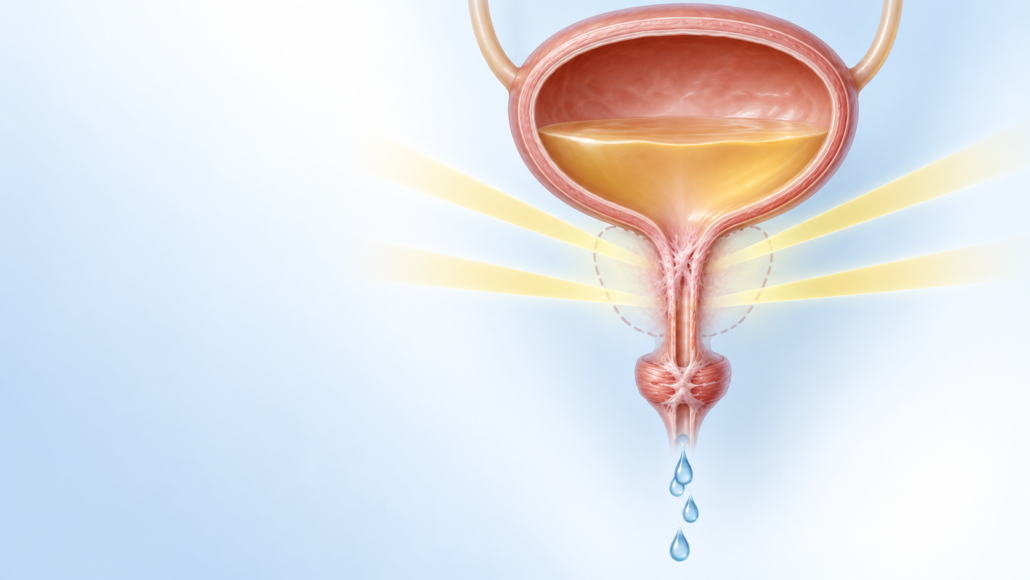
Urinary Incontinence After Prostatectomy and Salvage Radiotherapy
Why leakage may become more complex after both treatments
Urinary leakage after radical prostatectomy is common in the early recovery period and usually improves with healing and pelvic floor rehabilitation. Some men, however, require salvage radiotherapy because their PSA remains detectable or rises after surgery.
Radiotherapy can help control recurrent prostate cancer, but it may also affect tissues that have already been altered by surgery. Radiation can cause progressive scarring, reduced blood supply and loss of elasticity in the urethra, bladder neck and bladder. These effects may develop months or even years later.
As a result, leakage after prostatectomy and salvage radiotherapy is not always caused by a weak urinary sphincter alone. A man may have:
- Stress urinary incontinence: leakage with coughing, standing, lifting, walking or exercise because the sphincter does not close effectively.
- Urgency urinary incontinence: leakage accompanied by a sudden, difficult-to-defer urge, often caused by an overactive or irritated bladder.
- Overflow leakage: leakage associated with poor bladder emptying, a weak bladder muscle or obstruction.
- Mixed incontinence: a combination of stress and urgency leakage.
- Radiation-related complications: bladder-neck contracture, urethral stricture, radiation cystitis, poor bladder compliance, fistula, tissue necrosis or, in severe cases, a severely damaged bladder outlet.
Correctly identifying the cause is essential. Tightening the outlet when the bladder cannot store or empty safely may replace one problem with another.
When should the problem be assessed?
Continence can continue to improve during the first year after prostatectomy. Pelvic floor muscle training should begin early, and surgical treatment may be considered as early as six months when severe leakage is clearly not improving. Persistent, bothersome stress incontinence at approximately 12 months deserves formal assessment.
Following salvage radiotherapy, earlier review is appropriate if there is:
- worsening leakage;
- blood in the urine;
- recurrent urinary infection;
- pain, burning or severe urgency;
- a weak stream or difficulty emptying;
- urinary retention;
- pelvic or perineal pain; or
- urine leaking through an abnormal opening.
Visible haematuria, fever, inability to pass urine or severe pain requires prompt medical attention.
Investigating incontinence after salvage radiotherapy
1. A careful history
The first step is to establish what type of leakage is occurring, when it began and whether it changed after radiotherapy. Important questions include:
- Is leakage triggered by activity, or by urgency?
- How many pads are used, and how wet are they?
- Is the patient dry at night or when lying down?
- Is there a weak stream, straining or incomplete emptying?
- Are there recurrent infections, haematuria or pelvic pain?
- Were there previous bladder-neck or urethral procedures?
- How much does leakage affect work, exercise, sleep, intimacy and quality of life?
Manual dexterity and cognition are also important if an artificial urinary sphincter is being considered, because the patient must be able to locate and operate a small scrotal pump.
2. Bladder diary and pad assessment
A three-day bladder diary records fluid intake, voided volumes, urgency and leakage. Pad number gives a useful impression, but pads differ greatly. A 24-hour pad-weight test can quantify the actual volume lost and help grade severity and monitor progress.
3. Examination and basic tests
Assessment commonly includes:
- abdominal, genital, perineal and neurological examination;
- observation for leakage while coughing or standing with a comfortably full bladder;
- urinalysis and urine culture when infection is suspected;
- uroflowmetry;
- ultrasound measurement of the post-void residual; and
- renal function testing or upper-tract imaging when clinically indicated.
4. Cystoscopy
Cystoscopy is particularly important before continence surgery in a previously irradiated urinary tract. It allows the urologist to inspect the urethra, bladder neck and bladder for:
- urethral stricture or bladder-neck contracture;
- radiation damage, stones or tumour;
- erosion from a previous implant;
- tissue quality and sphincter appearance; and
- fistula or necrosis in complex cases.
Any clinically important obstruction or unstable urethral disease usually needs to be treated and shown to be stable before an anti-incontinence device is implanted.
What is the role of urodynamic studies?
Urodynamics is not mandatory for every man with straightforward stress leakage. It becomes more useful when symptoms are mixed, the diagnosis is uncertain, previous radiation has made the situation more complex, or the result may change treatment.
The study can assess:
- stress leakage and sphincter weakness;
- involuntary bladder contractions;
- bladder capacity and sensation;
- reduced bladder compliance or unsafe storage pressures;
- obstruction;
- weak bladder contraction; and
- the ability of the bladder to empty against a future sling or sphincter cuff.
Urodynamics is especially worth considering when there is marked urgency, nocturnal leakage, retention, a raised residual, poor flow, recurrent infection, prior outlet reconstruction or concern about a small, painful or poorly compliant radiation-damaged bladder.
The test does not simply decide whether a man “qualifies” for an operation. Its value is in identifying bladder dysfunction that should be treated first or a bladder that may not tolerate additional outlet resistance.
Initial and non-surgical management
Pelvic floor rehabilitation
Supervised pelvic floor muscle training can improve control and teach correct muscle activation. It is most useful early after prostatectomy but may still improve coping and control later. Repeated forceful exercises are not always better; poor technique can worsen pelvic tension or urgency.
Bladder and lifestyle measures
Management may include weight reduction where relevant, treating constipation, moderating caffeine and alcohol, adjusting the timing of fluids and diuretics, bladder training and treating urinary infection. Antimuscarinic medication or a beta-3 agonist may help an overactive-bladder component, but medication does not restore a damaged sphincter.
Pads, sheaths and clamps
Absorbent pads remain a practical option for mild leakage or while awaiting treatment. A condom drainage sheath can direct urine into a leg bag when penile skin and anatomy permit.
A penile clamp may provide short-term control for selected men with good sensation, intact skin and adequate bladder emptying. It must be released regularly and should not be used overnight. Extra caution is required after radiation because pressure injury may heal poorly.
Catheter options
Catheters manage drainage; they do not repair stress incontinence. They may nevertheless be appropriate when there is retention, very poor emptying, severe frailty, failed reconstruction or a need for temporary urinary control.
Intermittent self-catheterisation
Intermittent self-catheterisation is generally preferred when the bladder fails to empty but the patient has sufficient dexterity and urethral access. It avoids a continuously indwelling tube, although irradiated strictures or a false passage may make catheterisation difficult.
Long-term urethral catheter
An indwelling urethral catheter may be necessary in selected patients, but long-term use can cause infection, discomfort, blockage, bladder stones, urethral erosion and further outlet damage. A catheter passing through an activated AUS cuff can also cause serious urethral erosion; healthcare providers must be told that an AUS is present and the device should be deactivated before urethral instrumentation.
Suprapubic catheter
A suprapubic catheter enters the bladder through the lower abdomen. For long-term drainage it often avoids continuing urethral pressure and may be easier to manage than a urethral catheter. It still requires regular changes and carries risks including infection, blockage, bladder stones, leakage and skin problems.
Male sling versus artificial urinary sphincter
Male sling
A male sling supports and repositions or compresses the urethra. Its advantages include no scrotal pump and no need to operate the device each time the patient urinates. In carefully selected, non-irradiated men with mild-to-moderate stress incontinence, a sling can be effective.
However, previous pelvic radiotherapy is a recognised predictor of poorer sling outcomes. Fibrosis limits urethral mobility and tissue recovery, and moderate-to-severe leakage further reduces success. A sling may still be discussed in a highly selected patient with very mild leakage, good residual sphincter function and a stable, healthy-looking urethra, but expectations must be conservative.
Artificial urinary sphincter (AUS)
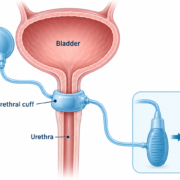
The AUS consists of a fluid-filled cuff around the urethra, a pressure-regulating balloon and a pump in the scrotum. The cuff stays closed to control leakage. The patient squeezes the pump to open it temporarily when passing urine.
For men with moderate-to-severe stress incontinence, the AUS remains the most established surgical treatment. Importantly, the AUA/GURS/SUFU guideline recommends offering an AUS rather than a male sling or adjustable balloons to men seeking surgery after primary, adjuvant or salvage radiotherapy.
Radiation does not make AUS implantation impossible, but outcomes are less predictable than in non-irradiated men. Radiation increases the risks of urethral erosion, infection, tissue atrophy, revision and device removal. Mechanical parts also have a limited lifespan, so further surgery may eventually be required.
Practical comparison
| Consideration | Male sling | Artificial urinary sphincter |
|---|---|---|
| Best-established role | Mild-to-moderate stress leakage in selected men | Moderate-to-severe stress leakage |
| Previous salvage radiotherapy | Lower success; generally not preferred | Guideline-preferred surgical option, with higher complication risk than in non-irradiated men |
| Patient operation | No pump | Scrotal pump must be squeezed for each void |
| Manual dexterity required | Minimal | Yes |
| Retention risk | Possible | Possible if device is not cycled correctly or obstruction develops |
| Long-term considerations | Persistent leakage or failure may require AUS | Mechanical failure, erosion, infection or atrophy may require revision or removal |
Neither operation guarantees complete dryness. The choice should consider pad weight, bladder function, urethral health, prior strictures or surgery, dexterity, patient priorities and the reconstructive surgeon’s assessment.
When an AUS or sling is not enough
A small group of men develop a severely scarred, painful or repeatedly obstructed outlet, sometimes called a devastated bladder outlet. This may include recurrent bladder-neck contracture or urethral stricture, fistula, radionecrosis, repeated AUS erosion, severe radiation cystitis or an unsafe low-capacity bladder.
Further implant surgery may then be unlikely to succeed. The priority changes from preserving normal voiding to obtaining dependable drainage, protecting the kidneys and improving quality of life.
Options at a specialist reconstructive centre may include:
- long-term suprapubic drainage;
- closure of the bladder neck with a suprapubic catheter in selected cases;
- a catheterisable abdominal channel in carefully selected patients;
- an ileal conduit, in which urine drains through a short segment of bowel to a urostomy bag on the abdomen;
- another form of continent urinary diversion in selected fit patients; or
- cystectomy with urinary diversion when the bladder is severely painful, contracted, bleeding, fistulating or otherwise unsalvageable.
These are major, irreversible procedures with substantial risks. They should be considered only after detailed imaging and functional assessment, review of cancer status, discussion with an experienced reconstructive team and consultation with a stomal therapy nurse.
A sensible treatment pathway
- Define the leakage: stress, urgency, overflow or mixed.
- Measure its severity: diary, pads and preferably pad weight.
- Check storage and emptying: urine testing, flow and residual; use urodynamics when the findings may alter treatment.
- Inspect the outlet: cystoscopy before implant surgery, particularly after radiation.
- Treat infection, obstruction and bladder dysfunction first.
- Use conservative or catheter strategies when appropriate.
- For persistent radiated stress incontinence, discuss AUS as the usual preferred operation.
- Reserve sling surgery for exceptional, carefully selected radiated patients after frank counselling.
- Refer severe outlet or bladder destruction to a high-volume reconstructive centre to discuss reconstruction versus diversion.
The take-home message
Urinary incontinence after prostatectomy and salvage radiotherapy is treatable, but it needs more than a pad count and a one-size-fits-all operation. The bladder, sphincter and urethra must each be assessed.
For straightforward sphincter weakness after radiation, the artificial urinary sphincter usually offers the most reliable surgical option, although radiation increases the likelihood of erosion and future revision. A male sling is less invasive but is less dependable in irradiated tissue. When the outlet or bladder is severely damaged, catheter drainage, bladder-neck closure or urinary diversion may provide a safer and more durable solution than repeated continence procedures.
This article provides general information and does not replace an individual assessment. Treatment should be tailored to the patient’s symptoms, examination, bladder function, urethral condition, cancer status and personal priorities.
References
- Breyer BN, Kim SK, Kirkby E, et al. Updates to Incontinence After Prostate Treatment: AUA/GURS/SUFU Guideline (2024). Journal of Urology. 2024. AUA guideline | Journal update
- European Association of Urology. EAU Guidelines on the Management of Non-neurogenic Male Lower Urinary Tract Symptoms: urinary incontinence assessment and treatment. Current online edition. EAU guideline
- American Urological Association, ASTRO and SUO. Salvage Therapy for Prostate Cancer Guideline. AUA/ASTRO/SUO salvage therapy guideline
- National Institute of Diabetes and Digestive and Kidney Diseases. Urodynamic testing. NIDDK patient information
- British Association of Urological Surgeons. Urinary diversion into an ileal conduit. BAUS patient information
Evidence note: Most data specific to men who have undergone both prostatectomy and salvage radiotherapy come from observational series rather than large randomised trials. Recommendations therefore combine guideline evidence, reconstructive-urology experience and individualised shared decision-making.



Leave a Reply
Want to join the discussion?Feel free to contribute!