
Focal Laser Therapy for Localised Prostate Cancer: What Do We Know?
Focal therapy is an evolving approach to treating selected prostate cancers. Instead of treating or removing the entire prostate, it aims to destroy the identified cancer while preserving as much surrounding prostate tissue as possible.
One technique under investigation uses laser energy delivered through a fine fibre placed into the prostate. Early clinical reports are encouraging, but focal laser therapy is not suitable for every cancer and long-term evidence remains limited compared with established treatments such as radical prostatectomy and radiotherapy.
This article explains the disease, the principle of focal laser ablation, the early Guy’s Hospital pilot and the questions patients should consider before choosing treatment. It does not recommend a particular product, device or provider.
Understanding localised prostate cancer
Localised prostate cancer appears confined to the prostate on the available investigations. However, cancers vary greatly in their grade, size, position and biological behaviour.
Assessment commonly considers:
- PSA level and PSA density
- digital rectal examination findings
- multiparametric prostate MRI
- prostate-biopsy grade, often reported using Grade Group
- number, position and extent of positive biopsy cores
- whether clinically significant cancer is present in one or several parts of the prostate
- the patient’s age, health, life expectancy and preferences
- staging investigations where indicated
Some low-risk cancers may be monitored safely with active surveillance. Other cancers require treatment because their features suggest a meaningful risk of growth or spread.
What is focal therapy?
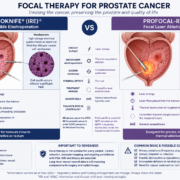
Focal therapy treats the known area of clinically significant cancer rather than the whole prostate. Depending on the extent and location of disease, treatment may target a small focus, a larger region or one side of the gland.
Energy sources used or investigated for focal therapy include:
- high-intensity focused ultrasound
- cryotherapy
- irreversible electroporation
- focal laser ablation
- other thermal or energy-based techniques
These methods are not interchangeable. Each has different equipment, treatment planning, evidence, limitations and regulatory status.
How does focal laser ablation work?
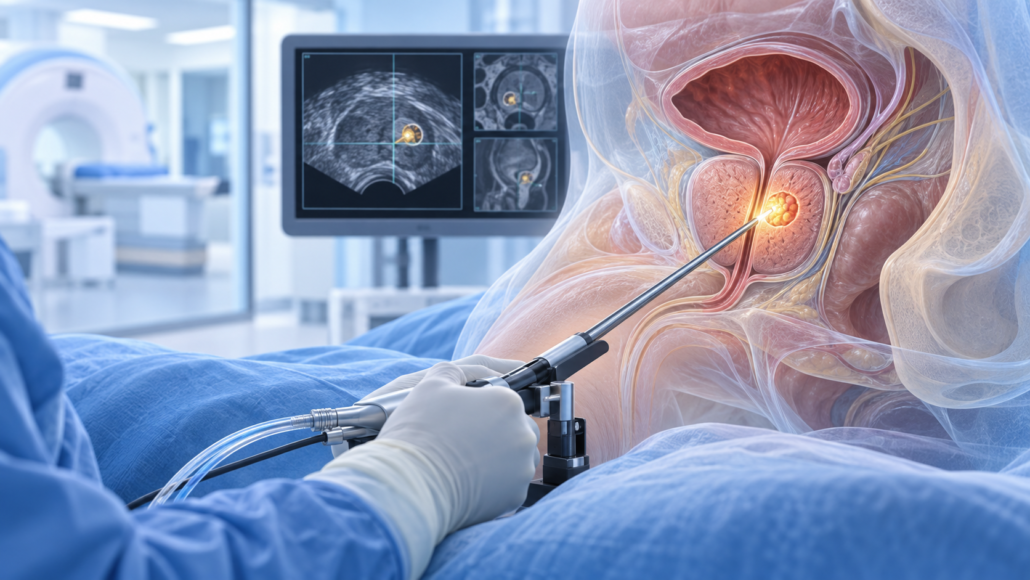
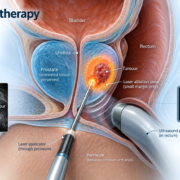
Focal laser ablation delivers laser energy through a thin fibre positioned within the planned treatment area. The energy heats and destroys targeted tissue.
Placement may be performed through the perineum, the area between the scrotum and anus, with MRI and ultrasound information used to guide treatment planning and positioning. Temperature monitoring, cooling systems or other safeguards may be used according to the particular technique.
The intended advantage is to treat the cancer focus while reducing injury to structures involved in urinary continence, erections and bowel function. This is a treatment aim, not a guarantee. Damage to surrounding tissue and functional side effects remain possible.
What did the Guy’s Hospital pilot report?
Guy’s Hospital in London began a pilot involving 30 patients with localised prostate cancer. According to the hospital information reported by the BBC, assessment of the first 10 treated patients found no remaining cancer in the treated area in eight, while two had a small amount of residual cancer.
These figures should be interpreted cautiously:
- they concern only the first 10 patients of a small pilot
- they describe early findings in the treated area, not long-term cure
- cancer may be present elsewhere in the prostate
- follow-up was not long enough to establish durability, metastasis prevention or survival benefit
- results from carefully selected research participants may not apply to all patients
The pilot includes ongoing follow-up, including imaging. Larger studies, longer observation and peer-reviewed comparative evidence are needed before firm conclusions can be drawn about long-term cancer control and functional outcomes.
Who might be considered for focal therapy?
Focal therapy may be discussed for carefully selected patients whose clinically significant cancer can be identified and targeted while untreated areas can be monitored reliably.
Selection may take account of:
- MRI-visible disease
- biopsy confirmation and cancer grade
- location, volume and number of cancer foci
- proximity to the urethra, urinary sphincter, rectum and neurovascular structures
- prostate size and anatomy
- previous prostate treatment
- ability and willingness to undergo close follow-up and repeat biopsy
- availability of appropriate expertise and governance
Multifocal, poorly defined, extensive or higher-risk cancer may make a focal approach unsuitable. An apparently single MRI lesion does not prove that no important cancer exists elsewhere in the gland.
What assessment is needed beforehand?
Accurate mapping of the cancer is essential. Depending on the patient, assessment may include:
- review of PSA history
- high-quality multiparametric MRI
- targeted and systematic transperineal biopsy
- expert radiology and pathology review
- staging imaging when indicated by risk
- baseline urinary, erectile and bowel function assessment
- discussion by a multidisciplinary prostate-cancer team
A treatment decision should not be based on MRI alone. Biopsy remains important for confirming the grade and distribution of cancer.
Potential advantages
Possible advantages for appropriately selected patients include:
- treatment directed at the known cancer rather than the entire prostate
- usually a shorter procedure and recovery than radical prostatectomy
- potential for same-day discharge
- a lower treatment burden for some patients
- the possibility of preserving urinary and sexual function more often than with whole-gland treatment
- retention of other treatment options if further cancer is later detected
These are potential advantages, not assured outcomes. Comparisons with surgery or radiotherapy are difficult because patient selection, outcome definitions and follow-up periods differ across studies.
Risks and limitations
Possible complications include:
- blood in the urine or semen
- discomfort, bruising or swelling
- urinary infection
- difficulty passing urine or temporary catheterisation
- urinary retention
- urethral narrowing
- urinary urgency or leakage
- erectile or ejaculatory changes
- injury to tissue surrounding the prostate
- residual cancer within the treated area
- clinically significant cancer elsewhere in the prostate
- need for repeat focal treatment or conversion to surgery or radiotherapy
Rare but serious complications may occur. The specific risk profile depends on the technology, treatment location, operator experience and individual anatomy.
Focal therapy does not remove the need for surveillance
Unlike radical prostatectomy, focal therapy leaves prostate tissue behind. PSA therefore remains detectable and cannot be interpreted in the same way as after complete prostate removal.
Follow-up may include:
- regular PSA testing
- clinical review
- repeat MRI
- targeted and systematic repeat biopsy
- assessment of urinary and sexual function
Imaging alone may not exclude residual or recurrent cancer. Patients need to be willing to undergo structured, long-term surveillance and possible further biopsy or treatment.
How does it compare with established options?
Active surveillance
Active surveillance avoids or delays treatment in suitable patients with lower-risk disease. It involves scheduled PSA tests, MRI, examination and repeat biopsy. It avoids immediate treatment side effects but carries the burden of monitoring and the possibility that treatment will later be required.
Radical prostatectomy
Surgery removes the prostate and seminal vesicles and provides complete pathological assessment of the removed gland. It has extensive long-term evidence for selected patients but may cause urinary incontinence, erectile dysfunction, loss of ejaculation and other surgical complications.
Radiotherapy
External-beam radiotherapy and brachytherapy are established treatments for localised prostate cancer. Risks may include urinary, bowel and sexual effects, which can develop during treatment or later. Some patients also require androgen-deprivation therapy.
Focal therapy
Focal therapy attempts to balance cancer control with preservation of function. Its principal uncertainties are the selection of suitable patients, untreated cancer elsewhere in the prostate, definitions of treatment success and the lack of mature comparative and long-term cancer-control data.
What happens if cancer remains or returns?
Further management depends on the location and risk of the cancer, previous treatment and patient preference. Options may include:
- continued surveillance in selected circumstances
- repeat focal treatment
- radical prostatectomy
- radiotherapy
- another appropriate cancer treatment
Salvage treatment after focal therapy may be technically more complex and can have different side-effect rates from primary treatment. Patients should discuss the available rescue options before choosing focal therapy, not only after treatment failure.
Australian regulatory status and access
Regulatory status, approved indications, availability, reimbursement and participation in clinical trials can change. A device being used in research overseas does not automatically mean that the same system is approved, routinely available or publicly funded in Australia.
Patients considering a particular technology should ask:
- Is the exact device included in the Australian Register of Therapeutic Goods for the proposed use?
- Is treatment being offered as standard care, through a clinical trial or under another access pathway?
- What evidence supports this technique for my particular cancer?
- What costs and follow-up procedures are involved?
- Who will manage surveillance and any residual or recurrent cancer?
Current regulatory information should be confirmed directly through the Therapeutic Goods Administration and the treating institution. This article does not make a claim that any named focal-laser system is TGA approved.
Questions to ask your prostate-cancer team
- What is my Grade Group and clinical risk category?
- Is the cancer confined to one clearly targetable area?
- How confident are we that significant cancer is not present elsewhere?
- Is active surveillance a safe option for me?
- What are the established alternatives and their long-term outcomes?
- What evidence is available for this focal technique?
- How will success be measured?
- Will I need another biopsy?
- What are the urinary, sexual and bowel risks?
- What happens if the cancer is not completely treated or later recurs?
- Is this standard treatment or part of a research study?
The bottom line
The early Guy’s Hospital experience adds to growing interest in focal laser treatment for localised prostate cancer. The reported initial findings are encouraging, but 10 early cases cannot establish long-term cure, comparative effectiveness or safety.
Focal therapy may be reasonable to discuss for carefully selected patients who understand the uncertainties and accept close surveillance. It should be considered alongside active surveillance, surgery and radiotherapy through shared decision-making with an experienced multidisciplinary team.
This article provides general disease education. It does not recommend or promote a particular therapeutic device, treatment system, clinician or health service and does not replace individual medical advice. Regulatory status and clinical evidence should be checked at the time treatment is considered.
References and further reading
- BBC News — Guy’s Hospital pilots prostate cancer treatment
- Therapeutic Goods Administration — Australian Register of Therapeutic Goods
- Therapeutic Goods Administration — Advertising health products
- European Association of Urology — Prostate Cancer Guidelines
- Cancer Council Australia — Prostate cancer
- Prostate Cancer Foundation of Australia — Treatment information
Publication note
This is an original educational article, not a republication of the BBC report.



Leave a Reply
Want to join the discussion?Feel free to contribute!