
Mid-Urethral Slings for Stress Urinary Incontinence: What Is the Current Australian Position?
Patient information for Australian women | Reviewed 22 September 2026
The word “mesh” can understandably cause concern. Public discussion has often grouped together several very different products and operations. A mid-urethral sling used to treat female stress urinary incontinence is not the same operation as transvaginal mesh used to repair pelvic organ prolapse, and it is also different from a single-incision mini-sling.
The Urological Society of Australia and New Zealand (USANZ) supports the continued availability of mid-urethral slings in Australia as one treatment option for appropriately selected women. That support is not unconditional: USANZ emphasises appropriate clinical governance, surgeon credentialing, informed consent, multidisciplinary review where appropriate, and monitoring of patient outcomes.
What is stress urinary incontinence?
Stress urinary incontinence, or SUI, is leakage caused by an increase in abdominal pressure, for example when coughing, sneezing, laughing, exercising or lifting. It is different from urge incontinence, in which leakage is associated with a sudden compelling need to pass urine.
An accurate diagnosis matters. Some women have both stress and urgency symptoms, difficulty emptying the bladder, prolapse, recurrent infections or previous pelvic surgery. A consultation may therefore include a history, examination, bladder diary, urine testing, measurement of residual urine and, in selected or complex cases, urodynamic studies or cystoscopy.
What is a mid-urethral sling?
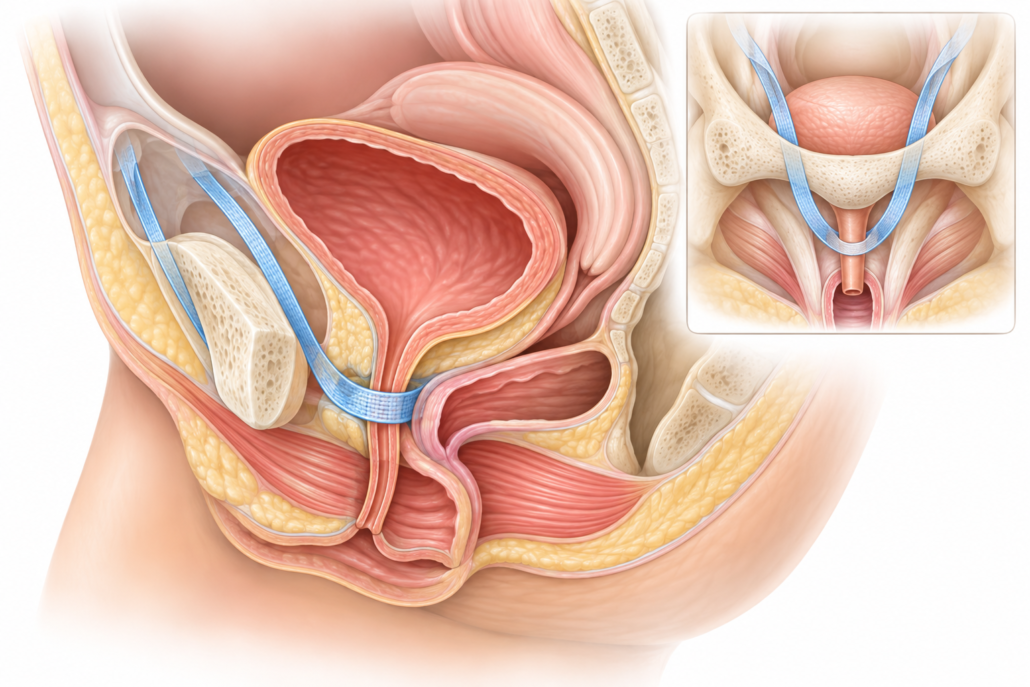
A mid-urethral sling is a narrow strip of permanent synthetic polypropylene mesh placed beneath the middle part of the urethra. It provides support during coughing, exercise and other activities that raise abdominal pressure.
The two established approaches are:
- Retropubic sling: the tape passes behind the pubic bone.
- Transobturator sling: the tape passes through the obturator region towards the groin.
These approaches have different risk profiles. The retropubic route has a greater risk of bladder perforation and short-term voiding difficulty, while the transobturator route has a greater association with groin or thigh pain. The most appropriate approach depends on the woman’s anatomy, previous operations, clinical circumstances and preferences.
What does USANZ say?
USANZ states that mid-urethral slings have an established evidence base for relative safety and effectiveness and should remain available in Australia for the treatment of female SUI. In its 2023 statement, USANZ specifically linked continued use to the clinical-governance improvements introduced in Australia since 2018, including:
- appropriate surgeon credentialing
- careful patient selection
- discussion through multidisciplinary processes where indicated
- genuine informed consent
- monitoring of outcomes through the Australasian Pelvic Floor Procedure Registry.
This position supports patient choice, not routine surgery for every woman. Conservative care should usually be considered first, and non-mesh alternatives must be discussed when surgery is being considered.
What is the TGA position?
The Therapeutic Goods Administration (TGA) regulates medical devices in Australia. Surgical mesh is classified as a Class III medical device, the highest-risk classification, requiring more stringent evidence and regulatory assessment.
Following its safety reviews, the TGA removed certain transvaginal prolapse mesh products and single-incision mini-slings from routine supply. This did not amount to a ban on established retropubic and transobturator mid-urethral slings for SUI. The TGA’s current register includes eligible Class III urogynaecological mesh devices intended for SUI; the precise indication must always be checked in the device’s approved Instructions for Use.
The TGA requires manufacturers to provide patient information leaflets and implant cards for these devices. A woman receiving a sling should know the product used and should retain her implant card.
How effective is a mid-urethral sling?
Mid-urethral sling surgery is one of the most extensively studied operations for female SUI. Australian safety and quality guidance describes it as highly effective in the short and medium term, with long-term studies showing sustained patient satisfaction for many women.
No operation can guarantee a cure. Outcomes depend on the definition of success, length of follow-up, type of sling, surgeon experience and the individual patient. Stress leakage may persist or recur, and urgency symptoms may remain, improve or occasionally develop after surgery.
What are the risks?
Most women do not develop a serious complication, but complications can be significant and may occur early or years later. Potential risks include:
- bleeding, infection and anaesthetic complications
- temporary or persistent difficulty emptying the bladder, sometimes requiring catheterisation or further surgery
- bladder or urethral injury
- urinary tract infection
- new or worsened urinary urgency or urge incontinence
- persistent or recurrent stress incontinence
- vaginal mesh exposure
- mesh erosion into the urethra or bladder
- pelvic, vaginal, groin or thigh pain
- pain during intercourse
- rarely, injury to major blood vessels, bowel or other pelvic structures.
Mesh is intended to remain permanently. If a mesh complication develops, partial or complete removal may be considered, but complete removal can be technically difficult or impossible and may require more than one operation. Removal may not fully resolve pain and can cause stress incontinence to recur.
Seek medical assessment if you develop persistent pelvic or groin pain, pain during intercourse, vaginal bleeding or discharge, recurrent urinary infections, difficulty passing urine, blood in the urine, or recurrent leakage after sling surgery.
What are the alternatives?
Treatment should be individualised. Options include:
- no active treatment or the use of continence products
- lifestyle measures, including weight management, treatment of constipation and chronic cough, and smoking cessation
- supervised pelvic-floor muscle training, usually for at least three months
- a continence pessary in suitable women
- urethral bulking injections, which are less invasive but generally less durable and may need repeating
- an autologous fascial sling using the patient’s own tissue
- Burch colposuspension using sutures and native tissue.
Autologous fascial sling and colposuspension avoid permanent synthetic mesh but usually involve a longer operation and recovery and have their own risks, including voiding difficulty. There is no single best operation for every woman.
Shared decision-making and informed consent
Before proceeding, a woman should have enough time and balanced information to consider:
- whether her symptoms are predominantly stress, urgency or mixed incontinence
- conservative, mesh and non-mesh options
- the expected benefits and limitations of each option
- short- and long-term risks, including mesh-specific complications
- the surgeon’s training and experience with the proposed procedure and alternatives
- what follow-up will occur and how complications would be managed
- the name and TGA registration status of the proposed device.
A second opinion is reasonable, particularly if symptoms are complex, previous continence surgery has failed, chronic pelvic pain is present, or the available options remain unclear.
The balanced Australian position
Mid-urethral slings are not appropriate for every woman, but neither are they prohibited in Australia. USANZ supports their continued availability for carefully selected patients within strong clinical-governance systems. The TGA continues to regulate eligible SUI sling devices as Class III medical devices and requires enhanced patient information and traceability.
The most important principles are an accurate diagnosis, consideration of conservative care, a balanced discussion of mesh and non-mesh alternatives, surgeon credentialing, informed consent and structured follow-up.
Important: This article provides general educational information and does not replace individual medical advice. It does not claim endorsement or approval by AHPRA, USANZ or the TGA. These organisations do not pre-approve individual practitioner website articles. Treatment recommendations must be based on personal assessment and shared decision-making.
References and further reading
- Urological Society of Australia and New Zealand. Vaginal mesh complications: USANZ submission, position statement and patient resources.
- Urological Society of Australia and New Zealand. USANZ supports pause on mesh stress urinary incontinence surgery in New Zealand. 23 August 2023.
- Therapeutic Goods Administration. Urogynaecological (transvaginal) surgical mesh hub. Updated 28 April 2025.
- Therapeutic Goods Administration. Australian transvaginal surgical mesh regulatory actions.
- Therapeutic Goods Administration. Current status of mesh products in Australia. Updated 9 June 2026.
- Australian Commission on Safety and Quality in Health Care. Treatment options for stress urinary incontinence: information for consumers. 2018.
- Australian Commission on Safety and Quality in Health Care. Care pathway for the management of stress urinary incontinence. 2018.
- Australian Health Practitioner Regulation Agency. Guidelines for advertising a regulated health service.
- Australian Health Practitioner Regulation Agency. Summary of the advertising requirements.


Leave a Reply
Want to join the discussion?Feel free to contribute!