
Vesico-ureteric reflux: when urine travels in the wrong direction
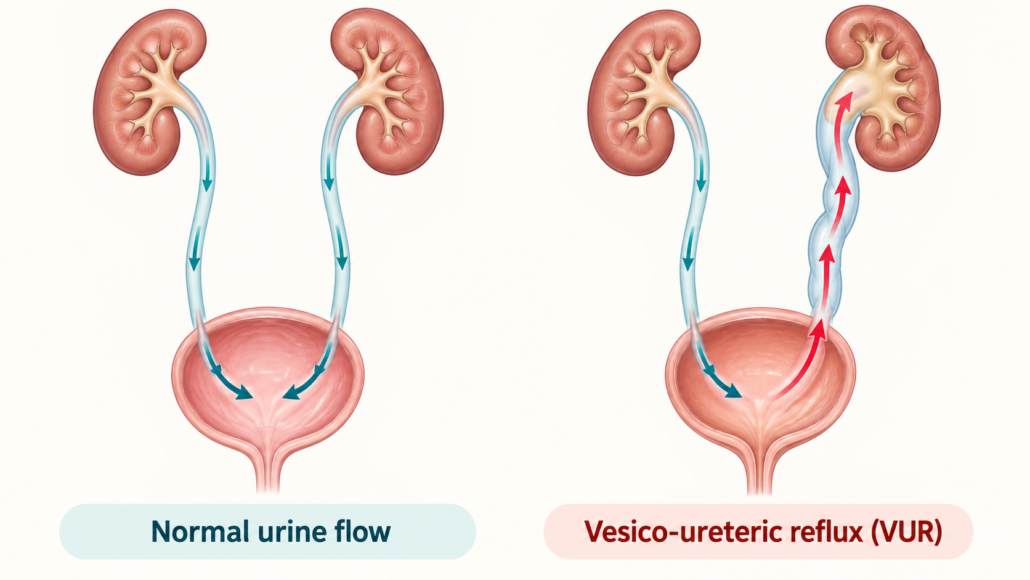
Vesico-ureteric reflux, also called vesicoureteral reflux or VUR, occurs when urine flows backwards from the bladder into one or both ureters and sometimes as far as the kidneys.
Normally, each ureter enters the bladder through a short tunnel in the bladder wall. As the bladder fills and contracts, this tunnel is compressed, acting like a one-way valve. In VUR, the valve does not close effectively.
VUR itself does not always cause symptoms. Its importance is that infected urine may travel towards the kidneys, increasing the risk of pyelonephritis, renal scarring and, in a small number of higher-risk patients, long-term kidney damage.
Primary and secondary reflux
Primary VUR
Primary VUR is usually a developmental condition. The ureter’s tunnel through the bladder wall is too short or positioned in a way that prevents reliable closure. It is most commonly diagnosed in infancy or childhood.
As a child grows, the bladder and ureteric junction mature. For this reason, many cases particularly lower-grade reflux, improve or resolve without surgery.
Secondary VUR
Secondary reflux develops because pressure within the bladder is abnormally high or because the bladder does not empty properly. Causes may include:
- posterior urethral valves or another bladder-outlet obstruction
- dysfunctional voiding
- constipation and bladder–bowel dysfunction
- neurogenic bladder, including spina bifida or spinal cord disease
- urethral stricture or an enlarged prostate in adults
- previous bladder or ureteric surgery
- a poorly compliant, high-pressure bladder.
Treating the underlying bladder or outlet problem is essential. Correcting the reflux alone may fail if the bladder remains unsafe or under excessive pressure.
How does VUR present in children?
Most children do not feel the reflux itself. It is commonly discovered while investigating a urinary tract infection.
Possible presentations include:
- a fever without an obvious cause, particularly in an infant
- recurrent urinary tract infections
- febrile UTIs or kidney infections
- vomiting, lethargy, irritability or poor feeding in babies
- abdominal, loin or back pain
- painful or frequent urination
- urinary urgency or wetting
- poor urinary stream or straining
- antenatal ultrasound showing hydronephrosis or an abnormal urinary tract
- poor growth
- high blood pressure or impaired kidney function in more advanced reflux nephropathy.
A child with fever, vomiting, flank pain or marked lethargy may have pyelonephritis and should receive prompt medical assessment.
How does VUR present in adults?
VUR is much less commonly diagnosed for the first time in adulthood. Some adults have persistent congenital reflux that was never detected in childhood, while others develop secondary reflux due to bladder dysfunction or obstruction.
Adults may present with:
- recurrent febrile UTIs
- repeated kidney infections
- loin or flank pain
- renal scarring found on imaging
- high blood pressure
- protein or blood detected in the urine
- reduced kidney function
- pregnancy-associated urinary infections
- lower urinary tract symptoms or incomplete bladder emptying.
Adult VUR should prompt assessment for an underlying cause such as bladder-outlet obstruction, neurogenic bladder, poor bladder compliance or dysfunctional voiding. The evidence guiding adult treatment is less extensive than the paediatric literature, so management is individualised.
How is VUR investigated?
Not every child who has one uncomplicated UTI requires an invasive reflux study. Imaging is selected according to age, clinical presentation, ultrasound findings and whether the infection is atypical or recurrent.
Urine testing
Urinalysis and urine culture confirm infection and help guide antibiotic treatment. A properly collected urine specimen is particularly important in babies and young children.
Kidney and bladder ultrasound
Ultrasound is painless and does not use radiation. It can assess:
- kidney size and development
- hydronephrosis or ureteric dilatation
- bladder-wall appearance
- congenital urinary abnormalities
- residual urine after voiding.
A normal ultrasound does not completely exclude VUR.
Micturating cystourethrogram
A micturating cystourethrogram, also called an MCUG or VCUG, is the standard test for confirming and grading reflux.
A small catheter is placed into the bladder, contrast is introduced, and X-ray images are taken while the bladder fills and during urination. The test shows whether contrast travels backwards into the ureters or kidneys and also provides information about the bladder and urethra.
Because catheterisation and a small radiation exposure are involved, MCUG is generally reserved for children in whom the result is likely to influence management.
Contrast-enhanced voiding urosonography
In centres where it is available, contrast-enhanced ultrasound can identify reflux without ionising radiation. Availability and local expertise vary, and conventional MCUG may still be required when detailed urethral anatomy needs assessment.
DMSA renal scan
A DMSA scan assesses the functioning renal cortex and can identify established renal scars. It is not required for every child but may be considered after recurrent febrile infections, in higher-grade reflux, when ultrasound is abnormal or when renal damage is suspected.
Additional assessment
Depending on the circumstances, investigation may also include:
- blood pressure measurement
- serum creatinine and estimated kidney function
- urine protein assessment
- a bladder and bowel history
- uroflowmetry and measurement of residual urine
- a bladder diary
- urodynamic studies when a high-pressure, neurogenic or poorly emptying bladder is suspected
- CT or other upper-tract imaging in selected adults.
The five grades of reflux
VUR is graded from I to V according to the international grading system.
| Grade | Imaging appearance | General interpretation |
|---|---|---|
| Grade I | Reflux reaches the ureter but not the kidney | Mild |
| Grade II | Reflux reaches the renal pelvis without dilatation | Mild |
| Grade III | Mild to moderate dilatation of the ureter and renal collecting system | Moderate |
| Grade IV | Moderate ureteric and collecting-system dilatation with some twisting of the ureter | High-grade |
| Grade V | Severe dilatation and tortuosity with loss of normal calyceal detail | Severe |
The grade is important, but it is not the only factor determining treatment. Age, recurrent infections, kidney scarring, bladder and bowel function, whether reflux affects one or both sides, and family preferences all matter.
What is the aim of treatment?
Treatment aims to:
- prevent febrile UTIs and pyelonephritis
- reduce the risk of further renal scarring
- preserve kidney function
- treat bladder, bowel or outlet dysfunction
- avoid unnecessary medication, radiation and surgery.
It is important to understand that repairing reflux cannot reverse established renal scars. Treatment is intended to prevent further infection and injury.
Observation and conservative management
Observation is appropriate for many children, particularly those with lower-grade reflux, healthy kidneys and no recurrent febrile infections.
Conservative care may include:
- prompt urine testing when fever or urinary symptoms occur
- regular and complete bladder emptying
- adequate fluid intake
- avoiding prolonged holding of urine
- treating constipation
- timed voiding
- management of daytime wetting or dysfunctional voiding
- periodic clinical and ultrasound review.
Lower-grade reflux is more likely to resolve as the child grows. Higher grades, bilateral reflux and reflux associated with renal abnormalities are less likely to resolve spontaneously.
Continuous low-dose antibiotic prophylaxis
A low dose of antibiotic may be prescribed daily to reduce recurrent infections while waiting for reflux to improve or while deciding whether intervention is required.
Prophylaxis is more likely to be considered in:
- infants with VUR following a febrile UTI
- recurrent febrile UTIs
- higher-grade reflux
- bladder–bowel dysfunction
- renal cortical abnormalities
- children considered at increased risk of another kidney infection.
Antibiotics can reduce recurrent UTIs in appropriately selected children, but they do not mechanically correct the reflux. Disadvantages include medication side effects, adherence difficulties and antibiotic resistance. The need for ongoing prophylaxis should therefore be reviewed rather than continued automatically.
Treating bladder and bowel dysfunction
Constipation, urinary urgency, wetting, infrequent voiding and incomplete bladder emptying increase the risk of recurrent infection and may reduce the success of reflux treatment.
Management can include:
- regular timed voiding
- relaxed toilet posture
- treatment of constipation
- pelvic-floor or continence physiotherapy
- medication for selected bladder conditions
- intermittent self-catheterisation when emptying is inadequate.
In secondary reflux, treating the bladder or outlet disorder may reduce or occasionally eliminate the reflux.
When is a procedure considered?
Intervention may be discussed when there is:
- a febrile breakthrough UTI despite appropriate prophylaxis
- recurrent pyelonephritis
- new or progressive renal scarring
- persistent high-grade reflux
- reflux unlikely to resolve spontaneously
- difficulty tolerating or adhering to antibiotic prophylaxis
- an anatomical abnormality requiring correction
- significant family preference after discussion of the alternatives
- persistent symptomatic reflux in a carefully selected adult.
The two main corrective options are endoscopic injection and ureteric reimplantation.
The STING procedure
STING stands for subureteric transurethral injection. A small telescope is passed through the urethra into the bladder under anaesthesia. A bulking material is injected beneath or within the lower end of the ureter to support and lengthen the valve mechanism.
Dextranomer/hyaluronic-acid copolymer, commonly known by the brand name Deflux, is the best-known injection material. Modified techniques such as HIT or double-HIT place the material within the intramural ureter rather than only beneath its opening.
Advantages
- minimally invasive
- no abdominal incision
- usually performed as day surgery
- relatively short anaesthetic and recovery
- low risk of major complications
- can be repeated if reflux persists.
Limitations and risks
- success is lower and less predictable than formal reimplantation
- results are generally better for lower grades of reflux
- more than one injection may be required
- reflux may persist or recur
- temporary blood in the urine, discomfort or infection can occur
- ureteric obstruction is uncommon but important
- reflux may occasionally appear on the opposite side
- long-term durability is not as certain as with successful reimplantation.
Published cure rates vary considerably because they depend on reflux grade, anatomy, injection technique, material used and how success is defined. A single injection commonly corrects approximately 70–80% of refluxing ureters overall, with lower success in grades IV–V. Additional injections can increase the cumulative success rate.
Ureteric reimplantation
Ureteric reimplantation is reconstructive surgery that creates a longer tunnel for the ureter through the bladder wall, restoring the one-way valve mechanism.
The operation may be performed using:
- an open extravesical approach
- an open intravesical approach
- laparoscopic surgery
- robot-assisted surgery in selected centres and patients.
Open reimplantation has a long-established success rate of approximately 95–98% for primary VUR when performed in suitable patients.
Advantages
- highest and most durable anatomical correction rate
- effective for high-grade reflux
- allows correction of some associated ureteric abnormalities
- usually requires only one definitive operation.
Limitations and risks
- more invasive than injection
- longer anaesthetic and recovery
- temporary bladder spasms, pain or blood in the urine
- urinary infection
- transient urinary retention, particularly after some bilateral extravesical repairs
- ureteric obstruction
- persistent reflux or reflux on the opposite side
- rare need for further surgery.
Robotic or laparoscopic reimplantation can reduce incision size, but it is still major reconstructive surgery and has not made open surgery obsolete. The best approach depends on the child’s anatomy, age, surgeon’s expertise and the reason for intervention.
STING versus reimplantation
| Consideration | Endoscopic injection | Ureteric reimplantation |
|---|---|---|
| Invasiveness | Minimally invasive | Reconstructive surgery |
| Typical stay | Usually day surgery | Often one or more nights |
| Recovery | Generally quicker | Longer |
| Success after one procedure | Lower and grade-dependent | Approximately 95–98% |
| Repeat treatment | Sometimes required | Uncommon after successful repair |
| Best suited to | Selected low- or moderate-grade reflux and families prioritising minimal invasiveness | High-grade, persistent or complicated reflux; failed injection; selected anatomical abnormalities |
| Main trade-off | Easier recovery but less predictable cure | More invasive but more reliable correction |
Neither operation is automatically “best.” STING may be attractive when a minimally invasive approach is preferred and its probability of success is acceptable. Reimplantation may be more appropriate when the highest likelihood of definitive correction is important.
VUR in adults
Adults with incidentally detected reflux and no infections, renal deterioration or high-pressure bladder may not require corrective surgery.
Treatment is more likely to be considered when there is:
- recurrent febrile UTI or pyelonephritis
- progressive kidney damage
- troublesome reflux-associated flank pain
- an untreated bladder-outlet or functional abnormality
- pregnancy planning in a patient with recurrent infections or reflux nephropathy.
The underlying bladder problem must be identified before anti-reflux surgery. Endoscopic injection can be effective in selected adults, although the supporting evidence is mainly from smaller observational studies. Ureteric reimplantation remains an option when a durable anatomical repair is required.
Women with previous VUR or reflux nephropathy who are considering pregnancy may benefit from pre-pregnancy assessment of blood pressure, kidney function, urine protein and infection risk.
Follow-up
Follow-up should be tailored to reflux grade, renal findings, treatment and infection history.
During observation
Review may include:
- interval history of UTIs or unexplained fevers
- height, weight and growth in children
- blood pressure
- urine testing when symptoms occur
- assessment of constipation and bladder symptoms
- renal and bladder ultrasound
- serum creatinine and urine protein testing when renal damage is present or suspected
- selective repeat MCUG, contrast-enhanced urosonography or radionuclide cystography
- DMSA scanning when new scarring is suspected.
Routine repeated invasive imaging is not necessary for every child. The timing and type of imaging should be chosen only when the result is likely to alter management.
After STING
Follow-up commonly includes an ultrasound to exclude obstruction and clinical monitoring for further UTIs. A repeat reflux study may be recommended after several months, particularly in high-grade reflux, recurrent febrile infection or when confirmation of cure will affect treatment.
Any fever or urinary symptoms after injection should prompt urine testing. Flank pain, vomiting, reduced urine output or significant hydronephrosis requires assessment for the uncommon complication of ureteric obstruction.
After reimplantation
Ultrasound is commonly performed after surgery to check drainage. Routine postoperative MCUG may not be necessary after an uncomplicated reimplantation with a reassuring recovery, but it may be appropriate after breakthrough infection, persistent hydronephrosis or an atypical clinical course.
Long-term surveillance
Patients with renal scarring, bilateral severe reflux, a solitary functioning kidney, proteinuria, hypertension or impaired renal function may require long-term follow-up into adulthood.
Monitoring can include:
- blood pressure
- kidney function
- urine protein
- recurrent infection
- pregnancy counselling when relevant.
Even when reflux has resolved, established reflux nephropathy can remain clinically important.
When should urgent medical advice be sought?
Seek prompt medical assessment for:
- fever with loin or back pain
- vomiting or marked lethargy
- reduced urine output
- a very unwell infant
- urinary symptoms during pregnancy
- fever or flank pain after a reflux procedure.
Early diagnosis and treatment of pyelonephritis are particularly important in patients with known VUR.
The key message
Vesico-ureteric reflux ranges from a mild childhood condition that resolves with growth to high-grade reflux associated with recurrent kidney infections and renal scarring.
Treatment should not be based on grade alone. The safest plan considers infection history, kidney health, age, bladder and bowel function, likelihood of spontaneous resolution and the advantages and disadvantages of observation, antibiotic prophylaxis, endoscopic injection and ureteric reimplantation.
References and further reading
- European Association of Urology. EAU Guidelines on Paediatric Urology: Vesicoureteric reflux. EAU Paediatric Urology Guidelines
- American Urological Association. Management and Screening of Primary Vesicoureteral Reflux in Children. AUA Vesicoureteral Reflux Guideline
- National Institute for Health and Care Excellence. Urinary tract infection in under 16s: diagnosis and management (NG224). NICE guideline NG224
- RIVUR Trial Investigators. Antimicrobial prophylaxis for children with vesicoureteral reflux. New England Journal of Medicine. 2014;370:2367–2376. PubMed
- Mattoo TK, Chesney RW, Greenfield SP, et al. Renal scarring in the Randomized Intervention for Children with Vesicoureteral Reflux trial. Clinical Journal of the American Society of Nephrology. 2016;11:54–61. PubMed
- Läckgren G, Cooper CS, Neveus T, Kirsch AJ. Management of vesicoureteral reflux: what have we learned over the last 20 years? Frontiers in Pediatrics. 2021;9:650326. Full text
- Salib A, Pizzi M, Landman J, et al. Vesicoureteral reflux in adults with urinary tract infections: is there a role for treatment? Current Urology Reports. 2020. PubMed record
This article provides general education and does not replace individual medical advice. Decisions about imaging, antibiotic prophylaxis or surgery should be made with an appropriately experienced urologist or paediatric urologist.


Leave a Reply
Want to join the discussion?Feel free to contribute!