
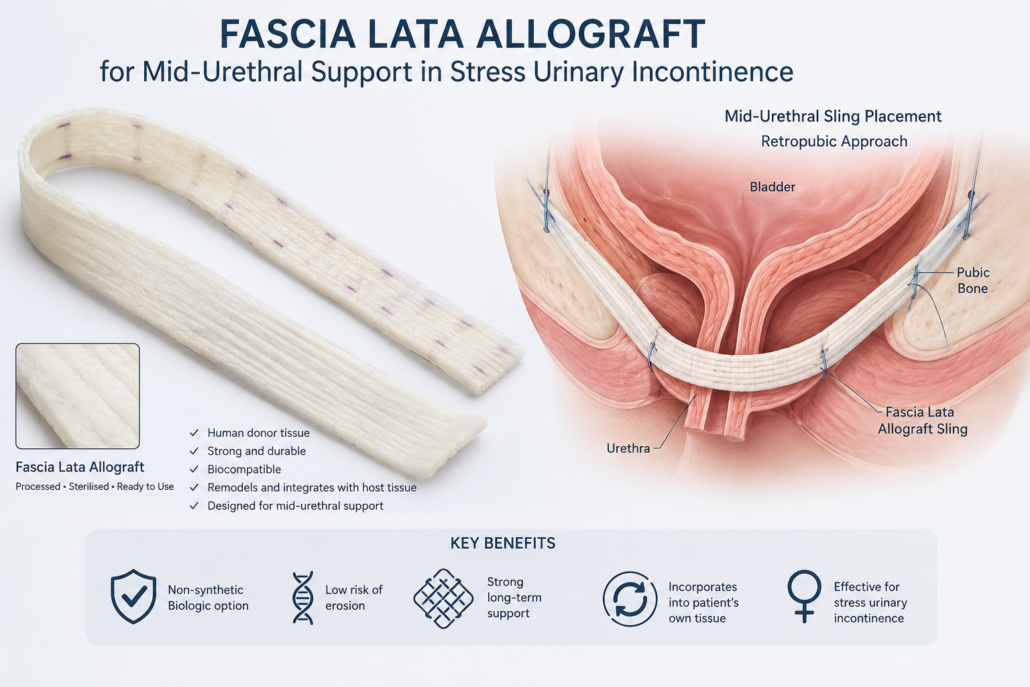
Fascia Lata Allograft as a Mid-Urethral Sling for Female Stress Urinary Incontinence
A “new/revamped” kid on the block – Fascia Lata Allograft: A biological alternative to synthetic mesh
Stress urinary incontinence (SUI) is one of the most common forms of urinary incontinence in women. It occurs when urine leaks with activities that increase abdominal pressure, such as coughing, sneezing, laughing, exercising, lifting or running.
For women whose symptoms remain troublesome despite pelvic floor muscle training and appropriate conservative treatment, surgical treatment can provide substantial and durable improvement.
For many years, the mid-urethral sling has been one of the most effective minimally invasive surgical treatments for SUI. Synthetic mesh mid-urethral slings remain available in Australia and have extensive evidence supporting their effectiveness. However, concerns surrounding synthetic mesh have led many women to ask whether there is a biological alternative.
One such option is a fascia lata allograft, including the fascia lata allograft supplied by Samson Medical Technologies in Australia.
The important distinction is that the Samson product is not a synthetic mesh. It is human donor fascia lata, processed for use as a biological graft. Samson describes its current fascia lata allograft as 100% human-derived, without storage media, non-irradiated and processed using Super Critical CO₂ technology.
However, there is an important caveat: the published clinical evidence for fascia lata allografts in SUI largely relates to earlier cadaveric fascia products and pubovaginal sling techniques, rather than Samson’s current specific product. Therefore, the historical allograft results should not be presented as if they were Samson-specific clinical trial results.
What is an allograft sling?
An allograft is tissue obtained from a human donor rather than from the patient herself.
Traditional biological pubovaginal slings have commonly used the patient’s own rectus fascia or fascia lata. This provides a strong, durable biological support but requires an additional incision to harvest the patient’s tissue.
An allograft avoids this donor-site surgery.
The fascia lata is positioned beneath the urethra and secured to provide a supportive platform. During coughing, sneezing or physical exertion, the urethra is compressed against this support, helping prevent urine leakage.
The concept is therefore quite different from a synthetic polypropylene mid-urethral sling. Instead of leaving a permanent synthetic mesh implant, the surgeon is using processed human connective tissue.
Samson currently supplies fascia lata allografts in several dimensions, including 20 × 100 mm and 20 × 120–140 mm configurations.
How effective are fascia lata allografts?
This is where the evidence requires some careful interpretation.
There is a substantial historical literature examining cadaveric fascia lata as a sling material, but the results have been inconsistent.
Early studies
Some early studies reported excellent short-term results.
One study of 26 women treated with solvent-dehydrated cadaveric fascia lata reported that 77% were completely dry and 92% used one pad or fewer per day at a mean follow-up of 15 months.
Another series of 31 women reported complete resolution of SUI in 93% at approximately one year.
A larger series of 104 women using freeze-dried, non-irradiated cadaveric fascia lata demonstrated substantial reductions in pad use, although the study’s follow-up was relatively short.
These studies created considerable enthusiasm for allograft tissue because it offered the advantages of a biological sling without the morbidity of harvesting the patient’s own fascia.
But there was also a warning signal
Other studies produced considerably less encouraging results.
A study of 18 women using solvent-dehydrated, gamma-irradiated fascia lata found that 27.8% experienced significant failure, with recurrent incontinence occurring within 3–6 months. The authors concluded that this particular allograft material was unreliable.
A subsequent comparative study of 71 women found a concerning difference in objective urodynamic recurrence: urodynamic stress incontinence was present in 41.7% of women who received Tutoplast allograft compared with none of those receiving autologous fascia lata at follow-up. Patient-reported outcomes, however, were more favourable.
Other series have reported much better results. In a 134-patient comparison, 63 women received allograft fascia and 71 received autologous fascia. There was no statistically significant difference in overall cure of stress and urge incontinence at approximately two years, while the allograft group experienced less postoperative pain and disability.
What does this mean?
The historical evidence suggests that allograft fascia can work well, but the durability and consistency of older allograft products were variable.
This variability is important when discussing the Samson allograft. There is currently insufficient published comparative evidence to state that the Samson product has a specific cure rate such as 80%, 90% or 95%.
The more scientifically defensible statement is:
Samson fascia lata provides a contemporary biological allograft option for sling surgery, but Samson-specific long-term comparative clinical outcome data are still developing.
That distinction is important when counselling patients.
How does Samson allograft differ from older allografts?
The earlier allograft literature predominantly involved freeze-dried, solvent-dehydrated and/or gamma-irradiated cadaveric fascia lata.
The Samson product currently described by the manufacturer is different in its processing. Samson reports that its fascia lata is:
- 100% human-derived
- non-irradiated
- supplied without storage media
- processed using Super Critical CO₂ technology
- available in several sizes.
The rationale behind modern tissue processing is to preserve the structural characteristics of the collagenous tissue while making the graft suitable for implantation.
Nevertheless, a different processing technology does not automatically establish superior clinical continence outcomes. Laboratory characteristics, tensile strength and histological appearance are not substitutes for long-term clinical trials.
This is one of the areas where future Australian outcome data will be particularly valuable.
How does an allograft compare with synthetic mid-urethral mesh?
Synthetic mid-urethral slings have the largest evidence base of any minimally invasive SUI operation.
A Cochrane review including 81 trials and more than 12,000 women found that more than 80% of women were cured or significantly improved following mid-urethral sling surgery, with good results maintained for up to five years.
Retropubic and transobturator approaches have broadly comparable effectiveness, although their complication profiles differ.
For example, retropubic slings have a higher risk of bladder perforation, whereas transobturator procedures have more groin pain. Vaginal mesh exposure is uncommon but recognised with both approaches.
The Australian situation
It is important to distinguish mid-urethral slings from transvaginal mesh used for pelvic organ prolapse.
The Australian TGA has removed certain transvaginal mesh products from the market, particularly mesh used for prolapse and single-incision mini-slings. However, mid-urethral sling devices for SUI remain approved in Australia.
Indeed, a 2026 Australian Government review concluded that mid-urethral sling devices should remain on the Prescribed List, with their existing listing unchanged.
Therefore, synthetic MUS should not simply be described as “banned mesh” in Australia. It remains an accepted treatment for appropriately selected women.
Potential advantages of an allograft
A biological fascia lata sling potentially offers:
Advantages
- No synthetic polypropylene mesh
- No fascial harvest from the patient’s abdomen or thigh
- Avoidance of donor-site pain
- Biological rather than permanent synthetic material
- Potentially useful where avoidance of synthetic mesh is an important patient preference
Potential disadvantages
- Less robust long-term evidence than synthetic MUS
- Historical allograft studies have shown variable durability
- It is still a surgical sling and can cause obstruction, urinary retention, infection, bleeding or pain
- It requires more extensive dissection than a conventional MUS
- It should not currently be marketed as proven superior to synthetic MUS
What about the Burch colposuspension?
The Burch colposuspension is the classic non-mesh surgical treatment for SUI.
Rather than placing a sling beneath the urethra, sutures are placed beside the bladder neck and proximal urethra and attached to supporting pelvic tissues.
It can be performed by open or laparoscopic surgery.
Long-term studies demonstrate that Burch colposuspension can be highly effective. One classic study found an 81.6% cure rate at 5–10 years.
More contemporary comparative data are reassuring. In a large study with more than 1,300 women and long-term follow-up, the proportion reporting no ongoing SUI was 83.0% after Burch colposuspension compared with 85.0% following retropubic MUS, with no significant difference.
However, Burch surgery is more invasive than a mid-urethral sling and is generally no longer the first surgical option for uncomplicated primary SUI.
It can nevertheless be an attractive option in selected women, particularly when avoiding synthetic mesh is important.
What about peri-urethral bulking agents?
Urethral bulking agents occupy a completely different part of the treatment spectrum.
A material is injected into the urethral wall around the bladder neck or proximal urethra to increase coaptation and improve continence.
In Australia, polyacrylamide hydrogel such as Bulkamid is an established example.
The major attraction is that it is substantially less invasive than sling surgery.
It can often be performed under local anaesthesia or sedation and has a relatively favourable safety profile.
The trade-off is effectiveness and durability.
A 2024 study of Bulkamid reported that at 12 months 69% of women described themselves as cured or improved, with 40% reporting cure, while 23% underwent subsequent treatment, including repeat Bulkamid injection or MUS.
Longer-term data are more modest. In a cohort of 357 women followed for a median of approximately 2.5 years, subjective cure was 30.9%, while 52.1% reported improvement. Minor adverse events occurred in 21%, with no serious adverse events attributed to the procedure.
Current guideline evidence therefore generally considers bulking agents less effective than MUS, Burch colposuspension or autologous fascial sling surgery, and repeat injections may be necessary.
Putting the options together
| Treatment | Approximate effectiveness | Main advantages | Main disadvantages |
|---|---|---|---|
| Samson fascia lata allograft sling | Samson-specific long-term cure rate not yet established; historical allograft studies range widely | Biological tissue; no synthetic mesh; no tissue harvest | Limited contemporary comparative evidence; historical allograft durability concerns; surgical sling risks |
| Synthetic mid-urethral sling | Generally >80% cure/improvement in medium-term evidence | Minimally invasive, rapid recovery, extensive evidence | Mesh-specific complications including exposure, pain and voiding dysfunction |
| Burch colposuspension | Approximately 70–85% long-term continence in many series | No vaginal mesh; durable native-tissue operation | More invasive; longer recovery; risk of prolapse and voiding problems |
| Autologous fascial sling | Generally high effectiveness, comparable with other established sling procedures | No synthetic mesh; patient’s own tissue | Requires tissue harvest; more postoperative morbidity |
| Bulking agent | Lower cure rate, but meaningful improvement for many women | Minimally invasive; useful for frail/high-risk patients or those avoiding sling surgery | Less durable; repeat injections commonly required |
The Australian Government’s own review of MUS specifically considered colposuspension, native-tissue pubovaginal slings and urethral bulking agents as important comparators.
Who might consider an allograft sling?
A fascia lata allograft may be particularly attractive for a woman who:
- has objectively demonstrated SUI;
- has failed appropriate conservative treatment;
- wishes to avoid a permanent synthetic mesh implant;
- does not want an abdominal or thigh incision to harvest her own fascia;
- understands that the long-term evidence base for contemporary allograft products is smaller than that for synthetic MUS;
- accepts that biological tissue does not eliminate the risks associated with sling surgery.
It may also have a role in selected women with recurrent SUI, particularly where previous synthetic mesh surgery makes another synthetic procedure unattractive. However, recurrent SUI is a more complex clinical situation and requires individual assessment.
The important question: is Samson allograft better than synthetic mesh?
At present, there is not enough evidence to say that it is.
The strongest evidence remains with synthetic mid-urethral slings. Their effectiveness has been demonstrated in thousands of women and across multiple randomised trials and systematic reviews.
The potential attraction of Samson fascia lata is different.
It offers a biological alternative for women who would prefer to avoid synthetic mesh while also avoiding the morbidity of harvesting their own fascia.
That makes it an interesting addition to the surgeon’s toolbox rather than a replacement for the established mid-urethral sling.
The key unanswered question is long-term durability.
Historical cadaveric allograft studies demonstrate that some allografts performed extremely well, while others experienced substantial early failure.
Consequently, contemporary prospective data specifically evaluating Samson’s processing technology, clinical continence outcomes, complications and durability would be valuable.
What should a woman expect from the procedure?
As with any continence operation, the goal is not simply to make a stress test negative. The aim is to improve the woman’s quality of life while preserving normal bladder emptying and sexual function.
Potential complications of sling surgery include:
- temporary or persistent difficulty emptying the bladder;
- urinary retention requiring catheterisation;
- urinary tract infection;
- bleeding or haematoma;
- pain;
- de novo urgency or worsening overactive bladder;
- recurrent or persistent SUI;
- vaginal wound problems;
- infection;
- rarely, injury to the bladder, urethra or surrounding structures.
Synthetic mesh has additional mesh-specific risks, including vaginal exposure/erosion and chronic pain. The TGA specifically requires information regarding complications such as severe chronic pain, groin pain and bladder perforation in the instructions for use of Australian MUS devices.
An allograft avoids synthetic mesh exposure, but it does not make the operation risk-free.
The bottom line
For a woman with bothersome stress urinary incontinence, there is no single operation that is right for everyone.
Synthetic mid-urethral slings remain the most extensively studied minimally invasive surgical treatment and have excellent success rates.
Burch colposuspension remains a durable non-mesh alternative, although it is more invasive.
Bulking agents offer the least invasive surgical option but generally have lower and less durable success rates.
Fascia lata allograft represents an intriguing middle ground: a biological sling that avoids both synthetic mesh and the need to harvest the patient’s own fascia.
The Samson allograft is particularly interesting because its contemporary processing differs from several of the older cadaveric fascia products that generated the historical literature. Samson describes its current graft as non-irradiated human fascia lata processed using Super Critical CO₂ technology.
However, the enthusiasm should be matched by scientific caution. The historical literature demonstrates that allografts can achieve good continence outcomes, but it also demonstrates that not all allograft materials have behaved identically over time.
For patients considering this option, the most accurate discussion is therefore not “this is a better sling than mesh.” It is:
“This is a biological alternative to synthetic mesh, with encouraging historical experience but less mature long-term clinical evidence for the contemporary product.”
As further Australian experience and prospective follow-up accumulate, Samson fascia lata allograft may become an increasingly useful option in the treatment of female stress urinary incontinence.
Important note
This article is intended for general information and does not replace an individual assessment by a urologist or uro-gynaecologist. The choice between conservative management, bulking agent, synthetic MUS, biological or autologous sling and Burch colposuspension depends on the type and severity of incontinence, previous surgery, urethral function, pelvic anatomy, patient preference and overall health.



Leave a Reply
Want to join the discussion?Feel free to contribute!