
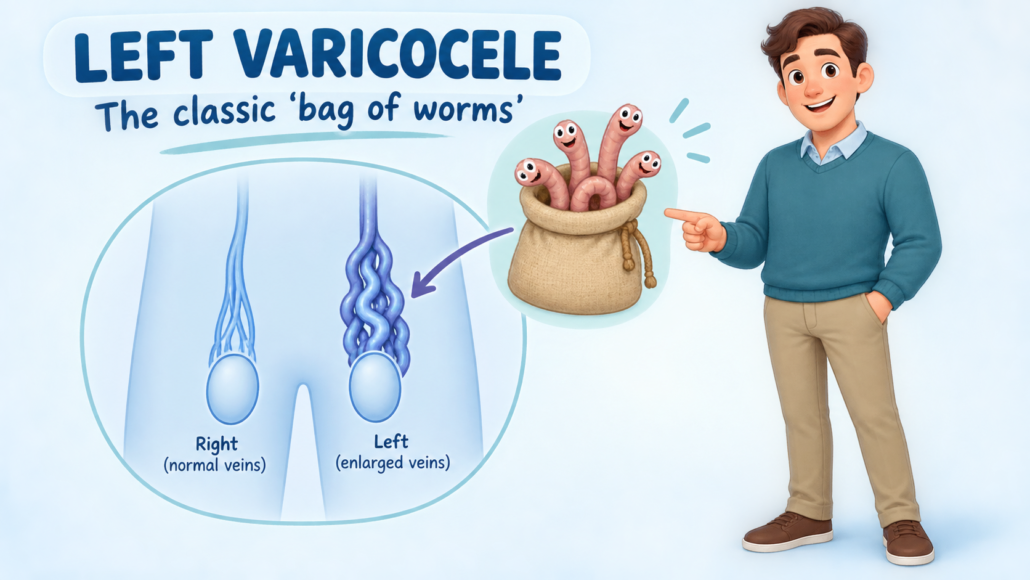
‘Bag-of-Worms” Varicocele: Causes, Symptoms, Fertility and Treatment Options
A varicocele is an enlargement of the veins surrounding the testicle. It is similar to a varicose vein in the leg, although it occurs within the scrotum.
Varicoceles are common and often harmless. However, in some men they may cause discomfort, reduce the size or function of the affected testicle, or contribute to fertility problems. Most varicoceles do not require treatment, and the decision to intervene depends on symptoms, testicular development, semen quality and plans for future fertility.
What causes a varicocele?
Blood leaves each testicle through a network of small veins called the pampiniform plexus. These veins normally carry blood upwards towards larger veins in the abdomen.
A varicocele develops when blood pools within these veins. This is usually related to poorly functioning venous valves, together with the anatomy and pressure within the testicular veins.
Around 80–90% of clinically detected varicoceles occur on the left side. This is because the left testicular vein is longer and enters the left renal vein at a right angle, making venous drainage less efficient. A varicocele may occur on both sides, while an isolated right-sided varicocele is much less common.
Most varicoceles develop gradually during puberty and have no dangerous underlying cause.
A new varicocele in an older man, particularly one that is right-sided, develops suddenly or does not disappear when lying down, may require abdominal imaging to exclude obstruction of the vein by an abdominal or retroperitoneal condition. This is uncommon but important to recognise.
How common are varicoceles?
A varicocele is found in approximately 15% of adolescent and adult men. Many men never know that they have one.
Varicoceles are more frequently identified among men being investigated for infertility. They may be present in approximately:
- 35–40% of men with primary infertility
- Up to 70–80% of men with secondary infertility, where a previous pregnancy has occurred, but the couple is now having difficulty conceiving
Importantly, most men with a varicocele remain fertile. Finding a varicocele does not automatically mean that it is causing infertility.
What are the symptoms?
Many varicoceles cause no symptoms and are discovered during a routine examination, fertility assessment or scrotal ultrasound.
When symptoms occur, they may include:
- A dull ache, dragging sensation or heaviness in the scrotum
- Discomfort that becomes worse after standing, exercising or later in the day
- Improvement in discomfort when lying down
- Visible or enlarged veins above the testicle
- A soft swelling sometimes described as feeling like a “bag of worms”
- Reduced size or slower growth of the affected testicle
- Abnormal semen-analysis results
- Difficulty conceiving with a partner
A varicocele generally does not cause erectile dysfunction or difficulty urinating. Its relationship with testosterone production remains under investigation, although some men with a clinically significant varicocele may have impaired testicular function.
Sudden severe testicular pain is not typical of a varicocele and requires urgent medical assessment to exclude testicular torsion or another acute scrotal condition. An abdominal ultrasound is also required to exclude a possible lesion in the abdomen obstructing the veins.
How is a varicocele diagnosed?
Diagnosis usually begins with a physical examination. The scrotum is examined while the patient is standing and lying down. You may be asked to take a breath and gently bear down, the Valsalva manoeuvre, to make enlarged veins easier to feel.
Clinical varicoceles are commonly graded as:
- Grade 1: Felt only during the Valsalva manoeuvre
- Grade 2: Felt while standing without straining
- Grade 3: Easily visible through the scrotal skin
A scrotal ultrasound may be recommended if the examination is uncertain, the testicles differ in size, pain is present, or another scrotal problem needs to be excluded. Ultrasound can measure the veins, assess backward blood flow and examine the testicles.
For fertility assessment, investigations may include:
- One or more semen analyses
- Testicular volume measurement
- Hormone tests when indicated
- Assessment of both partners, because fertility is a shared consideration
An ultrasound-only or “subclinical” varicocele that cannot be felt on examination is not usually treated for infertility.
How can a varicocele affect fertility?
The testicles work best at a temperature slightly below core body temperature. The pampiniform veins help cool the arterial blood entering the testicle.
Pooling of warm blood in a varicocele may interfere with this cooling system. Increased temperature, venous pressure, oxidative stress and altered blood flow may affect sperm production and testicular function.
Possible semen changes include:
- Reduced sperm concentration
- Reduced sperm movement or motility
- Increased abnormal sperm forms
- Increased sperm DNA damage
The degree of impact varies considerably. A large varicocele can be associated with normal fertility, while a smaller palpable varicocele may be significant in another man. The diagnosis must therefore be interpreted together with semen results, the couple’s fertility history, the female partner’s age and other fertility factors.
Does every varicocele require treatment?
No. Observation is appropriate when a varicocele:
- Causes no troublesome symptoms
- Is not affecting testicular growth
- Is associated with normal semen parameters
- Is found incidentally on ultrasound but cannot be felt
- Is unlikely to be the main cause of the couple’s fertility difficulty
Simple measures such as supportive underwear, avoiding activities that consistently aggravate discomfort and occasional appropriate pain relief may help mild symptoms. Regular review may be recommended for adolescents with a difference in testicular size.
When should treatment be considered?
Treatment may be considered when there is:
Infertility with abnormal semen parameters
Repair is most likely to benefit a couple when the man has:
- A varicocele that can be felt on examination
- Difficulty conceiving
- One or more abnormal semen parameters
- No better explanation for the infertility
- A reasonable opportunity for natural conception following treatment
Both the AUA/ASRM and European guidance support considering repair in men attempting conception who have a palpable varicocele and abnormal semen parameters. Treatment is not routinely recommended for a varicocele detected only by ultrasound. AUA/ASRM male infertility guideline and EAU male infertility guideline
Persistent scrotal pain
Repair may be reasonable when typical varicocele-related discomfort persists despite conservative measures and other causes of scrotal pain have been excluded.
Reduced testicular growth in an adolescent
Treatment may be discussed if the affected testicle is persistently smaller, growth is impaired, the varicocele is large or semen parameters are abnormal in an appropriately selected older adolescent.
Progressive testicular dysfunction
Selected men with deteriorating semen quality or evidence of impaired testicular function may benefit from repair after individual assessment.
What treatment procedures are available?
Treatment works by blocking or dividing the abnormal veins. Blood then returns through healthy alternative veins while the testicular artery and lymphatic drainage are preserved.
| Management option | How it is performed | Advantages | Disadvantages and risks |
|---|---|---|---|
| Observation | Clinical review, with semen analysis or testicular measurements when appropriate | No procedure or anaesthetic; suitable for most asymptomatic men; avoids unnecessary treatment | Does not correct the varicocele; symptoms or testicular changes may require future review |
| Conservative symptom management | Scrotal support, activity modification and appropriate pain relief | Simple and non-invasive; may adequately control mild discomfort | Does not remove the varicocele or improve abnormal semen parameters; long-term anti-inflammatory medication may not be suitable for everyone |
| Microsurgical subinguinal varicocelectomy | A small incision is made near the groin. An operating microscope helps identify and divide abnormal veins while protecting the testicular artery and lymphatics | Usually the lowest recurrence and hydrocele rates; no abdominal incision; effective for unilateral or bilateral disease; commonly preferred for fertility treatment | Requires an anaesthetic and microsurgical expertise; temporary bruising, swelling or discomfort; uncommon risks include infection, recurrence, hydrocele or testicular artery injury |
| Microsurgical inguinal varicocelectomy | Similar microsurgical repair through a slightly higher groin incision | Good visualisation and low recurrence when performed microsurgically | Requires opening the external oblique fascia; recovery may involve slightly more groin discomfort |
| Laparoscopic varicocelectomy | Veins are clipped or divided through small abdominal keyhole incisions | Both sides can be treated during the same procedure; useful in selected cases | General anaesthetic; entry into the abdomen; generally higher hydrocele risk than lymphatic-sparing microsurgery; rare abdominal or vascular complications |
| Open high ligation | The testicular vein is divided through an abdominal or groin incision without microsurgical magnification | Established technique; may be effective where microsurgery is unavailable | Higher recurrence and hydrocele rates than modern microsurgical repair; less precise preservation of small arteries and lymphatics |
| Radiological embolisation or sclerotherapy | An interventional radiologist passes a catheter into the testicular vein and blocks it using coils, plugs or a sclerosant | No surgical incision in the scrotum or groin; often performed with local anaesthesia or sedation; relatively quick recovery; useful for recurrence after surgery | The vein cannot always be accessed; radiation and contrast exposure; recurrence or persistence may occur; coils can rarely migrate; availability depends on local expertise |
How effective is treatment?
The results depend on why treatment is being performed, the technique used and whether other fertility or pain-related factors are present.
Improvement in semen quality
Following repair of a clinically significant varicocele, approximately 60–80% of appropriately selected men demonstrate improvement in at least one semen parameter. Improvement is not guaranteed, and some men show little or no measurable change.
Because sperm production takes approximately three months, semen analysis is usually repeated about three months after treatment and may be reassessed again at six months.
Pregnancy and fertility outcomes
Varicocele repair may increase the chance of natural pregnancy in selected infertile couples, but it does not guarantee conception. Studies commonly report spontaneous pregnancy in roughly 25–40% of couples after repair, although rates vary substantially according to female partner factors, duration of infertility, baseline semen quality and study design.
Treatment may also improve semen quality sufficiently to allow a couple to use a less invasive assisted-reproduction option. In other cases, IVF or intracytoplasmic sperm injection may still be required.
The couple’s overall fertility timeline is important. If the female partner has reduced ovarian reserve or advancing reproductive age, waiting several months for semen improvement may not be appropriate. Varicocele repair and assisted reproductive treatment should therefore be considered as part of a shared plan.
Relief of pain
When pain is typical of a varicocele, a dull ache or heaviness made worse by standing or activity, approximately 70–90% of appropriately selected men experience meaningful improvement after repair.
Surgery is less predictable when pain is sharp, constant or atypical, and pain may occasionally persist despite technically successful treatment.
Testicular growth
In adolescents with a persistently smaller affected testicle, repair may allow “catch-up” growth. Decisions should be based on repeated measurements rather than a single ultrasound result.
What are the possible complications?
Varicocele procedures are generally safe, but potential complications include:
- Bruising, swelling or wound discomfort
- Infection or bleeding
- Persistence or recurrence of the varicocele
- Hydrocele, caused by fluid collecting around the testicle
- Ongoing or occasionally altered scrotal pain
- Injury to the testicular artery, which is uncommon but potentially serious
- Testicular shrinkage, which is rare
- Anaesthetic complications
- Technical failure, contrast reaction, radiation exposure or coil-related problems following embolisation
Using microsurgical magnification and preserving the lymphatic vessels usually reduces the risks of recurrence, hydrocele and arterial injury.
Recovery after varicocele repair
Most men return home on the day of treatment. Bruising, mild swelling and groin or scrotal discomfort are expected during the early recovery period.
Patients are commonly advised to:
- Wear supportive underwear
- Keep the wound clean and dry
- Avoid heavy lifting and strenuous exercise for the period advised by the surgeon
- Resume sexual activity when comfortable and medically cleared
- Attend follow-up to assess healing and symptom improvement
- Repeat semen analysis after approximately three months when fertility is the reason for treatment
Specific recovery instructions vary according to the procedure and the individual patient.
When should you seek medical advice?
Arrange a medical assessment if you notice:
- A new lump or swelling in the scrotum
- Persistent scrotal discomfort or heaviness
- A difference in testicular size
- Difficulty conceiving
- A new right-sided varicocele
- A swelling that remains when lying down
Seek urgent medical attention for sudden severe testicular pain, rapid swelling, nausea or a high-riding testicle. These features may indicate testicular torsion, which is an emergency.
The bottom line
A varicocele is common and, for most men, causes no significant harm. Treatment is not based on the ultrasound appearance alone. The most important considerations are symptoms, testicular development, semen quality and the couple’s overall fertility situation.
For men with persistent typical pain, impaired testicular growth or a palpable varicocele associated with infertility and abnormal semen parameters, treatment can be worthwhile. Microsurgical varicocelectomy generally offers the most favourable balance between effectiveness, recurrence and complication risk, while embolisation is an effective minimally invasive alternative in selected patients.
A consultation with a urologist allows the varicocele—and the patient rather than simply the scan—to be assessed before deciding whether observation, surgery or embolisation is the most appropriate approach.
This article provides general information and does not replace an individual medical assessment. Treatment recommendations depend on examination findings, semen results, symptoms, age and the fertility circumstances of both partners.




Leave a Reply
Want to join the discussion?Feel free to contribute!