
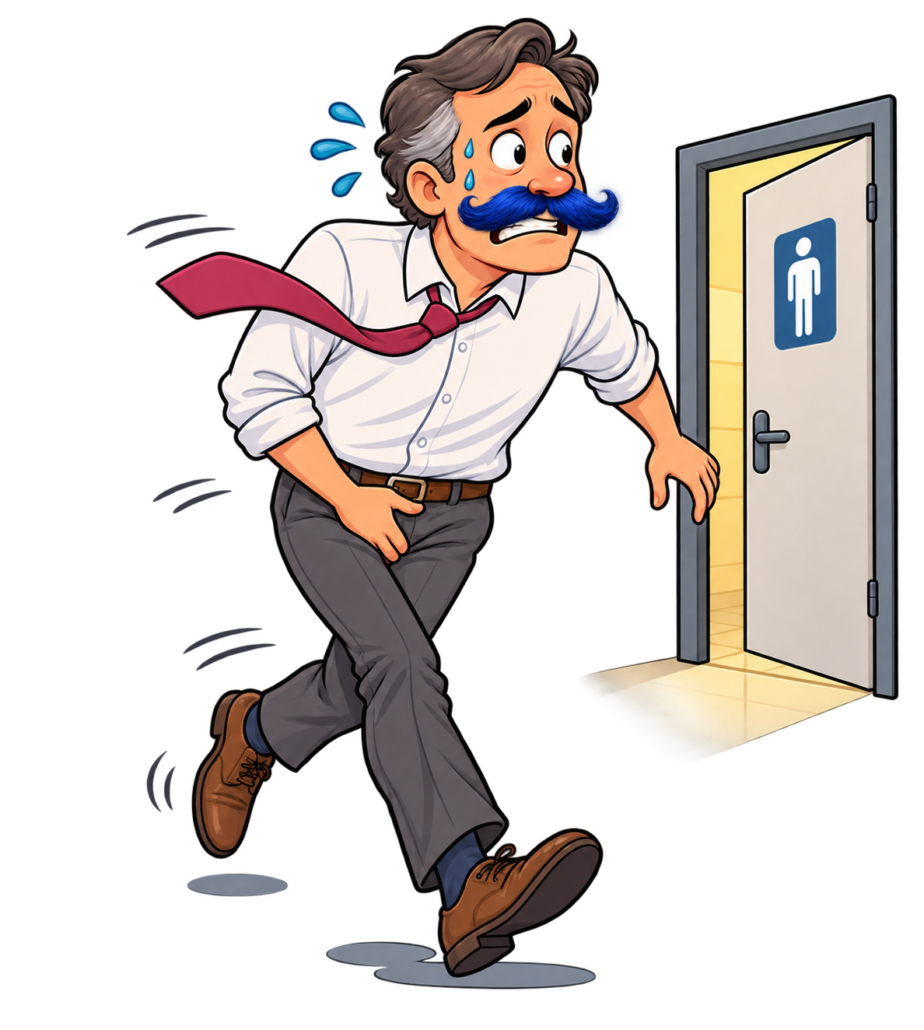
When the leak won’t quit: urinary incontinence in men
A Movember reminder that help is available
Movember is a good time to talk about men’s health issues that are often kept quiet. Urinary leakage is one of them. It can affect confidence, exercise, work, travel, intimacy and sleep. After prostate surgery, some leakage is common during recovery, but men do not have to simply put up with persistent or troublesome symptoms.
This article focuses on urinary incontinence after prostatectomy. It is general information, not a diagnosis or a substitute for advice from your own doctor.
What does “incontinence” mean?
Urinary incontinence means urine escapes when you do not intend it to. After prostate surgery, the most common pattern is stress urinary incontinence: leakage with coughing, sneezing, lifting, walking, standing up or exercise. The operation can affect the urinary sphincter and the support around the urethra.
Some men instead, or as well, experience urgency incontinence: a sudden, hard-to-delay urge followed by leakage. This may relate to an overactive bladder. Other causes: including infection, difficulty emptying the bladder, a narrowing at the bladder outlet or a medication effect. may also need consideration. The treatment depends on the pattern, so it is worth describing exactly when leakage happens.
What to expect after prostatectomy
Leakage is common soon after the catheter is removed and usually improves over time. Many men continue to regain control over the first 6–12 months, although recovery varies and some men have persistent leakage. A small amount of leakage can still be very disruptive, and heavier leakage deserves timely review rather than a wait-and-see approach without support.
If leakage is not improving, is affecting daily life, or you are worried, speak with your GP, urologist, continence nurse or pelvic health physiotherapist. You can ask for help at any stage of recovery.
Start with an assessment
A clinician will ask about the amount and timing of leakage, urgency, night-time symptoms, bowel habits, previous radiation or other procedures, and how much the problem affects you. A bladder diary and pad count or pad-weight test can help describe the pattern and severity. Examination, urine testing, bladder emptying checks, cystoscopy or urodynamic testing may be useful in selected cases—particularly before surgery or if the symptoms are not straightforward.
Assessment helps distinguish stress leakage from urgency or mixed symptoms, and checks for problems that should be treated before continence surgery.
Pelvic floor physiotherapy: learning the right muscles
Pelvic floor muscle training is commonly offered after radical prostatectomy and may also be started before surgery with your treating team’s advice. A pelvic health physiotherapist or continence nurse can show you how to find and correctly contract the muscles, then build a programme around your recovery. The aim is a controlled lift and squeeze around the back passage and base of the penis, followed by a full relaxation. Try not to hold your breath or tighten your buttocks, thighs or stomach.
A correct contraction should not hurt. Avoid repeatedly stopping your urine stream as an exercise; that can interfere with normal bladder emptying. Follow your surgeon’s instructions about when to begin or resume exercises, particularly while a catheter is in place. Some men benefit from learning a quick pelvic floor contraction before coughing, lifting or standing.
Training can help speed recovery and improve control, but it is not a guaranteed cure, and it may not overcome significant sphincter damage on its own. Keeping active safely, avoiding constipation and getting advice about continence products can make recovery more manageable. Do not deliberately dehydrate yourself; adequate fluid intake helps avoid concentrated urine and constipation. If caffeine or alcohol aggravates urgency, reducing it may help those symptoms.
Other non-surgical support
Absorbent pads or a male urinary sheath can help you stay active while recovery continues. A continence nurse can help with fit, skin care and practical use. A penile clamp may suit selected men for short periods, but it can restrict blood flow or injure skin and should only be used after professional advice. Medicines may help urgency or overactive bladder symptoms, but they do not repair a weakened urinary sphincter.
When is surgery considered?
If bothersome stress leakage is not improving despite conservative care, surgery can be discussed from around six months in selected men; persistent leakage is generally reviewed for surgical treatment by about 12 months. The timing should be individualised with your urologist, taking account of the severity and trajectory of leakage, cancer treatment plan, bladder and urethral health, and your preferences.
Two established operations are a male sling and an artificial urinary sphincter (AUS). Neither is right for every man, and both require a careful assessment and discussion of expected benefits, possible complications and the chance of future treatment.
Male sling
A sling is placed beneath the urethra to support it and improve its closure. It is generally considered for men with mild-to-moderate stress leakage, particularly when they have not had pelvic radiotherapy and do not have severe leakage. It does not have a pump to operate. A sling may not work as well for heavier leakage, and previous radiation or some other urethral procedures can reduce the chance of success. Some men continue to leak or may later need another procedure.
Artificial urinary sphincter
An AUS uses a fluid-filled cuff around the urethra, connected to a small pump placed in the scrotum. The cuff stays closed to prevent leakage. To urinate, the man presses the pump; the cuff opens temporarily and then closes again automatically. The device is a well-established option for moderate-to-severe stress leakage, and may also be considered for other degrees of troublesome leakage after discussion.
An AUS requires an operation and the ability to understand and operate the pump. It can substantially improve control, but it may not make every man completely dry. Infection, erosion or mechanical problems can occur, and the device can lose effectiveness over time. Further procedures to revise or replace it are common over a person’s lifetime. If you have an AUS, tell any doctor, nurse or hospital team before a urinary catheter or instrument is inserted, as special care is needed to avoid damaging the cuff or urethra.
Choosing between them
The choice depends on leakage severity, previous radiotherapy or urethral surgery, bladder function, hand function and cognition, anatomy, personal priorities and the surgeon’s assessment. In general, slings are most often discussed for mild-to-moderate leakage, while an AUS is often favoured for more significant leakage or after radiotherapy. Cystoscopy is usually part of the assessment before an operation; urodynamics may be useful where it could clarify the diagnosis or guide counselling.
The emotional side matters too
Wearing pads, planning every trip around a toilet, or worrying about leakage during exercise or sex can be isolating. These concerns are legitimate health issues, not a personal failure. A partner, GP, urologist, continence nurse or physiotherapist can help you find a practical next step. Movember is a reminder to check in with your mates—and to speak up about your own health as well.
When to seek prompt medical advice
Seek urgent medical advice if you cannot pass urine, develop fever or feel acutely unwell with urinary symptoms, notice visible blood in your urine, or develop new severe pain. If you have an AUS and develop pain, swelling, redness, difficulty urinating or a sudden change in leakage, contact your treating team promptly.
Key message
Urinary leakage after prostatectomy is common, but persistent leakage has treatment options. Pelvic floor physiotherapy is an important part of recovery; pads and other supports can help in the meantime; and selected men may benefit from a sling or artificial urinary sphincter. The first step is an open conversation and an assessment tailored to the type and severity of leakage.
Further information and references
- American Urological Association, GURS and SUFU. Incontinence after Prostate Treatment: Guideline (2019; amended 2024). AUA guideline PDF.
- European Association of Urology. Guidelines on the Management of Non-neurogenic Male LUTS, 2026: Disease Management. EAU guideline.
- Continence Health Australia. Bladder control after prostate surgery. Patient information.
- Prostate Cancer Foundation of Australia. Pre- and rehabilitation: urinary incontinence and pelvic floor exercises. PCFA resource.
- Cancer Council Australia. Managing side effects of prostate cancer treatment. Cancer Connect.
This information is educational and does not replace an individual consultation. Treatment decisions should be made with your treating health professional.




Leave a Reply
Want to join the discussion?Feel free to contribute!